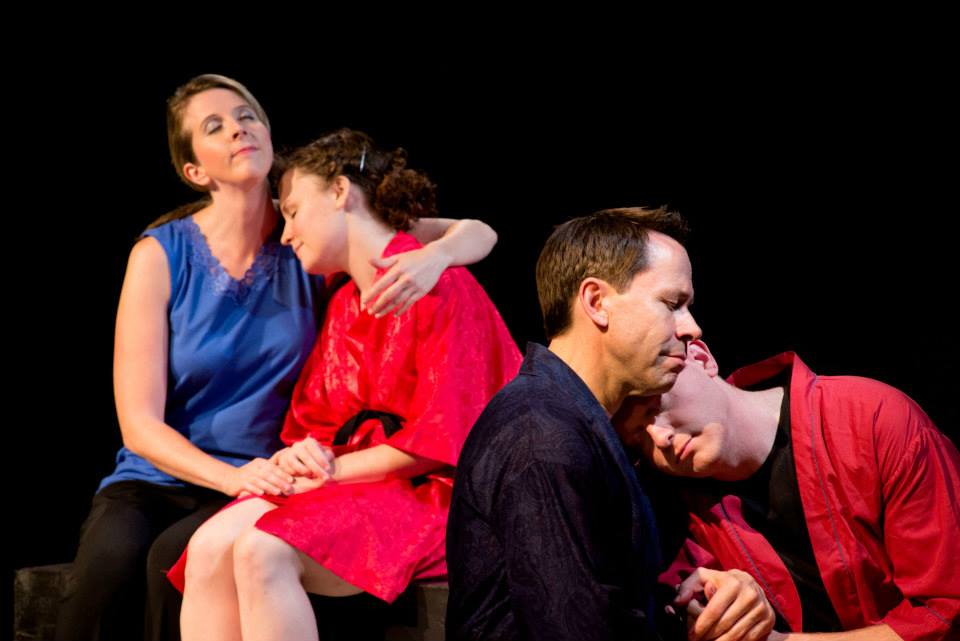
I wasn’t going to mention my current theater (at Arlington, Virginia’s American Century Theater) project here, until I dropped Ethics Alarms’ conservative warrior Steven Mark Pilling a note on Facebook that I had just posted on the topic he is most passionate about, preventing the abuse of child actors in Hollywood. Steven is not, to say the least, a fan of gay marriage (this might be the topic he is next most passionate about) , and I realized that my Facebook thumbnail, showing two same-sex couples in an intimate moment from my show, might put him off.
The show I just finished directing ( with the assistance of Quinn Anderson and my musical director Tom Fuller) the old Harvey Schmidt-Tom Jones chestnut, “I Do! I Do!”, ( Remember “My Cup Runneth Over,“ Ed Ames fans? Hello? ) the tw0-actor Broadway musical based on the 1950 play “The Fourposter.” Back in 1966, when Robert Preston and Mary Martin starred in the musical, it was considered an affectionate and perceptive look at the institution of marriage, and the show has attracted nostalgic, usually elderly married couples to regional and dinner theaters ever since. Productions of “I Do! I Do!” are becoming rarer, however, because the societal developments have rendered the tale of the epic marriage of Agnes and Michael Snow increasingly alien to the current American scene. In particular, what was once a musical intended to speak to all married couples and candidates for future nuptials now appears to exclude the very group that comprises musical theater’s hardiest supporters: gays.
In marked abandonment of my theater’s usual principles (we don’t update shows, believing that it is more interesting and fair to the authors to let audiences reflect on what has changed since an original production, and what has not), I decided that for the benefit of audiences, the culture and the show itself, it was time to re-conceive “I Do! I Do!” so it would gain renewed relevance and vitality in a post DOMA age. My approach, courageously and generously approved by the authors, was to show the marriage of the show’s couple through a constantly rotating prism that alternately revealed them as a same-sex female couple, a same-sex male couple, and the traditional heterosexual couple of the 1966 version. This required four very versatile and gutsy actors who could pull off the illusion of showing one marriage three different ways without giving the audience whiplash or confusing them hopelessly. In Steve Lebens, Esther Covington, Chad Fournwalt and Mary Beth Luckenbaugh, I found the dream cast. Continue reading


 Ethics Alarms