Yale’s Core Values Betrayal: The Case Of The Student’s Unnecessarily Provocative Philosophy Essay

It certainly appears as if U.S. higher education is sailing toward the shoals of ethics bankruptcy, full speed ahead. It also appears that Yale, although it’s part of a tightly bunched armada, is leading the way.

A law suit called Doe v. Yale tells a jaw-dropping tale that once would have been unbelievable, “once” meaning “before a large segment of the culture accepted the proposition that free expression and thought were undesirable unless they met certain lockstep requirements that will ease the way to a progressive utopia.” The plaintiff, a male student, claims that Yale punished him for the offense of writing a class essay that offended a female teaching assistant.

According to his lawsuit, in late 2013 a philosophy teaching assistant filed a complaint with the university’s Title IX office, complaining about a short paper “Doe” had written in the class she was helping to teach.  The essay discussed Socrates’ discussion, recounted in Plato’s “Republic,” of the three divisions of the soul and their relationship to justice. It applied the Greek philosopher’s ideas to rape, arguing that the crime was also an irrational act in which  the soul’s appetites and spirited components overwhelm its reason, which must have primacy for mankind to be moral and just.

The Title IX coordinator, an associate dean in the Graduate School of Arts and Sciences named Pamela Schirmeister, told Doe that his essay was “unnecessarily provocative.” By daring to discuss rape, he had committed an offense against the teaching assistant. He was told to have no contact with the teaching assistant, and ordered to attend sensitivity training at the university’s mental-health center—re-education and indoctrination, in other words. “Doe” was now, he was told, a “person of interest” to Yale, meaning that that the college was now going to be watching him with a grounded suspicion that he was a potential danger to the campus.

What followed, a few months later, were two dubious accusations of sexual assault by female students, both handled with the slanted, pro-accuser, due process-avoiding  approach that has become epidemic on campuses since President Obama’s Dept of Education issued its infamous “Dear Colleague” letter in April of 2011.  Ethics Alarms has discussed some of these cases and the letter, but that is not the topic before us today.

Today the topic is the suppression of free speech, thought, and expression on college campuses.  Continue reading

Portrait Of A Really, Really Stupid Ethics Train Wreck

This is the incredibly ridiculous United Airlines/dress code/ leggings story. I don’t want to write about it: there are no good guys, lots of miscreants, and I have a well-earned bias against United already.

Fortunately, the travel site One Mile At A Time did a thorough and ethically astute analysis, here, ending like this:

I see non-revenue passengers asked to follow different rules nearly every time I fly — you probably do too. Nothing about two non-revs being asked to change clothes and/or take a later flight is shocking or newsworthy or even interesting to anyone with an ounce of perspective.

Exactly: not even interesting. So how did this become a hot story on cable news and social media? Well..

1.  Two employees of United didn’t follow company policy regarding proper dress when they fly free. They were Wrong.

2. A family behind the two employees in line and who didn’t understand what was happening leaped to conclusions, and made their daughter change what she was wearing too, completely unnecessarily. They were Wrong.

3. A prominent  publicity-seeking social justice warrior, Shannon Watts, was an observer of all this, and began furiously tweeting, misrepresenting what was going on, and claimed that United was engaged in sexist and discriminatory conduct, when it was not.  She was Wrong.

4. United’s Twitter team responded by referencing the §21 of the company’s Contract of Carriage, stating that passengers can be denied boarding for being “barefoot or not properly clothed”. This was confusing, since that provision had nothing to do with why the two non-revenue passengers were told to change. Typical of the crack United staff, however. Incompetent. Also Wrong. Continue reading

From The “‘Dear Colleague’ Letter Aftermath” Files: Amherst’s War On Men

Once the Obama Education Department sent out its threatening “Dear Colleague” letter that strongly hinted at dire consequences for universities and colleges that did not tilt their sexual assault disciplinary procedures toward a less stringent standard of guilt, horror stories about male students unjustly presumed guilty of sexual assault or rape have been proliferating. This is the worst one I’ve ever seen.

In February of 2012, a male, Asian-American student (“John Doe”) and “Sandra Jones,” as she is referred to in court documents, went back to Jones’ dorm room after a night of hard drinking.  John blacked out, and couldn’t  recall anything about the evening, a claim Amherst deemed “credible” during his disciplinary hearing. At some point, Sandra performed oral sex on John. Nearly two years later, Sandra  accused John of sexually assaulting her.  In his lawsuit, John Doe alleged that his adviser couldn’t speak for him, that he could only write down questions for his accuser or witnesses ( no cross examination)  and that the hearing panel was made up of administrators trained in “social justice education.” You know: Men bad, women victims.

In the school’s hearing, Jones claimed she texted a friend to come over for help because she had been sexually assaulted. The school never bothered to obtain those text messages—after all, they followed the Hillary Clinton directive that “victims of sexual assault have the right to be believed.”  Here’s what she texted to her girl friend: Continue reading

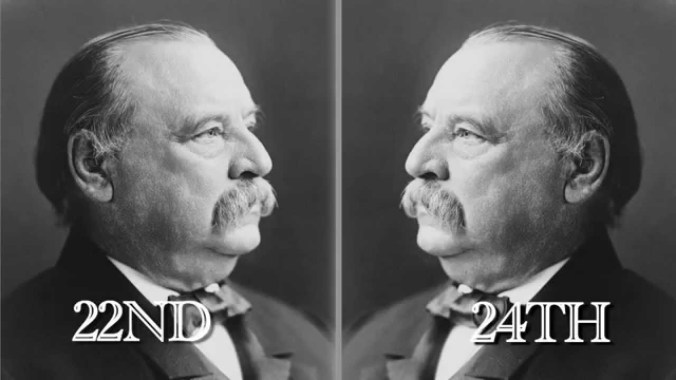
It’s Presidents Day! Our Special Guests: the 22nd and 24th Presidents, Grover Cleveland [UPDATED]

grover-2

Grover Cleveland has all sorts of unusual distinctions among the Presidents. (No, he wasn’t “normal,” either.)  He was one of several Presidents to drop a more prosaic first name for his less common middle one (like Grant, Wilson,  and Eisenhower). He was the second biggest President at over 250 pounds, and had the largest collar size. Despite his reputation for being a tough guy, Grover ended a string of Civil War heroes elected President by being the only POTUS who had paid a poor man to take his place in the Union army. That was legal, but it was not especially admirable.

Cleveland was one of only two bachelors elected President, and was the only one married in the White House (to a 21-year old beauty, the Melania of her day, who was less than half his age). Grover also lost the Presidency when he ran for re-election despite winning the popular vote, in the most similar election (1888) to our last one. This set up his most famous distinction, serving split terms, as he came back to beat President Harrison in 1892.

My favorite Cleveland tale is how the President pulled off the amazing feat of having part of his jaw removed and replaced with a rubber prosthetic without the public learning about it, by secretly having the operation performed on a yacht.

Ah, but all of these pale compared to his central role in the worst scandal ever to strike in a Presidential campaign, which he survived, incredibly, by telling the truth.

Or so we have been told.

Maybe not.

On July 21, 1884, a bit more than three months from the Presidential election, , the Republican Buffalo Evening Telegraph broke a story that seemed like it would determine who was to be President. Ten years earlier, a Buffalo woman named Maria Halpin had given birth to a son with the surname Cleveland, and then been taken to a mental asylum while the child was adopted by another family. The mother claimed that former Buffalo mayor and current New York Governor and Democratic Presidential nominee Grover Cleveland was the father.

In a remarkably quick display of candor, then or now,  Cleveland admitted that indeed he and  Halpin had been “illicitly acquainted,” and the son might indeed be his. As the only unmarried man among several Cleveland friends who, the campaign implied, may have “known” the woman,  Cleveland had claimed paternity and helped Halpin place the boy with a caring family. Still, this was the Victorian era, and the clergy, in particular, was disgusted.  “It seems to me that a leading question ought to be: do the American people want a common libertine for their president?”  wrote a preacher from Buffalo to the editor of the Chicago Tribune.

While Cleveland, whose nickname was “Grover the Good,” had sex problems, Maine Senator James G. Blaine, the Republican candidate, had been caught taking bribes. Why he was nominated with such a record of dishonesty and influence peddling, I will never understand. (No modern political party would do something that stupid, fortunately.) being able to use the catchy mocking anti-Cleveland chant, “Ma, ma, where’s my Pa?” was a godsend for the struggling Blaine campaign.

To make things worse for Grover, reporters tracked down Halpin, and her version of the relationship differed from the candidate’s in unpleasant ways. Days from the election, the Chicago Tribune quoted her as saying, darkly, “The circumstances under which my ruin was accomplished are too revolting on the part of Grover Cleveland to be made public.”

Continue reading

The Most Unethical 2017 Super Bowl Ad Is Yet To Be Revealed, But The Prize For The Most Shameless Is A Lock

http://www.youtube.com/watch?v=G6u10YPk_34

Of course, all Super Bowl TV ads by definition are horribly unethical, exploiting for commerce a professional blood sport that renders healthy young men brain-damaged for a drooling public’s coarse amusement. To Hell with all the ads I say. Still, some are worse than others.

History suggests that the obnoxious Audi commercial above won’t be the worst, but it nicks a wider range of ethical breaches than the typical Super Bowl ad. For that it deserves, at very least, a hardy Ethics Alarm Bronx cheer, or “raspberry”…

to wit…

Continue reading

Sanctioned Race And Gender Bias In Tort Compensation?

For its next witness, the defense calls the distinguished  forensic economist...

“For its next witness, the defense calls the distinguished forensic economist…”

I was going to make this an ethics quiz, but there really is only one answer. The practice is ethically indefensible, and noxious too. The only question is how and why it is still occurring.

One reason may be that not enough people know about it. I certainly didn’t. Kudos to the Washington Post for shining light on a terrible, and terribly unethical, practice.

The American tort system frequently uses race and gender statistics to calculate the damages victims or their families should receive in compensation after someone is catastrophically injured or killed by another individual’s negligence or misconduct. Experts are allowed to testify regarding what a particular victim might have achieved and earned during their lives, were they not dead, or brain-damaged, or paralyzed. Race and gender are among the factors allowed into that calculation.

Writes the Post:

As a result, white and male victims often receive larger awards than people of color and women in similar cases, according to more than two dozen lawyers and forensic economists, the experts who make the calculations. These differences largely derive from projections of  how much more money individuals would have earned over their lifetimes had they not been injured – projections that take into account average earnings and employment levels by race and gender.

Continue reading

The Doctor, The Emergency And The Flight Attendant: A Depressing Ethics Tale With No Ethical Resolution In Sight

Was it race, gender, youth, all of them, or none of them?

Was it race, gender, youth, all of them, or none of them?

Tamika Cross, a young OB-GYN flying Delta from Detroit to Minneapolis,  heard flight attendants calling for medical assistance when a passenger  man two rows in front of her was found to be unconscious. Dr. Cross raised her hand, only to be told, according to Cross’s subsequent Facebook post on the incident, “Oh no, sweetie, put your hand down. We are looking for actual physicians or nurses or some type of medical personnel. We don’t have time to talk to you.”

Cross says she tried to  explain that she was a physician, but was “cut off by condescending remarks,” from the attendant. A moment later, when there was a second call for medical assistance and Cross again indicated that she was ready to help, the same flight attendant said, according to Cross, “Oh wow, you’re an actual physician?” She then quizzed Cross  about her credentials, area of practice, and where she worked. In the meantime, a white, middle-aged male passenger appeared, and Cross, she says, was dismissed.

On her now viral Facebook post, Dr. Cross concludes:

“She came and apologized to me several times and offering me Skymiles. I kindly refused. This is going higher than her. I don’t want Skymiles in exchange for blatant discrimination. Whether this was race, age, gender discrimination, it’s not right. She will not get away with this….and I will still get my Skymiles….”

What’s going on here?

Stipulated:

1. This was an emergency situation.

2. Dr. Cross sincerely felt insulted and treated with disrespect.

3. She also feels that she was the victim of stereotyping,, bias and prejudice.

4. Her account can be presumed to be an honest recounting of how she experienced the episode.

5. The Roshomon principles apply. We do not know how the flight attendant perceived the situation as it developed, and will never know, since the incident is already tainted with accusations of racism.

6. This was an emergency situation.

7. There is no way to determine what the flight attendant was thinking.

8. Despite all of the above, observers, analysts and others will be inclined see the event as confirmation of their own already determined beliefs and assumptions.

9. This was a single incident, involving a set of factors interacting in unpredictable ways.

Next, some ethical observations…. Continue reading

Ethics Dunces : Michigan State University Student Feminists

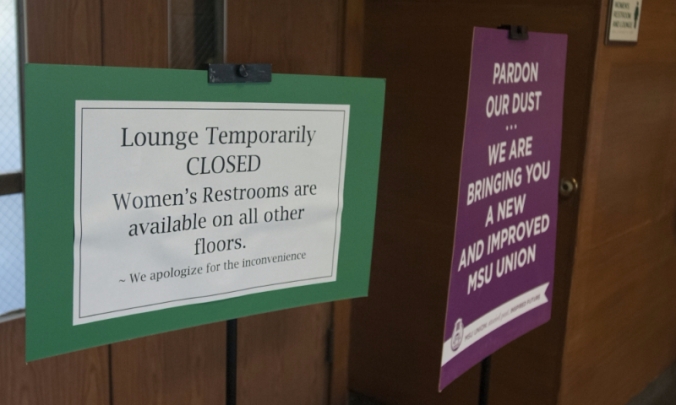
MSU womens_study_lounge

Higher education progressives, students, professors and administrators alike, are seriously confused about ethics, and some basic principles like fairness, respect, equity, and competence, not to mention common sense. How did they come to such a state?

For various reasons, none of them reasonable, Michigan State University had maintained that gender segregation was appropriate in the student Union, and  a study lounge there was designated for women only. Perhaps we can forgive the school’s initial judgment in this case, since the Union’s Women’s Lounge, located on the main floor of the MSU Union, debuted in 1925, just five years after women gained the right to vote.Men vastly outnumbered women then, and were looked upon as oddities, or perhaps temptation.

It is 2016, however, and women are demanding equality where it may already exist, and declaring gender discrimination where it may not, so the continued existence of the male excluding lounge was more than a bit anachronistic. After all, Harvard College just declared war on any male student who dared to belong to off-campus all-male clubs, since even freedom of association away from school is deeply offensive to the progressive values of Ivy League educators.

Then a University of Michigan-Flint professor named Mark Perry, filed a complaint to the Michigan Department of Civil Rights towards MSU alleging that the lounge violated federal anti-discrimination law, which it obviously does. Continue reading

DNC Progressives Jump The Shark

Pop Quiz: Name all the ways this photo is appropriate to the post...

Pop Quiz: Name all the ways this photo is appropriate to the post…

[A “Happy Days” reference seems felicitous, since last week saw series creator, writer and frequent director Garry Marshall head off to the Big Malt Shop In The Sky. In addition to having the good taste to be named Marshall, Gary’s myrth-inducing career in TV and movies as a producer, writer, director and actor (Marshall’s turn in “Lost on America” as the incredulous casino boss whom a desperate Albert Brooks tries to persuade to give back the life savings lost by Brooks’ wife in a mad gambling spree might be my favorite comic acting bit of all time) was long and productive, and the culture will miss him greatly. As will I. ]

Attention must be paid to the fact that while the speakers at the Republican National Convention sounded scary (to some), the Democratic National Convention authorities acted scary.

Twenty-one Vermont Democrats have filed an official complaint with the party, protesting that the Democratic leadership ordered  the state party to replace Vermont Sen. Tim Ashe and party member Ken Dean with women, in the name of “gender balance” without adequate due process.

By all means, let’s make sure that gender discrimination in pursuit of the greater good and Progressive Nirvana is done with due process!

I think it’s cute that both political parties are losing their minds at the same time, don’t you? Continue reading

It’s Gender Issues Confusion Monday! PART 1: Observations On “Sweatergate”…You Know, One Of Those Stupid Social Media Controversies That Has Some Genuine Issues Buried Inside

SWaetergate

The 8 a.m. Saturday broadcast on KLTA in Los Angeles area featured  Liberté Chan in a black, shimmery, shoulder-baring  cocktail dress, giving her report on the day’s weather. Suddenly, weekend anchor Chris Burrous’s arm appeared on the side of the screen, holding a gray cardigan sweater.

“What’s going on?” she said. “You want me to put this on? Why? Cause it’s cold in here?”

“We’re getting a lot of emails,” came the offstage voice of her male colleague. Then his hands placed the cardigan on Chan.

“There you go,” he said. “That’s nice.”

“OK. I look like … a librarian,” she says.

Whereupon social media “erupted,” as the current cliche goes, with many on Facebook, Twitter and whatever else there is out there in the social media jungle condemning the station for sexism. Others insisted that Chan’s cocktail dress was inappropriate attire, sending a message that “The Weather Girl is just eye candy, like the women in bikinis at boxing matches.”

Chan, in a post on her own blog, had this to offer…

I …didn’t think there was anything that inappropriate (the beads/sequins were probably a little much for the morning, but what girl doesn’t like something that sparkles?!), so I played along and put on the sweater.

That prompted a barrage of tweets and more emails from viewers, some of which I included below.

To be perfectly honest, the black beaded dress was a backup.  The pattern on my original black and white dress didn’t work on the weather wall (for some reason, it turned semi-transparent), so after my first weather hit at 6am, I changed.

For the record, I was not ordered by KTLA to put on the sweater.  I was simply playing along with my co-anchor’s joke, and if you’ve ever watched the morning show, you know we poke fun at each other all the time.

And, also for the record, there is no controversy at KTLA. My bosses did not order me to put on the cardigan, it was a spontaneous moment..  I truly love my job, I like my bosses and enjoy working with my coworkers.  Since talking to my team, I want our viewers to know it was never our intention to offend anyone. We are friends on and off the air and if you watch our newscast, you know that. More importantly, I hope my viewers were able to plan their Saturday once they heard my forecast and enjoyed the sunny weather after the clouds cleared.

Observations:

1. I was just watching MLB’s Heidi Watney on “Quick Pitch,” where she reviews the highlights of all the baseball games of the previous day, standing up in the middle of a studio. She was wearing a shoulders-baring cocktail dress much flashier than Chan’s,  my wife, not for the first time with Heidi, went nuts, complaining how the outfit was unprofessional and demeaning to women. She has similar reactions to the outfits of the Fox Blondes, and my favorite of the breed, Robin Meade, who frequently looks like she just returned from a wild night after a Vegas party. Is this kind of attire unprofessional? Well, it depends, doesn’t it? It depends if the job being done is seen as informational or  performance. If  it’s performance, then a costume is appropriate. If it is a professional conveyance of information to an audience only, a sound argument can be made that professional attire enhances trustworthiness.

Here’s a typical Heidi outfit: Continue reading