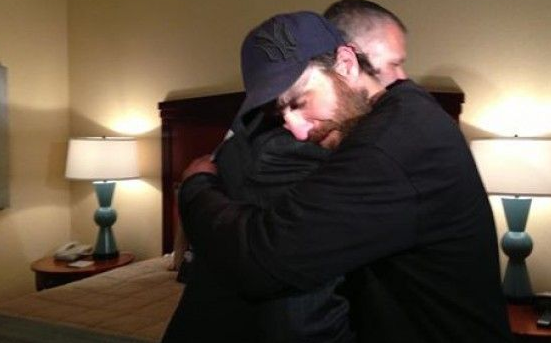
Ethics Hero, Thanksgiving Division: Scott Stuckey, Manager of Atlanta’s Omni Hotel

Scott Stuckey gets hugged by a grateful non-criminal Joel Hartman was homeless and surviving in Atlanta by dumpster diving, but when he found a lost wallet with the owner’s identification and credit card inside, he was determined to do the right thing. The wallet obviously belonged to a tourist, so the 36-year-old man checked the hotels in downtown Atlanta until he found out that the tourist (from France, for a conference) was staying at the Omni Hotel.

After Alanta’s Omni manager Scott Stuckey saw the surveillance video of Hartman—who looked as destitute as he was— turning in the wallet to the hotel’s  security guards, he decided that a reward was in order.  Hartman had given them a fake name, so it took some effort to track the shy good Samaritan down. Stuckey and his staff searched for a week, leaving messages with other homeless people that the Omni wanted to thank the man who recovered its guest’s stolen wallet. Eventually Hartman heard about their quest, and showed up at the hotel. He was shocked at what Stuckey had planned for him. Hartman was told that he would be the Omni’s guest in a luxury room through the Thanksgiving holiday with complimentary room service. The hotel also  gave him $500.

I think the gesture by Stuckey and the Omni was kind, appropriate, and in keeping with the spirit of the holiday….but: Continue reading


Ethics Heroes: The Al Ittihad Soccer Team

Spontaneous  sportsmanship  broke out in a recent international soccer match between Al Nahdha, an Omani soccer club, and Al Ittihad, a Saudi soccer club. I’ll take my encouragement from wherever I can get it these days.

Al Nahdha’s goalkeeper was about to make a clearance early in the second half of a 2-2  tie, but hesitated because his shoelace was untied, and seemed worried that his shoe would fly off. An opposing player, a Brazilian striker named  Jobson, noticed the goalkeeper’s dilemma  and  instead of taking advantage of the soccer equivalent of a wardrobe malfunction, tied his opponent’s shoelace for him. The surprised and grateful goalkeeper slapped Jobson on the back and gave him a high-five as the crowd cheered its approval, then he kicked the ball.

A ref, however, spoiled the moment by signaling that the goalie had delayed the game by taking too long with his clearance. He awarded an indirect free kick to Al Ittihad , and Al Nahdha lined up to defend.  Then, after talking the situation over, the Saudi team took what could have been its shot at a game-deciding goal.
The team just kicked the ball harmlessly past the goal, refusing  the penalty (and rebuking the referee), while also making certain that its earlier good sportsmanship wasn’t rendered pointless by a gratuitous ruling.

The crowd loved it.

I bet I would have too, if I would let myself be caught dead at a soccer match.

[Disclaimer: The title on the video above is the opinion of the video poster, and does not necessarily represent the views of Ethics Alarms.]

__________________________

Pointer: Jonathan Turley

Strange Tales Of The Ethically Clueless 1%: When A Birthday Gift Is Worse Than No Gift At All

"Oh, thank you, kind sir!"

“Oh, thank you, kind sir!”

The title of Ethics Dunce doesn’t do Fort Wayne Newspapers CEO Mike Christman justice.

In order to “celebrate” his employees’ birthdays, and, of course, recognize his loyal staff’s value, hard work, industry and loyalty, he gives each member of his corporate family a small token of his  appreciation on his or her birthday, and I do mean small token: a $1.25 token that can be used to buy a soda or a snack at a company vending machine.

How condescending, demeaning, disrespectful, insulting and, of course, cheap: the equivalent of a pat on the head. In the Gilded Age, rich men would occasionally drop nickles on the street for the street urchins to pick up. John D. Rockefeller was the most famous practitioner of this form of low-level charity, though he would use dimes. During the Depression, though he was still a billionaire, he switched to nickels. (Nickels in the Great Depression were worth a lot more than $1.25 today.) His beneficiaries were children, however. Continue reading

From Oklahoma, A Remarkable Ethics Lesson

hartmanparkinglot_610x458

Young Christian Lunsford was disgusted when he saw the TV report about the mugging of seventy-eight-year-old Tona Herndon of Bethany, Oklahoma, robbed while visiting the gravesite of her husband of 60 years, who had died just two weeks earlier. It wasn’t merely that the mugger took a purse and $700 from a vulnerable and grieving woman, but that the culprit was Christian’s father. He had been quickly arrested, and his mug shot, shown on TV, was all-too-familiar to his fifteen-year-old son. Christian’s parents divorced when he was two, and his contact with his father had been minimal as the elder Lunsford kept ending up in jail. The teen had recently heard from his dad, however, when he sent Christian $250 to pay for his participation in a school band trip.

The latest crime, however, moved Christian to do something exemplary. He contacted Tona Herndon and asked her to meet him in a church parking lot. When she did, he mugged her too, as a tribute to his father.

No, that’s not what happened: I was just messing with you. Continue reading

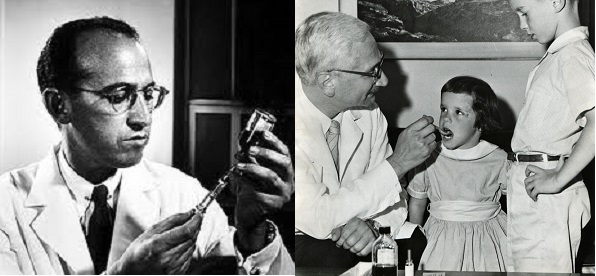
Exemplary Ethical Conduct I’m Embarrassed I Didn’t Know About Dept.: Jonas Salk and Albert Sabin

Salk and Sabin

Salk and Sabin, true professionals. Did you know?

You learn the damnedest things in the damnedest places, which is a good reason to keep your ears open wherever you may be.

Last night I found myself listening to Michael Savage, easily the most offensive of all conservative talk show hosts, and he gives Rush and Mark Levine a run for their money in the ego category, too. I only listen to Savage by accident, and then only in bites of five minutes or less; it frightens me that millions of people might be influenced by such consistently hateful commentary.

But Savage (whose real name is Michael Alan Weiner) is no dummy, and not infrequently goes off on learned tangents about philosophy, history or religion in between declaring that the nation is under Nazi rule. Yesterday, just as I was reaching for the dial, he disclosed that one of his heroes growing up was Jonas Salk, not because he invented the first effective polio vaccine, but because he refused to patent it, and gave it to the world for the benefit of humanity. A bit later, Savage noted that Albert Sabin, Salk’s bitter rival who later invented the oral vaccine, also declined to profit from his invention.

Could all this be true, I wondered?  If it is true, why did I not know about it? Why doesn’t everybody know about it? Continue reading

Of Hero Ethics, Credit, Fame, And Angel Cordero

Angel Cordero, unsung hero. And in good company.

Angel Cordero, unsung hero. And in good company.

Apparently a Cleveland man named Angel Cordero is every bit as deserving of accolades in the rescue of the three kidnapping victims of Ariel Castro [of alleged kidnapper and rapist Ariel Castro, that is. Reflect on this case the next time someone puffs themselves up to reprimand you for a missing “alleged” and lectures you about how the accused are “innocent until proven guilty.” Yes, we know—and that means we can’t lock them up and throw away the key until they have had a fair trial and been officially proven guilty beyond a reasonable doubt in the judgment of a jury. It does not mean,  in a situation where there is literally no possible interpretation of the facts that would not end with the conclusion that the man who owns the house where three women have been kept prisoner for ten years and who have told interviewers that he beat them, starved them and raped them, that to state the obvious is some kind of human rights violation. By the way, O.J. is guilty too.] as the more colorful, more publicized–and more ridiculed—Charles Ramsey.

I want Cordero to receive the credit and admiration he deserves. I don’t want him to feel bitter and unappreciated. If the media, public and popular culture is inclined to bestow its goodies on the heroes of this horrible story, I hope he gets his fair share. Still, I also hope that he would be sufficiently large of soul and solid of values to adopt the attitude that what is important is that the women were rescued, and not who gets credit for it, now or in the future. Continue reading

Ethics Hero: Neil Diamond


Kansas City Royals v Boston Red Sox

The pop singer whose ear-worm of a 60’s hit, “Sweet Caroline,” inexplicably became a Fenway Park crowd sing-along tradition made a surprise appearance at the Red Sox-Royals game this afternoon, apparently voluntarily and at his own expense, to contribute to the festivities as Boston celebrated the end of a violent and frightening week. The song has been played at other ballparks in recent days, even at Yankee Stadium, in a show of solidarity with the besieged city and its residents.

Neil Diamond flew to Boston and contacted the Red Sox slightly before game time, saying he was eager to sing along with himself in the seventh inning. Surprised club officials assented. So he wandered out onto the field, looking paunchy, old and happy, and sang into a microphone while his ancient record played—since this was all impromptu, there was no other accompaniment available. And the crowd loved it: you can watch and listen here.

Unlike David Ortiz, Diamond didn’t have to resort to obscenity to give his appearance emphasis. He gave an unsolicited  gift to Boston and Red Sox fans, lending his talents to the celebration without compensation because it was a caring and classy thing to do. It didn’t matter that singing along with his 44 years younger self was hardly flattering, or that the sound was lousy, or even that “Sweet Caroline” is hardly Gershwin or even Billy Joel (I always preferred “Cracklin’ Rosie,” myself).  A big, wealthy recording star simply helped the city’s  healing along by a generous gesture when there was nothing in it for him.

Neil Diamond is a good guy.


Ethics Hero: Michael Bublé

This video, and therefore the incident, is three years old now and viewed on YouTube by millions,  but it’s new to me, and it raises my opinion of Michael Bublé , an old-fashioned but youngish Vegas-style crooner in the Andy Williams mold, but cuter.

Here is what’s ethical about the singer’s spontaneous conduct:

  • He was kind. Few performers allow their concerts to be hi-jacked like this.
  • He was courageous. Professionals know that any time you give up control, anything can happen.  Bublé was confident that he could handle whatever came his way, but it is still a risk.
  • He was generous. His reaction to realizing the kid could really sing was pitch-perfect.
  • He demonstrated the Golden Rule, and explicitly so, when he made the decision to bring the 15-year-old on stage, saying, “I remember being your age.”

…all marks of an Ethics Hero, and a lucky one, because this could have gone horribly wrong.

_________________________________

Pointer: Kathleen Dunn (via Facebook)

Out Of A State Lottery, A Golden Rule Moment

We're NOT going to be selfish and exclusive, even though we can and you expect us to!

“We’re NOT going to be selfish and exclusive, even though we can and you expect us to!”

It never seems to work out this way, and thus it is interesting to speculate why the office lottery pool at Keller Williams Partner Realty in Plantation, Florida treated a dilemma so differently, and so much more ethically, than the key participants here, or here.

Jennifer Maldonado had only been working as an administrative assistant at the company for two weeks, and because she hadn’t received her first pay check, she decided not to join the office Powerball pool when she was approached. The organizer even offered to loan her the money: nope, insisted Maldonado. Not this time; maybe next. Naturally, the pool not only won that week, but won big: a million dollars to be divided among the 12 person staff…except Maldonado, of course.When Maldonado showed up for work and saw everyone screaming, crying and celebrating, she thought they were playing a practical joke in her to teach her a lesson. “I knew I was the only one who hadn’t put in the money, so I thought they were pranking me and going out of their way to make me feel something,” she recalled, that “something” presumably being “rotten.”

Jennifer obviously didn’t know her co-workers yet. Not only weren’t they trying to make her feel badly, they had held a meeting and decided to give her a cut of the winnings even though she hadn’t opted in to the enterprise—not a full share, but a significant amount. Jennifer didn’t expect anything, wasn’t going to sue them or hold a grudge, and yet they made her part of the group’s good fortune anyway. This is the Golden Rule exemplified. It is also exemplary ethics: generosity, kindness, empathy, and inclusiveness. The staff”s gesture said, and eloquently, “Welcome to the family! You can trust us. We care about you. We look out for each other, and we handle each other’s mistakes.”

Perfect. Continue reading

Georgetown Law Center and The Case Of The Double-Crossed Donor

Sometimes those naming deals backfire, you know?

Sometimes those naming deals backfire, you know?

Scott K.  Ginsburg, a media mogul who got a J.D. from Georgetown Law Center in 1978, had been wooed by the school’s development team for a major gift when he was riding high, amassing billions in the 1990s. He agreed to contribute some pocket change–five million bucks—to build a new fitness center that would bear his name. The deal was put into writing, and the University issued a cheerful press release. Then, in 1999, shortly after the agreement was reached,  the Securities and Exchange Commission filed suit against Ginsburg, accusing him of passing along inside information to his father and brother. A jury agreed with the SEC, and he was orderedto pay $1 million in fines. After a flurry of appeals, the verdict stuck. (NOTE: In the first version of this post, I implied that this was a criminal case. It wasn’t: this was a regulatory lawsuit, and a civil verdict. A dumb error on my part, and I apologize to readers and Mt. Ginsburg for the misinformation.)

While all of this was going on, the Law Center, understandably, got nervous. Although Ginsburg was not a practicing attorney at the time, law schools don’t like having facilities named after grads who have been found to have violated laws or regulations in high-profile cases. In 2002, then-Georgetown Law Center Dean Judith Areen sent Ginsburg a letter thanking him for his support but also asking to revise the agreement, eliminating the promise of naming rights.  Areen said the school would find some way to “honor your gift without generating negative media coverage.”  Ginsburg, however, refused to sign on. As the years went by and the school continued to promote his gift as enticement to other donors as well as hitting him up for more money, he assumed the Scott K. Ginsburg Health and Fitness Center was under construction. There’s a fitness center, all right, on the GULC campus, but Ginsburg’s name isn’t on it. Now he is suing the Law Center, alleging that it reneged on the deal. Continue reading