Encore: From “The Law vs Ethics Files: The July 24, 1983 Pine Tar Incident, When Baseball Chose Ethics Over Law, And Was 100% Wrong

Several things led me to re-posting this Ethics Alarms entry from 2017.

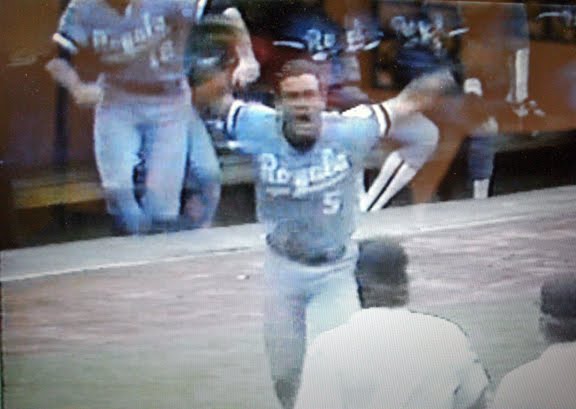
First of all, the MLB network showed a documentary on the career of George Brett today, and scene above, with Brett erupting in fury at the umpire’s call voiding his clutch, 9th inning home run, is one of the classic recorded moments in baseball history. There was also a recent baseball ethics event that had reminded me of Brett’s meltdown: Yankees manager Aaron Boone was thrown out of a game because a fan behind the Yankees dugout yelled an insult at the home plate umpire, and the umpire ejected Boone thinking the comments came from him.. When Boone vigorously protested that he hadn’t said anything and that it was the fan,Umpire Hunter Wendelstedt said, “I don’t care who said it. You’re gone!”

Wait, what? How can he not care if he’s punishing the wrong guy?

“What do you mean you don’t care?” Boone screamed rushing onto the field a la Brett. “I did not say a word. It was up above our dugout. Bullshit! Bullshit! I didn’t say anything. I did not say anything, Hunter. I did not say a fucking thing!” This erudite exchange was picked up by the field mics.

There was another baseball ethics development this week as well, one involving baseball lore and another controversial home run. On June 9, 1946, Ted Williams hit a ball that traveled a reported 502 feet, the longest he ever hit, and one of the longest anyone has hit. The seat was was painted red in 1984 (I’ve sat in it!), and many players have opined over the years that the story and the seat are hogwash, a lie. This report, assembling new data about the controversy, arrives at an amazing conclusion: the home run probably traveled farther than 502 feet.

But I digress. Here, lightly edited and updated, is the ethics analysis of the famous pine tar game and its aftermath:

***

 I have come to believe that the lesson learned from  the pine tar incident is increasingly the wrong one, and the consequences of this extend well beyond baseball.

On July 24, 1983, the Kansas City Royals were battling the New York Yankees at Yankee Stadium. With  two outs and a runner on first in the top of the ninth inning,  Royals third baseman George Brett hit a two-run home run off  Yankee closer  Goose Gossage to give his team a 5-4 lead.  Yankee manager Billy Martin, however, had been waiting like a spider for this moment.

Long ago, he had noticed that perennial batting champ Brett used a bat that had pine tar (used to allow a batter to grip the bat better) on the handle beyond what the rules allowed. MLB Rule 1.10(c) states: “The bat handle, for not more than 18 inches from the end, may be covered or treated with any material or substance to improve the grip. Any such material or substance, which extends past the 18-inch limitation, shall cause the bat to be removed from the game.” At the time, such a hit was defined in the rules as an illegally batted ball, and the penalty for hitting “an illegally batted ball” was that the batter was to be declared out, under the explicit terms of the then-existing provisions of Rule 6.06.

That made Brett’s bat illegal, and any hit made using the bat an out. But Billy Martin, being diabolical as well as a ruthless competitor, didn’t want the bat to cause just any out. He had waited for a hit that would make the difference between victory or defeat for his team, and finally, at long last, this was it. Martin came out of the dugout carrying a rule book, and arguing that the home run shouldn’t count.  After examining the rules and the bat, home-plate umpire Tim McLelland ruled that Brett used indeed used excessive pine tar and called him out, overturning the home run and ending the game.

Brett’s resulting charge from the dugout (above) is video for the ages. Continue reading
From The Law vs Ethics Files: The July 24, 1983 Pine Tar Incident, When Baseball Chose Ethics Over Law, And Was 100% Wrong

I have written on this topic before, but this is the famous incident’s anniversary, and I have come to believe that the lesson learned from  the pine tar incident is increasingly the wrong one, and the consequences of this extend well beyond baseball.

On July 24, 1983, the Kansas City Royals were battling the New York Yankees at Yankee Stadium. With  two outs and a runner on first in the top of the ninth inning,  Royals third baseman George Brett hit a two-run home run off  Yankee closer  Goose Gossage to give his team a 5-4 lead.  Yankee manager Billy Martin, however, had been waiting like a spider for this moment.

Long ago, he had noticed that perennial batting champ Brett used a bat that had pine tar (used to allow a batter to grip the bat better) on the handle beyond what the rules allowed. MLB Rule 1.10(c) stated: “The bat handle, for not more than 18 inches from the end, may be covered or treated with any material or substance to improve the grip. Any such material or substance, which extends past the 18-inch limitation, shall cause the bat to be removed from the game.” At the time, such a hit was defined in the rules as an illegally batted ball, and the penalty for hitting “an illegally batted ball” was that the batter was to be declared out, under the explicit terms of the then-existing provisions of Rule 6.06.

That made Brett’s bat illegal, and any hit made using the bat an out. But Billy Martin didn’t want the bat to cause just any out. He had waited for a hit that would make the difference between victory or defeat for his team, and finally, at long last, this was it. Martin came out of the dugout carrying a rule book, and arguing that the home run shouldn’t count.  After examining the rules and the bat, home-plate umpire Tim McLelland ruled that Brett used indeed used excessive pine tar and called him out, overturning the home run and ending the game.

Brett’s resulting charge from the dugout (above) is video for the ages. Continue reading

Once Again, Fairness vs. Integrity In A Baseball Controversy

George Brett was a bit chagrined when his home run was disallowed...

George Brett was a bit chagrined when his home run was disallowed…

It has happened again, as it has thousands of times since the great game of baseball was invented. A result that is permitted by the rules violates the sense of fairness of  objective observers, who thereupon demand that the result be “fixed,” after the fact, by baseball’s powers that be. The most infamous recent example of this scenario was in 2010, when umpire Jim Joyce robbed a deserving pitcher of the perfect game he had pitched (27 batters, 27 outs) by calling the final batter safe at first on a close play, when the player was obviously (to all but Joyce, that is), out. The umpire quickly and openly admitted his error after the game, but there is no provision in the baseball rules for the League or Major League Baseball reversing an umpire’s judgment call after the fact, no matter how bad it was or how unjust the results. Baseball’s Commissioner Bud Selig, to his credit, refused to yield to the popular outcry to give the unfortunate Detroit Tigers pitcher, Armando Galarraga, the achievement and place in baseball history that should have been his. The rules say that unless umpires have actually misinterpreted the black letter rules of the game, there is no remedy. Umpire errors, like player errors, are part of the game.

Last night, what should have been a game-winning home run was called a double by umpires, and what was worse, they held to their mistaken call even after the mandated video review MLB now allows for disputed home run calls. The umpires viewed video that clearly shows the Oakland A’s Adam Rosales’ hit clearing the wall, but crew chief Angel Hernandez bizarrely claimed that the video wasn’t conclusive enough to justify a reversal. Since the A’s lost the game by one run, this altered the result, and there have been calls for an official reversal with the game being replayed. Continue reading