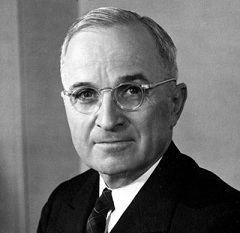
Ethics Dunce: Los Angeles Clippers Forward Blake Griffin

Harry gave credit for HIS slam dunks!

My favorite Harry Truman quote, and one of my favorite quotes generally, is

“It is amazing what you can accomplish if you do not care who gets the credit.”

It is a fair assumption that Los Angeles Clippers forward Blake Griffin has never heard of it, or if he has, he has no idea what Harry was talking about.

The  2011 NBA Slam Dunk Contest over the weekend featured a spectacular  dunk by Griffin, jumping over the hood of a car and slamming the ball through the hoop after it was fed to him, mid-air,  through the sunroof. His contest winning dunk was a sensation, and Griffin can be expected to reap both publicity and dollars from it over and above his contest prize.

But fan Michael Scrivner is calling a foul on Griffin, telling the media that he gave the star the idea for the dunk and deserves some thanks and credit. And he is 100% right. Continue reading

The Huffington Post Bloggers’ Lament

There is ethical indignation in Left-leaning Blogger Land, where Ariana Huffington’s Huffington Post just got $315 million to become part of AOL’s media stable.  The six-year-old  online news site supplements its staff of 2oo with an estimated 3000 volunteer bloggers of widely varying talent, reliability, and sanity. Those writers, who traded periodic contributions to “HuffPo” in exchange for more traffic and notoriety than they would have received in months of laboring, pajama-clad, on their own obscure sites, now are loudly complaining that they were exploited. Their unpaid labor built the site into a multi-million dollar asset, they cry, and yet Ariana is pocketing all of the profits. Where is the justice in that? There is talk of boycotts and mass defections. Continue reading

Ethics Quiz: Amazon, Project Gutenberg, and Montgomery Burns

Amazon is taking public domain texts from a free site, and selling the books for profit to Kindle users.

Question: Is this ethical or unethical? Continue reading

Heeding the Christmas Season Ethics Alarms

Yes, it has come to this. The period between Thanksgiving and Christmas season is a pre-unethical condition, getting worse every year. (Pre-unethical conditions are situations that experience teaches us deserve early ethics alarms, since the stage is set for habitual bad conduct.) The financial stresses on the public and the business community in 2010 will only fuel the creeping tendency to ignore the moral and ethical values that are supposed to underlie the winter holidays—charity, gratitude, generosity, kindness, love, forgiveness, peace and hope—for the non-ethical considerations that traditionally battle them for supremacy: avarice, selfishness, greed, self-pity, and cynicism. Combine this with the ideological and political polarization in today’s America and the deterioration of mutual respect and civility, and the days approaching Christmas are likely to become an ethical nightmare…unless we work collectively to stop that from happening. Continue reading

Update: Derek Jeter Is Now A Full-Fledged Ethics Dunce

In an earlier post, I noted that Yankee legend Derek Jeter could do the right thing and accept the New York Yankee’s generous offer to pay him about twice what he’s worth, or become an Ethics Dunce (qualifications: greed, ingratitude, selfishness, unfairness, abuse of power ) by trying to extort the team for millions of dollars he neither needs nor deserves.

He has chosen the latter. Sorry, Yankee fans. Derek’s a Dunce after all.

I really thought he was better than this.

One Word Removed From Ethics Dunce-hood: Yankee Shortstop Derek Jeter

Derek Jeter is not an Ethics Dunce yet, and all those who admire the career of the great Yankee shortstop—even grudging Red Sox fans like myself–have to hope and wish that he does nor become on. He is perilously close, however—one word away, in fact. The word is “no,” and if he utters it in response to the reported contract being offered to him by the New York Yankees, it is time to replace his NY cap with a tall, pointy one. Continue reading

Celebrity Ethics: Rihanna’s “Fuck You” Necklace

Pop star Rihanna is getting media flack for being photographed with a group of young children while wearing a necklace with a design that spells out “Fuck You.” “We know she probably wasn’t anticipating being bombarded by a bunch kids and shit, but damn, she could’ve tucked that joint in before agreeing to take photos with the little crumbsnatchers,” opines the classy gossip site Bossip, for example. Continue reading

Revisiting the Obligation vs. Charity Issue in Baseball Retirement Benfits

In a recent post, Ethics Alarms discussed that demands of a group of former Major League baseball who receive inferior retirement benefits, because the changes made to the game’s pension and health insurance qualifications in 1980 were not made retroactive. The group has argued that it was unfair for the baseball clubs and players union to have voluntarily extended benefits to  pre-1947 players—players who played before there were any retirement benefits at all—and not them. The post argued…

“…The inclusion of the older players, from before 1947, was not the same: the group included many of the game’s greatest players, who could legitimately say that they were essential in building the industry that had made the current players so wealthy.  Leaving all the older players without any pensions or medical plans from Major League Baseball looked like ingratitude toward the men who, quite literally, helped make the teams and players rich. The sport owed them, and it was right for them to help the veteran group…[The 1948-1979 group], by definition, were not stars; for the most part, they were…journeyman spare-part players who barely held on to their jobs…The fact that players with one day of service in the big leagues today qualify for a health insurance no more entitles the Moonlight Grahams of the Seventies to the same than the million dollar salaries of today’s second-string catchers entitles retired catchers who made $30,000 a year to insist on retroactive pay at today’s pay scales. Baseball players are paid what their rarified talents are worth, and those who create today’s multi-billion dollar industry are worth much more than the players who toiled before the big cable contracts and merchandising kicked in…The fair thing is for people to live with the deals they freely agreed to as conditions of their employment, and when a future employee negotiates a better deal for the work you once did, the fair thing is to say to him, “Good for you!” It would be generous and kind for the Major League teams and players to close some of the disparity in benefits; I hope they do it. Nevertheless, they have no obligation to do it, and it is not a breach of fairness if they don’t.” [You can read the entire essay here.]

The post attracted a strong comment from Craig Skok, one of the players in the 1948-1979 group. He is an excellent representative of the plight of this group, because he just barely missed the cut-off for full benefits. He wrote… Continue reading

Charging Your Parents Interest: Ethical?

An inquirer to the Christian Science Monitor’s financial blog “The Simple Dollar” poses this real life scenario:

“I’m 22 and have very robust finances…My dad recently suggested to me that instead of paying his credit card company interest (~20%, he thinks) on his balance (~$4000), I could lend them the money to pay it off in exchange for something like 10%….This is money I can afford to lose, and would otherwise be sitting in a money market or bond index fund. So my question: is it unethical to charge my parents interest, at least more than I’d earn otherwise? While 10% is much lower than their current payment, it’s much higher than I’d earn otherwise. If I’m willing to lend them the money at a lower rate, am I ethically obliged to?” Continue reading

Obligation or Charity: Retired Baseball Player Pensions and Fairness

It is an old ethical problem: what is “fair”?  If you help someone, are you obligated to help everyone? Does charity have to be consistent to be fair? Does a potential beneficiary of generosity have a right to demand it? It is obviously good for those who are fortunate and successful to share the benefits of their success with the unfortunate and less successful, but is it unethical if they choose not to?

These are some of the ethics issues being raised in a controversy launched by the major league baseball veterans, now retired, who played  between 1947-1979. In those days, when free agency was just beginning and top players made six-figure salaries rather than seven or eight as they do now, a player needed four full years of  time on a big league roster to qualify for  medical benefits and an annuity. In 1980, however, new rules put in place by the Major League Baseball Players Association  granted health insurance benefits to those with just one day of service, and a pension after merely six weeks. The new benefits were not retroactive. Continue reading