Morning Ethics Warm-Up, 11/16/17: Keeping the Public Ignorant About Unethical Lawyers, Sugar Lies, And A Terrible Trump Tweet…

Good Morning, John!

Sing us into the first item, would you?

1 “Is anybody there? Does anybody care?” Everywhere I go, lawyers are talking about the David Boies scandal, which I wrote about here. I haven’t seen much media discussion about it at all. We have now seen one prominent hack lawyer, Lisa Bloom, and one prominent, skilled and respected lawyer, Boies, demonstrate high profile professional conduct that should receive serious sanctions from their profession, and it appears that most of the public and the media neither knows this nor cares.

Bloom is just a venal, incompetent, bad lawyer. The real crisis is when top lawyers blithely engage in wildly unethical conduct in a high profile case, but I doubt the public sees the difference. Very little commentary on Boies’s betrayal of the New York Times  focused on the throbbing black-letter ethics violation involved.  Today, a front page story in the New York Times about Black Cube, the sinister investigative crew hired by Boies to gather dirt on the Times before it blew the whistle on Harvey Weinstein completely missed this crucial element of the story. It also makes it near-certain that no one will read the report who need to know how poorly legal ethics are enforced.

Here’s the headline in the print edition: “Sleuths for Weinstein Push Tradecraft Limits.”  Tradecraft? Online: “Deception and Ruses Fill the Toolkit of Investigators Used by Weinstein.” Nowhere in the article are readers informed that lawyers are forbidden, without exception, from using any contractor that regularly uses deception.

Here is the kind of thing Black Cube specializes in, from the Times piece:

“Earlier this month, a former hedge fund employee was flown from Hong Kong to London for a job interview. Around the same time, a current employee of the same Toronto hedge fund was also flown to London for interviews. The company courting them was fake. Its website was fake. There were no jobs to be had, and the woman who set up the interviews was not a recruiter but an agent working for an Israeli private investigative firm.

This was not an episode of “Homeland” or the latest “Mission: Impossible” installment. Interviews and court papers show that these deceptions were part of a sophisticated and expensive investigative operation. The objective, according to one filing, was to gather proprietary information held by the hedge fund. The agent worked for Black Cube.”

Every single jurisdiction in the United States declares in its legal ethics rules, usually in the rule about misconduct, 8.4 (bolding mine):

It is professional misconduct for a lawyer to:

(a) Violate or attempt to violate the Rules of Professional Conduct, knowingly assist or induce another to do so, or do so through the acts of another;

(c) Engage in conduct involving dishonesty, fraud, deceit, or misrepresentation…

How much clearer can it be? It is unethical for a lawyer to employ someone or an organization that he or she knows routinely and reliably engages in “dishonesty, fraud, deceit, or misrepresentation.” Yet that’s the only reason anyone hires Black Cube. Conclusion: Boies breached a major ethics requirement, perhaps the most serious one there is. And why?  Because a client paid him to. Continue reading
Morning Ethics Warm-Up, 10/1/2017: Puerto Rico, Baseball Ethics, And Good Riddance To Hugh Hefner

Gooood Morning October!

1 And with October comes the wonderful post-season of that all-American sports that does not leave its athletes with brain disease, that requires some erudition and an attention span longer than a terrier puppy’s to appreciate, and that does not subject its fans to incoherent political theater as part of the price of watching a game. Yes, “it’s baseball, Ray.”

Yesterday the Boston Red Sox finally clinched the America League East title, the first time in over a century that this perverse team has won a championship in consecutive years. In other words, nothing can spoil my mood today.

There are a couple of baseball ethics notes, too:

  • In Miami, Giancarlo Stanton has one last game to hit his 60th home run, which would make him the sixth major league to reach that mark in baseball history. Two of the six, Babe Ruth, whose 60 homers in 1927 stood as the season record for 34 years, and Roger Maris, the Yankee who broke the record with 61 in something of a fluke season, reached the mark fairly. The other three, Mark McGwire, Sammy Sosa, and Barry Bonds, were steroid cheats. Ever since Stanton caught fire after the All-Star break and looked for a while as if he would exceed 61, wags have been saying that he would become the “real” record holder, since the totals of Mark, Sammy and Barry ( 73, the current record, in 2001) shouldn’t count. Of course they should count. They have to count. The games were official, the runs counted, the homers are reflected in the statistics of the pitchers, the teams, and records of the sport. Bonds should have been suspended before he broke any records, but baseball blew it. Saying his homers (and Sosa’s, and McGwire’s) don’t count is like arguing that Samuel J. Tilden, Al Gore and Hillary Clinton were elected President.

Integrity exists in layers, and the ultimate integrity is accepting reality. The 1919 Reds won the World Series, fixed or not. O.J. is innocent in the eyes of the law, and Roger Maris no longer holds baseball single season home run record.

  • In Kansas City, manager Ned Yost did something gracious, generous, and strange. The Royals, a small market team that won two championships with a core of home grown, low-visibility stars, now face losing all or most of them to big free agent contracts that the team simply cannot afford. Fans are often bitter about such venal exits, and teams usually fan the flames of resentment: better that the market be angry at the players than the organization. After Red Sox fan favorite Johnny Damon, a popular symbol of the 2004 World Series winning club, left for greener pastures in the New York Yankees outfield, he was jeered every time he came to bat in Fenway Park for the rest of his career.

But Ned Yost, who will be left with a shell of his team and a new bunch of kids to manage in KC next year, was not going to let the players who made him a winner depart amidst anger and recriminations. During yesterday’s 4-3 victory in front of the home crowd at Kauffman Stadium, Yost engineered an emotional curtain call for all four of the players who were probably playing their last games as Royals.

He pulled them from the game, one by one, all while the team was in the field or the player on the bases, so each could get a long standing ovation: Eric Hosmer in the moments before the fifth inning; Mike Moustakas with one out in the sixth. Lorenzo Cain for a pinch runner. Alcides Escobar in the middle of the seventh.

Nice.

And none of them took a knee on the way out…

2. I have been researching to find any objective reports that support the claim that the federal government and FEMA are not doing their best to help Puerto Rico. There aren’t any. There are plenty of videos of the devastation, but even the New York Times, which is the head cheerleader for anti-Trump porn, has only been able to muster headlines about the relief effort being criticized. All of my Facebook friends writing—it’s really dumb, everybody—about how Trump is uncaring as they signal their virtue by telling us how their hearts go out to the residents of the island literally know nothing about the relief efforts. They don’t know anything about the planning, the logistics, the problems or what is feasible. Nonetheless, they think they have standing to say that it is incompetent, or slow (which means, slower than it has to be), or, and  anyone who says this better not say it to me, based on racism. Their assertions arise out of pure partisan bias, bolstered by convenient ignorance.

Vox’s Matt Yglesias, one of the knee-jerk doctrinaire leftists in the commentary world who does an especially poor job hiding his malady,  attempted to take a shot at the Trump administration by tweeting,

“The US government supplied Berlin for nearly a year by air despite a Soviet blockade using late-1940s technology.”

This is only a valid comparison for the willfully obtuse. You can’t airlift electricity and water, or a communication and transportation infrastructure that is necessary to distribute supplies. Berlin was surrounded, but it had all of these. Continue reading

Morning Ethics Warm-Up, 9/20/17: More Factchecker Spin, More Hillary (Unfortunately), And A Thank-You [UPDATED!]

Good Morning!

1 One comment thread over the last few days encompassed media fact-checkers and the consistent position here that they are intrinsically biased and untrustworthy. Law prof/blogger Jonathan Turley was so incensed (his term was “floored”) over one of the better factcheckers (Wapo’s Glenn Kessler) spinning for James Comey and against Trump press secretary Sarah Huckabee Sanders that he wrote a column for The Hill exposing it. (Hey! That’s MY job!) He writes on his blog about what prompted the column:

I have discussed previously how there has been a palpable bias in reporting on the Trump Administration. It is often that case that some journalists are not simply satisfied with disagreeing with the Administration. They sometimes take judgment calls or opinions and declare the Trump side to be simply factually incorrect. This relieves the need for readers to address the opposing view of controversies like the alleged misconduct of former FBI director James Comey. Those views are simply dismissed as untrue. This is a prime example.

The professor is right. It’s embarrassing. Read Turley’s whole piece, clearly prompted because Kessler refers to Turley’s repeated indictments of Comey (while saying that he does not believe Comey should actually be indicted). One respect in which the ever-polite and professorial Turley differs sharply from Ethics Alarms: he says that he has ” written for the Washington Post and [has] great respect for the publication. Indeed, I have objected to the attacks by President Donald Trump on the Post and the New York Times which remain two of our premiere journalistic organizations.”

Hmmm.

1) Turley obviously wants to keep writing for the Post, I guess, and 2) premiere members of a group that has become unprofessional and untrustworthy are still unprofessional and untrustworthy. Be that as it may, Turley concludes,

The Post concludes that the memos were, despite Comey’s denial, FBI material and that he violated FBI rules in removing and releasing such information. It also accepts that employees under Comey as director could well have been fired for such violations. It also agrees that the memos might have been either classified or privileged, even though there has been no final determination. Regardless, the Post awarded two Pinocchios for Sanders stating that Comey’s actions were “improper and likely could have been illegal.”

I have to give the Post two “Blue Fairies.” (I do not want to steal the Post’s Pinocchio signature motif so the Blue Fairy in the Disney story will do). After all, it was the Blue Fairy who said, “A lie keeps growing and growing until it’s as clear as the nose on your face.”

2. There are two items about Hillary Clinton in the Warm-Up today, because she is simultaneously a human ethics train wreck of a failed Presidential candidate, but also needs as little publicity for being so as possible. Continue reading

Accumulated Ethics Notes On The Charlottesville Riots, The Statue-Toppling Orgy and The Confederate Statuary Ethics Train Wreck, Part One

As an introduction, I have to say that this episode, which has quickly turned into an ethics train wreck of sweeping and perhaps catastrophic proportions, frightens me as few issues do. It has become a danger to free speech, to cultural diversity, to liberty, education, historical fairness, cultural cohesion and  common sense. It appears to be the metastasis of all the demonizing rhetoric, self-righteous pandering and virtue-signaling, and totalitarian-minded efforts to remold the past in order to control the future. The level of contempt, hate and intimidation being focused on those who—like me—are attempting to keep the issues in perspective by analyzing complex and emotional ethical components in context is causing the fervor involved to approach  that of unthinking mobs. The damage done by the worst mobs of the past, however, were mostly confined to a restricted region, or, like The Terror in France or the Red Scare here, were immediately repudiated one the fever broke. I’m not sure that this fever will break, at least not before it breaks us. It is the perfect storm of self-righteous fanaticism, as the anti-Trump hysteria collides with Obama era race-baiting and victim-mongering, both of which have run head on into the mania for air-brushing history to remove any mention of events, movements, attitudes or human beings that “trigger” the perpetually outraged of today.

Social media has magnified the intensity of this already deadly storm, by allowing once intelligent people to throttle their brains and judgment into mush by confining their consideration of the issues to partisan echo chambers. Daily, I am embarrassed and horrified by what I read on Facebook by people who I know—I KNOW—are capable of competent critical thought but who have completely abandoned it to be on the “right” side, where facile, half-truths and lazy conclusions are greeted by a myriad “thumbs up” and “hearts.”

And I am angry–contrary to popular opinion, I’m not usually emotionally involved in the issues I write about; like Jessica Rabbit, who isn’t really bad (she’s just drawn that way), I’m not usually as intense as I seem. I just write that way—that I am so tangential and impotent that what see so clearly has little persuasive power at all, because I’ve frittered away my opportunities to be influential in a thousand ways.

I have never allowed futility to stop me, though, because I have spent a lifetime banging my head against walls.

Here are the ethics observations I’ve been accumulating since the first torches were lit in Charlotte:

  • Please watch this video, from Ken Burn’s “The Civil War”:

I was moved when I first saw this, which was in the documentary’s final chapter, and I am moved still. The old Union soldiers moaned when they saw the men who had tried to kill them, and who had killed their friends and comrades, re-enacting their desperate open field march into deadly artillery. Then they dropped their arms and met their former foes, and embraced them.

These men didn’t think of the former Confederates as traitors, or racists, or slavery advocates. They, like the Union veterans, were just men of their times, caught up in a great political and human rights conflict that came too fast and too furiously for any of them to manage. They were caught in the same, violent maelstrom, and knew it even 50 years earlier. Soldiers on both side wrote how they admired the courage of the enemy combatants they were killing, because they knew they were, in all the ways that mattered, just like them. It was the Golden Rule.  After the war, these soldiers who had faced death at the hands of these same generals, officers and troops, did not begrudge them the honor of their statues and memorials, nor their families pride in the bravery of their loved ones.

Yet now,  self-righteous social justice censors who never took up arms for any cause and in many cases never would, employ their pitifully inadequate knowledge of history to proclaim all the Civil War’s combatants on the losing side as racists and traitors, and decree that they should be hidden from future generations in shame. We have honored men and women for the good that they represent, not the mistakes, sins and misconduct that are usually the product of the times and values in which they lived. In doing so, we leave clues, memories, controversies, differing vews, and stories for new generations to consider and better understand their own culture and society, and how it came to be what it is.

Those who want to tear down monuments to the imperfect, whether they know it or not, are impeding knowledge, perspective, wisdom, and understanding. They want only one view of history, because they will only tolerate one that advances their ideology and values—just as the Americans of the past believed in their values. Foolishly, I suppose, they trusted future generations to act on their own ethical enlightenment without corrupting the historical record. Continue reading

From The “Grandstanding Ingratitude” Files…Ethics Dunce: Boston Red Sox Owner John Henry

Ah, Ethics Alarms heaven! The statue-toppling mania issue has collided with the Boston Red Sox, just two days after my pilgrimage to Fenway Park!

ESPN reported yesterday that Red Sox owner John Henry wants Boston to change the name of  the street that borders the legendary park, Yawkey Way, and he is trying to exploit the   current political correctness mania that has cities pulling down statues of war heroes in the dead of night to accomplish his goal.

That’s my characterization, of course, not ESPN’s.

Henry told the Boston Herald that he is “haunted” by the racist legacy of previous owner Tom Yawkey, who led the team from 1933 to 1976. Because he is haunted, he thinks that it is fair and right that the man who beyond question saved the team, ran it as a Boston institution and public utility, and is as responsible as anyone for the fact that Henry owns one of the prestige franchises in all of sports, should be dishonored and shunned because he wasn’t enlightened about civil rights long before Martin Luther King began marching.

Such disgraceful moral grandstanding and self-righteous ingratitude is seldom seen. But I guess if anyone should be able to grandstand, its someone who owns a baseball park.

For those who mock the idea that the desecration of Robert E. Lee’s statues leads directly to George Washington, now hear this; for the Boston Red Sox, Tom Yawkey is George Washington.

The only owner any one remembered before Tom Yawkee bought the team was Harry Frazee, consigned to Beantown Hell for selling Babe Ruth (and many other stars) to the New York Yankees in 1919. From that moment on, the team was a perennial loser, often in last place, while New York won pennant after pennant and sneered at its proud rival on the Bay. In 1933,

Tom Yawkey , a lumber tycoon and baseball enthusiast, bought the team and poured money and love into it, buying other team’s stars (Left Grove, Joe Cronin, Jimmy Foxx) and turning the team into worthy challenger to the Yankees.  From the beginning, Yawkey paid no  attention to the bottom line as he tried to build a champion out of the franchise, or as he put it, “to bring a championship back to the fans of Boston.” This was during a period when teams had permanent control over player contracts, and most owners used that leverage to pay players pathetic wages. Not Tom Yawkee. He was criticized for over-paying players–hilarious now, when we’re talking about his paying a utility infielder $15,000 when others of his ilk were making just $8,000, and current utility players make a couple million dollars a season. Sportswriters in Boston called the Red Sox a country club, and blamed Yawkee for “falling in love with his players.” In 1960, Ted Williams had to ask Yawkey to cut his salary, because he felt embarrassed after a bad year, his only one.

Was Yawkey a racist? He was born in 1903, and grew up during the Wilson Administration, when Jim Crow really took of. Sure he was a racist, along with about 95% of the whites in the nation.  Continue reading

Morning Ethics Warm-up: 8/16/17

GOOD MORNING!

1. I’m heading to Boston and Fenway Park in a few hours to meet with two of my high school classmates and together pay our respects to the 1967 Boston Red Sox, the spiritual beginning of Red Sox Nation, and a group of men, then barely more than boys, who had as profound an effect on my life and view of it as anything I have ever experienced.

It’s the 50th Anniversary of that amazing team and the heart-stopping pennant race it won against all odds, in a four team race that came down to the final game of the regular season. I mean heart-stopping literally: the team wasn’t called “The Cardiac Kids” for nothing. TWO of my father’s colleagues at the Boston Five Savings Bank died of heart attacks while attending Red Sox games, during one of the 9th inning desperation rallies for which the team was famous. The only reason I didn’t perish in like fashion is because I was just 16 years old.

Why was this team, and that summer 50 years ago, so important to me? I don’t have time or space to answer that question well, and you’d probably wonder what I was babbling on about anyway. A 2017 film by Major League Baseball called “The Impossible Dream” does a fair job of explaining it, but it’s too short to do the job right.

I had listened to, watched or attended every Boston Red Sox game for five years, as the team lost and lost. From those bad teams, followed weakly by the city in those days, in a crumbling old park that seemed destined to be abandoned and torn down, I learned that winning wasn’t everything, that loyalty wasn’t easy, that Hemingway was right, and that baseball was about courage, humility, perseverance, doing your job every day, sacrifice, and hope, as well as usually losing at the end. That summer of 1967 taught me that hope is worth the effort even though hope is usually dashed by the ice water of reality, that you should never give up, that miracles do happen, and that nothing is as wonderful as when a community is united in a single, inspirational goal, no matter what that goal might be…and that you should never be afraid to give everything you have in pursuit of a mission, even when it is likely that you will fail.

I learned difficult, discouraging lessons, too. When an errant pitch hit Red Sox right-fielder Tony Conigliaro in the face on August 18, 1967, it was the beginning of a lesson that revealed its tragic last chapter 23 years later. That one taught me that life is horribly, frightening unpredictable, and that we envy others at our peril. It taught me that we need to do what we can to accomplish as much good as we can as quickly as we can, because we may lose our chance forever at any moment.

Tony C, as he was and is known as, was a beautiful, charismatic, local kid, the idol of Boston’s huge Italian-American community,  in his fourth season with his home town team at the age of 22. He dated movie stars; he recorded pop songs; he had a natural flair of the dramatic, and was destined for the Hall of Fame. One pitch took it all away. Although he had two comebacks and played two full seasons facing major league fastballs with a hole in his retina and his field of vision, Tony was never the same. After his final attempt to keep playing failed at the age of 30, he became a broadcaster, and at 37 was seemingly on the way to stardom again in 1982 when he suffered a massive, inexplicable heart attack—Tony  did not smoke, and had no family history of heart problems– that left him brain damaged until his death in 1990.

As Henry Wiggin, the star pitcher protagonist of the novel, play and movie “Bang the Drum Slowly” observes as he  reflects on the death of his catcher and roommate, everyone is dying, and we have to remember to be good to each other. But it’s so hard. Ethics is hard. The ethics alarms ring faintly when we are about the task of living, or not at all…

At the end of the story, the narrator, the best friend of the catcher (but not really that close a friend) recalls how quickly everyone on the baseball team went back to their selfish ways after their teammate went home to die Even the narrator, who was the leader of the effort to make the catcher feel loved and appreciated in his last days, ruefully recalls his own failing. The catcher had asked him a favor, just to send him a World Series program (the team won the pennant after he had become too ill to play), and he had forgotten to mail it until it was too late. How hard would it have been, the narrator rebukes himself, to just put it in an envelope and mail it? Why are we like that, he wonders?

1967 was the beginning of my exploration of that mystery too.

So I am going to Boston for the 30 minute ceremony. I can’t even stay for the game; I have a seminar to teach tomorrow morning, and the last flight out of Logan is at 9 PM. There will probably be just a small contingent from the Cardiac Kids: most of them are dead now, or too infirm even to walk onto the field. But Yaz will be there, and Gentleman Jim Lonborg; Rico Petrocelli, Mike Andrews, and maybe even Hawk Harrelson  and Reggie Smith. I will be there to say thank-you, that’s all.

And to show that I remember. Continue reading

A Brief Message From Your Host

Before we get into the Memorial Day weekend and I start obsessing about the sharp dip in traffic that always triggers (What’s the matter, too busy for ETHICS???), I want to convey my appreciation, admiration and gratitude to Ethics Alarms commenters, who have shined even more brilliantly than usual in the last couple weeks.

I just trashed a comment under moderation that said,

As soon as I saw what Gianforte did here in kaliforniah I went to his website and donated $50.00. I wish someone would slam Rachel Mad-dike. I was very happy to see him win in spite of the commie collective of main stream news commies.

This is the kind of comment I don’t allow here, and yet it is typical of most of the discourse I read on all but a few websites and blogs. Contrast that with the varied, substantive, perceptive and serious comments that appear here every day, as exemplified, though not exclusively, by the recent flood of Comments of the Day by Extradimensional Cephalopod, Mrs Q, Glenn Logan, Spartan, crella, Humble Talent, texagg04, fattymoon, Zoltar Speaks!, and Steve-O-in-NJ. This was all in 10 days, and some of these contribution prompted over a hundred comments themselves.

I envisioned Ethics Alarms as an ongoing participatory pan-ethics conference or colloquy, never as a monologue. For that ambitious concept to work requires a lot of passion, thought and commitment from more than just the moderator, and recent days have proved that, thanks to all of you, Ethics Alarms has these and more in abundance. Few other online forums are so fortunate.

Thank you.

Bravo.

A Tale Of Two Hotels: Same Problem, Different Responses

A couple of weeks ago, I stayed at Atlanta’s sumptuous Lowe’s hotel downtown. I like the hotel a great deal, but room service at breakfast is ridiculous: essentially you might as well order the deluxe pig-out, which could feed a family of three. The way the menu is set up, you pay the over $25 for any other choice and get half as much food. This is primarily because a pot of coffee costs more than ten dollars, and only the deluxe breakfast has coffee included.

Even though all expenses were being paid by the client, I hate this, so I decided to order a couple of muffins (still about $15 without coffee, not counting tax and the automatic service charge) and tolerate the free instant coffee that is  offered by the little single cup machines in the room. I was a good plan, but the damn thing wouldn’t work. The water didn’t heat. Annoyed (no coffee, 6 AM, brilliant money-saving scheme foiled), I called the front desk to complain. They sent up a young man—he arrived in about 15 minutes, after the continental breakfast—who fiddled with the coffee machine. It was obvious that he had never seen one before.  Eventually he gave up, apologized, and left to get another one. By the time he returned, I had finished most of the muffins, but I made a cup of (lousy) coffee anyway.

Last night, I had to stay in a hotel to make sure that D.C.’s $%^&$#@! Rock and Roll Marathon didn’t stop me from getting to my early morning presentation to new D.C. bar members. The streets around the venue were blocked off, and weird traffic was expected; hard experience dictated the expense was the better part of valor. There was breakfast provided at the bar event, so all I needed was some coffee in my room to wake me up sufficiently so that I didn’t wander onto 14th street and die.

This time, the hotel was the J.W Marriott, and again the little one cup coffee machine didn’t work. Just like in Atlanta, I called the front desk, sounding even more annoyed about the inconvenience than the before. (This was unfair, of course; there is no reason the Marriott should inherit my upset with Lowe’s.) The response from the desk was identical after I described my plight: she would send someone up to my room to check on the machine. Great.

When the knock came and I opened the door, I was greeted by the head of guest services, in a uniform. He had a new coffee machine with him, and also handed me a bag containing two large cups of Starbuck’s coffee, ten creamers, napkins, utensils, and two hot pastries. He replaced the machine after confirming that it was broken, apologized profusely, and took his leave.

Wow.

Now that’s service.

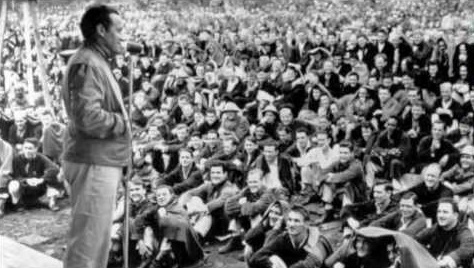
Remembering Bob Hope

hope and troops

I can’t blame the airport officials who voted 8 to 1 last month to eliminate Bob Hope’s name and change the airfield’s label to “Hollywood Burbank Airport.”  It was a business decision based on hard data. Hope’s name wasn’t resonating with passengers outside of Southern California, especially those east of the Colorado Rockies.

The airfield had been  rechristened to honor Hope in 2003, not long after his death at the age of 100. Yet just a bit more than a decade later, the entertainment icon whose theme song was “Thanks for the Memory” is fading from ours at record speed.  The comments on various news reports on the airport’s decision range from stunningly ignorant to disrespectful. Bob Hope deserves better. The culture will be stronger if it remembers him, and so will the nation.

I must admit, I didn’t see this coming, but I should have. The survival or disappearance of once famous figures from our cultural memory fascinates and often horrifies me. One of the definitions of culture is what a society chooses to remember and chooses to forget: these seemingly random decisions have significant long-term consequences. Occasionally there is a last-minute rescue:  just as the Treasury was preparing to remove Alexander Hamilton from the ten-dollar bill, a Broadway musical, of all things, rescued his image and re-established his cultural presence. Usually, however, once a figure drops down the memory hole, he and the public appreciation of his importance is gone, gone, gone. Forever.

The mechanics of this process are chaotic. A single movie that enters classic territory and is featured regularly on television can rescue the memory of a whole career for generations. Ray Bolger, an eccentric dancer who was never regarded as close to Fred Astaire or Gene Kelly in the hierarchy of Hollywood hoofers nonetheless remains a recognizable figure today purely on the basis of “The Wizard of Oz.” Edward G. Robinson was a famous and respected actor mostly on the strength of his gangster films, but his memory survives almost entirely due to his strange ( and strangely miscast)  role as the Hebrew villain in “The Ten Commandments.” Meanwhile, who remembers George Raft?

Hope, I now realize, despite one of the longest and most successful careers in show business history and epic stardom on radio, films, theater and T, despite being the most frequent and most successful MC for the Oscars telecast and while he was alive and regarded for 50 years as the undisputed champion of stand-up comics, has no such marker to keep his image and memory alive. Humor is famously dependent on the times and culture, and Hope’s humor and style were more so than most. He was not a physical or slapstick comedian, and his movies, with the exception of the best of his “Road” movies with Bing Crosby, were at best mildly funny. The later ones, like his films with Phyllis Diller and Lucille Ball, weren’t even that. By the 1960’s, Bob Hope’s reputation as an entertainment icon was so well-established that he didn’t really need to be funny; the fact that he was Bob Hope was enough. He was a living relic of vaudeville, radio comedy and traditional TV skits who never changed his delivery or mildly self-deprecatory yet cocky demeanor. But what was special about him? There’s little available on TV or elsewhere to let new generations in on the secret. Continue reading

Ethics Dunce: Guardian Journalist Mona Chalabi

But Mona, doesn't you correcting people who correct people's grammar and calling them purveyors of white privilege make you an ANTI-grammar snob?

But Mona, doesn’t you correcting people who correct people’s grammar and calling them purveyors of white privilege make you an ANTI-grammar snob?

This won’t take long. It’s like shooting fish in a barrel.

Mona Chalabi, a  journalist for the British tabloid “The Guardian,” has asserted that correcting someone’s grammar (and presumably word use, sentence structure and other aspects of effective communication) is racist.

“Grammar snobs are patronizing, pretentious, and just plain wrong, ” she says. “It doesn’t take much to see the power imbalance when it comes to grammar snobbery. The people pointing out he mistakes are more likely to be older, wealthier, whiter, or just plain academic than the people they’re treating with condescension. All too often, it’s a way to silence people, and that’s particularly offensive when it’s someone who might already be struggling to speak up.”

Of course, correcting anyone to humiliate them, embarrass them, or make them hesitant to speak is cruel and wrong, as would be slapping them in the face and shouting, “Shut up, fool!”  Neither of these, or other examples of bad manners and disrespectful treatment, is the conduct that Chalabi is condemning as a demonstration of white privilege, however. (Glenn Reynolds, the Instapundit, frequently quips, “White privilege—is there anything it can’t do?”) No, she is saying that the simple act of one human being pointing out to another that they have made a verbal mistake that may embarrass the speaker in the future makes the person offering the correction a “grammar snob,” and is unethical.

To the contrary, correcting anyone’s mistakes in speaking, when done with discretion and proper attention to the speaker’s feelings, is a gift, an act of social kindness and even a social obligation. Expressing oneself in a manner that causes others to conclude, possibly correctly, that you do not know correct meanings, grammar, construction and etiquette is a serious life handicap and an obstacle to success. A listener may conclude that you are badly educated, do not read, do not listen to those who speak to you correctly sufficiently to learn from them, are ignorant, are not very bright, or worse, know how to communicate but don’t have enough respect for the rest of the world to make an effort to do so. Unlike concluding such unflattering things about a stranger or casual acquaintance based on an accent or verbal regionalism, making judgments based on poor communication skills is not prejudice or bias. Communication is a vital life skill and occupational tool. Every individual has an obligation to master these as early as possible, certainly by young adulthood. Believing one has done this and being wrong is a dangerous and potentially tragic situation. Continue reading