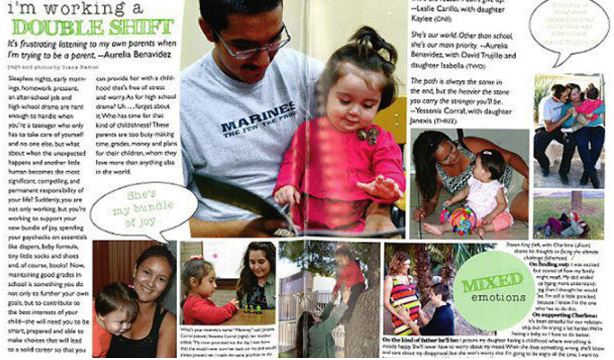
Irresponsible and Incompetent —and Jaw-Droppingly Stupid— School Administration Decision Of The Decade: “Hey! Let’s Have A Yearbook Salute To Seniors Who Have Kids Before They Graduate!”

teen-parents yearbook

I love the way the news media describes stories like this, with disturbing little mini-news flashes buried within. The depressing story of the Mesa High School Yearbook’s adorable feature on its graduating, unwed parents gave us many examples.

  • “Mesa yearbook photos of teen parents anger some”–wait, you mean everyone with half a brain isn’t horrified by this? At least The Arizona Republic was one of the “some,” writing in an editorial “that featuring pregnant teens in a two-page spread of photos glamorizing a life-altering mistake risks normalizing dysfunction.” Uh, yeah, I would think that would be obvious to more than “some.” News Flash! It isn’t.
  • “A representative for the district did suggest that parenting isn’t a valuable accomplishment for high schoolers,” writes ThinkProgress. He suggests it? Statistics tell us that those teen parents are more likely to drop school, more likely to be unemployed, and more likely to require government hand-outs to survive. Out-of-wedlock births increased from 7.7 percent in 1965 to more than 40 percent in 2012, including 72 percent of black babies, with teen pregnancies leading the way. The reason this has happened, and few can dispute this, is society’s elimination of all significant opprobrium or disapproval of the act of pre-marital sex, teen sex, and, therefore, teenage motherhood. Helping the social pathology take root, and it is one that has disproportionately crippled the prospects of minorities, are various toxic role models: TV characters, like Murphy Brown; movie stars, singers, TV kid show stars (Britney Spears little sister), even a proud, unmarried, pregnant Congresswoman, Rep. Linda Sanchez, who uttered this fatuous justification: We’ve evolved as a society so much. The reality of single working moms is such a powerful reality!

Democrats must be so proud. Continue reading
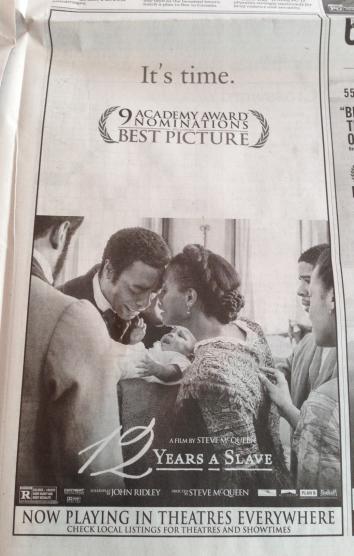
Ethics Quiz: “12 Years A Slave” Plays The Racial Guilt Card On Oscar Voters

12_years_ad_2.jpeg

“It’s time.”

This is the  tag line in the post-Oscar nomination ads being prominently run in New York and California for  “12 Years A Slave,” a strong Academy Award contender (nine nominations, including best film).

Although there is room for disagreement, and the ad has the virtue of all clever advertising that it conveys different messages to different markets—Haven’t seen the film yet? “It’s time!”  Desperate to see the best movie you saw in 2013 finally get its due? “It’s time!”  When will the question of whether the most honored film of the last 12 months will win the biggest honor of them all be answered? “It’s time!”…or almost time, as the Oscar ceremonies are coming up on March 2—the consensus is that “It’s time” is mainly aimed at Oscar voters, and the message it conveys is, as Slate puts it, “it’s time for a movie about slavery, and with a significantly black cast and crew, to be recognized by the Academy of Motion Picture Arts and Sciences.” Film critic Phil Hammond puts it slightly differently:

“The ad not only can be interpreted as shining a light on a very dark period in American history, it also shines a light on the Academy’s fairly dismal record of awarding its top honor to any movie about the black experience. In fact there has been only one Best Picture winner in the 85 years the Academy of Motion Picture Arts and Sciences has been handing out Oscars that even remotely qualifies in this regard. In 1968, In The Heat Of The Night, a murder mystery set against the racial divide in a small Southern town, won Best Picture and four other Oscars just a few days after the assassination of Martin Luther King (the ceremony was even postponed two days out of respect). The votes were in before the King assassination, but it seemed then that “It’s Time” would have been an appropriate way to describe that victory. However, outside of lead actor Sidney Poitier — who also co-starred in another racially themed Best Pic nominee that year, Guess Who’s Coming To Dinner —  this movie  featured a largely white cast, white producer, screenwriter and director (Norman Jewison).”

If so many in the industry are interpreting the ad this way, it is fair to assume that this was at least one of the ad’s objectives, and on the assumption that it was an objective, your Ethics Alarms Ethics Quiz today is this:

“Is appealing to Oscar voters on this basis fair and ethical?”

I can see strong arguments for each position. Continue reading

Well, Crap. Again.

Regret2

I am now in shock, having just learned that a dear friend of four decades is now in a hospice with complications of congestive heart failure, and not long to live. We had been exchanging cheery emails, and while I knew of his health issues, I was under the impression that they were manageable, and certainly not this dire. Naturally, we had kept planning on getting together for dinner or a ball game, but one thing or another always intervened, usually on my end, and I had not seen him since the Spring.

This has happened to me before, more than once. What will it take to make me take the time to show love and appreciation to the many people in my life who have earned it, and to try to enrich their days, however many they have left, in some small way, rather than allowing everything else to get in the way?

________________________

Graphic: Ronnie Tabor

“Hot Mom” Maria Kang Is A Self-Obsessed Narcissist, and Yes, There’s A Reason Humility Is An Ethical Virtue

Kang

Lots of Americans are obsessed with outward appearances, unreasonably devoted to being attractive at all costs and for as long as possible,convinced that their own priorities are what everyone should embrace, and feel superior as a result. Most don’t go out of their way to broadcast these obnoxious attitudes and to accuse others of being inferior, rationalizing slugs while thrusting their cosmetic successes in the faces of those who no longer can squeeze int their fashion jeans.

Maria Kang, pictured above in all her buff glory, did, reaped the predictable result, and now is being called the aggrieved victim while she remains resolutely self-righteous.

Yechhh. Continue reading

The Ethics Of Demanding Charity

Joanna Leigh

Joanna Leigh

I can not imagine much more heartbreaking plights than that of Boston Marathon bombing victim Joanna Leigh.

By April 14, 2013, Leigh, 39, had a newly minted doctorate in international development, and a promising career as a consultant. On April 15, she was at the finish line of the marathon, waiting for a friend to cross it, when the second of two bombs exploded ten feet from her. She was shielded from the deadly flying metal by other spectators, but still knocked unconscious. When she awoke, there was chaos around her, people screaming, maimed, covered with blood. She helped some injured find help, and then, dazed, walked home. For various reasons, she did not get herself checked out at a hospital until more than a week had passed.

Gradually, however, the symptoms of her injuries began appearing. Soon, it became obvious that the closed head injuries she suffered in the explosion have caused devastating long-term damage to her brain, and it is doubtful that her life will ever be normal again. Today, she says, she has to sleep most of the day. She cannot work or drive, and is easily disoriented, even getting lost on her own block. She has blurred vision, her hearing is impaired and she cannot avoid the constant ringing in her ears. Concentration has become difficult, and the simplest everyday tasks are overwhelming.   Continue reading

Comment of the Day: “Ethics Hero Emeritus: Henri Salmide, 1919-2010”

Henri Salmide

Henri Salmide, Hero: Unknown in the US, and only barely recognized in Germany or France. Greatly appreciated on Ethics Alarms, however.

German visitor Reinhard Gross sent me a useful clarification on the 2010 Ethics Alarms tribute to Henri Salmide, who as a German soldier in World War II saved the French port of Bordeaux by defying orders to blow it up and blowing up his German superiors instead. You can read the post on Salmide, an Ethics Hero Emeritus, here, and his New York Times obituary here. It’s an inspiring story, and if you are not familiar with Salmide, you should be.

Salmide lived the rest of his life as a French citizen in Bordeaux, and until late in life was seldom noted for his heroic act in France, so strong was the bias against him as a former German soldier. I asked Reinhard what the attitude in Germany was toward Salmide, and his Comment of the Day was the response. It also provides some insight on the the long and painful process the German culture must work through, as the German people come to terms with the dark Nazi period, when their society and its values were so horribly warped, with such tragic consequences for Germany and the world.

Here is Reinhold Gross’s Comment of the Day on the post Ethics Hero Emeritus: Henri Salmide, 1919-2010…and I thank him for reminding me of Henri Salmide’s courageous and ethical act: Continue reading

Tales From The “Ick!” Files: If Luke Married Leia…

Luke and Leia

Emily Yoffe, who is not Ethics Alarms’ favorite advice columnist, gets one right at Slate—a weird one, but then, that’s the only kind of question she usually chooses to answer. If I had to bet, I’d place my money on this question being a fake. Emily acknowledges that possibility, but couldn’t pass this one up, and neither can I.

A loving husband who already knew that both he and his wife (it was virtually love at first sight when they met in college) were raised by lesbian parent couples who conceived via sperm donors found out that they both have the same donor to thank for their conception. Now he thinks “sister” every time he sees his spouse, and ask 1) what should he do? and 2) should he tell his wife that he has learned that they are half-siblings? Yoffe tells this poor guy to stop feeling guilty, and that he hasn’t done anything wrong. She also advises him to get some counseling, and to suck it up and tell sis about their dilemma….but not to reveal the secret to their kids, Anteater Boy and Tilly the Boneless. Continue reading

Tricking Yourself Into Being More Ethical

Cracked 5 waysOver at Cracked, the website that excels at developing clever factoid lists and debunking conventional wisdom, they have posted a list of “5 Scientific Ways To Trick Yourself Into Being A Good Person.”

Uh-huh. As usual for this site, the headline is just a bit overstated. “Trick” is a misleading word here: most of the devices involve the phenomenon of priming, which basically means that we are more ethical the more something focuses our attention on the ethical implications of what we are doing. By Cracked’s definition of “trick,” Ben Franklin’s morning and evening questions are tricks.

Skepticism is also warranted because we are just getting summaries of studies, and brief, non-technical, non-critical ones at that. It is impossible to know what extraneous factors might have polluted the results, or what biases the researchers brought to their research. Social science research is notoriously fallible and subject to design flaws, particularly regarding sample size. Such research is also prone to confuse cause and effect. I am especially dubious of #2 on the list, “Washing Your Hands Makes You Less Prejudiced.” Yes, researchers found that those who chose to use sanitary wipes on their hands when given the option during a flu epidemic scored better after doing so than those who declined to sanitize when they were asked to answer a survey designed to measure prejudice. I think it is a logical stretch to conclude that the act of ridding their hands of germs washed away the subjects’ biases; it is more likely that those who were more considerate of people around them, as indicated by their interest in sanitizing their hands during a flu outbreak, were also the most empathetic, tolerant and unbiased to begin with. That result isn’t nearly as startling as the claim that handwashing magically heals one’s prejudices, but Cracked apparently needed something to fill out a list of four.

It’s still an interesting article, even though ethical conduct takes a lot more cognitive effort than “tricks.”. You can read the whole thing here.

Football Fashion, Ethics, and Our Wasteful Consumption

The many fashion choices of the Oregon Ducks...and children are starving in Appalachia.

The many fashion choices of the Oregon Ducks…and children are starving in Appalachia.

On his excellent ethics blog, the Ethics Sage, a.k.a. Dr. Steven Mintz, recently expressed dismay at the increasing trend in college and high school football teams that has them changing uniform designs for no discernible reason, but at significant expense. Focusing on the multiple uniforms used over a season by the Oregon Ducks, he wrote:

“The poverty line threshold in the U.S. ($23,050 for a family of four) is, on a daily basis, about $16 per person per day. If my estimates are close, the cost to outfit the Duck football players for a year is about $48,000, double the poverty level for a family of four and enough to sustain 3,000 people for one day or about 8 people for one year. When you think about the extravagant spending on uniforms by the Ducks, you begin to understand that it reflects a society where glitz and glamor are valued over feeding the hungry — not a pretty picture”

I am not sure what to make of this argument. Is Mintz arguing that the Ducks are ethically obligated to send the money they spend on extravagant uniform diversity to the poor? Isn’t this really just the old “How dare you waste those perfectly good peas when children are starving in Ethiopia?” argument? Realistically , there is no way the university’s football uniform budget is going to be able to help feed the poor. Why pick on the Ducks? He goes on to write, Continue reading

One For The “Innocent Until Proven Guilty” Crowd

Stop scaring my dog!

A commenter recently pulled out the hoary and almost always misused “innocent until proven guilty” line, which reliably makes me scream, frightening the dog and the neighbors. Thus I was happy to see this September 28 ruling by the Louisiana Supreme Court, which found that Philip Pilie, a 2007 University of Georgia School of Law  who passed the bar examination in 2009, lacked the character and fitness to be admitted to practice in the state, despite the fact that he was not convicted of the crime that resulted in his disqualification.

Why? Because he did it, that’s why. Pilie contacted what he thought was a 15-year-old girl online and arranged to have sex. She was, unfortunately for Pilie, really a big, hairy, middle-aged man looking for predators who like to have sex with under-age girls. Pilie  was arrested at the planned rendezvous and charged with two  felonies,  computer-aided solicitation of a minor and attempted indecent behavior with a minor.

Pilie negotiated a deal with the district attorney to avoid prosecution. He completed a pre-trial diversion program including counseling, and all charges  were dropped. Pilie took and passed the bar exam, but was informed  in March 2009 that he lacked the character and fitness for admission to practice, because he trolled on computers for young girls to have sex with, by his own admission. His appeal to Louisiana’s highest court failed, twice.

In the latest decision, the court said that Pilie’s lack of a criminal conviction made no difference in its reasoning. “Had petitioner been a practicing attorney at the time of his misconduct, it is very likely he would have been permanently disbarred,” it wrote. “Given this fact, we can conceive of no circumstance under which we would ever admit petitioner to the practice of law.” Pilie was permanently barred from ever again seeking admission, without ever being “convicted in a court of law.” Continue reading