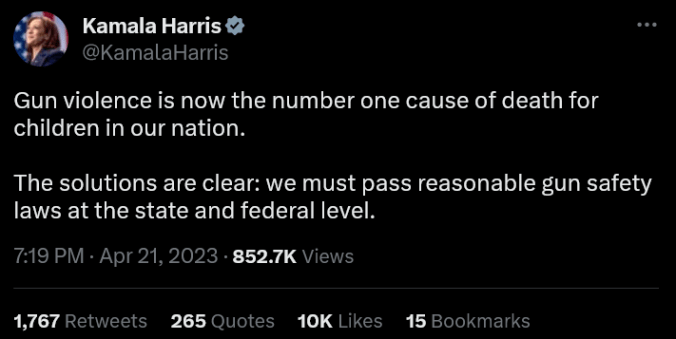
Right on cue, the Brown mass shooting was instantly the inspiration for the usual gang of anti-Second Amendment zealots, utopians,”Imagine” fans, fact-phobic progressives and nascent totalitarians (funny how they hang out together…huh!) to again scream for “common sense gun control.” Joe Biden did it, or whoever was standing near him barely moving their lips or pretending to drink a glass of water.
Last week, quirky, smart, logic-obsessed substacker Holly Mathnerd issued a typically thoughtful essay called “The Reality of Nationwide Gun Control…the math behind the policy.” Holly gifted me with a subscription to her blog a while back as a gesture of professional courtesy so I pass her analysis on to you. I have written essentially this exact post on Ethics Alarms before and long ago, however, and probably more than once. My reaction to Holly’s work is, “Yes, of course. Why do we keep having to explain this?” Her delivery is a lot less abrasive than mine, so if that helps, great.
Gun control is also on my list of policy objectives that I view as unethical because they are impossible, and arguing for them is 1) a waste of time, 2) misleads the slow of wit into thinking they aren’t impossible when they are, 3) constitute virtue-signaling and 4) would be terrible mistakes even if they weren’t impossible. Read Holly’s whole argument, but the short version is…
If “nationwide gun control” is going to mean anything more than a slogan, it has to be defined in operational terms. Not aspirations. Not values. Mechanics. Logistics. Physical Reality. What specific actions actual humans would have to take with their human bodies in the material world.
In a country with roughly 450 million privately held firearms already in circulation, nationwide gun control cannot mean preventing future purchases alone. Even a total ban on new sales would leave hundreds of millions of existing weapons untouched for decades. So the policy people are implicitly calling for is not regulation at the margin, but the systematic reduction of the existing stock of guns. That requires locating them.
There is no way to meaningfully restrict, reclaim, or eliminate privately owned firearms without first knowing who has them and where they are. Which means a comprehensive national registry: mandatory disclosure of ownership, backed by penalties for noncompliance, with mechanisms for verification. Anything less is symbolic. Once a registry exists, enforcement becomes unavoidable. Some people will comply. Many will not. Some will be confused, some distrustful, some quietly resistant.
That resistance is not an edge case; it is a certainty at this scale. At that point, enforcement ceases to be abstract. It becomes door-to-door. This is the moment where “nationwide gun control” stops sounding like a policy preference and starts sounding like a domestic enforcement regime. Warrants. Searches. Seizures. Follow-ups. Informants. Penalties for concealment. Escalation when compliance is refused.
There is no clean or frictionless version of this process, and no serious proposal pretends otherwise once you spell it out.






 Ethics Alarms