A Futile Ethics Request To Anti-Gun Activists: Don’t Exploit Richard Martinez

Richard Martinez

Richard Martinez

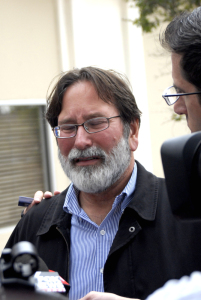
I am certain that plans are already in the works to trot out Richard Martinez, the grieving father of one of the victims of killer Elliot Rodger in his murderous rampage at the University of California in Santa Barbara, for service in hearings, at rallies, for fund-raisers, at protests and in anti-gun ads. The emotionally distraught father provided a ready-made media sound chomp in his CNN rant against anyone and anything that have, in his mind, prevented radical restrictions on guns, those who, in his view, contributed to the death of his son.

“What has changed? Have we learned nothing? These things are going to continue until somebody does something, so where the hell is the leadership? Where the hell are these people we elect to Congress that we spend so much money on? These people are getting rich sitting in Congress, what do they do? They don’t take care of our kids.My kid died because nobody responded to what happened at Sandy Hook. Those parents lost little kids. It’s bad enough that I lost my 20-year-old, but I had 20 years with my son, that’s all I’ll have. But those people lost their children at six and seven years old. How do you think they feel? And who’s talking to them now? Who is doing anything for them now? Who is standing up for those kids that died back then in an elementary school? Why wasn’t something done? It’s outrageous!”

I don’t blame Martinez for how he feels, but I will blame those who exploit him, and I know there is no chance that they won’t.

In 2013, we all saw how every Sandy Hook parent who was sufficiently enraged and camera-worthy fueled the shameless drive to use fear-mongering and exaggeration in the push to finally gut the Second Amendment, as anti-gun activists have so long wanted to do. Martinez is perfect, just as Cindy Sheehan, destroyed because her soldier son died in a war, was custom-fit for pacifists and anti-war advocates, just as a brain-damaged Gabby Giffords was ideal to have recite child-like generalities against firearms in Congress. Continue reading

Bergen Community College Shows Us Why Justin Carter Is Being Persecuted

Can't have this. Terrifying. Dangerous.

Can’t have this. Terrifying. Dangerous.

Remember Justin Carter? Last I checked, he was being tried for making a joke on Facebook, because of the culture of fear and speech monitoring created by the irresponsible hysteria over guns and terrorism.  He faces prison time. That this is a freedom-suffocating societal illness that threatens any and all of us is chronicled in Ken White account, and accompanying commentary, on the astonishing mistreatment of Bergen Community College Professor Francis Schmidt by the school, which was sent into a frenzy of terror because he posted to Google+ “a cute picture of his young daughter wearing a Game of Thrones t-shirt in a yoga pose next to a cat.”  Inside Higher Ed reports what happened next: Continue reading

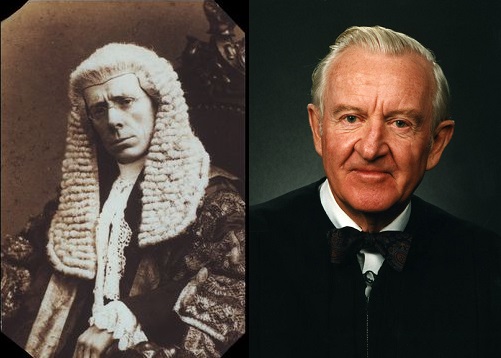
John Paul Stevens’ Gilbertian Nonsense


The Lord Chancellor-Stevens

A rather long preface is in order. Bear with me, please…

In the great, underperformed Gilbert and Sullivan operetta “Iolanthe,” W.S. Gilbert, a lawyer by training, devised a satirical judicial solution to a dire turn in the plot. Iolanthe, a fairy, violated Fairy Law by marrying a mortal, who happened to be the Lord Chancellor of England (he never noticed her wings, apparently.) The transgression commands the death penalty, but Iolanthe received a pardon on the condition that she allow her husband to think her dead, which she does for a couple of decades, much of which she spends doing penance at the bottom of a froggy stream, on her head.…but I digress.

When she learns, however, that her husband of yore is about to marry the sweetheart of her half-fairy son, who, though the Lord Chancellor doesn’t know it, is also his son, Iolanthe reveals herself and the paternity to the Lord Chancellor, who is duly stunned. This again triggers the death penalty and just minutes away from the finale, it looks like Iolanthe is going to end up like Carlo in “The Godfather,” as the fairy equivalent of Clemenza waddles on to the stage. (That’s how I would stage it, anyway.) Then this happens: Continue reading

The Ethics Alarms List of Debate Cheats and Fallacies

fallacy

I realized it was time to post the definitive Ethics Alarms List of Debate Cheats and Fallacies after once again having to point out to an indignant commenter that calling  him a jerk based on a jerkish comment was not an ad hominem attack, and that saying idiotic things on-line carry that risk. Here, at last, is the current list, adapted from multiple sources. As with the Rationalizations List, with which this occasionally overlaps, I invite additions. Participants here should feel free to refer to the various fallacious arguments by number, and to apply critically them to my posts as well as the comments of others. Am I immune from occasionally falling into one or more of these bad debate techniques and rhetorical habits? No. The other reason I wanted to get the list up was to reinforce my own efforts to be persuasive without being manipulative.

1. Ad Hominem Attack

An ad hominem attack means that one is substituting the character or quality of an adversary’s thought for the argument the adversary is presenting. This is unfair, as well as misleading. “Your argument is invalid because you are a crook, a fool, an idiot” is an ad hominem attack. It is not an ad hominem attack to prove an argument idiotic, and conclude, on the basis of signature significance, (which requires that an  argument be so idiotic that no non-idiot would conceive such a thing and dare express it),that the one making the argument is an idiot, since only an idiot would make such an argument. Confusing the true ad hominem attack with the latter is a useful deflection by poor advocates of the fair consequence of their advocacy. Idiots can still hold valid positions, and disproving the position has nothing to do with proving they are idiots.

1 a. The Toxic Introduction.

A more subtle application of the ad hominem attack is The Toxic Introduction, where the argument of another is introduced by noting a negative quality about the individual. The effect is to undermine the argument before it has even been heard, by its association with a less than impressive advocate.

2. Butch’s Stratagem (The Straw Man)

Continue reading

Post-Sandy Hook No-Tolerance Encore: Another Finger-Gun Massacre

"Level One or Level Two gun? Wait...I'm sorry! It's just a finger!"

“Level One or Level Two gun? Wait…I’m sorry! It’s just a finger!”

Should Ethics Alarms post on substantially the same ethics stories every time they occur? The news that an Ohio fifth grader has been suspended from school for three days for the offense of making an imaginary gun out of his fingers is just such a repeat. I wrote about a similar no-tolerance episode in Montgomery County a year ago, here and here. What is left to say, and why say it again?

I think you have to say it again, in this case at least, because it didn’t sink in the first time. In Montgomery County, Maryland, the school system was forced to revoke the suspension and even apologized to the boy as a result of the ridicule that showered down on the hapless administrators who inflicted the absurd punishment. Officials at Devonshire Alternative Elementary School, where ten-year-old Nathan Entingh wielded his deadly digits “execution-style,” couldn’t have missed the Maryland fiasco, yet they failed to absorb its lesson, which seems extremely obvious to the reasonable, the fair and the responsible: “This is stupid, cruel and abusive treatment. Don’t do it.”

Why didn’t they heed the lesson? I think one reason may be that such hysterical policies are now less about hysteria than they are about thoughtful anti-gun indoctrination. Continue reading

Ethics Quiz: Rank The Unethical Politicians!

Three pols

For your first Ethics Alarms Ethics Quiz of the New Year:

Consider these unethical politicians from Florida, Texas and California…

Unethical Politician A:

California State Sen. Kevin de Leon (D-Los Angeles)

Ethics Failures:

Competence, Responsibility, Diligence

Explaining his proposed legislation SB808, dealing with “ghost guns” (that is, home-made weapons) at the California Capitol in Sacramento last week, de Leon held up such a firearm and said, “This right here has the ability with a .30-caliber clip to disperse with 30 bullets within half a second. Thirty magazine clip in half a second.”

This is genuine anti-gun gibberish that could not possibly be uttered with a straight face by anyone even slightly familiar with guns. There is no such thing as a “30-caliber clip;” he is referring to a 30-round magazine. (There is also no such thing as a “30 magazine clip.) “Caliber” refers the measurement of the width of a bullet or the internal diameter of a gun barrel, not what the magazine will hold. And the average rate of fire for a semi-automatic rifle, which is what he was holding, is about 120 rounds per minute, not 3,600 rounds per minute.

Why are legislators who don’t care enough about guns to educate themselves about what they are, how they work and what they are capable of doing, submitting legislation about guns? Because they just know guns are dangerous, and in their infantile, knee-jerk reasoning, that’s all they have to know. The rest is fakery: the legislator is pretending that he has sufficient expertise to be credible on the issue, when he is too lazy and arrogant to do the minimum study necessary to render him qualified to vote on gun regulations, much less author them.  This is the equivalent of a legislator who thinks babies are delivered by storks proposing abortion laws. Continue reading

Ethics Quiz: The Case Of The Reasonable Gun Nut

A voice of moderation in the gun control debate?

A voice of moderation in the gun control debate?

“Guns and Ammo Magazine,” a stalwart of gun rights advocacy,  fired contributing editor Dick Metcalf after he penned, and the magazine published, an editorial advocating moderate gun control.

In his opinion piece titled “Let’s Talk Limits,” Metcalf wrote in part,

“Way too many gun owners still seem to believe that any regulation of the right to keep and bear arms is an infringement. The fact is, all constitutional rights are regulated, always have been, and need to be….All U.S. citizens have a right to keep and bear arms, but I do not believe that they have a right to use them irresponsibly.”

The Horror. You would have thought he had come out for legalized cannibalism. Readers attacked the editor and the magazine on social media, and threatened to cancel subscriptions. “Guns and Ammo” editor Jim Bequette posted an apology to readers on the magazine’s website, saying he should never have run the column:

“In publishing Metcalf’s column, I was untrue to that tradition, and for that I apologize. His views do not represent mine — nor, most important, ‘Guns & Ammo’’s. It is very clear to me that they don’t reflect the views of our readership either. I made a mistake by publishing the column,” he continued. “I thought it would generate a healthy exchange of ideas on gun rights. I miscalculated, pure and simple. I was wrong, and I ask your forgiveness.”

Bequette not only announced that “Guns & Ammo” had fired the author, but also that he was leaving as well.

Your Ethics Alarms Ethics Quiz for today is…

Was “Guns and Ammo” unfair to fire Dick Metcalf for writing a moderate and thoughtful opinion piece advocating some gun controls? Continue reading

Regarding the New, Improved Second Amendment, Indoctrination and Hanlon’s Razor

Just in time for the latest round of political exploitation of a gun-related tragedy, it has been discovered that a school history textbook used in some Texas  high schools (and probably others) mis-states the meaning of the Second Amendment, neatly editing away the part that all the controversy is about.

In fact, John J. Newman’s “United States History: Preparing for the Advanced Placement Examination,” rewrites the Second Amendment to the United States Constitution. On page 102 of Newman’s book (page 134 of the PDF version), the author summarizes the amendment in a way that distorts its meaning:

newman-book-1

Could this be intentional? Well, it is certainly wrong, and one is not being conspiratorial to wonder how such a blatant error 1) got into a history text in the first place , 2) passed any review process, and 3) lasted this long.

It is well-established that the Second Amendment  guarantees the individual’s right to keep and bear arms, and not only in a militia. How far that guarantee extends is indeed a matter of intense debate, but Newman has misleadingly limited that right only to those who are members of a government militia, essentially editing the amendment right into obsolescence.  Though that is clearly where many anti-gun zealots, including Senator Diane Fienstein, CNN talk-meister Piers Morgan, and many others would like to see it go, it is not the current state of the law, and never has been.The Supreme Court opinion in  District of Columbia vs Heller (2008), which is not mentioned in the textbook, held that the Second Amendment “protects an individual right to possess a firearm unconnected with service in a militia, and to use that arm for traditionally lawful purposes, such as self-defense within the home.”

There is no defending Newman’s textbook, except as a justifiable attempt to destroy the Second Amendment by teaching students that the right to bear arms doesn’t exist in the modern world—in other words, by using deception and indoctrination. Continue reading

Disaster Ethics: The D.C. Naval Yard Shooting

Twelve dead? This is great---we can make another push for gun control!!!"

“Twelve dead? This is great—we can make another push for gun control!!!”

About 10 minutes from where I live, unidentified gunmen have killed 12 people (one of the gunmen is also dead) in an unexplained rampage. The facts are still being sorted out, and at least one shooter is still at large as I write this, but already two predictable examples of unethical disaster and crisis response have been on display:

1.  Reflex anti-gun tragedy exploitation

Apparently from now until the Second Amendment is but a distant memory, some Democratic politicians and anti-gun zealots will use every gun-related tragedy as a springboard to lobby for more regulations, and the facts be damned. At this point, we have not been told why the attack took place, who the shooters were, whether it was a terrorist act or not, whether the killers were Americans, whether or not the weapons were obtained illegally and what kind of guns they were. Never mind: interviewed on the radio, D.C. Delegate Eleanor Holmes Norton, Congress’s non-voting member, immediately pointed out that with all the guns that are available in this country, it should be no surprise to anyone that tragedies like this occur. I’m sure she would have liked to have been able to claim that global warming also played a part, except that it is a cool day in Washington. Continue reading

A Handbook For Manipulation and Deceit, Rationalizations Included

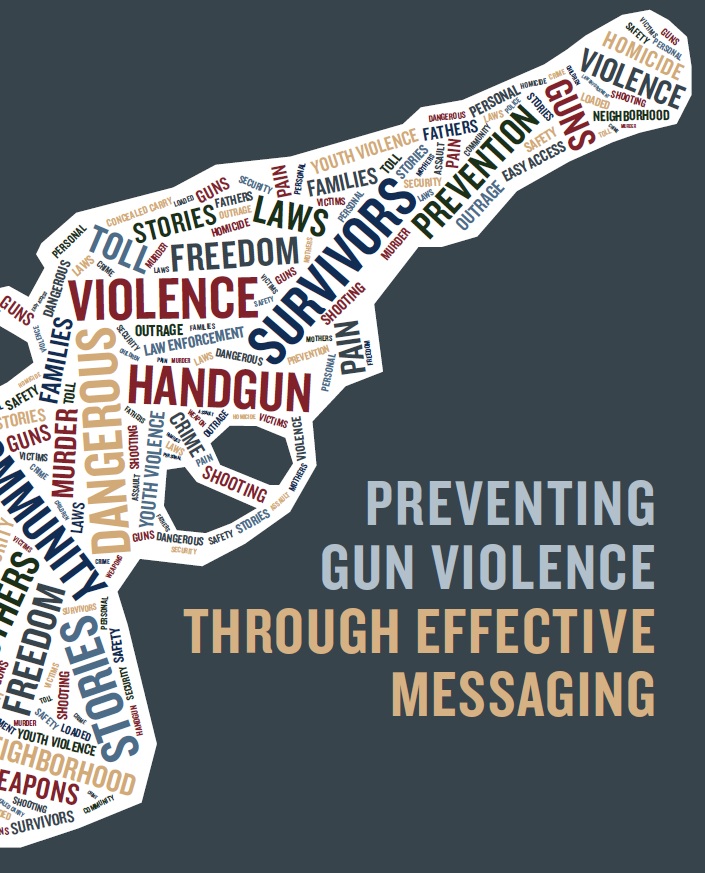
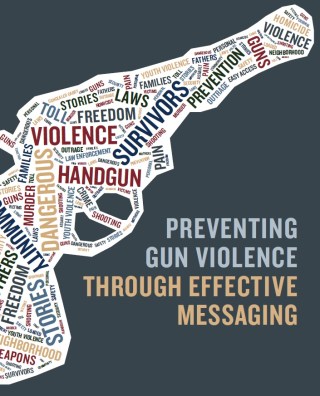
PreventingGunViolence

This wasn’t considered newsworthy by the mainstream media, and that alone is worthy of some pondering: a 70-plus page how-to guide titled “Preventing Gun Violence Through Effective Messaging” has surfaced, produced last year by the Washington, D.C.-based firm of Greenberg Quinlan Rosner.* The guide is a political strategy lesson for anti-gun advocacy, and its favored tactics involve emphasizing emotional hot-buttons over rational discourse and informative debate. The manual was produced, it appears, for the Seattle-based Washington Alliance for Gun Responsibility (WAGR) before the Sandy Hook tragedy, but its advice tracks in every way with the approach employed by Democrats, including President Obama, during the disgraceful rush to exploit public horror over the shooting in an effort to pass strong anti-gun measures in the states and nationally.

Of course this is newsworthy. The public is the target of manipulation, deception and persuasion tactics that are designed to provoke half-baked opinions and positions based on emotion rather than rational analysis. If the public recognizes such tactics as the cynical ploys they are, such tactics will not be as effective. Such tactics shouldn’t be effective, and should be employed by honest, ethical advocates on any side of any issue. The mainstream media chose not to publicize the manual because 1) most reporters agree with the manual’s objective, and 2) the mainstream media eagerly facilitated the unethical methods recommended, and will probably continue to do so.

“The debate over gun violence in America is periodically punctuated by high-profile gun violence incidents including Columbine, Virginia Tech, Tucson, the Trayvon Martin killing, Aurora, and Oak Creek,” the guide points out. “When an incident such as these attracts sustained media attention, it creates a unique climate for our communications efforts.”  Early on, the document it makes it clear that the “communication efforts” must always concentrate on stirring up emotions, not relying on facts or engaging in substantive debate. “A high-profile gun violence incident temporarily draws more people into the conversation about gun violence. We should rely on emotionally powerful language, feelings and images to bring home the terrible impact of gun violence.”

For example,  the guide addresses Stand Your Ground laws and advises substituting pejorative (and misleading) descriptions like  “Shoot First” and “Kill at Will,” asserting that these terms are “more accurate and persuasive.” At every turn, the guide cautions against getting bogged down in potentially nuanced statistics and facts, and urges anti-gun advocates to overwhelm any efforts at balancing or considering pros and cons with talking points based on  emotion salted with one-sided, group-tested statistics and generalities...”The core frame should be personal and emotional—centered on ‘people’ and not on facts, laws, or legislation.”  The top things to remember, cautions the guide,

#1: ALWAYS START WITH THE PAIN AND ANGUISH THAT GUN VIOLENCE BRINGS INTO PEOPLE’S LIVES

#2: USE STATISTICS TO REINFORCE AN EMOTIONAL ARGUMENT, NOT TO REPLACE IT.

Recommended phrases to use in forums and interviews include,

  • “It breaks my heart that every day in our country (state or city) children wake up worried and frightened about getting shot.”
  • “Just imagine the pain that a mother or father feels when their young child is gunned down.”
  • ” The real outrage – the thing that makes this violence so unforgivable – is that we know how to stop it and we’re not getting it done”

To the authors of the guide, effective persuasion “means emphasizing emotion over policy prescriptions, keeping our facts and our case simple and direct, and avoiding arguments that leave people thinking they don’t know enough about the topic to weigh in.”

That’s right, keep them ignorant and thinking that they aren’t. It’s the American way.

The guide is professional and well-thought out. It is certainly a useful document for any advocate to study before going on a talk show, or before drafting remarks at a rally, and it is obvious that this is exactly what such advocates do, if not with this document, then with similar ones. It is creepy to read line after line that is immediately recognizable as an endlessly repeated “talking point” during the Trayvon Martin uproar and the Sandy Hook aftermath. The manual also could grow cynicism on a rock. There is nothing honest or genuine about the political and policy-making process that the guide presupposes and attempts to control. There is nothing productive either. The objective is only to win—to get a desired policy initiative past the stage where public support is important and into the back rooms where the deals can be cut . You know that there was an equivalent document during the Affordable Health Care Act. These are blueprints for rushing policies into law, not for educating the public or fairly exploring complex issues before taking giant leaps of faith. They are, in short, instruction books on how to exploit the ignorance of the American people and distort the democratic process.

This is a bi-partisan practice, of course. The only difference between this guide and those produced by conservative consultants is that if one of those was found, the mainstream media would have reported it, Media Matters would have announced that it was a smoking gun document showing how evil Republicans corrupt America with their lies, and on MSNBC, Lawrence O’Donnell would have smirked over it for a week.

The number of rationalizations at the ready, therefore, begin powerfully with “Everybody does it” (#1 on the Rationalizations list). So is, as a direct result, #2, “They’re just as bad” and #7, “Tit for tat,” Such a document and the politics behind it also invokes #3, Consequentialism, and #4, Marion Barry’s favorite, “If it’s legal, it’s ethical.”  It employs # 11, the Dissonance Drag, since the reason it will be deemed acceptable by anti-gun types is because they happen to like the people using the strategy; if the same document outlined the NRA’s approach, they would sincerely and passionately feel it was despicable.

It is the very embodiment of The Saint’s Excuse (#12), otherwise known as “It’s for a good cause,” as well as #13, Self-Validating Virtue. #17,  Hamm’s Excuse or “It wasn’t my fault,” is one of the predictable responses to criticism: “Hey, this is how the game is played. We didn’t make these rules; this has been going on for decades. Don’t blame us!”  My least favorite rationalization of all, #22, Comparative Virtue,  “There are worse things,” is also in play; so is “We have no choice” (because the evil NRA keeps buying legislators and rational debate doesn’t work!), # 24#27, “These are not ordinary times!” is a natural, of course.  So is #30, The Troublesome Luxury, usually expressed as “Ethics is a luxury we can’t afford right now!”

Politics being politics, it’s perfect for #31, The Unethical Role Model, as in “Thomas Jefferson/Abe Lincoln/ Jack Kennedy would have done the same thing.” Heck…A new book suggests Jesus might have done the same thing!

Fourteen out of thirty-two possible rationalizations is an impressive arsenal, all right, but they are still rationalizations for what is a Machiavellian, “the ends justifies the means,” “by any means necessary,” unethical strategy that intentionally aims at the weaknesses of democracy and exploits them through the cynical use of psychology, manipulation, and deceit. Yeah, I know, it works, just as so many methods used by governments and interest groups to deceive the public and warp their perceptions have worked and work still.

That’s not really working, though, is it now? Causing a system designed to involve an informed and rational citizenry  to malfunction by exploiting laziness, ignorance and hysteria isn’t working, just because it succeeds. In fact, such tactics result in the kind of politics and government we have right now.

That is called, not working, but failing.

* According to the guide, Quinlan was part of “a team of communicators” with “decades of experience advising organizations on message development and strategic communications.” Other members of this team were Frank O’Brien, creative director and founder of OMP, another Washington, D.C.-based firm, and Jeff Neffinger and Matthew Kohut at KNP Communications, also headquartered in Washington, D.C. Among GQR’s clients are the Mayors Against Illegal Guns, the Joyce Foundation, several state education associations, Defenders of Wildlife, National Public Radio and the Sierra Club. Among OMP’s clients are Planned Parenthood of America and the Natural Resources Defense Council.

_______________________________________

Sources: WSJ, Washington Examiner, Examiner