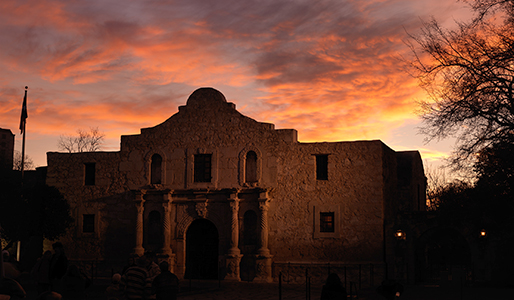
1 Remember the Alamo! On this date in 1836, before dawn, the Alamo fell. From the official Alamo website:
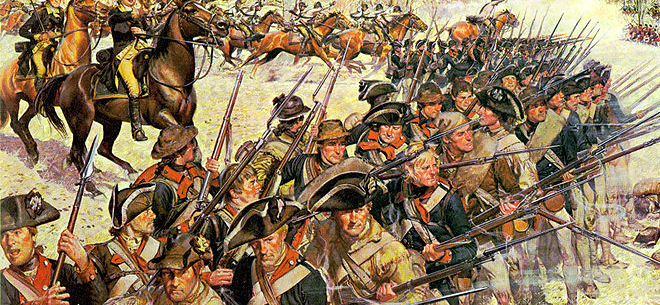
While the Alamo was under siege, the provisional Texas government organized at Washington-on-the-Brazos. On March 2, the convention declared independence and the Republic of Texas was born, at least on paper. The Alamo’s garrison showed its support for independence from Mexico by sending its own delegates to the convention.While they were unaware that Texas had declared independence, the roughly 200 Alamo defenders stayed at their post waiting on help from the settlements. Among them were lawyers, doctors, farmers and a former congressman and famous frontiersman from Tennessee named David Crockett. While the youngest was 16 and the oldest defender was Gordon C. Jennings, age 56, most defenders were in their twenties. Most were Anglo, but there were a handful of native Tejano defenders as well. Legendary knife fighter and land speculator James Bowie was in command before falling ill and sharing duties with Travis. Several women and children were inside the Alamo, including 15-month-old Angelina Dickinson. Just before the final battle, Travis placed his ring around her neck, knowing she would likely be spared. One of the last messages from the Alamo was a note from Travis asking friends to take care of his young son Charles.
The final attack came before dawn on March 6, 1836. As Mexican troops charged toward the Alamo in the pre-dawn darkness, defenders rushed to the walls and fired into the darkness. Travis raced to the north wall but was soon killed. Bowie was most likely killed in his bed, while reports differ as to Crockett’s death. Many believe Crockett survived the initial attack but was put to death by Mexican soldiers soon afterward.
Mexican soldiers breached the north wall and flooded into the compound. The fierce battle centered on the old church, where defenders made a last stand.
The battle lasted about 90 minutes.
From the San Antonio Express News:
BEXAR, Texas, March 6, 1836 — Alas, alas! Forever more, the name of the Alamo shall stand alongside that of Thermopylae in the annals of history as a tale of unmatched bravery to be handed down from generation to generation.
The bastion of Texas Liberty has fallen, and to a man, Lt. Col. William Travis and his fellow defenders — like the immortal 300 Spartans — have been martyred.
After withstanding an unrelenting siege of twelve days’ duration by one of the mightiest armies ever assembled on this continent, the walls of the old mission that had housed Travis (a man as brave as the fabled King Leonidas), Col. James Bowie, the Hon. David Crockett and some 200 other defenders were breached before the sun rose to-day.
Savagery was unleashed therein as a juggernaut orchestrated by the modern-day Xerxes, Mexican Gen. Antonio López de Santa Anna, swept over the Alamo….
Since I was a small boy, this episode in American history moved me more than any other. It still does. I first learned about the Alamo when I watched Fess Parker as Davy Crocket, swinging his rifle like a baseball bat at Mexiacn skulls, the last man standing as behind him we could see more of Santa Anna’s soldiers pouring over the wall. We never saw Davy fall—my dad explained that this was appropriate, since nobody is sure how or when he died, unlike Travis and Bowie, and the last verse of the Ballad of Davy Crocket played…
from grassy plains to the mountain crest
He’s ahead of us all meetin’ the test
followin’ his legend into the West
Davy, Davy Crockett, king of the wild frontier!
The politics and complexities of the Texas war of independence don’t alter the essential facts: a group of men of different backgrounds, under the command of three prototypical American figures—the pioneer (Crocket), the settler (Bowie), and the law-maker (Travis), all of whom were trying to recover from dark periods in their lives—chose to make the ultimate sacrifice for a cause they believed in fervently enough to die for, in the company of others who felt the same. It was, after all, the perfect ethical dilemma, the choice between an ethical act for the benefit of society and a non-ethical consideration, the most basic one of all: staying alive. They all had the same choice, and rejected life for a principle.
That’s what I remember about the Alamo.
2. There is hope. Once again, I gave a 90 minute presentation to a Boy Scout troop and parents last night, and challenged them this time with several hypotheticals that Ethics Alarms readers would recognize, such as this one, the plight of Ryan Seacrest and those who snubbed him on the red carpet, the “Mrs. Miniver” flower show, and this one, from personal experience, which set off the most lively debate of all:
The Option
Your professional theater company has limited funds, so it offers its actors an option. They may choose a flat fee for their roles, or get a percentage of the show’s profits, if there are any, on top of a much smaller base fee.
The company just completed an extremely profitable production, the biggest hit your theater has ever had. Nine of the show’s ten cast members chose the percentage of profits option, a gamble, because most of the shows lose money. One, the star, who you know could not afford to gamble, took the flat fee for the role. After the accounting for the production is complete, you realize that every member of the cast will make $1000 more than the star, because of the show’s profits.
Question 1: What do you do?
- Give him the extra $1000. It’s only fair.
- Pay him the flat fee. A deal’s a deal.
You can weigh in:
Question 2: You remount the production, and the exact same thing happens. The actor chooses the flat fee, the show is again a huge money-maker,,and the rest of the cast will make much more than him because they chose the percentage. Do you give him the extra amount again?
- No. Now he’s taking advantage of me.
- Yes. Nothing has changed.
As before, the approximately 50 11- and 12-year old boys were astute, serious, thoughtful, and gutsy, and their ethical instincts were superb. Continue reading




 Ethics Alarms