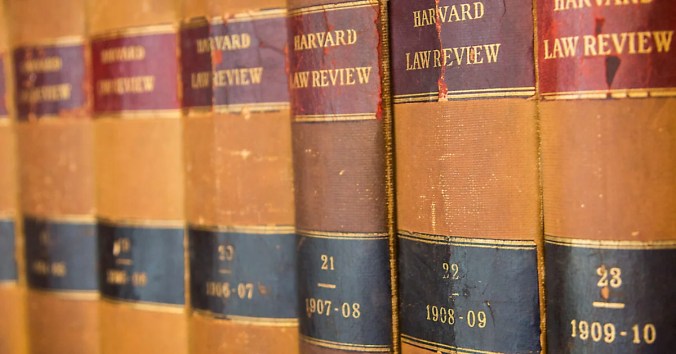
The conservative Washington Free Beacon launched a thorough investigation into the ways Harvard University has deliberately sought ways to defy the Supreme Court’s ruling that affirmative action policies at colleges and universities are illegal and unconstitutional. (You didn’t expect the Axis media to do that, did you?) Last week, the project resulted in a damning report of how the Harvard Law Review engaged in—is engaging in—outright racial discrimination in selecting staff, authors and articles:
The law review states on its website that it considers race only in the context of an applicant’s personal statement. But according to dozens of documents obtained by the Free Beacon—including lists of every new policy adopted by the law review since 2021—race plays a far larger role in the selection of both editors and articles than the journal has publicly acknowledged.
Just over half of journal members, for example, are admitted solely based on academic performance. The rest are chosen by a “holistic review committee” that has made the inclusion of “underrepresented groups”—defined to include race, gender identity, and sexual orientation—its “first priority,” according to resolution passed in 2021.
The law review has also incorporated race into nearly every stage of its article selection process, which as a matter of policy considers “both substantive and DEI factors.” Editors routinely kill or advance pieces based in part on the race of the author, according to eight different memos reviewed by the Free Beacon, with one editor even referring to an author’s race as a “negative” when recommending that his article be cut from consideration.
“This author is not from an underrepresented background,” the editor wrote in the “negatives” section of a 2024 memo. The piece, which concerned criminal procedure and police reform, did not make it into the issue.
Such policies have had a major effect on the demographics of published scholars. Since 2018, according to data compiled by the journal, only one white author, Harvard’s Michael Klarman, has been chosen to write the foreword to the law review’s Supreme Court issue, arguably the most prestigious honor in legal academia. The rest—with the exception of Jamal Greene, who is black—have been minority women.
Nice. What does the race of an author have to do with the quality of legal analysis, which is what law review articles are supposed to be? Nothing. Absolutely nothing.
 Ethics Alarms