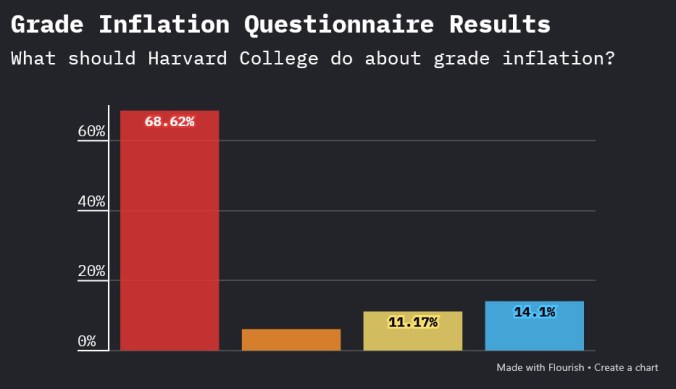
The chart above reflects the results Harvard got from its alums when it asked last month in its alumni magazine what the school should do about its absurd grade inflation, which Ethics Alarms examined here , here, and here.
The red bar shows the percentage of readers who felt that Harvard should “Implement recommendations from a Faculty of Arts and Sciences subcommittee, such as imposing a 20-percent cap on A’s in every class and awarding internal honors based on “average percentile rank” instead of GPA.” In other words, fix the problem. In other words, establish a grading system with some integrity. In other words, ensure that a Harvard College diploma means something other than that a student somehow got admitted to the iconic and supposedly challenging institution.
What should be troubling to Harvard—and us— is that the other options got as much support as they did:
- 14.1% think that the school should “Grade all classes pass-fail; take A’s out of the equation.” This doesn’t address the problem at all. Harvard doesn’t fail anyone already: it is harder to flunk out of Harvard than almost any U.S. college. The pass-fail option just substitutes one false standard for another.
- 11.17% chose the “solution” “Nothing; students work hard and it’s unfair to change the rules.” Morons. Who says they “work hard”? Effort doesn’t mean success, achievement or mastery: one can work hard and accomplish nothing. It’s unfair to change what obviously doesn’t work? How does an intelligent, educated person reach that bizarre conclusion? Revelation: over 10% of all Harvard grads are incompetent and irresponsible.
- 6. 12% voted to “Implement changes, but only if other schools do it too.” Wow. There’s leadership for you. 6.12% of all Harvard grads are apparently weenies.
In related news, the embarrassing Harvard student petition opposing grading reform at Harvard University as “racially harmful” has been removed from Change.org. The petition urged Harvard to abandon the plan limiting top grades because doing so would “mirror and reinforce existing racial and socioeconomic hierarchies.” I had expressed my dismay at the petition here.


I don’t like the red bar solution. I think the classes should be graded based on a percentile rank. Let’s take the equation below.
Weighted grade = 2(grade/median grade)
We then get a ‘traditional grading scale’ that lets us know how average the student is. It is self-correcting for faculty and course section. It also can be applied retroactively to study grades.
Example 1. A student is awarded a B in a class and the median grade in the class is a C.
Weighted grade = 2(3/2)=3.
The student is awarded a weighted grade of B (3). The student was above average in this section of the course.
Example 2. A student is awarded an A in a class where the median grade is also an A.
Weighted grade= 2(4/4)=2
The student is awarded a weighted grade of C (2), they were average in that section of the class.
Professors can award any grades they want, but if they don’t differentiate, the students in the class will all be judged average (as they are). If they want any students to get high weighted grades, their median grade must come down.
I would love to see a study that runs past grades through this analysis.
I agree that your formula is superior. But it wasn’t in the report….
That is because faculty committees are composed of faculty who have nothing better to do than serve on such committees. Faculty who can teach a variety of in-demand courses do not get to form university decisions.
…or maybe they didn’t come up with it because they teach at Harvard. ;.)
I was coming to say something like this.
The simple answer is to give them the grade they earn. No bell curve, no highest gets an A, everyone gets bumped up, no turning in things late, just an individual mastery of the material and an ability to conduct yourself in a classroom setting. But as far as I understand it, that really isn’t the issue.
I suspect the larger issue to grade inflation is not that students aren’t meeting the grade but they aren’t the same quality of students 30 years ago.
I think what they need to do is look at what they were teaching/testing on 30 years ago, and what they are teaching/testing on now. If a 400 level math course that is now teaching/testing on 200 level material, that would identify the issue.
When I was in college, one of my professors reused exams and kept records. On the first exam in the class, he put the following information below on the board (more or less).
Year Mean Score
1964 85%
1976 67%
1984 52%
1992 40%
He pointed out that the students in 1964 were using a slide rule and fountain pens and we had electronic calculators. Now, in my circle of friends, we all scored in the 80’s, but the point was not lost on us. I am afraid that mean on that exam would be close to 0% today.
I have assessment data using standardized tests that go back over 20 years for my classes. I can show you the decline of American education in a few slides. What is interesting is that the accreditation bodies won’t let me use this as assessment data anymore. The new assessment has to be qualitative and relative, not quantitative and absolute. I keep it anyway…for me.
My brother took an EE class his senior year in the 1990’s. The next year, they made it part of the master’s program. A few years later, they made it for doctoral students only. Then it disappeared. He asked the program why and they said that even the doctoral students can’t handle it anymore. From an undergraduate course to unteachable in less than a decade.
Now, you do have to consider that in 1964, only the top 10% of the high school class was considered college-worthy. There were a lot fewer college seats/high school graduate than today. Because of this, colleges could push those students without worry about enrollment. There were always others who wanted to learn this material an so failing out 50% of the students their 1st year was common. If you only have the top 10% and you fail out 1/2 of them, imagine what you can do with the remainder. That is how we got to the moon. Remember, the guy who figured out how to get the capsule to navigate to the moon had a B.S. in Physics and was only a year or so out of college when he got the assignment.
That having been said, I think we are at a tipping point. The Renaissance is typically presented about the ‘rediscovery’ of the knowledge of the ancient world. But where was that knowledge hiding for 1000 years? Was it under a rock? Was it in the walls of someone’s house? No, it was in the libraries. The monks had been copying it so that it wouldn’t be lost. But why didn’t they use it? They couldn’t understand it. When Rome fell, the barbarians who invaded lowered the education to the point that there was no one left who was capable of understanding. It took 1000 years to rebuild the education system to the point that people could understand the concepts in those works. It took us 1500 years to fully recover. I am now seeing a lot of students who are just incapable of understanding my freshman classes. Not, ‘they need to study more’, but ‘they lack the reading comprehension and math ability to even understand what is being presented’. They aren’t stupid, but their education has left them intellectually stunted. It is the majority of the students now. The current 25 ACT math students have difficulty following the presentation of a solution requiring Algebra I. Those same students are often in Calculus I or Calculus II at the time, but have difficulty following the solution below. This example is an actual example from class. A student (currently in a calculus class) raised his hand and wanted me to explain the steps below. He couldn’t understand how I went from the first line to the second line.
101 + x = 5
x= -96
That is when I realized that we are in serious trouble. Most of the AI programs are written by AI currently. We don’t have many people left who can understand it. You can currently get a Computer Science degree from MIT without knowing any compiled language. Think about that. Most computer science departments don’t offer C or Fortran. They don’t even offer C++ anymore. The companies are calling retired people for consults if there is a problem with their C or Fortran code. We are a decade away from a new Dark Age at this rate.
A fascinating read, and frightening at the same time. Maybe my impending retirement will be more lucrative than I thought…
Well said. COTD worthy.
I think AI is a problem too. I can see it in my own field. My boss has been forwarding me these articles from an institute he is quite found of. Lately, it all seems AI generated. I even ran the last few articles through it a detector and it suspected it was 50% AI. I told a colleague about it later, and he told me he uses AI all the time. Give me some examples (which I admit were quite helpful), but at the same time neither or original, but damages in my line of work (ministry).
I can only image what this might have do to me as a student in seminary days. I wasn’t the best of one. I once got an F on a midterm because I decided I didn’t care to know the material and I was fine with a C in the class. If I had discovered I could have just used AI might have been tempted to use it for everything else and be terrible at my job now.
Holy smokes!!! Are you !@#$%^&** kidding me? Calculus students can’t solve a simple algebraic equation? We are in serious trouble.
I would like to see how close we can get to objective measurement criteria for competence in a subject or skill. If the whole class is brilliant or they’re all incapable, that’s something we should be able to see in their grades.
Grading is meant to rank, sort, and stratify students on the basis of ability, performance, and achievement. We should not shy away from this fact. Ranking, sorting, and stratifying students is desirable because students differ in ability and these differences in ability matter in the real world.
They matter because roles in the real world are not equally demanding. Filling highly demanding roles with low ability individuals leads to failures. Failures in important roles lead to disasters. Society needs a way to identify high-ability individuals. No matter what mechanism you choose, it will necessarily involve some form of ranking, sorting, or stratification.
But does that need to lead to socioeconomic ranking and stratification? Yes, it does. Because high-ability individuals need a reason to accept highly demanding roles. Don’t fool yourself that you can trick them or force them. There smarter than you – they will game your system and they will win. The only way to get them to fill those roles is if they win by doing so, and that means giving them desirable things – money, power, prestige, exclusivity. You don’t have to make every physicist a billionaire, but you do need to give them a reason not to push a mop bucket.
But DaveL, don’t you know that discrimination is wrong!
The question about education today is the disconnect. What students need to know vs what they are being taught, I would guess this is at all levels of structured education. So the students (as has always been the case) are less than motivated to learn or apply any more than necessary to pass to classes like calculus for a business degree. My son has geometry this year. He is completely unmotivated to memorize formulas that are indeed at the touch of your fingers and now you can probably ask AI for the answer if needed. There is an argument for work ethics but there is also an argument for prioritization and sometimes pointless classes (admit it there’s been at least one class you remember like that) don’t deserve your effort. The grades, effort to “fix” a system, apathy from students and continuing decline in quality, imo are just symptoms of the disconnect of what is taught (so much algebra) and what the real world adult should know today or in the case of calculus for a business degree, never needed to know in the first place and promptly forgot what little was in the class. I am using math as an example because so much emphasis is on math and so much frustration and decline is also about math.
having an AI or the formula at the touch of a button, assumes you can use the button and that the AI will give a valid answer, not a hallucination. If you cannot remember or recognize the actual formula then you are going to fail and hard.
I really saw the education system begin to decline rapidly with FERPA. How do you motivate people to be the best? Competition. Having classes without public grades is like having sports without scores, without winning teams, and without championships. Yes, you can do it for fun, but what motivates people to the peak of performance? Participation trophies don’t cut it.