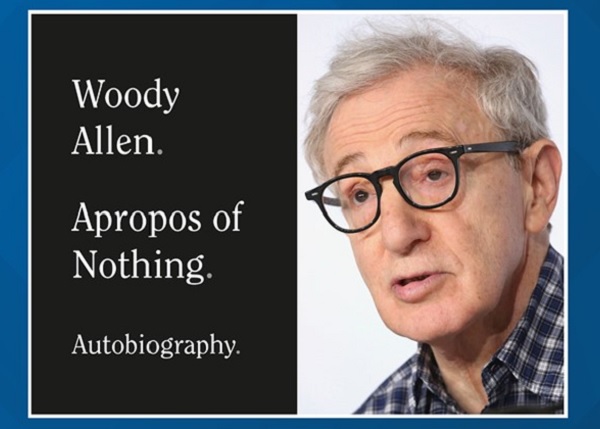
This blog certainly forces me to defend some unsavory characters.
Woody Allen is one among the small group of artists who I find so personally repellent that I can’t enjoy their work even while recognizing and appreciating its excellence. That does not mean, however, thatAllen’s work is not important nor that his life and career lack cultural significance. As I wrote here,
“I found myself unable to enjoy any of Allen’s films after he cheated on his de facto wife with his de facto daughter. I also don’t believe in enriching, even indirectly, horrible people in their professional endeavors if I can conveniently avoid it.”
That, however, is a personal choice that I would never impose on others, nor on the arbiters and trustees of culture, as it would be unethical to do so. Thus I wrote, just a few days ago, of Ronin Farrow’s demand that his publishers refuse to hand Allen’s memoirs because he believes his sister’s account that Allen sexually abused her when she was a child,
“I yield to no one in my contempt for Woody Allen as a human being, but he is a major figure in film and cultural history, and his memoirs are of obvious value and interest. Farrow’s publisher’s obligation is to readers and stockholders, not the sensibilities of one author.”
Now we learn that the publishers have been intimidated into dropping Allen’s book after all:
Hachette Book Group on Friday dropped its plans to publish Woody Allen’s autobiography and said it would return all rights to the author, a day after its employees protested its deal with the filmmaker. “The decision to cancel Mr. Allen’s book was a difficult one,” a spokeswoman for the publisher said in a statement. “We take our relationships with authors very seriously, and do not cancel books lightly. We have published and will continue to publish many challenging books. As publishers, we make sure every day in our work that different voices and conflicting points of views can be heard.”
But she added that Hachette executives had discussed the matter with employees and, “after listening, we came to the conclusion that moving forward with publication would not be feasible for HBG.”
There are those pesky rationalizations again! Oh, it’s a hard decision, so that excuses it from being a bad decision. This is 19 B. Murkowski’s Lament, or “It was a difficult decision” again, which I reviewed yesterday. Next, we get this nauseating sequence, which perfectly embodies 64, Yoo’s Rationalization, or “It isn’t what it is!”
The statement says that “We have published and will continue to publish many challenging books. As publishers, we make sure every day in our work that different voices and conflicting points of views can be heard,’ and follows it up by saying that it will not publish this “challenging book” and thus this different voice and conflicting point of view will not be heard. Seldom does such complete hypocrisy define itself in the span of so few sentences.
The “difficult” decision that contradicts the company’s stated values results from nothing better than cowardly capitulating to a mob carrying out the goals of cancel culture. In this case, those goals include infringing on free speech and the public’s right to know, if they want to know. Our democratic ideals and the principles enunciated in the Bill of Rights have no chance of surviving if those who own and run companies like Hachette emulate the spineless administrators of educational institutions and dissolve into pools of passive submission every time holding to those ideals and principles threatens to entail a risk of sacrifice or adverse consequences. Continue reading →
 Ethics Alarms