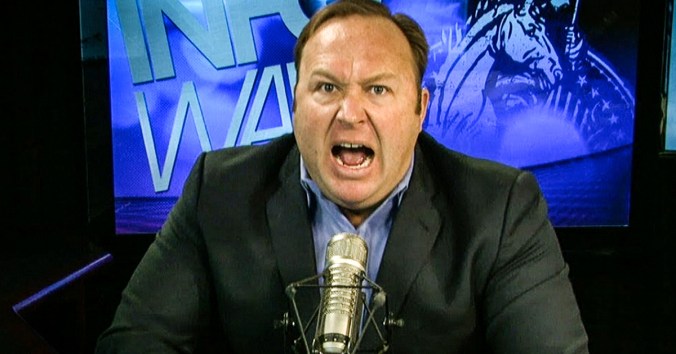
Unethical Quote Of The Month: Apple, Or “Stop Making Me Defend Alex Jones!”

“Apple does not tolerate hate speech, and we have clear guidelines that creators and developers must follow to ensure we provide a safe environment for all of our users. Podcasts that violate these guidelines are removed from our directory making them no longer searchable or available for download or streaming. We believe in representing a wide range of views, so long as people are respectful to those with differing opinions.”

—-A spokesperson for Apple last week, following confirmation that it had removed five out of six podcasts by far-right conspiracy theorist Alex Jones,  including “The Alex Jones Show” and some of his InfoWars audio streams. 

This is a terrifying statement…almost as terrifying as the fact that so many Americans won’t understand why it’s terrifying. Unless one does not understand the First Amendment and why its principles are the beating heart of American democracy, or unless you are an increasingly typical 21st Century progressive, who feels that the Left should have the power to decide what kind of speech is tolerable, Apple is telling us that it is going to use its immense power and influence over the distribution of ideas to suit its preferences regarding what people should see, hear, and think. Continue reading

Morning Ethics Warm-Up, 7/19/2018: The All-Denial Edition

Good Morning!

On this day in ethics, 1918: Washington catcher Eddie Ainsmith claimed that he should be deferred from the draft because he was a major league baseball player. Uh, nice try, Eddie, but no,  Secretary of War Newton D Baker ruled, as he tried to suppress uncontrollable eye-rolling..

1. “California, here I come!…here I come!…here I come!…” Oh. Never mind. The California Supreme Court took a measure off the ballot that would have allowed Californians to vote on whether the state should be divided into three smaller states, like this:

In its opinion, the Court argued that the changes demanded by the ballot measure exceeded California voters’ broad authority to enact laws by initiative, established in 1911. If enacted, the measure would have in effect abolished the state Constitution and all existing laws, which would have to be replaced by lawmakers  in the three new states. The measure would also alter the laws that define California’s boundaries, amending the state Constitution. That cannot be done by initiative, but instead requires approval by two-thirds of both houses of the Legislature to be placed on the ballot.

I know that the splitting up of California was a transparent effort to hijack the Senate by adding four more guaranteed Democrats. It was also doomed, since this plot would need to pass Congress and not be vetoed by the President. Still, wouldn’t something as obvious as violating the state Constitution arise before the wacko measure was placed on the ballot? How incompetent can you get? How much more incompetent can California get?

2. THIS will end well… Facebook claims that it will be removing false information from its pages when it threatens to cause violence, before it will cause violence. Sure, we all trust Facebook as an objective, trustworthy arbiter of speech, don’t we? Don’t we? Especially since they use the ever-reliable Snopes to check. During an interview with ReCode’s Kara Swisher, Mark Zuckerberg cited Holocaust denials as the kind of misinformation Facebook would allow to remain on the platform.  “At the end of the day, I don’t believe that our platform should take that down because I think there are things that different people get wrong,” Zuckerberg told Swisher. “I don’t think that they’re intentionally getting it wrong.”

He doesn’t? I’m not sure Holocaust denial is automatically eligible for Hanlon’s Razor; on the other hand, there are good faith idiots. Speaking of idiots, Zuckerman was surprised when his ignorant shrug sparked angry attacks like that of Jonathan Greenblatt, CEO of the Anti-Defamation League, who said, “Holocaust denial is a willful, deliberate and longstanding deception tactic by anti-Semites that is incontrovertibly hateful, hurtful, and threatening to Jews.Facebook has a moral and ethical obligation not to allow its dissemination.”  Continue reading

Morning Ethics Warm-Up, 7/5/18: Dinosaurs, Savages, And Censors

Good Morning!

1. Jurassic World II. I can’t honestly call this ethics, but as I posted about the film’s bad reviews earlier, I feel obligated to close the loop. I saw the movie last night, and as I knew I would, enjoyed it thoroughly, beginning to end. To those who did, I feel a bit the way I do about people who don’t like baseball, Westerns, Gilbert & Sullivan, and the United States of America: I’m sorry for you. This one even has a moment that seems to be written for those who don’t to help explain those who do, when Bryce Dallas Howard talks about her sense of wonder the first time she saw a dinosaur. Of course, the original movie better expressed the same sense of wonder in the iconic scene where Sam Neill is struck dumb by his first sight of  the brachiosaurus (and the lawyer’s only reaction is “We’re going to make a fortune with this place!”), but the Howard’s speech is no less an accurate description of how we dinosaur-lovers feel when we see these creatures on-screen.

No, it’s not the equal of the first “Jurassic World,” but it is excellent for the sequel, and better, I think, than either sequel to “Jurassic Park.” A vicious mutant raptor chasing a child through Victorian mansion is the stuff of nightmares, and a new concept; the dinosaur auction to a bunch of international bad-guys was a weird cross between “Goldfinger” and “Taken,” and several scenes, including the dinosaur stampede away from the erupting volcano, were worth seeing the film all by themselves. There were also more “Awww!” scenes than in all of the previous films combined: Chris Pratt’s home movies of bonding with the raptor babies; a mother triceratops and her adorable little one, and a haunting evocation of on of Charles Addams. best, but least funny, cartoons. I’ll leave it at that.

My biggest complaints would be that there was not enough of a role for the T-Rex, some of the deliberate homages to the earlier films were ham-handed and predictable, and that there was a fatal decision by one of the villains that made no sense to me at all. These flaws were more than compensated for by the star turn of the Pachycephalosaurus,  a species that had only cameos in “The Lost World” and “Jurassic World,” a terrific fight between a new species in the series, a Carnotaurus, and a Styracosaurus, (one of my mother’s best ceramic models in my collection) and several laugh-out loud moments authored by the dinosaurs. The film’s ending also sets up a final installment that should conclude the series, unless a “Jurassic Planet” is in the cards.

There are some ethics issues in the film, as in all of the films: respect for life, cloning, betrayal, and accountability for unforeseeable consequences. Michael Crichton had no qualms in his original novel with solving the problem of living dinosaurs by nuking the whole park, but Spielberg’s ending was better.

2. An Ethics Quiz That Is Too Minor To Justify A Whole Post. Do you find anything wrong with Donald Trump Jr. parading his new girlfriend in front of cameras at the White House before he is even divorced from his current wife? Writes Ann Althouse, “He and his wife have 5 children. He should be more discreet. Which, I know, obviously doesn’t sound like a Trump concept.” Let’s have a poll!

Continue reading

Now That The ACLU No Longer Wants To Be The ACLU, The United States Needs An ACLU

In a confidential memo obtained by former board member Wendy Kaminer, the American Civil Liberties Union has defined a policy that retreats from and undermines—perhaps the best word is betrays— its traditional mission of protecting the Bill of Rights, and especially the First Amendment rights of all Americans.  The memo says in part,

Work to protect speech rights may raise tensions with racial justice, reproductive freedom, or a myriad of other rights, where the content of the speech we seek to protect conflicts with our policies on those matters, and/or otherwise is directed at menacing vulnerable groups or individuals….We are also firmly committed to fighting bigotry and oppression against other marginalized groups, including women, immigrants, religious groups, LGBT individuals, Native Americans, and people with disabilities. Accordingly, we work to extend the protections embodied in the Bill of Rights to people who have traditionally been denied those rights. And the ACLU understands that speech that denigrates such groups can inflict serious harms and is intended to and often will impede progress toward equality.

…There is no presumption that the First Amendment trumps all other amendments, or vice versa. We recognize that taking a position on one issue can affect our advocacy in other areas and create particular challenges for staff members engaged in that advocacy. For example, a decision by the ACLU to represent a white supremacist group may well undermine relationships with allies or coalition partners, create distrust with particular communities, necessitate the expenditure of resources to mitigate the impact of those harms, make it more difficult to recruit and retain a diverse staff and board across multiple dimensions, and in some circumstances, directly further an agenda that is antithetical to our mission and values and that may inflict harm on listeners…Our defense of speech may have a greater or lesser harmful impact on the equality and justice work to which we are also committed, depending on factors such as the (present and historical) context of the proposed speech; the potential effect on marginalized communities; the extent to which the speech may assist in advancing the goals of white supremacists or others whose views are contrary to our values; and the structural and power inequalities in the community in which the speech will occur….

Where the ACLU defends the right to speak of those with whom it disagrees, it should generally engage in counter-measures both to reinforce the
values the speaker attacks and to make clear that we do not endorse the substance of the views. Some options might include:

1. Denouncing the views in press statements, op-eds, social media, and other available fora.

2. Participating in counter-protests. When we assist people in securing the right to march or demonstrate for views we condemn, we can and generally should support and participate in counter-protests, with consideration given to participation by senior staff or board members to highlight the ACLU’s commitment and ensure that such participation does not disproportionately burden other staff.

3. Supporting other counter-speech by supporting, organizing or helping to organize events, facilitating access to media, or taking other actions that will amplify and
strengthen the voices of those espousing our values.

4. Expanding our work on behalf of the values the speaker attacks.

5. Earmarking any fees recovered from the case to projects within the ACLU that further the values that we support and the speaker attacked, or donating them to another organization that works to advance those values, preferably in the geographical area where the speech occurred….

Continue reading

Weekend Ethics Warm-Up, 6/9/18: PART I, Bee’s “Apology”

Hi!

1  Bee gets an Eff. If I didn’t find Samantha Bee so loathsome and her transparent grab for headlines and attention by the cynical device of intentionally violating all standards of public civility and fairness, her on-air apology might warrant a full post here. “Where does it fall on the Apology Scale?,” I have been asked. She really does richly deserve to be shunned and ignored, however, not that she didn’t before. Her act is monotonous, obnoxious (Is there anything more revolting than someone who aggressively  presents themselves as smart and clever who obviously is neither?) and divisive. Like others, she exists to constantly reassure the “resistance” that they are justified in acting and talking like assholes because they lost an election.

Boy, they must need a lot of reassurance.

But since her apology on her show was an abomination (distinct from her apology on Twitter, which was a lie), I have to talk about it. What a crappy way to start a weekend. I’ll save time by commenting as we go. Yes, this is as long as a full post; it’s as long as a long full post. I know it’s silly, but even if it’s just a technicality, I refuse to give someone as contemptible as Samantha Bee more than Warm-Up status.

She said:

“You know, a lot of people were offended and angry that I used an epithet to describe the president’s daughter and adviser last week.”

In other words, “some people” were offended, not you, team member, because you LIKED me calling Ivanka a cunt, but we still have to deal with “those people,” who might be sponsors. Essentially Bee makes it clear immediately that this isn’t an apology  at all. The “you know” is a verbal shrug, and signals, “I don’t think this is a big deal, but I have to say something.”

This sentence, like the whole apology, is signature significance for a terrible human being. If she were my employee, I would stop her and say, “Start again.”

“It is a word I have used on the show many times..”

First rationalization in the second sentence! This is a subset of “Everybody does it”: “I do it all the time.”

“…hoping to reclaim it. This time, I used it as an insult. I crossed the line. I regret it and I do apologize for that. The problem is that many women have heard that word at the worst moments of their lives.”

Doubletalk. The word she used was “cunt.” It has never been anything but an ugly gutter word. What’s to “reclaim?” How it might have been used at other times is irrelevant, making this theme a flagrant act of misdirection, which is itself the theme of the whole phony “apology.” Imagine a male comic under fire for calling one of Obama’s daughters a “bitch”  saying “I have used that word many times–as a dog breeder, to describe swishy men, and in the phrase ‘son of a bitch’…” So what?

Bee’s bait-and-switch also cleverly reframes the issue. The offense was describing Ivanka Trump, on television, using a denigrating, misogynist word. Bee is now declaring that her offense was the rhetorical mistake of  misusing “cunt” as an insult. That was the line she crossed, according to her. Then: “The problem is that many women have heard that word at the worst moments of their lives.” Oh, the problem is when they heard it, not the use of the word itself.

Imagine a comic trying to weasel out of calling, say, Barack Obama a “nigger” making that argument in a parallel “apology.”

“A lot of them don’t want that word reclaimed. They want it gone, and I don’t blame them. I don’t want to inflict more pain on them.”

Wow—I hadn’t read this atrocity for a couple of days. It’s even worse than I thought.

Now Bee says the problem is that her using the word to denigrate the President’s daughter (who had done absolutely nothing to inspire such an attack) inflicted pain on other women—the good ones, you know. The ones who hate President Trump and his family.

“I want this show to be challenging and I want it to be honest, but I never intended it to hurt anyone, except Ted Cruz.”

Translation “You all know Ivanka IS  a cunt, but I didn’t want to hurt any other women by saying so, at least none who voted for Hillary.” Continue reading

Morning Ethics Warm-Up, 5/22/2018: Blemishes

Goooood Morning!

1. What is so hard to understand about the concept of Freedom of Speech and Freedom of Assembly? The Daily Beast negligently covers a story about how some alt-right groups are planning some kind of anniversary/reunion event in Charlottesville. (Funny, I thought we celebrated anniversaries of good things) and how some activists are plotting to block them. I especially like this sentence:

“Activists warned Charlottesville last year that the Unite the Right rally could turn violent. Now they’re determined to keep neo-Nazis out of their city for the anniversary.”

The rally turned violent because the counter-demonstrators turned it violent with help from authorities, who couldn’t, couldn’t, or didn’t want to keep the alt-right and the antifa demonstrations away from each other. This is the Berkeley trick: “Your speech will incite violence from us, so its irresponsible for you to speak. This issue was supposedly settled when the ACLU fought to allow Nazis to march in Skokie, Illinois 40 years ago.  In the end, the Nazis didn’t march but the principle that they couldn’t be blocked because of their message was made clear. I wonder if the self-righteous, speech-restriction fans represented by Black Lives Matter activist Lisa Woolfork even know about that case, given such ignorant quotes as,

“[Charlottesville authorities] seem to have gotten the message that white supremacist ideology is dangerous, but they are not willing to take, I believe, the truly moral step to say Kessler’s rally is a white supremacist Nazi rally, and therefore is inimical to our values and that we can ban that.”

No Lisa, you can’t ban that. You can’t ban ideas, no matter how dangerous you think they are, or how dangerous they in fact may be. The theory that the government should ban speech based on morality is infinitely more dangerous than anything these alt-right jerks say, but you still have the guaranteed right to promote such democracy-rotting garbage. Another Lisa quote:

“We did not ignore the white supremacists and let them proceed to go about their business undisturbed without any censure. These ideas are harmful, and they lead to horrible consequences in the real world.”

And I repeat: What is so hard to understand about the concept of Freedom of Speech and Freedom of Assembly? It sure seems to be especially hard to understand for the Left recently. Continue reading

Morning Ethics Warm-Up, April 12, 2018: Mistakes, Senators, Survivors, The Pope And Cosby

http://www.youtube.com/watch?v=SCD3QOBeIco

Good morning!

(I’m in a good mood because this happened last night…)

1. Incompetent elected officials of the month…From Reason:

On Tuesday, the Senate Judiciary and Commerce, Science, and Transportation committees grilled Facebook CEO Mark Zuckerberg about the company’s insufficient efforts to protect users’ personal data…

Sen. Roy Blunt, (R–Mo.) … didn’t seem to understand that Facebook lacks a means of accessing information from other apps unless users specifically opt in…. Sen. Roger Wicker (R–Miss.) needed a lot of clarification on how Facebook Messenger interacts with cellular service. Zuckerberg had to carefully explain to Sen. Brian Schatz (D–Hawaii) that WhatsApp is encrypted, and Facebook can’t read, let alone monetize, the information people exchange using that service. Zuckerberg had to explain to multiple senators, including Sen. Dean Heller (R–Nev.), that Facebook doesn’t technically sell its data: The ad companies don’t get to see the raw information. Sen. Patrick Leahy (D–Vt.) brought along a poster on which his office had printed out images of various Facebook pages. Leahy asked whether these were Russian propaganda groups. “Senator, are you asking about those specifically?” Zuckerberg asked. He of course had no way of knowing what was going on with those specific pages, just from looking at pictures of them….Sen. Amy Klobuchar (D–Minn.) offered this metaphor: “the way I explain it to my constituents is that if someone breaks into my apartment with a crowbar and takes my stuff, it’s just like if the manager gave them the keys.” But …Facebook didn’t willfully assist in a crime. …Sen. Debbie Fischer (R–Neb.) didn’t understand, at a fundamental level, that if you’re using Facebook, you have agreed to let Facebook know a lot of information about you. Sen. Lindsey Graham (R–S.C.) asked whether Facebook had any major competitors. …


This is a theme of regulation, rules and laws in the cyber age: the officials responsible for regulating the uses and abuses of technology don’t use the technology involved, don’t understand it, aren’t willing to take the time to learn, and are apparently not even aware of how irresponsible and incompetent this is, how stupid and lazy it makes them look, and how it undermines the public trust.

2. But don’t worry…In his testimony, Zuckerberg said that Facebook was working on a way to ban “hate speech.” I can’t wait to see what the left-wing crypto-fascists who run the Big Tech giants consider “hate speech.”  Actually, we have some pretty good clues. Facebook silenced pro-Trump video-bloggers “Diamond and Silk,” deeming their political content “unsafe to the community.” Continue reading

Morning Ethics Warm-Up, 3/21/18: Ethics Observations As The Snowflakes Fall

Good Morning!

1 Moral luck.  In Great Mills, Maryland, a student with a handgun entered a high school and began shooting. He was brought down by a lone, armed and trained officer before anyone was killed. In the Parkland shooting, the equivalent officer chose to avoid a confrontation. There were other material differences: yesterday’s student shooter seems to have had a specific target in mind (his ex-girl friend) whereas the Parkland shooter was juts out to kill as many kids as possible. One student carried a hand-gun (which is very difficult for anyone to acquire legally in Maryland, which has among the toughest gun laws in the country), while the Florida shooter had a semi-automatic rifle. However, the primary difference was moral luck: if a competent and courageous officer had entered Marjory Stoneman Douglas High and shot Nikolas Cruz before he could inflict carnage, and Deputy Blaine Gaskill, instead of almost immediately entering the school and shooting 17-year-pld Austin Wyatt Rollins dead, had done a Scot Peterson impression and remained outside, the results in Parkland and Great Mills might have been reversed. In any case, the results would not have been changed by different gun laws or demonizing the NRA and lawful gun owners, only by different responses by human beings, and the vicissitudes of moral luck.

I think Marjory Stoneman Douglas High has serious cultural and management problems that played a larger role in the massacre than gun policies. Today’s news certainly suggest that…

2. This is how puppies end up dead in airplane luggage bins…The headline that caught my eye was “Pit bull goes on rampage in elementary school.” What actually happened was that a pit bull -mix puppy got out of the yard and ran onto a nearby elementary school playground where small children were playing, they started screaming and running because their parents had either taught them to be terrified of dogs or never instructed them how to interact with them, the puppy chased the kids into the school, and began jumping and nipping, as puppies tend to do. I was taught not to run from dogs at about the age of four. The consensus later was that the dog was not aggressive, but was just stimulated by all the commotion and playing. A teacher calmed the dog. You know, dogs are a feature of our neighborhoods and communities, and failing to teach children basic dog-interaction skills is as irresponsible as not teaching them how to cross the street. Anti-pit bull hysteria doesn’t help either. “Rampage.”

Then, this morning, I watched an episode of “My Cat From Hell” on the Animal Planet cable channel. In the first segment, one of a family’s two cats was behaving aggressively, biting and scratching in response to any human contact. The reason became apparent to the cat therapist quickly: the family’s two little girls were abusing both cats, treating the more passive of the pets like a stuffed animal as the  parents laughed and took photos. The second segment was even worse. A couple had bought a Munchkin cat—which is an ethics issue itself, since these are deformed cats bred to have such short legs that they can’t climb or jump—

and apparently thought of the creature as a cute animated decoration. They had no toys or comforts for the cat, just a bare room and a litter box. “Have you ever played with your cat?” the therapist asked. “Play? Well, no, we’re both really busy,” came the response.  And the couple wanted to know why was the cat was behaving so neurotically… Continue reading

“The Indefensible ‘Nigger’ Double Standard,” The Sequel!

From Princeton comes exactly the same scenario that I wrote about in March of 2016.

This time, it was anthropology professor Lawrence Rosen who used “nigger” multiple times during a lecture this week in his Anthropology 212 course, “Cultural Freedoms: Hate Speech, Blasphemy and Pornography.” “What is worse, a white man punching a black man, or a white man calling a black man a nigger?” Rosen said, in the context of describing “what is acceptable as free speech and what is not.”

Several black students walked out of the class in protest, two registered a complaint, and now Princeton has vowed to sponsor “a dialogue” with students. This gives far  too much legitimacy to their objections.  The students enrolled in a course about hate speech, blasphemy and pornography, and protested when the professor said an offensive word?

The school’s response should be “Stop looking for ways to be offended and to put others on the defensive, learn the meanings of the concepts of ‘intent,’ education,’ and ‘context,’ and grow the hell up.

As the 2016 post about the identical nonsense at the University of Kansas concluded, “Context matters, and in the case of nigger, the only context that matters is what the word was intended to communicate. The “context” of the speaker’s skin color does not matter.”

I am happy to be able to post that clip from “The Life of Brian” again, in which an official condemning a man for uttering the taboo “Jehovah”is executed for saying the word in order to condemn him.

I wonder if those Princeton students would get the joke.

[A related post is here.]

________________________

Pointer: Other Bill

A Vermont State’s Attorney Prosecuted A College Student For An Overheard Phone Call. Why Is She Still Employed?

In October of last year, police charged Wesley Richter, a University of Vermont continuing education student, with disorderly conduct after university officials said he used “explicitly racist and threatening language” against black students and diversity initiatives on campus. Richter was overheard in a phone call with his mother, though exactly what Richter allegedly said has not been made public.unknown. Of course, what he said doesn’t matter, unless he was planning a crime, which he was not. He was talking to his mother, and a student who overheard the discussion took offense at what was said. Richter, through his lawyer, denied saying anything racist, but again, it doesn’t matter. Saying racist things in a phone conversation cannot be a crime. It’s bad manners. It’s disrespectful to those listening. A school may be able to justly find some kind of violation to a reasonable and neutral civility code involving words but not content. But an overheard phone conversation cannot be a crime. It is mere words.

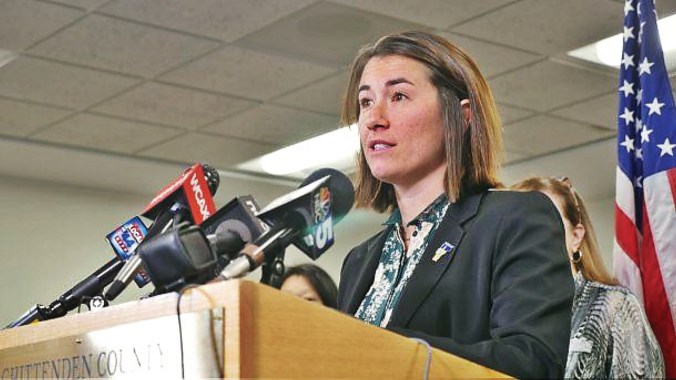
Nevertheless, the University of Vermont, the University of Vermont Police Department and the Chittenden (County) state’s attorney’s office in the person of Sarah George, the State’s Attorney, prosecuted the case against Richter. George is a graduate of the University of Vermont Law School, where presumably they taught constitutional law. There is no excuse for this.

Richter’s lawyer, Ben Luna, argued that George didn’t have probable cause to bring the misdemeanor charge, and Superior Court Judge David Fenster agreed. In a statement, Luna called the dismissal a victory for free speech and the First Amendment. “The court’s ruling reinforces my opinion that this matter should never have been brought,” he said.

The court’s ruling also reinforces my opinion that Sarah George should be disciplined by the bar and fired.

Right at the start, Vermont’s Rule 3.8, as in every other state, makes it clear that prosecutors must not charge anyone with a crime without probable cause:

Rule 3.8. SPECIAL RESPONSIBILITIES OF A PROSECUTOR

The prosecutor in a criminal case shall:

(a) refrain from prosecuting a charge that the prosecutor knows is not supported by probable cause;

The Comments to the rule say in part,

[1] A prosecutor has the responsibility of a minister of justice and not simply that of an advocate. This responsibility carries with it specific obligations to see that the defendant is accorded procedural justice and that guilt is decided upon the basis of sufficient evidence.

The First Amendment makes it beyond argument that the government may not punish or seek to punish citizens for the content of their speech. Since the only evidence that George had that a misdemeanor had been committed was a third party complaint about the content of Richter’s speech in a conversation over the phone with his mother, she did not have legal or sufficient evidence to charge or prosecute Richter. As a lawyer and a prosecutor she had to know that. If she knew it, she was knowingly abusing her power, and should be suspended from the practice of law.

If she didn’t know it, then she is incompetent and not fit to practice. She should be fired.

Incredibly, George said she thought the case was strong, but that it was also “a learning experience.” “It’s disappointing, but it’s also good for us to know. It’s a really great decision for us in terms of case law and reasoning, so we know now what this court expects of us,” George said.

Yeah, the court expects you to follow the Constitution. If you have to learn that at this late stage in your legal career, Sarah, you need to go back to the drawing board. Maybe you can sell maple syrup.

She wasn’t through. “What we allege he did, we still allege he did,” she continued.  “It just didn’t rise to the level of a hate crime.”

A phone conversation cannot be a “hate crime.” Speech cannot be a hate crime. “Hate speech” is not a legal designation.

Why is this woman a state prosecutor? Fire her.

If she is not fired, then this totalitarian, illegal, abusive and intimidating prosecution chills free speech, not just on the University of Vermont campus, but in the whole state. A citizen should not have to wait two months, as Richter did, for a judge to declare that the state cannot persecute him for what he is overheard saying, whatever it is.

Fire

Her. Continue reading