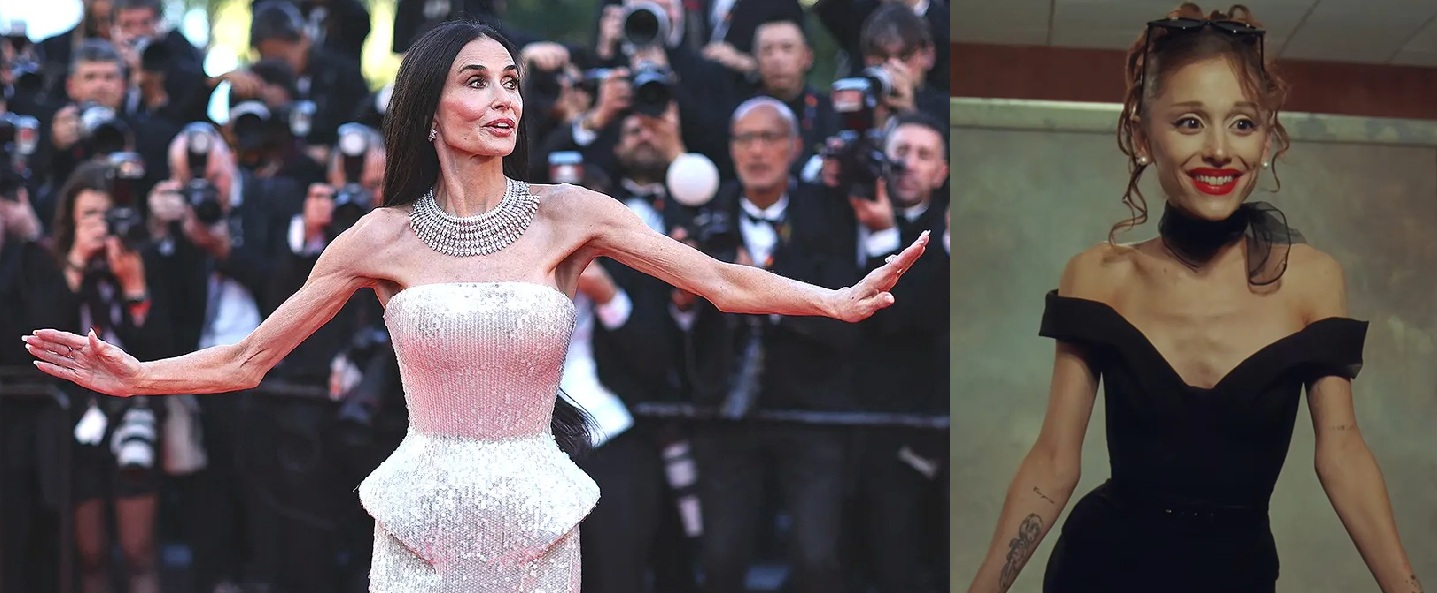
By pure luck, I stumbled across the photo above of Demi Moore from earlier in the year right after watching a disturbing PBS documentary about the late Karen Carpenter, who died in her early thirties as a result of a long battle with anorexia. The frightening figure to the right is pop singer and actress Ariana Grande. Both performers chose to highlight their appearance; several publications that used the photo of Moore referred positively to her “toned arms.”
In a related development, women (and some men) as young as 18 are getting botox injections because the flat, unexpressive forehead look is unavoidable if one watches much TV. Icons such as Jane Fonda and Goldie Hawn send the message that natural aging is shameful—Jane’s appearance in her 80s is so disturbing I refuse to look at her. In the meantime, Nicole Kidman has found some elixir or spell that has kept her appearance at 59 creepily similar to how she looked at 30, with none of the tell-tale signs of touch-ups that make other actresses her age grotesque.
My late wife suffered from anorexia in college and was so traumatized by natural aging that by the time she died Grace had become a virtual recluse. The damaging behavior of youth-obsessed celebrities is hardly a recent development; still, after being reminded of how one of the most gifted female vocalists was taken from us by the body dysmorphia their narcissistic habits inspire, I felt it necessary to flag the issue—again—today.
Public figures become role models whether they like it or not, and they influence the behavior and attitudes of others, especially the insecure, the emotionally vulnerable, and those without healthy and responsible role models in their own lives. It is impossible to measure the damage they do, the Demis to the aging, the Arianas to the young.
But it is a lot.