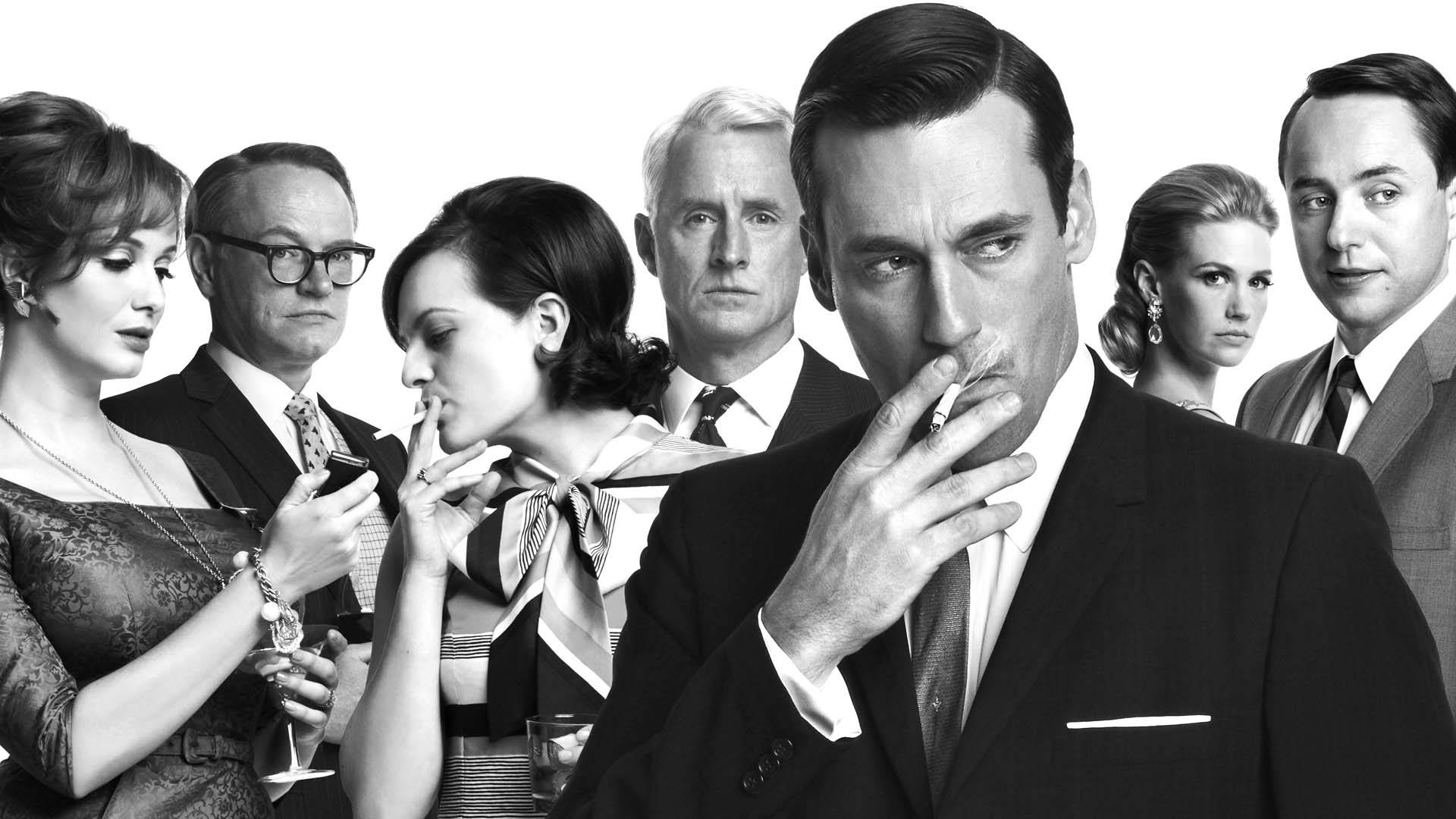
I’m finally watching the acclaimed AMC series “Mad Men.” I’m impressed: the character development is deft and complex, the evocation of the Fifties and early Sixties is fairer and more accurate than it usually is, and the ethical issues explored are many and complex.
At the end of season five the series presented as good an example as you will find of how motives behind conduct usually don’t change the analysis of whether the conduct was ethical or not. Series anti-hero Don Draper, a talented advertising innovator, finds the Madison Avenue firm where he’s a partner facing ruin because its biggest client, Lucky Strike cigarettes, has defected to a bigger agency. Now all of his agency’s clients are spooked, and potential clients are waiting to see if it survives.
Impulsively and without consulting his other partners, Draper buys a full page ad in the New York Times, announcing that he, and therefore his firm, is giving up tobacco and cigarettes because they kill people, and marketing such a deadly product is wrong.
Draper doesn’t do this as a matter of conscience. He does it to take control of his firm’s fate, to make it seem like the loss of a large cigarette client was in fact a proactive decision made in the public interest, and by virtue-signaling and grandstanding, to attract new clients impressed by courage and integrity. The ad is, in short, self-serving, desperate, and cynical: ethics have nothing to do with it. Appearing ethical is the point.
Yet that does not change the fact that the public condemnation of smoking was the right thing to do regardless of his motives. The results of the declaration will be the same, whether the reasons behind it were pure or not. Thoughts are not ethical or unethical. Conduct is ethical or unethical.
The complicating factor in the “Mad Men” scenario is that advertising is a Bizarro World culture, like war and politics. It is inherently unethical, so applying traditional standards of right and wrong often don’t make sense, nor are ethical and unethical actions dependably likely to have the same effects they might have in other contexts. Conduct that may have salutary consequences outside of Madison Avenue may be disastrous in the weird world of advertising. Don Draper only cares about whether his shocking public attack on tobacco saves his firm, not how many lives it saves, if any.
Ironically, however, it may do both.
But even if it accomplishes neither, it is still an ethical act.


Speaking of evocations of the ‘fifties, at my fiftieth college reunion, I was speaking with a classmate who’d grown up wealthy in Essex, Connecticut. I’d expressed to her I thought “Mad Men” was overblown and over dramatized on the promiscuous sex front, to which she replied, “Two couples my parents were close friends with wife swapped.” End of thought.
I can top that: my co-den mothers when I was a Cub Scout swapped husbands! It kind of ruined that Cub Scout pack…both had two sons, and I knew all four of them. It was the biggest scandal to hit Arlington, Mass. since our church’s deacon left his wife and twin girls to run off with his gay lover.
Caramba!
And speaking of Arlington, Mass, Mrs. OB’s father was impregnating his high school girlfriend with Mrs. OB’s half-sister at the same time Mrs. OB’s mother was carrying her older brother at their house on Rangely Road. Mrs. OB found out about the half-sister a couple of years ago via 23 and me.
But neither Mrs. O.B.’s dad nor the Deacon nor the spouses of the den mothers were in the advertising world. I’m not sure what that says.
In the movie “Mr. Blandings Builds His Dream House”, Cary Grant’s titular character is in the advertising business, and when he gets suckered into buying a dump, his smart-aleck lawyer friend observes that he’s become a victim of his own industry. “Every time you get tight you come weeping on my shoulder about the advertising business…how it has you go about bamboozling the American public. Well I’d say a part of that public has redressed the balance.” Not sure I got the quote exactly right, but having done door-to-door sales, I’ve always struggled with hyping every good part about a product or service, while seeking to minimize or hide every possible objectionable part.
And right now, I think it’s pretty accurate to say we have a salesman in chief!
Naturally, I am waiting for the penetrating, honest analysis about ‘what went wrong’ and why in American culture.
My impression on this blog is of people describing, superficially, the circumstances that developed from corruption — for one example the use of the public relations industry (propaganda agency) that created a smoking craze and addiction through glorification of it that resulted in enormous health problems. But where is the analysis of the use of mass-propaganda that has gone into and is going into everything surrounding this present war? and indeed the entire social and industrial juncture that the nation faces and is in? Why is one element seen but not the other, and not the full picture. The issue is so extensive really. But there is no meta-analysis about what is happening in the larger sense. Even if nothing can be done to stop the tidal-wave of general collapse, shouldn’t one be able to understand and describe what happened and why?
And then the nearly nostalgic reminiscences about how families were torn apart because of the selling of sexual promiscuity by ways of movies and novels that have so very obviously contributed to the present breakdowns in society? (Reminding me of the film Ice Storm). This is what Boomers do. I am reminded of the character Forest Gump: he went through everything, everything happened to him, and he understood absolutely nothing. It is a perfect emblem for the American awareness in the present. Sleepwalking along as disaster and ruin are visible on the horizon.
Everything that is occurring today has direct antecedents. It all happened step by step, stage by stage. You had decent, intelligent kids who could read important books and had a spiritual and moral life (5 or 6 or 7 decades ago) and then, so many decades later, they are lonely sexual perverts who cannot assimilate a paragraph and who are enemies of God (and even of the ‘construct’ of God if that is how it is seen. That was the reference made by Deepok Chopra in the Epstein Files: God is a construct but those young girls surely were not).
Now, kids do not know what to love of their country or their heritage because a ‘certain generation’ drunk and unconscious allowed it to fall to pieces.
Your nation falls apart at the seams — surely this is a significant moral and ethical event? — and you are glued to the TeleScreen with a bowl of buttery popcorn 🍿
I recommend letting this contrived argument go, A. Iran should have been attacked and neutralized long ago, and it would be irresponsible not to take that openly murderous and dangerous nation before nuclear weapons are more than a twinkle in its eye. Supporting Iran is just like wearing a badge that says, “I am either Trump Deranged, anti-Israel, or both.” It undermines your credibility and perceived seriousness.
I am not pro Zionist and a whole sector of Jewry is turning in that direction I’ll have you know. I oppose 40-50 years of bad policy in the ME.
I have asked myself: Why does not Jack learn more about this? And answering that question is really quite involved. You seem to have no idea what is being debated in the Jewish arena. What about Greenwald? Do you have a special way to totally dismiss his argument?
This is what I am talking about: Some things can be seen, and condemned, but a whole ranges of other things are off-limits. Post after post will hammer AOC for (hi Steve!) her idiocy, but things far more serious are dis-regarded.
Let’s see: Israel and Americans who are Israeli agent buy up American media. And you-plural have nothing to say. Amazing! Forrest Gump slept-walked through history … my point exactly.
This America-Israel thing is possibly one of the most important things going on …
Anyway, I am just trying to point sone things out.
While I wait for a blocked post to do through I will see if WP will allow a smallish comment:
“I am either Trump Deranged, anti-Israel, or both.”
Really, Jack, that is not a fair comment or argument. I voted for him. I am opposed to Trump’s policies because they do not make good on his promises. He demonstrates corruption and a sort that is endemic, out of control. He is irrelevant as a man.
History says that Trump has made good on his campaign promises to a greater extent than any 21st Century POTUS, and has exceeded the majority of 20th, 19th and 18th Century Presidents as well.
I would appreciate it if you would re-post that listing of his accomplishments. I do not disregard them. Sorry, I lose track of threads when they disappear into the past.
I have (and large groups of people have) objections to 1) his subservience to Israel. It is criminal. And the Founders would have had a similar actor shot. 2) His mishandling of the deportations. 3) His far too brazen use of military. (The Venezuela thing was extremely bad PR on a world level).
His irresponsible communication skills, his dressing in apostolic robes, and other stupidity, I can look beyond. But many can’t. So: he shoots his own self in the foot so that he may CAUSE the mid-terms to be lost.
Serious errors. My position is rational.