President Obama’s Epic, Tragic Incompetence: A Review

Obama

I stumbled upon this piece in Commentary by Peter Wehner. At first I was grateful that he had written it so I didn’t have to, and then was struck by the title: The New Obama Narrative: Epic Incompetence. New? This has been the narrative of the entire Obama Presidency, and I have been periodically and grimly drawing attention to that fact, while watching the mainstream media attempt to obscure it, from the very beginning. Now, as the Veteran Administration fiasco finally presents a scandal that Democrats and journalists don’t dare to try to dismiss as, in Dana Milbank’s description of the Benghazi cover-up, a “nothing-burger,” incompetence in the unaccountable, unmanaged, embarrassingly unprofessional Obama Administration is suddenly being pronounced unacceptable. To the contrary, it is because the news media unethically accepted it that the incompetence of this President is finally killing people.

The tragic legacy of Barack Obama will be recorded in three parts: his groundbreaking achievement as the nation’s first black President, his utter incompetence at governing and leadership, and his dishonesty and the dishonesty he engendered by those who reported to him. The first has been fatally undermined by the second and third, and the third, dishonesty, necessitated by the second, the relentless incompetence. The reason this is so tragic should be obvious to all. President Obama, like all trailblazers, needed to be a stand-out, exemplary performer to avoid setting back the causes his ascension needed to advance. But instead of Jackie Robinson, he has been Pumpsie Green, and that may be unfair to Pumpsie, the first black player to wear a Boston Red Sox uniform who knew his limitations, and did the best he could for as long as he could. It is also tragic because America, as much as any time in its history prior to the Civil War, needed a strong, wise, confident, unifying leader to deal with great and difficult problems that will only get worse with time. The challenges would have tested the best of leaders; for President Obama, with neither leadership instincts or talent, they have proven impossible. Worse, the basic requirements of governing have been proven to be beyond him, and he does not have the self-awareness or humility to seek the help he needs.

From Wehner’s piece:

“The emerging narrative of Barack Obama, the one that actually comports to reality, is that he is a rare political talent but a disaster when it comes to actually governing. The list of his failures is nothing short of staggering, from shovel-ready jobs that weren’t so shovel ready to the failures of healthcare.gov to the VA debacle. But it also includes the president’s failure to tame the debt, lower poverty, decrease income inequality, and increase job creation. He promised to close Guantanamo Bay and didn’t. His administration promised to try Khalid Sheikh Mohammed before a civilian jury in New York but they were forced to retreat because of outrage in his own party…The White House response to everything from the VA and IRS scandals to the seizure of AP phone records by the Department of Justice is that it learned about them from press reports. More and more Mr. Obama speaks as if he’s a passive actor, a bystander in his own administration, an MSNBC commentator speaking about events he has no real control over. We saw that earlier today, when the president, in trying to address the public’s growing outrage at what’s happening at the VA, insisted he “will not stand for it” and “will not tolerate” what he has stood for and tolerated for almost six years…On every front, he is overmatched by events. It’s painful to watch a man who is so obviously in over his head. And more and more Americans are suffering because of it.”

Continue reading

The Pazuzu Defense For A School Board President Who Called A Parent “Chubby-Wubby”

Exorcist IV: Pazuzu And The School Board

Exorcist IV: Pazuzu And The School Board

In the “funny but wrong” category:

Raymond Cote resigned as the head of the Mahopac Board of Education in the Putnam County school district (in upstate New York) after an open microphone at a meeting caused him to be overheard saying, “Oh I know, I know. This one here, ‘Chubby wubby.’ She gets fatter and fatter at every meeting. She really does!”

This isn’t political correctness. This is a leader demonstrating contempt and lack of respect for his constituency. Denigrating parents based on weight and personal appearance makes Cote untrustworthy as a school board member obligated to be responsive to parental concerns. He also announced he would not run for re-election. to the board. He got that right, at least.

His apology, however, was ridiculous: he embraced the Pazuzu excuse, in which someone who says something horrible claims that he was somehow not responsible for the words that cane out of his mouth, as when Linda Blair served as the ventriloquist dummy for the demon Pazuzu in “The Exorcist.” Cote emailed an apology to parents:

“I would like to apologize for my choice of words after the close of the board meeting on April 8, 2014, which are regretful. My words were inappropriate and do not reflect my feelings or attitudes. I will strive to regain the trust and respect of the community.”

Interesting!

1. If the words didn’t reflect his feelings, whose feelings do they reflect? Of course they are his feelings. Why would he say something completely alien to what he thinks…unless…it was the demon Pazuzu!!!

2. It wasn’t his choice of words, it was what his choice of words expressed. Is there a choice of words that would be a, kind, civil, respectful and acceptable way to say the parent gets fatter every meeting?

3. The words may have been regrettable, but they were not “regretful.” Maybe finding  a literate, English-speaking head of the school board is an idea whose time has come.

________________________________

Pointer and Facts: ABA Journal


Michael Sam Flunks Trailblazer Ethics, And Many Will Suffer Because Of It

Sam kiss

The most charitable explanation for Michael Sam’s disastrous performance in the wake of the NFL draft is that he’s a young man who got terrible advice. A less charitable theory is that he’s an idiot. The worst theory of all is that Michael Sam is less interested in being the first openly gay pro-football player who blazes a clear path for those who follow him, and more concerned about becoming a gay icon, or worse, a martyr. Whatever the reason, Sam accepted the massive responsibility of being a cultural trailblazer, and fumbled the ball.

Sam wasn’t the best player in the NFL draft, but everyone knew, including Sam, that he would be the most closely watched. He had “come out” as gay soon after the college football season, and in light of his prominence and recognition as a stand-out athlete, his honesty and openness about his sexual orientation was hailed as a cultural turning point, an advance for gay Americans, and a test for the macho NFL. Would he be drafted? If he wasn’t (or was?), would it be because he was gay? ESPN’s cameras were in the Missouri defensive end’s home Saturday as the drafts neared its final stages with Sam name still uncalled. When St. Louis Rams coach Jeff Fisher called Sam at his agent’s house in San Diego to tell the former University of Missouri defensive lineman that they had selected him in the seventh and last round of the draft, it was instant drama.

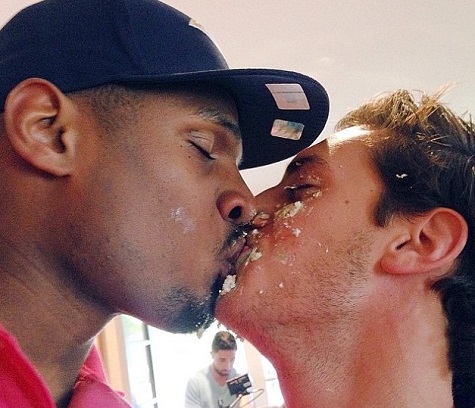
There was more drama, in fact, than ESPN and viewers probably expected. Sam burst into tears while receiving the call, and then received an emotional, mouth-t0-mouth kiss from his boyfriend, Vito Cammisano.

Not that there’s anything wrong with that.

Actually, there is; several, in fact. To begin with, Sam had violated the Second Niggardly Principle, which states,

“When an individual or group can accomplish its legitimate objectives without engaging in speech or conduct that will offend individuals whose basis for the supposed offense is emotional, mistaken or ignorant, but is not malicious and is based on well-established impulses of human nature, it is unethical to intentionally engage in such speech or conduct.”

A clearer example of the SNP would be hard to find. No doubt about it, most heterosexual Americans, which means most of the public, are not used to seeing adult men kissing each other on the lips. There is no question that Sam knows this: of course he does. Even now, popular culture uses the image for shock value; it was only the 90’s when an impulsive lip-lock from Kramer on Jerry drove the studio audience to screams of laughter. No, there’s nothing “wrong” with two men kissing each other, but an awful lot of people were raised to think it is unnatural, and it is wrong to intentionally or negligently offend or upset them gratuitously. It is the flip side of tolerance: consideration and etiquette. Causing discomfort just because you can, or because your targets “deserve” or “need” to feel uncomfortable is just trouble-making for the hell of it. “Deal with it!” is confrontational and aimed at creating rancor, not comity. Continue reading

Cincinnati’s Swinger Parochial School Teacher Principle*

Sexy nun*The reference in the title is to the “Naked Teacher Principle,” discussed often here. In brief, it holds that a teachers whose nude (or in some cases, almost nude or sexually provocative) photographs become publicly available cannot object when they are terminated as unfit to teach.

Teachers employed in the Catholic schools in the Cincinnati archdiocese are being asked to sign a new restrictive contract that denies them the option of engaging in acts outside the classroom that are in opposition to Catholic teachings. It expressly forbids a “homosexual lifestyle” as well as any public support of homosexuality. It forbids abortions or advocacy of abortion rights, surrogacy, and in vitro fertilization.  A teacher who signs the agreement agrees not to live with a partner as a couple outside marriage,  engage in sexual activity out-of-wedlock,  and not to endorse either practice.

New York Times columnist Frank Bruni is offended by this, and feels it is unethical. “Does a Catholic-school teacher relinquish the basic privileges of citizenship?” he asks, pointing to political engagement and free speech. Continue reading

Are Haunted House Ethics The Same As Murder House Ethics?

Haunted-Homes2

I spent the wee hours last night watching “Insidious 2” (not as scary as “1,” and too confusing to watch while composing ethics blog posts), and, to fend off nightmares, the Wayans’ “A Haunted House” (sillier, grosser and not as funny as their two “Scary Movie” efforts). Naturally, this set me wondering about the ethics of selling a haunted house to an unaware buyer.

I thought I had covered this problem before here and here, where the topic was whether a property owner had an ethical obligation to divulge that the house in question had been the site of gruesome murders or suicides. The law in most states declares caveat emptor, but that’s only the law. The ethics verdict, in my view (but not everyone’s) is this, which my last comment on the topic, in 2013: Continue reading

Pineda-Pine Tar, Part II: Baseball Clarifies Its Bizarro Ethics Culture

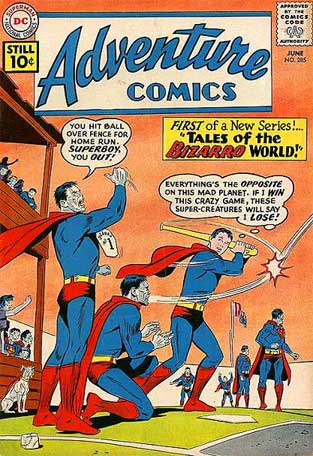
bizarro_world-baseballYou shouldn’t have to appreciate, care about or even understand baseball to find illumination in its latest ethics controversy, which shows how cultures can go horribly wrong, precluding exactly the values that any functioning entity must embrace to remain viable and healthy. For someone like me, to whom Baseball is Life, the whole thing just makes me want to jump out the window.

You will recall that a couple weeks ago, the sport embarrassed itself by making excuses and accepting lies regarding New York Yankees pitcher Michael Pineda being allowed to break the game’s rules against pitchers applying foreign substances (in this case, pine tar) on the baseball while pitching to the Boston Red Sox. I wrote about it here. I interpreted the post-incident consensus of the game and its pundits as “everybody does it, so let’s not make a big deal over a little infraction on a night when it was abnormally cold and hard to grip the ball.”  That’s unethical enough, but the truth, as revealed in Part II, is far worse.

Last night, fate had Pineda on the mound against the Red Sox again. Baseball’s ethics had already begun falling apart in chunks when Sox manager John Farrell, asked about whether he expected Pineda to cheat again (for that is what using pine tar on baseballs is—cheating. Official Rule 8.02 states: “The pitcher shall not apply a foreign substance of any kind to the ball.” ) answered that hopefully, if he did, he would be more discreet about it. Huh?

But Pineda was not discrete; in fact, he could not have been more obvious, or ridiculously so. After a rough first inning in which he gave up two runs, Pineda emerged from the dugout with a large, brown, greasy gob of pine tar on his neck. On TV. In nationally broadcast game. Against the same team that he was caught using pine tar against before. In that team’s home park.

In the Red Sox dugout, Manager Farrell and the team were laughing and rolling their eyes. Farrell finally shrugged, and walked out to complain to the home plate umpire, for it is an automatic ejection for a pitcher to be caught doctoring the ball. The umpire dutifully walked out to the mound—he had to have seen the offending gob before Farrell complained—and to add to the foolishness, checked Pineda’s glove, cap and jock strap before looking at the huge brown smear on his neck. Finally he did so, said, “That’s pine tar!” (in the previous game, Pineda told the press it was “dirt”) and threw him out of the game.

In subsequent interviews with Farrell and others, the explanation that emerged was this gibberish: “everybody” uses something to grip the ball better when it is cold (and often when it isn’t); hitters don’t mind because they don’t want to get hit. Pineda’s offense wasn’t that he used pine tar, but that, as Farrell suggested before the game, that he was “blatant” about it. That gave Farrell no choice, you see….even though his own pitchers also use foreign substances to grip the ball (in unequivocal violation of a baseball rule), and this sets his team up for “retaliation.”

I feel like I’m going crazy. Continue reading

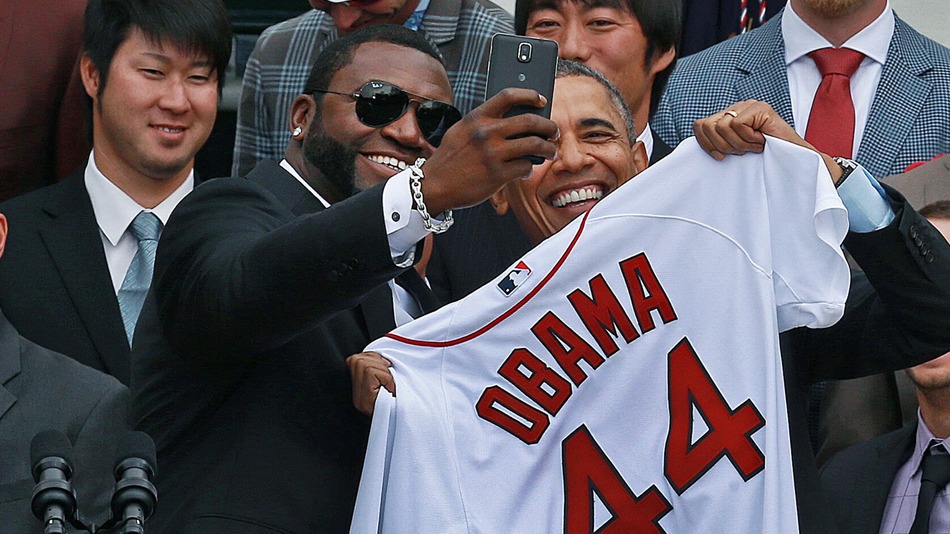
Selfie Ethics: Yes, Big Papi Exploited The President

Ortiz-Obama-Selfie.jpg

I wrote about this ethical breach when Ellen DeGeneris did it at the Oscars. The short version is this:

“It’s unethical to pretend that a selfie is a spontaneous  gesture of fun and friendship when you have a commercial agreement in place to use the photograph in a way that promotes the cell phone manufacturer.”

This is exploitation for commercial gain, and it’s wrong. It’s wrong when the victims are movie stars, and it’s wrong when the exploited party is President of the United States. Continue reading

Autonomy: The Ethics Alarm That Obamacare Should Be Setting Off, But Isn’t

fire_alarm

Autonomy. This is the ethical value, a sub-set of the “respect” section of the Josephson Institute’s Six Pillars of Character, that is suddenly absent from the value set of the New American Left. This is cause for concern to say the least, because autonomy is the very value that was the impetus for the nation’s founding, and that is at the core of the Bill of Rights as well as the “inalienable rights” that introduce Mr. Jefferson’s mission statement for our strange experiment in self-governance. Beginning back in Bill Clinton’s administration, advocates of a nationalized health care system, including President Clinton himself, began floating the historical and logical nonsense that Jefferson and the Founders would have enthusiastically supported national health care. This is, of course, a cynical lie if one is educated (as it was in Clinton’s case) or proof positive of complete unfamiliarity with, oh, everything about the Founders, their political philosophy, and political philosophy generally. Whatever the value of a national health care program, the idea that the government would presume to dictate how one managed something so personal and intimate as one’s own health would have horrified  every signer of the Declaration, from its author to Button Gwinett.

That Mr. Jefferson’s supposed followers—he is the Original Democrat, by most lights, would reach the point of maintaining that the public’s beliefs, opinions and attitudes must be bent to their will is a development that threatens the existence of United States society and culture as we know it. The recent flare in this emergency arrived via the mugging of Brandon Eich, ex-CEO of Mozilla, who was deemed by the liberal elite as unworthy of keeping his job (though Mozilla is an internet company and he is an innovator in the field) because he was not convinced of the rightness of same-sex marriage by the elite’s newly determined, and well past,  deadline—a deadline that such progressive icons as Barack Obama and Hillary Clinton also missed, but never mind. Conformity to Progressive Truth has become the order of the day, and woe be to any good citizen who dares to oppose it. Does this sound like freedom to you? “Choice,” to use a popular rallying cry in the protest against the “War against Women?” It doesn’t sound like freedom to me. Continue reading

The Abysmal Quality of Ethical Reasoning in Baseball: A Depressing Case Study

"Dirt."

“Dirt.”

The first bona fide ethics controversy of the 2014 baseball season has erupted, and it involves the team of my youth, the Boston Red Sox. It is not the controversy itself that is so noteworthy, for it is an old, old one: pitchers using foreign substances to doctor the balls so they dip, curve, and sing “Take Me Out To The Ball Game.” What is noteworthy is the reaction to the incident by players and the sports media, which has me feeling that as an ethicist, I need to think about following another sport. The ethics reasoning, or lack of it, is truly depressing.

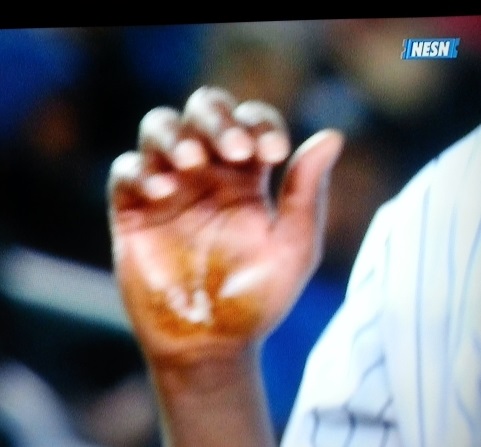
What happened was this: During last night’s Red Sox-Yankee game in Yankee Stadium, the Boston broadcasting team of Don Orsillo and Jerry Remy noticed a glossy brown substance on New York starting pitcher Michael Pineda’s pitching hand. It was very obvious, especially once the NESN cameras started zooming in on it.   “There’s that substance, that absolutely looks like pine tar,” play-by-play man Don Orsillo said. “Yeah, that’s not legal,” color commentator and former player Jerry Remy replied.

Indeed it isn’t.  According to rule 8.02(a)(2), (4) and (5), the pitcher shall not expectorate on the ball, either hand or his glove; apply a foreign substance of any kind to the ball; [or]  deface the ball in any manner.

The Red Sox, who probably knew about the gunk on Pineda’s hand, didn’t complain to the umpires, and just went about their merry way, losing the game. Asked about the stuff on his hand, Pineda demonstrated the full range of body language indicating that he was lying his head off. “It was dirt,’ he said. Later, when the ick appeared to be gone,  Pineda explained, he had just sweated his hand clean. Right. Whatever was on his hand—beef gravy, crankcase oil, chocolate syrup…the majority of pundits think pine tar—it wasn’t “dirt.” Pineda’s manager, Joe Girardi, was brazenly evasive.

The Yankee pitcher was cheating. This isn’t a major scandal, but cheating is cheating: sports shouldn’t allow cheating of any kind, because if a sport allows some cheating, however minor, it will encourage cynical, unscrupulous and unethical individuals on the field, in the stands, and behind keyboard to excuse all other forms of cheating, from corked bats to performance enhancing drugs. Cheating is wrong. Cheating unfairly warps the results of games, and rewards dishonesty rather than skill. Cheating undermines the enjoyment of any game among serious fans who devote energy and passion to it. Any cheating is a form of rigging, a variety of lying.

And yet, this clear instance of cheating, caught on video, primarily sparked the sports commentariat, including most fans, to cite one rationalization and logical fallacy after another to justify doing nothing, and not just doing nothing, but accepting the form of cheating as “part of the game.” I’ve been reading columns and listening to the MLB channel on Sirius-XM and watch the MLB channel on Direct TV since this episode occurred. Here are the reactions, my comments in bold:

  • This isn’t a new phenomenon. Show me the statute of limitations on ongoing misconduct, please. Also not new: torture, rape, adultery, incest, bribery and embezzlement. So what? That makes these things all right? Excuses society from trying to reduce their occurrence?

Continue reading

I Repeat: April Fools Day Is Not For Ethical Professionals

april-fools-day-banner

In a much attacked post here way back in 2010, I offered some ethical guidelines for April Fool’s Day, which was just beginning to get out of hand. I was right, my critics were wrong, and maybe some of the mockers who are now trying to figure out when their favorite news organization is lying to them today for fun, as opposed to the rest of the year when it lies to them out of bias or incompetence, are beginning to appreciate my position.

I just watched three different morning news shows that contained fake news or commentary that the reporters and anchors, at least, seemed to think was hilarious. In one case, on Fox, conservative talk-show host Laura Ingraham dead-panned a remarkably even-handed and fair explanation for HHS Secretary Sibelius’s much-maligned TV silence when asked about the Affordable Care Act’s unpopularity.  April Fool! Laura wasn’t being fair or objective, she was just tricking Fox’s audience into being angry at her for being fair and objective, or, in my case, admiring her integrity for pointing out that the incident had more than one plausible interpretation. Got me, Laura. I just heard an NPR host plead with the audience not to regard the upcoming segment as a hoax because of the date, an especially difficult plea since NPR springs virtual hoaxes on its audience all year.

The first and most important of my April Fools guidelines was this:

1. April Fools’ Day tricks are not for professionals to play on those who depend on them, trust them, or otherwise rely on them for information or services, unless there is a special relationship as well. The risks of harm and abuse are too great.

The succeeding four years have validated my position. Journalism, government and politics are the prime examples. CNN played a video that showed Jay Carney crowing yesterday about the Affordable Care Act’s success even as the Healthcare.gov website had crashed. Wait..is this a joke? Did the Obama White House film this for fun and games? They wouldn’t do this, you say? Government officials don’t use their high office for jokes and hoaxes? Really?

Sen. Ted Cruz, also on Fox, showed his new tattoo, apparently an April Fools’ joke, but also said he was certain that the Affordable Care Act would be repealed. Which is more likely, that the AFA will be repealed, or that wacky Ted Cruz would get a tattoo? Slate has a post up by someone called Rehan Salan, which is, clearly, a clever anagram for “En Anal Rash” or something, arguing that adults without children should be forced to pay extra taxes to support parents. Hah! Good one, Slate! That should turn the “pro choice” crowd on its head: lets; punish the choice not to have children via a penalty—I’m sorry, Chief Justice Roberts, a tax, wink-wink. Wait…that isn’t a joke? Ok, well, I’m sure about this, then: that fake video showing famous tough guy Don Baylor, a record holder for being hit by pitches when he played and now a coach for the Los Angeles Angels, “breaking his leg” catching the ceremonial first pitch of the baseball season. April Fools, right ESPN? No????

Continue reading