Ethics Quiz: Is It Wrong For A Rescuer To Sue The Victim He Rescued?

"OK, Princess, you'll get my bill for this rescue in five to seven business days."

On March 11, 2009, Mark Kinkaid and David Kelley were riding in Kinkaid’s truck when they saw a detached bumper, headlights and all, lying in the middle of Rt. 23.  Smoke was rising up from the highway embankment,  and the two men concluded that someone was in trouble. The truck stopped, and they got out, hopped a barbed-wire fence, made their way down the steep highway embankment, where they saw a flaming Hummer. Theresa Tanner was trapped inside, screaming for help. They forced their way into the vehicle, pried a door open and pulled Tanner out. She was injured and burned, but after weeks in intensive care, survived.

Now Kinkaid and David Kelley are suing Tanner, claiming that the crash was her fault and that she is liable for the injuries they sustained in rescuing her. They have filed a lawsuit asking for damages of at least $25,000 each. “All I know is that I am not the same man I used to be,” says Kelley, a 39-year-old truck driver and father of five, who says the heavy smoke and fire that day damaged his lungs so that he can’t carry a laundry basket up the three flights of stairs in his home.

The law provides a rationale for such a lawsuit. “The precedent is clear: danger invites rescue … and if you’ve acted recklessly or negligently and someone gets hurt rescuing you, you could be in trouble,” says Stan Darling, a tort law specialist. A well-established principle known as “the Rescue Doctrine” holds that if someone is in peril because of their own negligence or recklessness, an injured rescuer can recover damages if he acted reasonably and can prove that his injuries were caused by the rescue attempt.

That’s the law, however. This is ethics, and your Ethics Quiz today is:

Is it ethical for a rescuer to sue the person he rescued? Continue reading

Custer, Gettysburg, and the Seven Enabling Virtues

Sometimes the Enabling Virtues will save an army, and sometimes they’ll get you killed.

July 3, 1863 was the date of Pickett’s Charge, when Confederate General Robert E. Lee ordered a desperate Napoleonic advance against the Union line at Gettysburg in what has come to be a cautionary tale in human bravery and military hubris. The same day marked the zenith of the career of George Armstrong Custer, the head-strong, dashing cavalry officer who would later achieve both martyrdom and infamy as the unwitting architect of the massacre known as Custer’s Last Stand.

Custer’s heroics on the decisive final day of the Battle of Gettysburg teach their own lessons, historical and ethical. Since the East Calvary Field battle has been thoroughly overshadowed by the tragedy of Pickett’s Charge, it is little known and seldom mentioned. Yet the truth is that the battle, the war, and the United States as we know it may well have been saved that day by none other than undisciplined, reckless George Armstrong Custer. Continue reading

Ethics Dunce: The University of Alberta

"Now that you've been caught red-handed, there need to be an investigation to determine what color your hand is."

The University of Alberta’s Faculty of Medicine dean, Dr. Philip Baker, delivered a convocation speech to medical students last Friday that included verbatim excerpts from a speech given last year by Harvard professor Atul Gawande to graduates of Stanford University Medical School. Nevertheless, the plagiarizing dean has not been suspended and will remain working “until allegations are investigated in a formal procedure,” University officials announced. “This is somebody’s reputation and we take this very seriously.”

If the University takes it seriously, why hasn’t Baker been fired, or, for that matter, why hasn’t he resigned? Continue reading

Ethics Hero: Lincoln School in Spring Valley, Illinois

Thanks to Lincoln School, this isn't me. Yet.

Thank you, oh thank you, Lincoln School in Spring Valley, Illinois! Your superb and inspiring decision has stopped me, for the moment at least, from seeking species reassignment surgery. My membership in the human race has been an embarrassment to be of late, and I had been seeking alternatives. You give me hope.

Spring Valley’s Lincoln School gymnasium held a day of appreciation this week for custodian Edward “Red” Nestler,  88, who will retire on June 30. To his surprise, Red did not receive just a free lunch, or a watch, or a jacket, or a plaque in appreciation and commemoration of his many years with the school, a journey that began when he was a student there in the 1930s. On his “day,” Red learned that the school board, responding to a petition from students and staff, had voted to name the school gymnasium in his honor. Continue reading

Ethics Heroes: World Journalists

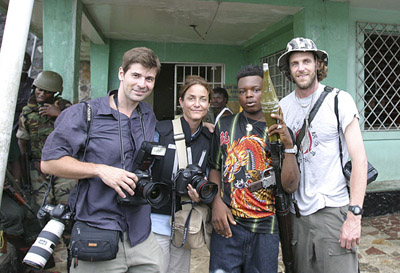
Chris Hondros (left) and colleagues

I know Ethics Alarms is critical of the media and journalists for breaches of objectivity and fair reporting. Nevertheless, there are few professions more inherently heroic than journalism, especially when it requires on-the-scene reportage under dangerous conditions. This was demonstrated, once again, by the recent death of Chris Hondros, a distinguished photo-journalist who was killed last week in Libya.

May 3 is World Journalist Day, and an excellent time to honor the tough and dedicated professionals who bring us important and hard-to acquire news, often risking their lives in the process. To that end, there is no better on-line destination than the website of New York-based non-profit Committee to Protect Journalists, dedicated to making it possible for journalists to do their jobs without fear of reprisals.  There you can learn about the perils faced by media personnel all over the globe, and read about the journalists killed since January 2010 while trying to let us know what is going on in the world.

Ethics Dunce: Fort Wayne Mayor Tom Henry

Mayor Trivial T. Spineless

He was, without question, the best mayor Fort Wayne, Indiana has ever had. When he first took office, he consolidated city departments launched construction of Fort Wayne’s massive underground sewage system and built the city sewage treatment plant, which is used to this day, seventy years later. When W.W. II came, he held war materials drives, upgraded city equipment and services, and broke ground for was is now Fort Wayne International Airport. and lowered city tax rates. In his last term, he opened up a major area of the town for development by elevating the railroad tracks. And he kept taxes low.

For 21 years beginning in 1934, this dedicated public servant was only not mayor for three years: he died at his post in 1954. And the people of Ft. Wayne haven’t forgotten him. This year, when city officials asked its citizens to vote on whose name the new government center should bear, the response was overwhelming. Ten times more people again voted for the former mayor they had always voted for while he was alive than for anyone or anything else (the runner-up choice was “Thunderdome”).

The current mayor, however, has decided not follow the results of the poll. He thinks the name would be inappropriate. You see, the famous leader that the people of Fort Wayne want to honor was named Harry Baals.

The current mayor’s name?  Trivial T. Spineless. Continue reading

Ethics Heroes: The Fukushima 50, Reminding Us What Real Heroism Is

We all throw around the words “hero” and “heroism” too readily, and it cheapens the real thing, which is rare, and awe-inspiring. Teachers are heroes, cancer patients are heroes, mothers and dads are heroes, legislators who ignore polls are heroes, quarterbacks are heroes. There is much heroism around us, certainly—those who do vital jobs and make courageous choices at personal sacrifice deserve praise and recognition, as do those who overcome tremendous personal challenges. We should appreciate these acts when we see them.

Still, this leaves us unable to muster the words to distinguish the rarest and most remarkable of heroes, like the fifty Japanese nuclear technicians who have remained behind to try to prevent a nuclear catastrophe at the Fukushima Dai-ichi nuclear plant damaged by Friday’s earthquake. They are not merely risking their lives, but quite probably trading them, for the well-being of their country and its citizens.

We should all aspire to such courage, selflessness, and character.

In the pantheon of ethical conduct, the Fukushima Fifty deserve the most honored place of all.

Don’t Knock “The Code of the West”!

A commenter just nominated the Republicans in the Montana State Legislature for “Incompetent Elected Official” status because they have proposed “The Code of the West” as  Montana’s State Code.

Nomination rejected. I don’t want to argue about whether a state needs a State Code, although it seems a lot more useful and constructive than state birds, state songs and state pies. I also don’t feel like debating the political correctness attacks on the potential use of the Code of the West by Native American activists, who apparently think the Code glorifies cowboys and insults Indians (Oh, all right: the complaint is nonsense. Valid ideals are not sullied by the misdeeds of those who espoused them.) But I like the cowboy codes, all of them. One is already on the site. I might not choose the same ten tenets of the unwritten Code of the West that is being debated in Montana, but the Code of the West is a perfectly good statement of ethical principles, and any state that embraces it should be praised, not embroiled in a lot of political posturing. Continue reading

Frank Buckles, Speaker Boehner, and the Duty To Remember

Frank Buckles is our last chance to remember...

They fought overseas in battles with strange names like the Meuse-Argonne Offensive. They sang charmingly upbeat songs like “Over There!” and “Inky-Dinky Parley-Voo.” A lot of them were gassed, about 200,000 were wounded, 120,000 died, and many of them who  came home were never the same, dubbed “the lost generation” by Ernest Hemingway. They were America’s “doughboys,” the young homegrown heroes of World War I, who arrived late to a pointless war they didn’t start, and became the first American soldiers to die in large numbers in foreign lands.

The last of them died last week. His name was Frank Buckles, and he had lied about his age to become a soldier at the tender age of 16. In his 110 years, Buckles took part in a lot of history, sailing for the Continent on the Carpathia, the very same ship that rescued the Titanic’s survivors; traveling the world by sea as ship’s purser, which afforded him an accidental encounter with Adolf Hitler, and having the bad luck to be in the Philippines when the Japanese invaded, ending up as a prisoner for most of World War II.

Sen. Jay Rockefeller (D-W.Va.), and Rep. Shelley Moore Capito, (R-W.Va.) have introduced resolutions to allow fellow West Virginian Buckles to lie in honor in the Rotunda of the U.S. Capitol, where the public could pay their respects to him by filing past his casket. Though usually reserved for former presidents and distinguished members of Congress, unelected American citizens of distinction have laid in state in the Rotunda, such as civil rights icon Rosa Parks and Gen. Douglas MacArthur.

Apparently Speaker of the House John Boehner doesn’t think Buckles makes the grade, for he has rejected the idea and decreed that the last World War I soldier in a special ceremony at Arlington National Cemetery, but not at the Capitol. Continue reading

Maybe Lies Aren’t Protected Speech After All…

This week, in United States v. Robbins (W.D. Va.); a district court disagreed with previous court opinions this year holding that the Stolen Valor Act, which makes it a criminal act to falsely represent that one had been awarded a military honor for valor on the field of combat, was a violation of the First Amendment guarantee of free speech: Continue reading