Ethics Hero: Dylan Farrow (and Observations On Her Open Letter To Woody Allen’s Fans)

dylan-farrow

Dylan Farrow was 7 years old when, she alleges, her adoptive father Woody Allen began sexually molesting her. Although this became the focus of the legal and public relations battle between her mother, actress Mia Farrow and Allen as their once romantic and domestic relationship—-already destroyed by Allen’s courtship, seduction and marriage of Dylan’s older, also-adopted sister Soon Yi—exploded onto the scandal sheets more than 20 years ago, the now-married Dylan has never spoken out about it herself, though her mother and other siblings have. Allen avoided any criminal charges despite an investigation that found probable cause, and his popularity among film-goers and his stature in Hollywood seemed to be undamaged. Last month, however, a lifetime achievement award at the Golden Globes (accepted by a fawning Diane Keaton) re-opened the unhealed wounds for the Farrows, and Allen’s Oscar nomination last week for his original screenplay for “Blue Jasmine” was apparently too much.

Now Dylan Farrow has decided to tell her own story, and has done so in open letter form, published on the blog of New York Times columnist Nicholas Kristof.

I ask that you read it now, here, before you read anything else. Her courage in writing this powerful statement earns the right to have it received on its own terms.

Observations: Continue reading

Reluctant Self-Promotion Dept.: An Honor From Trust Across America

Trust

I am directed by management to announce to you all that your Ethics Alarms host was recently honored by Trust Across America, whose co-founder and Executive Director Barbara Kimmel often weighs in here. The inspiring non-profit organization, which pursues the crucial mission of enhancing trustworthy behavior in organizations, annually names its Top 100 Thought Leaders In Trustworthy Business, and I made the 2014 list, which is a distinguished one. For example, it also includes Charles H. Green, whose commentaries on posts here often enhance the site.

The list is described on the TAA site this way:

“While there are many “top” lists and awards, none specifically address trustworthy business – perhaps because the word “trust” presents a definitional challenge. For five years Trust Across America has been working with a growing team of experts to study, define and quantify organizational trust. During the course of our research, we have met with and spoken to hundreds of experts, across a variety of professional disciplines who, when their efforts are combined, help create trustworthy organizations. As our understanding of trust deepens, so does our pool of exceptional candidates. Many of the honorees are well-known CEOs and leadership experts, while others are quietly working behind the scenes as teachers and researchers. We intend to shine the spotlight on both groups, to redirect the focus from the “scandal of the day” to the trustworthy leaders and organizations of the day.”

I could not be more grateful, honored or humble (hey, I can be humble!), and I want to thank Barbara and her organization for this recognition and encouragement. Trust, as I write here often, really is the essential goal of ethics, for without trust, productive human society is impossible. We have a very long way to go to repair the fraying societal and institutional trust now plaguing America, but groups like Trust Across America give me hope that the task is not impossible, just daunting. I do believe that together, by setting and maintaining high standards and not allowing ourselves to be distracted by biases and rationalizations, a more trusting, ethical world is within reach.

Maryland’s Ethics Dunce State Senator, Len Bias, And Statue Ethics

The late Len Bias. No hero he.

The late Len Bias. No hero he.

Maryland State Sen. Victor R. Ramirez (D-Prince George’s County) has introduced a bill to designate state funds to erect a statue of Len Bias, a former University of Maryland basketball star, at Northwestern High School in Hyattsville, Md. Bias, a graduate of the school, died in 1986 of cocaine intoxication less than two days after he was drafted s by the NBA’s Boston Celtics, shocking the area and the nation. Ramirez’s efforts, as well as a recent decision to name another local high school after President Obama, is causing the Prince George’s County Education Board to revise and formalize its policy for such honors as statues and building names. Will an African-American kid who cut off his promising life as it was just beginning with a self-administered drug overdose be deemed worthy of immortalization, to serve as inspiration for future generations of black youth? Stay tuned.

The Stupid is strong in this one...

“Len Bias was a student athlete in Prince George’s,” Sen. Ramirez argues. “He moved the University of Maryland basketball program to new heights. He and Michael Jordan were the two best college players at that time, until he tragically died. . . . We can learn something from everything. The nation learned a lot from this unfortunate incident.” Well, if learning “a lot” from someone’s demise is the criteria for honoring them with a heroic statue, that opens up all kinds of possibilities. Good thinking, Senator! A statue of Richard Nixon reminds us that power corrupts, certainly a valuable lesson for all. A statue of Benedict Arnold teaches us the dangers of pride, and how a sense of entitlement can lead to tragic choices. And what could be more illuminating than a statue of Adam Lanza, the Newtown shooter? Maybe even one showing him mowing down those kids—such a powerful statement about gun abuse, and the failures of the mental health system! In fact, what would really be appropriate is naming a public school after him.

By the end of his life, Len Bias was no hero or role model, and he deserves no honor for knowingly breaking drug laws and getting himself killed while disappointing legions of fans and supporters. Erecting a statue to Bias would be just one more step in society’s capitulation to the seductive, and destructive, appeal of the drug culture, and the elimination of the vitally important societal stigma attached to recreational drug use. What Bias did was willful, ignorant, irresponsible and illegal, and even if that last is removed for his young admirers, the first three remain.

The County Board of Education is now going to debate the appropriateness of making a hero out of a  drug abuser and a 21 year old cocaine casualty. If they have to discuss it to answer that question, they all need to be replaced, not that the pathetic performance of their schools isn’t reason enough for that. Len Bias’s death wasn’t “a tragic incident.” A car crash is a tragic incident. Bias died because, like so many young people in Prince George’s County and elsewhere, he deliberately engaged in dangerous conduct that he knew was forbidden, and learned, the hard way, why.

Placing a triumphal statue in front of a high school is no way to discourage deadly attitudes like the one that got Bias killed…unless the design of the proposed statue shows the young man at the exact moment his heart seized and his eyes rolled back in his head.

________________________________

Facts and Graphic: Washington Post

Source: The Nation

Ethics Hero: Sid Bream

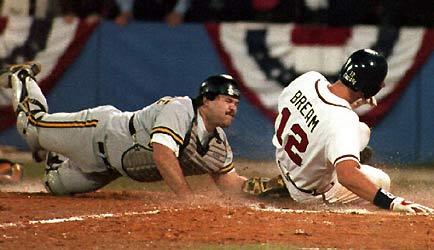
sid_breamYou all remember Sid Bream, don’t you? Well, probably not: he was a mediocre first baseman about 20 years ago who played for the Pittsburgh Pirates and the Atlanta Braves. He hasn’t been heard from in a long time, being quietly retired, but the Braves may be hosting the Pirates in an upcoming National League Division Playoff Series as the baseball post season gets underway, and they invited Bream to throw out the first pitch in Game #1 if that is the case—-Pittsburgh has to win a wildcard play-off game with Cincinnati first. You see, the one thing in his career that Bream is remembered for, at least in Atlanta, is scoring the run that won the National League Championship Series over the Pirates in 1992, in a close play that also lives in Pirates’ fans nightmares.

Throwing out the first pitch is fun: the team flies you in and pays for your hotel, gives you a prime ticket, and then announces your name as you trot on the field to cheers. If you have kept your arm in shape, you might even get off a throw to the catcher from the pitcher’s mound that doesn’t embarrass you, and that will acquire more cheers. from the packed stadium. Wait…this is Atlanta, not Boston. OK, from the two-thirds filled stadium. Even then, what’s not to like?

But Sid Bream turned the Braves down. Remember that I began by saying that he played for both the Braves and the Pirates. He said,

“Whatever their motive (for the invite) was, I don’t want to be involved. I wasn’t surprised (by the offer). Whether their motive was to rub it in the Pirates’ faces, I don’t know. I think it was just more of a gesture to commemorate those two teams getting back together in the postseason. But I’ll stay neutral. I’m not going to do anything to tell the fans in Atlanta or Pittsburgh that I’m (rooting) one way or the other.”

Oh, I think it’s fair to say that rubbing the Pirates’ faces in their last loss to the Braves in a postseason game was exactly what the Braves had in mind. This kind of voodoo has been a standard part of baseball gamesmanship for a long time: nobody believes that the Yankees had Bucky Dent throw out the first pitch when the Yankees had a crucial playoff game against Boston (which they lost) in 2004 “to commemorate those two teams getting back together in the postseason.” It’s psychological warfare, and more or less good-natured; there’s nothing wrong with it, and there would have been nothing wrong with Bream agreeing to play along.

But Sid Bream is, it seems, loyal. He was a Pittsburgh Pirate for a long time, a Brave only for a couple of years, and he doesn’t feel like being part of one of his former teams’ effort to unsettle the other one, even though its’ no big deal, and even though his old team won’t hold it against him. It just would feel right to him.

This is called integrity.

Good for Sid Bream.

_______________________

Pointer, Graphic and Facts: NBC Sports


Should Steroid Users Make Baseball’s All-Star Team? Should Felonious and Hypocritical Ex-Governors Be Elected Comptroller?

Bartolo and Eliot

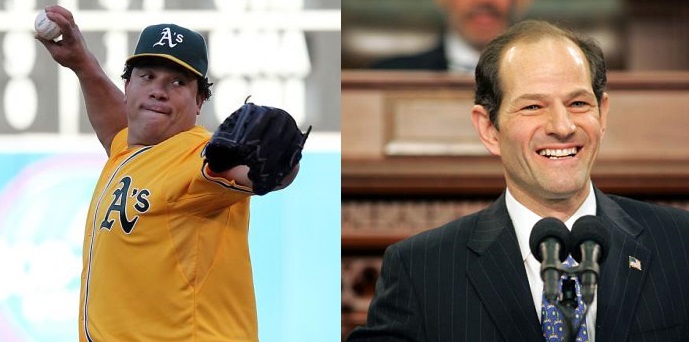
USA Today sports columnist Christine Brennan made what I assume will be a controversial argument that baseball players who have tested positive for steroids at any point in their careers should be permanently banned from being honored with inclusion on baseball’s All-Star teams. This is controversial, because a lot of misguided souls, including sportswriters, think that proven steroid cheats ought to be allowed into baseball’s Hall of Fame, a much greater and more significant career honor. The issue arises because Oakland pitcher Bartolo Colon, who last year tested positive for banned PED’s (Performance Enhancing Drugs)and was suspended for 5o days, has been selected for the American League All-Star squad. Brennan writes,

“Colon, and every other performance-enhancing drug user in baseball, should never be allowed to become an All-Star, or win any MLB award. No Cy Young, no MVP, no batting title, no nothing. It doesn’t matter that he was caught and suspended last year, not this year…The bottom line is, you don’t suddenly become a non-cheater once your suspension is over. Colon is 40 years old, yet he’s having his best season in eight years. Where have we heard that before? Even though last year’s illegal testosterone isn’t still in his system, it helped build the body that he is using today…Because Colon and his tainted body are in the All-Star Game, someone like (Tampa Bay pitcher Matt) Moore is not. He has the same record as Colon, 12-3, but with a higher ERA, 3.42 to Colon’s 2.69. We’re presuming, of course, that Moore is not on PEDs, which means his season is more impressive than Colon’s because it isn’t built on a chemical foundation as Colon’s is…It’s a privilege to receive these honors, not a right. They are extras, add-ons, awards to be cheered. They do not belong to the Brauns, A-Rods and Colons of this world. Those players should be given absolutely nothing to celebrate.” Continue reading

And This, Craig, is Why Barry Bonds Should Only Get In The Hall Of Fame With A Ticket

Blame Barry, Chris.

Blame Barry, Chris.

In Baltimore, a young, slugging first baseman is leading the charge to get the Baltimore Orioles into the American League play-offs. He is on a home run pace that could net him 60  or more, and fans voted him the starting first baseman on his league’s All-Star team. Because his production this year far exceeds anything he had accomplished before, however, Chris Davis’s emergence isn’t being celebrated as much as it is being suspected. Another steroid scandal looms over major league baseball, one which threatens to engulf two former MVPs, as well as other players. Fans and sportswriters don’t trust players any more, or their power totals, not since Mark McGwire and especially Barry Bonds juiced and injected their way to shattering the game’s home run records.

This bothers lawyer/baseball blogger Craig Calcaterra, and it should., as someone concerned with justice. Of the smearing of Davis, he calls it…

“…utterly baseless speculation; Davis has always had tremendous power but is now, in the past year, matched it up with better plate discipline — is the product of a media landscape which has decided that every power hitter is a ‘roider. Jose Bautista got this treatment a couple of years ago. Davis is getting it now. Everyone who engages in this business does so because they’ve been convinced by the baseball media that such speculation is not just justified but necessary. It’s neither of those things. The drug testing system put in place had avoiding these parlor games as one of its primary justifications. But that’s not good enough for some, apparently.” Continue reading

Comment of the Day: “What’s Next for the Alisal Union School District…John Dillinger High School?”

Dillinger. Such a pleasant looking fellow!

Dillinger. Such a pleasant looking fellow!

This is the first of two informative Comments of the Day regarding this post. 49erDweet is correct, of course: the decision to honor Tiburcio Vasquez is a disgrace, and the comment shows that it is even more outrageous and irresponsible than I thought. I have read some of the claims on the web that Vasquez was “framed,” and that he didn’t commit the crimes attributed to him. None of them offer any proof other than the fact that mainstream scholars and historians, which naturally are biased against Mexicans, chronicled his activities, and none explain this mystery: if Vasquez didn’t commit all those crimes, what the heck did he do that was so remarkable? The only reason he is famous is because of his crimes. If he really was innocent, then he was a non-entity.

Here is 49erDweet’s Comment of the Day on the post, “What’s Next for the Alisal Union School District…John Dillinger High School?”:

“The Alisal school district’s area is directly adjacent to mine but in the same community, so I’m a tiny bit familiar with the issue. I’ve disbelievingly read most of the few published responses of a couple of their board members and their superintendent. For some reason the other board members haven’t been available.
From what I’ve read it’s apparent the individuals involved, all of whom have Hispanic surnames, believe the available published history concerning California is biased and untrue, and Vasquez should be considered a popular hero in the same vein as was Robin Hood. For the crimes he committed against his own people, which they believe were minor, they readily forgive him. And to their way of thinking he’s a folk hero who should be idolized.

“I believe this is sad, bad community leadership, obviously a major ethics fail, and is more than passingly ironic because the area they represent is one of the major Mexican prison gang battlefields currently in crisis in California. They are preparing to hold up a killer, thief, robber and rapist as a person their future students should emulate. Which, for a gang area, should build up the prison population and a much shorter than normal life expectancy.

“My heart breaks for the students who will be negatively impacted by this dreadful decision.”

What’s Next for the Alisal Union School District…John Dillinger High School?

OK, so he was hanged for murder. Nobody's perfect.

OK, so he was hanged for murder. Nobody’s perfect.

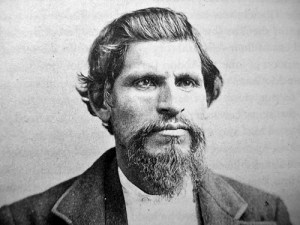
According to the University of Southern California historical archives, Tiburcio Vasquez (1835- 1875) was California’s second most notorious bandit. At the age of 14 he stabbed a constable, then embarked on a life of crime. He became the leader of his own gang, which ranged up and down central and southern California, robbing and killing. Vasquez was convicted of horse-stealing and sentenced to San Quentin prison in 1857, escaped, stole more horses, and was finally released in 1863, after playing a role in four prison breaks that resulted in the deaths of twenty inmates. For the next ten years he and his gang committed a string of burglaries, robberies and murders in the San Benito County area, finally ending with his capture in 1874. Convicted of two murders of the six attributed to him, Vadquez was sentenced to death, and executed by hanging the next year. Shortly before the noose was placed around his neck, Vasquez dictated an explanation for his actions:

“A spirit of hatred and revenge took possession of me. I had numerous fights in defense of what I believed to be my rights and those of my countrymen. I believed we were unjustly deprived of the social rights that belonged to us.”

I know what you must be thinking: “What a perfect historical figure for the Mexican-American community to honor by naming an elementary school him!” Continue reading

Of Course Barry Bonds Doesn’t Belong In The Hall Of Fame

Buy a ticket, Barry.

Buy a ticket, Barry.

A full complement of baseball’s steroid class is among the 37 players on the 2013 Hall of Fame ballot, so it was predictable that a new round of arguments would surface claiming that it is unfair, illogical, inconsistent or otherwise unseemly to exclude Barry Bonds and others from enshrinement. Predictable but frustrating: the arguments in favor of Bonds are arguments against maintaining ethical values, in baseball, sports, and American society.  It is also an annoying debate to engage in, and I have been engaging in it in various forms for many years, because Bonds’ defenders typically represent themselves as modern, reasonable, and realistic, while anyone making the quaint argument that cheating on a grand scale should earn shame rather than honors is mocked as judgmental, sanctimonious and naïve.  As ever, I am a glutton for punishment, and since otherwise wise and perceptive commentators like NBC Sports’ Craig Calcaterra choose to ally themselves with Bonds, I really am obligated to point out what a corrupt, illogical and unethical position it is.  If I and people like me don’t persist in this, we’ll have cheating approved as a cultural norm before we know what hit us.

Calcaterra has been supporting Bonds as a Hall of Fame candidate for a while now, but the title of his latest essay, “It’s Lunacy To Keep Barry Bonds and Roger Clemens Out of the Hall of Fame” is a gauntlet that begs to be picked up.  “Bonds and Clemens,” Craig writes, “ are two players who, in a just world, would be unanimous selections for induction…”  I find this an indefensible, even shocking, statement, both before and after the writer attempts to defend it. In a just world, a member of a profession who achieved his prominence in part by breaking the law and the rules, as well as lying about it, should be accorded the highest honor that profession has!  What an astounding point of view.

For simplicity’s sake, I’m going to leave Clemens out of this, in part because I can see a Hall of Fame voter credibly deciding that there isn’t enough evidence to conclude that The Rocket really did use performance enhancing drugs on the way to forging one of the top five pitching careers of all time, and in part because I suspect Craig of pairing Bonds and Clemens to make his various rationalizations more pallatable than they would be in defense of Bonds alone.  Belief in Roger’s steroid cheating rests entirely on the testimony of a proven liar and slime-ball, his former trainer. MLB’s Mitchell Report sided with the trainer, and I’m inclined to as well, but Clemens’ unfitness for the Hall of Fame, unlike Bonds (and Mark McGwire, Rafael Palmeiro, and some others), is not an open-and-shut case.

I give credit to Craig for not raising my least favorite of the Bonds defenses, that he has to be regarded as innocent because he has not been “proven guilty.” Calcaterra is a lawyer, and he understands the over-use and misuse of that cliché, as well as how it only applies when “guilty” means “you’re going to jail.” Indeed, he begins by conceding the obvious, that the evidence that Barry Bonds used steroids is overwhelming, which it is.

His first argument, however, is terrible. Under the ironic heading “Baseball Bonafides,” Calcaterra begins by reciting Bonds’ (and Clemens’) impressive list of achievements, which taken at face value show Barry Bonds to be one the best of the best, not just a qualified Hall of Fame baseball player, but an epitome of a Hall of Fame player along with such legends as Babe Ruth, Walter Johnson , Ted Williams and Willie Mays. “Put simply,” Craig says in conclusion, Bonds is an “immortal.” But he’s not-–not if he cheated, not if he achieved his historic status by corrupting his sport and lying to team mates and fans. And, as Calcaterra admits at the outset, this he did. As a result, the fact that Bonds won a record seven Most Valuable Player Awards is irrelevant. He cheated to win some of those awards. He gets no credit for them.  In Bonds’s case, “baseball bonafides” are not bona fide at all. Continue reading

The Ethical Fate For Joe Paterno’s Statue

In the wake of the Freeh Report’s revelations regarding the extent of the late Joe Paterno’s involvement in allowing Jerry Sandusky’s child molesting appetites to be sated with Penn State’s  assistance, many are calling for the campus statue honoring the now-disgraced coach to be removed.

I am generally opposed to removing memorials and honors to historical figures according to the popular verdicts of the day, for several reasons. The main one is that every individual who ever achieved something worthy of such honor also was guilty of misconduct that someone could convincingly argue outweighs it on moral or ethical grounds. New facts are uncovered, cultural values shift, and over time, no revered figure is safe from deconstruction. The reverse is also inevitable: if a life can be judged unworthy of honor, subsequent generations may well disagree. The verdict of a community, a culture and an era should be given due weight and respect;  a statue, memorial or monument not only recognizes an individual but also represents the judgment of our predecessors. Leave their judgments alone, and if we disagree with them, try to make ours better. Continue reading