Proposition: An Illegal Immigrant Is Entitled To Receive A Life-Saving Organ Transplant That Otherwise Would Go To A U.S. Citizen In Similar Need

There must be something wrong with me, for I don’t think this proposition is ethically obvious at all. In fact, I think it’s probably dead wrong.

Here is the story:

Silvia Lesama-Santos, 46, is a mother of four who has lived illegally here for at least 30 years. The transplant program at the Oregon Health and Science University denied her request to receive a new liver, telling her that she did  “not have documentation of lawful presence or immigration documentation,” which was required for her to be eligible for a transplant.

The ACLU of Oregon took on Lesama-Santos as a cause, and publicized her plight. The Oregon ACLU’s  head, Mat dos Santos, called the hospital’s policy “cruel and inhumane.”

The bad publicity, in turn, quickly forced the hospital to change its policy. “It was brought to our attention this evening that an archaic transplant policy was preventing an undocumented individual from being evaluated at OHSU,” the school said in a statement this week. “Upon learning of the policy, OHSU leaders acted immediately and terminated the policy. We deeply regret the pain this has caused the family. OHSU is committed to serving our entire community — all are welcome at OHSU, and this policy does not reflect our values.”

Flushed with success, the ACLU is planning  “to ask other hospitals to change similar policies,” ask, in this case, meaning “coerce.” Continue reading

Ethics Quiz: The DNR Tattoo

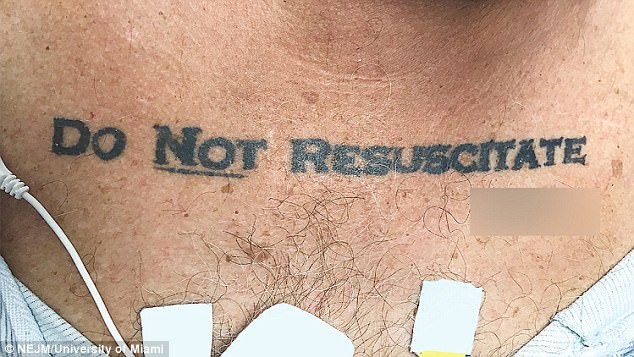
 Paramedics brought a 70-year-old man to the University of Miami hospital emergency room after finding him on the street, intoxicated and unconscious. Doctors tried to revive him got no response. Then they had an unusual problem: The man had a ‘Do not resuscitate’ tattoo on his chest, with a line under the ‘not.’ There was also something that looked like his signature. Tattoos are not legally-binding DNR orders, and in Florida, there are  very specific requirements for DNRs. to be legal.  Both a doctor and the patient must sign it, and they must be on paper, not on chests.

The doctors decided to respect the man’s tattoo. They did not try to revive him after the initial efforts failed

Your Ethics Alarms Ethics Quiz of the Day:

Was that the right call?

Continue reading

Oh, NO! ANOTHER Ethics Story That I Don’t Understand At All! EVERYTHING IS SEEMINGLY SPINNING OUT OF CONTROL!

Emory University Hospital in Georgia had scheduled kidney transplant surgery for a 2-year-old boy to take place on October 3. The organ donor, however, the boy’s father, Anthony Dickerson, violated his parole. Hospital administrators then postponed the surgery until Dickerson could comply with parole requirements for an additional three months.

The boy’s mother, Carmella Burgess, received a letter from the hospital that said Dickerson would be re-evaluated as a donor in January after it receives documentation of his success.

What warped reasoning is going into this decision? The boy’s health care needs are the same. The kidney being donated is the same. The father is still a willing donor. Why would the hospital care whether Dickerson had violated parole or not? Why would anything Dickerson did change the hospital’s medical duty to his son, or warrant postponing life and death surgery? So the father was discovered eating puppies. So he was found to be a convert to Isis. So he is caught saying nice things about Harvey Weinstein, Donald Trump or Satan. In fact, Dickerson violated parole in September and was charged with possession of a gun. So what?

“They’re making this about dad,” Burgess told the Atlanta Journal-Constitution. “It’s not about dad. It’s about our son.”

That seems to be an accurate analysis.

If anyone can explain how this can possibly be ethical conduct by the hospital, please do.

Disrespect And Assault In The Operating Room: Our Nightmares Are Real

clown-in-the-operating-room

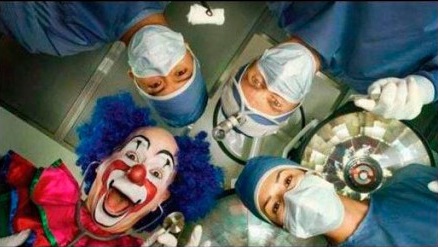
“A few moments later, the anesthesiologist walks in the room and asks, ‘What do you got?’ Dr. Canby says, ‘Vaginal delivery. Uterine atony. External massage failed. Give her some ketamine.’”…I look at Mrs. Lopez—her eyes are half-closed and vacant. Dr. Canby instructs me to hold her knee. A fellow medical student holds her other knee….Canby then performs an internal bimanual uterine massage. He places his left hand inside her vagina, makes a fist, and presses it against her uterus. I look down and see only his wrist; his entire hand is inside her. Canby puts his right hand on her abdomen and then massages her uterus between his hands. After a few minutes, he feels the uterus contract and harden. He says something like, ‘Atta girl. That’s what I like. A nice, tight uterus.’ And the bleeding stops. The guy saved her life…But then something happened that I’ll never forget. Dr. Canby raises his right hand into the air. He starts to sing ‘La Cucaracha.’ He sings, ‘La Cucaracha, la cucaracha, dada, dada, dada-daaa.’ It looks like he is dancing with her. He stomps his feet, twists his body, and waves his right arm above his head. All the while, he holds her, his whole hand still inside her vagina. He starts laughing. He keeps dancing. And then he looks at me. I begin to sway to his beat. My feet shuffle. I hum and laugh along with him. Moments later, the anesthesiologist yells, ‘Knock it off, assholes!’ And we stop.”

This is an operating room anecdote related in an anonymously authored article published this week in the Annals of Internal Medicine, a respected medical journal. The publication says that the piece is intended to shine light in a dark corner of the medical profession. Oh-oh. The essay is anonymous, I assume, because the author is afraid that there would be professional repercussions from his revealing this—what? Bad habit? Dirty secret? Crime? Reason for us to go stark, raving mad? Continue reading

Why Ethics Rules Are Useless Without Common Sense

HIPAA

An ethicist’s pet peeve: People who misuse formal ethics rules to justify unethical or stupid behavior because they never thought about what why the rule exists.

This happens a lot. My favorite example was the famous athlete enmeshed in a scandal. Ay a press conference, he said that he couldn’t answer specific questions because of “atttorney-client privilege,” and not one of the reporters had the education to say, “Huh? You’re the client! The attorney-client privilege prevents your lawyer from revealing what you told him. It doesn’t stop you from revealing anything, you cretin.” In my seminars, when an attendee cites a professional ethics rule as the reason why he shouldn’t do something, I often ask, “And why is that a rule? What’s wrong with what it forbids?” Often, disturbingly often, the individual has no idea.

The New York Times today featured another example: medical providers and others not even subject to the law using HIPAA to avoid giving out information they could and should give out, in mots cases misinterpreting the law to do so. Among the examples in the Times story:

  • A retirement home refusing to tell friends of a resident that the resident had died (only health care providers, health insurers, clearinghouses that manage and store health data, and their business associates are covered by The Health Insurance Portability and Accountability Act of 1996. a.k.a. HIPAA)
  • A hospital that  refused to accept information about a patient’s allergies from the patient’s daughter (Wow: hospitals can receive medical information; HIPAA restricts the ways they can disclose it)
  • Another relative of a patient reprimanded by hospital staff for talking about her loved one’s medical problems in the cafeteria, because, she was told, it was a HIPAA violation.
  • A minister told a church staff not to announce the names of ailing church members because it was would violate HIPAA  (That’s right: he really thought it was against the law to tell congregation that someone was sick.)
  • Some providers cite HIPAA to block patients from seeing their own records.

This is why morality alone doesn’t make people ethical, especially if they aren’t very bright. Continue reading

The Case Of The Trash-Talking Doctors, And The Price Of Trust

So, did you hear the one about why surgeons wear those masks?

So, did you hear the one about why surgeons wear those masks?

When I first heard about this case, I thought the jury award of $500,000 was ridiculous. The more I think about it, the more I begin to think it was appropriate.

Before his colonoscopy, a Vienna, Virginia patient pressed record on his smartphone, not intending to record everything that was said but ending up with the entire proceedings anyway. That was a half-million dollar stroke of luck for him, and the confirmation of dark suspicions for the rest of us. The resulting recording revealed that the surgical team amused itself by insulting and demeaning the semi-conscious anesthetized man throughout the procedure.

The anesthesiologist, Tiffany M. Ingham, was the ringleader and the primary offender.  Among her inspired bon motsContinue reading

Religion + The Right Of A Woman To Control Her Own Body=Murder

[I am tired, having engaged in a knockdown, drag-out session on legal ethics with a lively group of Federal bar practitioners. This was not the issue I wanted to come home to for the last post of the day. In fact, I gave up and am posting it this morning. Funny, the issue isn’t any easier now than it was yesterday.]

Charles Taze Russell, founder of Jehovah's Witnesses, and still getting kids killed since 1879.

Charles Taze Russell, founder of Jehovah’s Witnesses, and still getting kids killed since 1879.

A pregnant woman who was a Jehovah’s Witness checked into a Sydney, Australia hospital suffering from leukemia. She directed the staff that her treatment could not include blood transfusions, as her religious beliefs forbade them. She suffered from acute promyelocytic leukemia (APL), which is treatable, and often successfully. According to The American Cancer Society, “more than 90% of patients with APL go into remission with standard induction treatment.” Pregnant women with the cancer have an 83 percent remission rate, and their babies have a high rate of survival when their mothers are diagnosed in their second or third trimesters.

In the end, the fetus and the mother died for want of proper treatment.  “Staff were distressed, grappling with what was perceived as two ‘avoidable’ deaths,” doctors at the Prince of Wales Hospital in Australia wrote in a letter published this month in the Internal Medicine Journal.

Well, they should be distressed: they aided and abetted negligent homicide.  Continue reading

Baby-Switching Ethics

http://www.youtube.com/watch?v=djB_bqUrI9A

The song from H.M.S. Pinafore tells the story amazingly well.

In Johannesburg, South Africa, a horrendous situation resembling the plot-resolving song from “H.M.S. Pinafore” may be reaching an unusual resolution for such cases—a sensible and ethical one. The families never suspected until one of the mothers underwent tests when her ex-husband refused to pay child support. One of the mothers wanted her biological child back, while the other wants to keep the child she had raised. A judge now has to decide.

The court asked the University of Pretoria’s Centre for Child Law to investigate and make a report n what would be in the children’s best interests. The experts’ answer: “The recommendation is that the children should stay with the parents who have raised them and should also be permitted to have contact with their biological parents.”

Exactly. Let’s hope that the court follows the recommendation, the only ethical one. Four years old is too old for this wrong to be set right without making it worse. What about three years old, though? Where do we draw that line? Furthermore, I am assuming that the two families are more or less equally fit, able and qualified to raise children. What if the investigation showed that one family was clearly more advantageous for a child: better educated parents with more resources and experience with children, living in a safer community? Then what would be the calculation of “the right thing”? The benefit of one child would be the detriment of the other, a zero sum game. In such a case, would fairness govern, rather than the best interests of the children? Why should one child be cheated out of the better life awaiting him, because of a nurse’s mistake? Fortunately, we don’t have those details, so we can make a confident abstract ethics judgement without confounding factors and issues. Continue reading

Ebola in Dallas: No Excuses For the CDC

doctor_stooges_2

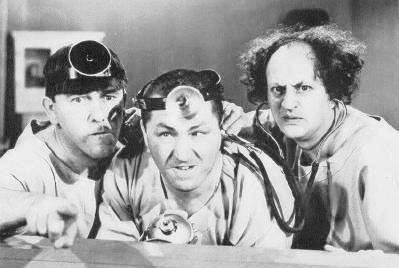
The statement by the nurses union in Dallas describing the Three Stooges level breaches in safety protocols surrounding the treatment of Thomas Duncan, the nation’s first Ebola fatality is shocking, but it should be no surprise, ironically. By now, Americans should be used to being told that our benevolent overseers in the government have matters well in hand, our best interests at heart, and the expertise and resources to do the job governments are supposed to do.  They are also used to discovering, especially lately, that the expensive systems and professionals we have been instructed to trust are in truth lazily administered, incompetently run, staffed with too many sluggards just waiting for a paid retirement, and most of all, well aware that failure carries little or no accountability.  In the recent past it has been the Secret Service, the Veterans Administration, the State Department, Homeland Security, the IRS, HHS and our military that have shown deficits in management, oversight, planning, professionalism and common sense undermining our trust. Now it is the Center for Disease Control. Continue reading

Explain to Me Why We Tolerate Illegal Immigration, Again?

Yes, I'm in a rotten mood today! Wanna make something out of it??

My cranky Saturday continues with an issue that I increasingly find bewildering: the tolerance, denial, and enabling by so many Americans of illegal immigration, although its unethical character cannot be denied or argued away. I know why Democrats support it—pure electoral cynicism—and I know why the business community encourages it—greed. What I don’t comprehend is why anyone else with a modicum of logic, fairness, and common sense isn’t confronting both of these self-serving institutions and demanding real enforcement of anti-illegal immigration measures. Instead, we get outrageous legislation like the Maryland Dream Act, which institutionalizes incentives for aliens to defy our laws. Continue reading