Sparing Bin Laden: Ethics Lessons From Bill Clinton’s 2011 Admission

In an alternate universe, this missile strike prevented 9-11. It doesn't matter.

In an alternate universe, this missile strike prevented 9-11. It doesn’t matter.

Sky News host Paul Murray revealed a previously unreleased audio recording of Bill Clinton speaking to a group of Australian businessman in Melbourne (undoubtedly for an obscene fee, since the Clintons were poor as church mice back then, but I digress) on September 10, 2001.  Clinton’s fascinating answer to an audience question about terrorism has raised a lot of eyebrows:

“Osama bin Laden — he’s a very smart guy, I’ve spent a lot of time thinking about him, and I nearly got him once. I nearly got him. And I could have gotten, I could have killed him, but I would have to destroy a little town called Kandahar in Afghanistan and kill 300 innocent women and children. And then I would have been no better than him. And so I didn’t do it.”

Observations from an ethics perspective: Continue reading

State Of U.S. Journalism: “Conflict of Interest? Oh, THAT Old Thing!”

At last report, rolling in his grave...

At last report, rolling in his grave…

I believe that the field of journalism ethics has been negated, as the news media now routinely ignores the most obvious conflicts of interest, and make no effort  to avoid them, address them, or disclose them.

Case #1: Taking orders from Hamas

 Hamas has published media guidelines instructing Gazans to always refer to the dead as “innocent civilians” and to never post pictures of armed Palestinians on social media. Hamas has prevented foreign reporters from leaving the area, and it is easy to see how foriegn journalists would conclude that the best way to ensure their safety is to avoid angering their “hosts.” Seemingly mindful of these concerns, the New York Times’ reporting on the Gaza conflict from Israel depicts tanks, soldiers, and attack helicopters, while virtually all images from Gaza are of dead children, weeping parents, bloody civilians, ruined buildings, overflowing hospitals, or similar images of pain, carnage and anguish. As Noah Pollack noted in the Weekly Standard website,  a Times photo essay today contains these images:

“…three of Gaza civilians in distress; one of a smoke plume rising over Gaza; and three of the IDF, including tanks and attack helicopters. The message is simple and clear: the IDF is attacking Gaza and harming Palestinian civilians. There are no images of Israelis under rocket attack, no images of grieving Israeli families and damaged Israeli buildings, no images of Hamas fighters or rocket attacks on Israel, no images of the RPG’s and machine guns recovered from attempted Hamas tunnel infiltrations into Israel.”

Is this just naked anti-Israel bias, or is the Times simply trying to report the story without getting its reporters’ into further peril? I’ll be charitable and presume the latter: fine. But that defines a clear conflict of interest that mars the objectivity of the Times’ reporting, and the paper has an ethical obligation, under its own guidelines, to disclose it in every report where it might be relevant.

It has not. Continue reading

Children Make Us Stupid, Or “Why Are U.S. News Networks Assisting Brutal Palestinian Propaganda?”

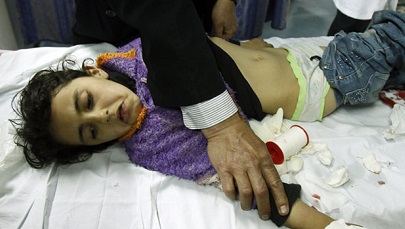
child victim

“Children make us stupid” is but a corollary to the law often stated here, “Bias makes you stupid.” Our natural bias in favor of caring for, protecting and seeking happiness for children is genetically wired into our being. Thus, in action movie after action movie, when the villain puts a gun to a child’s head, the hero invariably drops his weapon, apparently giving the world over to dictatorship, pestilence or death to save one rosy-cheeked kid. (Well, except for Dirty Harry, who picks off the creep holding the gun to the kid’s head with one well-aimed shot.) The trade-off is really, really stupid, and not ethical either: sacrificing the welfare of the many for a single child is simply illogical and wrong. But to those sentimentalists who don’t strain themselves by thinking, and to cynical politicians who know better but also know that convincing morons is all it takes to win “a majority” ( “…if even one child’s life can be saved…“—President Obama, 2013 State of the Union Message), the human bias that gives irrational priority to children is pure gold.

Obama’s use of the false ethic was  his call for gun control in the wake of the Sandy Hook tragedy, in which an anomalous attack on a grade school was used to make it seem like children were being hunted down like rabbits. We are currently watching another classic demonstration of the “children trump everything” fallacy, and it is both a logical and an ethical fallacy:  the emotional and irresponsible rhetoric over the fate of the unaccompanied South American children being sent to the United States as a predictable response to Democratic promises of a better life, a college education, and eventual citizenship. The fact is that child illegal immigrants are just as illegal and just as undesirable as any other variety: they are just cuter, sadder, less culpable and easier to use to demonize principled opposition.

It is not surprising that the Palestinians, who pioneered using children as suicide bombers, figured out that sacrificing their own kids might be a dandy way to turn public opinion against Israel in its long, mad, apparently endless quest to eliminate the Jewish state. Israel turned over control of Gaza to the Palestinians there, and the Palestinians elected Hamas, which seeks, as written policy, the elimination of Israel. Instead of  using its resources to create a state and a stable infrastructure for society, Hamas spent millions importing and producing rockets, launchers, mortars, small arms, and even drones to do battle with Israel. It built a network of tunnels, and stockpiled the weapons in hospitals, religious sites, and crowded residential areas, using these locales to fire a barrage of rockets into Jerusalem and Tel Aviv. Continue reading