Ethics Quiz On A Story I’m Betting Is A Hoax: The “Identical Twins” Married Couple

I have now read three accounts in borderline news sources about a Mississippi married couple who went to a fertility clinic and discovered to their horror that they were “identical twins.” I’m assuming it is a fake news story, perhaps planted through collusion with the Trump campaign by Russian government operatives, and not just because identical twins cannot be different sexes. (Hey! Maybe one of them had  gender reassignment surgery! Now that would be a story!)

I suppose it’s possible; Robert Ripley found odder coincidences for decades, but never mind: let’s assume for the sake of ethics problem-solving practice that the story is true. (I’ll be stunned if it is.)

Your Ethics Alarms Ethics Quiz of the Day is…

What is the couple’s most ethical course now that they know they are siblings, or is there one?

Key question: Is this ick rather than ethics?

Trap: I’m not asking what’s moral.

It’s all yours…

“Rogue One” Ethics: Peter Cushing Returns From The Grave

He's baaaaack!

He’s baaaaack!

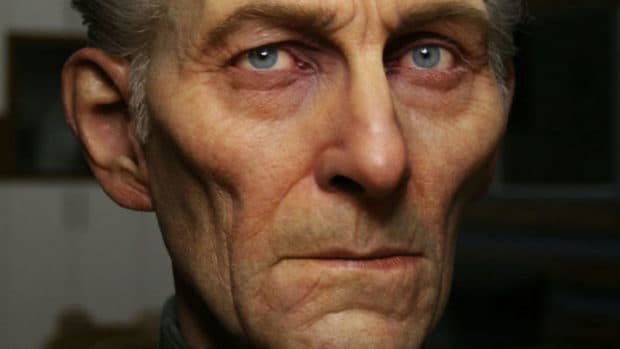
Hammer Films horror icon and Christopher Lee foil Peter Cushing died in 1994 from prostate cancer. That couldn’t stop the makers of the latest “Star Wars” movie from bringing his image back from the grave.  The gaunt-faced British actor—an early “Doctor Who”!—played Grand Moff Tarkin in the original “Star Wars,” a bad guy, Cushing’s specialty. Since “Rogue One,” the current addition to the series, is a prequel, Tarkin is alive again (he went down with the Death Star in Episode IV). Instead of recasting the part, the producers decided to recreate Tarkin/Cushing using CGI technology. Lucasfilm-owned digital effects house Industrial Light & Magic reanimated Cushing’s likeness so that a recognizable Tarkin could make a convincing  appearance in “Rogue One.” The results are not perfect, but it is still one step closer to allowing future movies to cast avatars of long dead stars to interact seamlessly with live performers.

We have recently seen actors like Arnold Schwarzenegger, Jeff Bridges and Anthony Hopkins digitally youthened, but forcing a dead actor’s image to perform is a different matter entirely. The use of computer animated images of dead performers to do the bidding of their director masters evokes memories of “Looker,” a science fiction film directed and written by the late Michael Crichton of “Jurassic Park” and “Westworld” fame. In that 1981 movie, a corporation transferred the images of living models to a computer program that could use the new cyber-models to do and say anything more effectively and attractively than the models themselves in television ads. Then the company had the models killed—less residuals that way.

The emerging technology raises many ethical issues that didn’t have to be considered before, but when it comes to using a dead actor in a new role, the ethics verdict should be easy. It’s unethical, unless a performer  gives informed consent for his image to be used post mortem in this fashion. Presumably, the consent or the lack of it will be part of future negotiations and standard contracts. Actors who agree to have their images used as cyberslaves will also probably want to limit the uses of their names and images. No porn films, for example. No uses of an actor in a role he would have never agreed to playing while alive. Don’t make John Wayne shoot someone in the back. Don’t show Fred Astaire as clumsy on his feet; don’t make Jimmy Cagney a weenie.

Allowing another actor to use a dead one’s face and body, like Andy Serkis wore his cyber King King suit, is a closer call. If it is clear that the dead actor isn’t the one doing the acting, and that digital technology is being used as the equivalent of make-up, maybe that practice is just icky rather than unethical, provided the credits are clear.To make Cushing’s Tarkin live again on screen, “Rogue One’s “film-makers hired Guy Henry, a 56-year-old British actor who resembles Cushing. Henry played the part of Tarkin on the set, then the tech wizards transformed him into a Cushing clone. Continue reading

Don’t Feel Too Bad, Americans: Ethics Alarms Aren’t Ringing In Canada, North Korea Or Japan, Either

It’s an International Ethics Dunce parade!
donald-trump-humane-society

1. Ontario, Canada

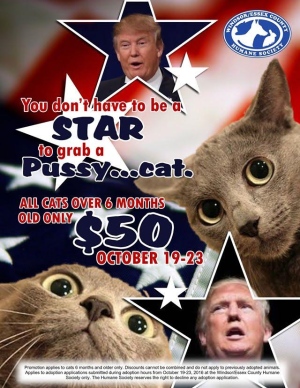
The Windsor-Essex County Humane Society in Ontario thought it would be really clever to use the Donald Trump phrase that many believe disqualify him to be President in an ad to adopt kitty-cats. It featured a photo of Trump and said, “You don’t have to be a star to grab a pussy … cat.”

Amazing. Not one person in the chain of custody of this—I would say obviously, but when so many people miss it, I guess it’s not—offensive ad had an ethics alarm sound.  Nobody had the sense, prudence or guts to say,

“Uh, guys? Hello? You do realize that this is using a phrase describing sexual assault while alluding to the one who used it to describe sexual assault? You do realize that “pussy” alluding to female genitalia is vulgar and uncivil, right? No? Here, let me explain it to you…or hwo about this: there is no way this won’t spark criticism. Is that what you want?”

Sure enough,  the ad promoting cat adoptions this week for $50, was taken down shortly after it appeared this week.

The society offered a pathetic apology. Melanie Coulter, executive director of the humane society, “explained” it was an attempt to make light of the U.S election campaign, though it also “made light” of sexual assault, contemptuous attitudes toward women,  and obscene rhetoric.

“We are obviously sorry if people are offended by the ad — that wasn’t our attempt in the least,” Coulter said. “Our attempt was to find homes for cats that need them.” She also added that the shelter took in more than a hundred cats in the last week.

For the record, the rationalizations here are…

3. Consequentialism, or  “It Worked Out for the Best”

13. The Saint’s Excuse: “It’s for a good cause”

19A The Insidious Confession, or “It wasn’t the best choice.”

It also suggests that I need to add “We meant well” to the list as a sub-rationalization to #13.

****

contest-winner

2. Kuroishi, Japan

Continue reading

Hey, At Least Donald Trump’s Foundation Is Unethical In Unequivocal And Straightforward Ways!

trump-check

It is unethical for charitable foundations to serve as tax-free conduits to personally benefit one of its officers. It’s also illegal. The Donald J. Trump Foundation can certainly give a grant to a cause that Trump himself approves of and supports. If, however, that otherwise legitimate cause is an organization that employs his mistress (just hypothesizing here), or one that is chaired by a major contributor to his campaign in what looks like a quid pro-quo deal, or is a cause favored by a Senator who then votes for a bill favored by President Trump, these are all unethical abuses of a charitable foundation’s integrity. They are also common abuses that personal foundations regularly engage in and get away with. Another unethical use of charitable funds is to allow the foundation employ relatives and friends of foundation leaders at high salaries. Again, this is business as usual for many foundations, and is, while unethical, very difficult to stop.

If, however, a foundation that has tax exempt status uses funds that by law must only be used for charitable activities in ways that directly profit an individual connected to the foundation’s management, that’s a version of money laundering and a fraudulent use of charitable grants. There are no nuances there, none of the spin, legalisms and rationalizations used by the Clintons to justify their foundation’s unethical machinations. It’s just plain, unvarnished, unethical, illegal abuse.

That’s what Donald Trump has used his foundation for:

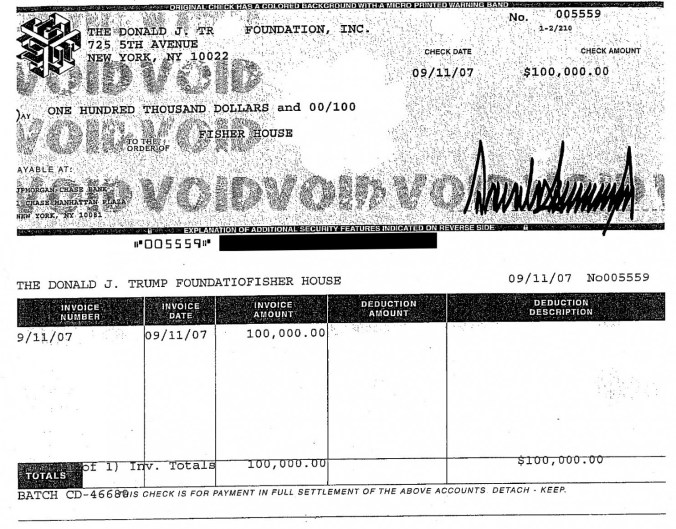
  • In 2007, Trump’s Mar-a-Lago Club had to pay  $120,000  fines from the town of Palm Beach, Florida. Palm Beach agreed to waive those fines, and avoid litigation challenging their validity, if Trump would make  a $100,000 donation to a charity for veterans. Instead of making the contribution with his own money, or the club’s money, Trump had his foundation make the contribution (above), which was primarily composed of tax-deductible gifts to his foundation  from others. Trump’s business’s fine was essentially paid by the foundation, and the beneficiary was Trump.
  • One of Trump’s golf courses settled a lawsuit by making a $158,000 donation to the plaintiff’s favorite charity. Again, the Trump Foundation, gave the money, according to tax records.
  • In 2013, Trump directed the Trump Foundation to pay $5,000 for  advertisements touting his chain of hotels in programs for fundraising three events organized by a D.C. preservation group.

Finally, In 2014, Trump’s foundation  paid $10,000  at charity fundraiser for a portrait of himself. Continue reading

Ethics Quiz: “Hot As Hell” Bikinis For Toddlers

We haven’t had a good “Icky or Unethical?”  issue for a while. Here is one to start off your week…strangely.

Last weekend, as I’m sure you all know, commenced Miami Swim Week 2016, which runs though July 19. During the  swimwear fashion and trade show (now in its 12th year!), designers, buyers and models from around the world come to Miami Beach to promote the latest in swim wear.

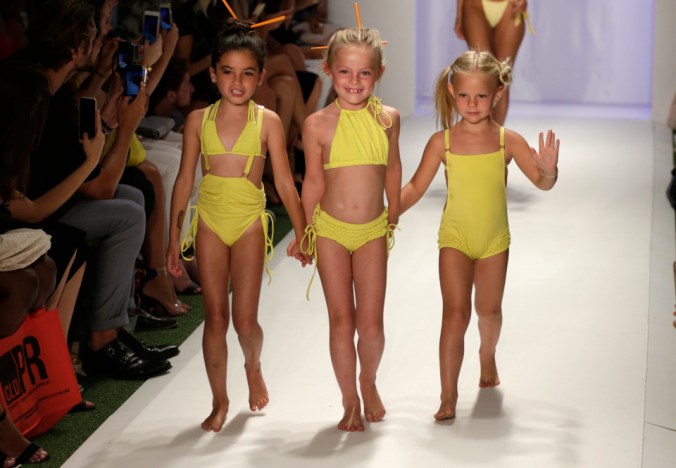
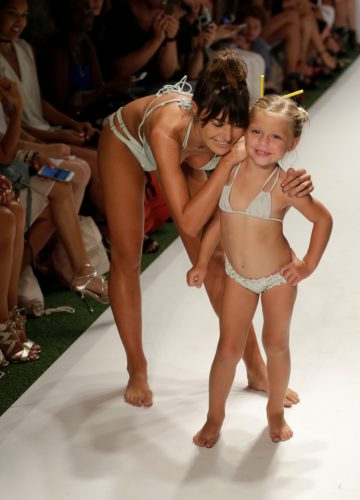
This year, the brand Hot As Hell featured adult-style bathing suits for little girls. Tiny models walked down the runway, strutting their stuff. Often they were accompanied by full grown models wearing similar out fits, like this…

Hot as Hell2

or this…

NINTCHDBPICT000252438834

Many observers were horrified, and  pronounced the bikinis, the line, and the runway display disturbing, child porn, titillation for pederasts, child abuse, and another dangerous step into the societal abyss of sexualizing childhood. Others have responded with “Aw, they’re so cute!”, “Oh, get over it” and “You’re the one with the dirty mind!”

Hmmmm.

Your Ethics Alarms Ethics Quiz to begin this Republican National Convention Week of Shame is…

Are the kiddie bikinis unethical, or just icky?

Continue reading

Boy, You’re Gonna Just Hate THIS Ethics Quiz…

Tigers manager Brad Ausmus, the quiet, Ivy League-educated manager of the struggling Detroit Tigers in the American League, snapped in frustration during last Monday’s game. He cursed, he raged, he threw dirt, he threw his cap,  he took off his hoodie and draped it over home plate. Some of his X-rated remarks were captured by microphones and broadcast to the nation. Naturally, such conduct is frowned upon by MLB umpires, so he was thrown out of the game, suspended and fined.

Now he is auctioning the hoodie and cap from his tirade on the web. Here’s part of the description:

” Neither item has been washed since the May 16 game and both items show dirt consistent with being placed or tossed on the field.”

Bidding is approaching  $5000. The auction website adds: “Neither item has been washed since the May 16 game and both items show dirt consistent with being placed or tossed on the field. Both items feature the #7, as seen in the photos.” Bidding will close on Wednesday.

Your annoying Ethics Alarms Ethics Quiz of the Day is….

Is auctioning the items used by Ausmus in his on-field tantrum as unethical, more unethical, or less unethical than George Zimmerman’s auctioning the gun that he used to defend himself against Trayvon Martin, resulting in the teen’s death?

Continue reading

Ethics Verdict On George Zimmerman’s Gun Auction: Ick, But Not Unethical

Only used once!

Only used once!

George Zimmerman is auctioning off the 9-millimeter pistol he used to shoot Trayvon Martin on a website called GunBroker.com.

Zimmerman wrote,

“I am honored and humbled to announce the sale of an American Firearm Icon The firearm for sale is the firearm that was used to defend my life and end the brutal attack from Trayvon Martin on 2/26/2012.”

George goes on to say that the proceeds will be used to “fight [Black Lives Matter] violence against Law Enforcement officers” and to “ensure the demise of Angela Corey’s persecution career and Hillary Clinton’s anti-firearm rhetoric.”

Social media is going  nuts with hate, with many comments wishing that someone would buy the gun and shoot Zimmerman with it.

Now hear this:

There is absolutely nothing unethical in any way about Zimmerman selling his property, including the gun that he used to shoot Trayvon Martin.

The gun has historical and cultural significance. Despite its grisly past, someone may want to purchase it.  Booth’s derringer is exhibited at Ford’s Theater, and nobody has ever taken offense at someone purchasing and exhibiting the gun that killed a President and American icon. Continue reading

Fairness Quandary In Britain: What To Do With A Dog That Ate His Master?

No photo of Buster is available, but this is a Staffordshire Bull Terrier, and if this image  fills you with fear and revulsion, you're an idiot, at least when it comes to dogs.

No photo of Buster is available, but this is a Staffordshire Bull Terrier, and if this image fills you with fear and revulsion, you’re dangerously ignorant, at least when it comes to dogs.

In Waterloo, England last September, a Staffordshire Bull Terrier named Buster (or Butch…he apparently answered to both names, much in the way I answer to my wife when she calls me “Jack” or “You Idiot”…) found himself in a situation reminiscent of the infamous 1972 Andes plane crash that forced its survivors to resort to cannibalism. His master died suddenly, leaving the dog trapped in the apartment without access to sustenance. After an undetermined amount of time and increasing desperation, Buster  decided “Oh, the hell with it” and ate a sufficient amount of his best friend to stay alive..

I know—“Ick.” Buster may well have felt the same way. Once police had made the grisly discovery, however, Buster found himself in big trouble even though he was was in an emaciated state that suggested that he didn’t do this for fun. The police claimed he was a danger to the community, and the deceased’s family made it clear that it wanted Buster to be put down. Dog lovers and animal rights groups insisted that Buster was a victim of circumstance and that absent evidence that he had plotted to convert his live master into a feast, there was no precedent for blaming the victim in such a case.

After all, those passengers who survived in the Andes by eating the bodies of their less-fortunate companions were not executed. They appeared on talk shows.

Why the different attitude? Well, let’s see: Continue reading

“Ick” Or Unethical: The NBA Decides To Let Its Players Be Human Billboards

Classy. I can't wait.

Classy. I can’t wait.

News Item, from ESPN:

The NBA announced… that the board of governors has approved a three-year pilot program to allow teams to sell a corporate logo on their jerseys.

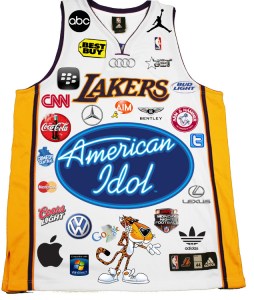
Teams can now start pitching companies on buying a 2.5-inch-by-2.5-inch space as the NBA becomes the first of the four major U.S. sports leagues to put ads on regular game-day jerseys. In an era when virtually every facet of the sports experience is advertised or sponsored, the uniform had been the last ad-free haven.

The first season of the program will be in 2017-18…

“It’s my hope, independent of whatever additional revenues are generated through this patch program, that the greatest impact will be in this amplifying effect of companies choosing to associate directly with a team jersey, then going out and promoting that relationship to the largest market,” NBA commissioner Adam Silver said.

Silver said the league had calculated that the program will be worth about $100 million a year.

Well, ick.

It’s not bad enough that a city’s sports teams have to play in arenas and stadiums named after pet food retailers, banks, car insurance companies and fraudulent corporations rather than local landmarks and community heroes. Now our kids’ heroes will be branded with commerce too…not literally, of course. Not yet.

The NBA has always been the crassest of the major league sports, so the identity of the first league to break one of the last barriers of money-grubbing indignity was preordained. Most of the NBA’s fans, who already don’t mind that the league corrupts college sports and glorifies men who collect illegitimate children the way normal people collect matchbooks, don’t care, so this was not a hard call for the NBA, I would guess.

It’s gross, but is anything wrong with it? After all, NBA players already accept money to put their names on products. It isn’t as if they have an aura of purity about them, and their obvious venality pales in the shadow of game-winning three-pointers and spectacular dunks. What ethical principle is being violated by the NBA turning its players into walking, jumping, shooting billboards? Continue reading

Pre-Unethical Conditions: Surrogate Mother Contracts And Making Babies With Jerks

womb-for-rent2Most surrogate mother arrangements work out exactly as intended by the participants. A couple or a single parent gets the biologically linked baby they bargained for, and the mother gets what she wanted, cash. To many the contracts seem unethical because the idea, only recently beyond the realm of science fiction, of a woman bearing another couple’s child, or allowing a stranger’s seed to impregnate her,  appears strange, unnatural and  icky, which it is. No, it is not unethical, but it is what we call a pre-unethical condition, a situation that lays a foundation for unethical conduct and results if care isn’t taken and one or more participants lack functioning ethics alarms. Three recent episodes demonstrate how icky can turn to unethical, especially when the wrong kind of people are involved.

I. The Unwanted Triplet, continued.

Earlier this year, Ethics Alarms hosted a spirited debate regarding Melissa Cook, a surrogate who fought against the man who owned her three unborn triplets, having rented out her womb to gestate them. He wanted to have one of them aborted, because two babies were all he felt he could support. She refused, and challenged the surrogacy contract in court. I asked… Continue reading