The Unknown Ethics Dunce And The Date Refund Invoice

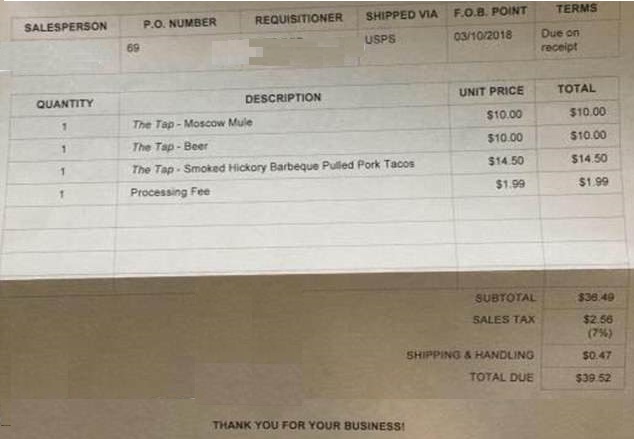
Indianapolis  resident Amanda Burnett, 23, had a dinner date with a man she didn’t relate to very well. What she ate is pictured above: it’s not exactly Le Cirq, but he paid the tab.

She decided to stop answering his texts, cutting off contact with him. A few weeks later, he sent her this, an invoice for the cost of her meal and drinks…

…followed by this text… Continue reading

The Unethical Web-Shaming Destruction Of Holly Jones

kilroysFB.0

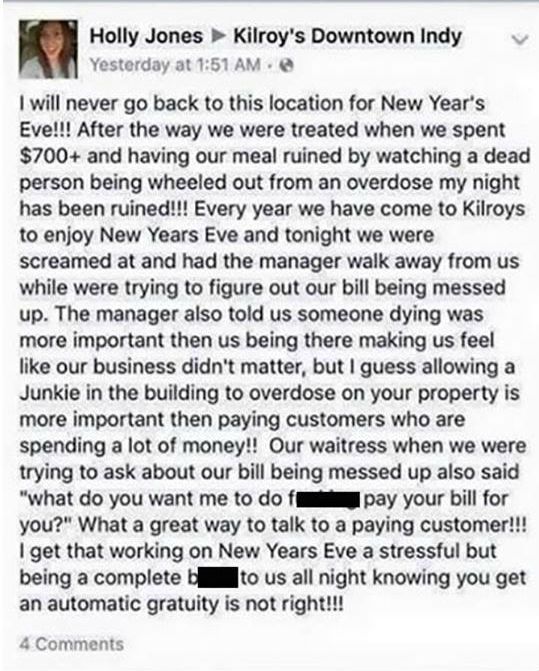
“I will never go back to this location for New Year’s Eve!!!” young Holly Jones ranted on an Indianapolis bar and restaurant’s Facebook page. “After the way we were treated when we spent $700+ and having our meal ruined by watching a dead person being wheeled out from an overdose my night has been ruined!” The angry post accused the evening’s restaurant manager of rudeness, the party’s waitress of profanity and the establishment itself of inattention.

After a sharp on-line rebuttal by the restaurant, the Web Furies were unleashed. Jones’ post became the latest web-shaming catalyst and an invitation to join a cyber-mob where fun could be had by all turning an ordinary jerk into a national villain. Lots of people signed up. The mob tracked down Jones and bombarded her own Facebook page with hate—she took the page down—then moved on to the salon where she worked as a hairdresser, threatening a boycott unless it fired Jones.

So it did.

These exercises in vicious web shaming can be ranked along an ethics spectrum. At the most unethical end is the destruction of Justine Sacco, who had her legitimate marketing career destroyed by social media’s  hysterical over-reaction to a self-deprecating, politically incorrect tweet. Now she works promoting a fantasy sports gambling website, a sleazy enterprise that entices chumps into losing serious cash with a business model derived from internet poker—she not only had her life derailed, she was corrupted too.

At the other end is Adam Smith, the one-time executive who wrecked his own career, with the help of another cyber-mob, by proudly posting a video of himself abusing an innocent Chic-fil-A  employee because Smith didn’t like her boss’s objections to gay marriage.  Somewhere between the two is Lindsay Stone, who lost her job by posting a photo showing her pretending–she later said— to scream at the Tomb of the Unknown Soldier while flipping the bird at the “Silence and Respect” sign.

The distance between Smith and Jones is the difference between words and conduct. Smith’s video showed him abusing a young woman, and his posting of the video indicated that he saw nothing wrong with it. Jones, in contrast, did nothing, other than prove herself to be, at least at the moment she posted her rant, an utter jerk. Everyone along the spectrum, however, including Jones, were excessively and unjustly harmed by the web-shaming  campaign against them. Last I checked, Smith was unemployed and destitute three years after his episode of atrocious judgment.

In the current case, the cyber-mob forcing Holly’s employer to fire her is ethically worse, by far, than anything she can reasonably be accused of doing by posting her criticism of the restaurant. Continue reading

A Tale of Two Heathers

All right, cooking your child doesn't mean you're a bad person.

Heather #1: Ethics Hero Heather Elliott, who saw two small boys locked in a car parked outside a Kroger store in Indianapolis. The temperature was in the 90s and climbing, and the boys looked red-faced and hot. One was screaming and crying, and banging at the closed window. Elliott decided to take action, and began to try to find a way to open the car doors.

Heather #2: Ethics Dunce Heather Query, 21-year-old mother of the two cooking boys, who arrived on the scene just as Heather #1 was trying to rescue her children. “How long were you in that store?’ Heather #1 asked #2.  “It’s 100 degrees outside.” ‘What do you care?” said Ethics Dunce Heather. “Mind your own business” When Ethics Hero Heather responded, “I’m just concerned about your kids. I’m just thinking about the safety of your kids,” Heather #2 attacked her, punching her in the face.

There’s gratitude for you. Continue reading

Chris Plante and the Cupcakes: Why You Can’t Trust Talk Show Hosts

A new Gallup poll shows that the public’s trust in news media has plunged to discouraging new (but completely deserved) levels. One of the side effects of this, the inevitable and correct result of  the incompetence, arrogance and bias of journalists and editors every single day, is that the public has begun to trust even less trustworthy sources. For example, a large proportion of twenty-somethings get their primary news information from the Daily Show, which is today’s equivalent of using Bob Hope’s monologues as a current events resource. This is foolish beyond words, because Jon Stewart’s professional obligation is to be entertaining, provocative and funny, not fair, accurate, or responsible. Indeed, if he has an opportunity to make a hilarious joke and doesn’t do it because it would require distorting the truth, he’s breaching a professional duty. He’s accountable to no one; he has no ethical standards to meet. It is unfair to rely on Jon Stewart for the news. He doesn’t want your trust: don’t trust him.

Others…older, but no wiser…go to public issue talk shows as their primary news sources. These people are not journalists either. They may be lawyers, former military men, spooks, authors, agitators, stealth political candidates,  or pundits; they may also be comedians, satirists, blowhards, ignoramuses, idiots, misanthropes, radicals, cynics, phonies or bigots. Among their ranks are too many agendas to count, in addition to those they all share: they want you to listen to them and adopt their views of the world. Those agendas are not conducive to truth either.

Some of the talk show hosts are less trustworthy than others. Take Chris Plante, for example—a B-list conservative talk show host whose primary tools are smugness and mockery. Continue reading

The Fake Fight, the Injured Officer, and the Forgotten Fable

In the wake of a high-profile case in which a black teen was apparently beaten by an arresting police officer, an Indianapolis African-American minister decided that a simulation of an arrest situation might be revealing. James Harrington, a pastor at Mt. Vernon Missionary Baptist Church, asked Police Sgt. Matthew Grimes to speak at an anti-violence symposium, but he had a surprise for the officer. Harrington had arranged for actors to stage a fight in the crowd—a test, Harrington said later, of Grimes’ response to a fight between two black men. Grimes attempted to break up the faux fight, and seriously injured his back. Continue reading