Fake News Update: Fake History, Santa’s Number One Elf, And The Ornery Irishman

maine

Consider this three-headed post an exploration of just how tangled and gray the Fake New Ethics Train Wreck really is.

Let’s start with…

1. The Irishman.

Last week the obituary of Chris Connors was viral on social media. The first part of it read,

Irishman Dies from Stubbornness, Whiskey

Chris Connors died, at age 67, after trying to box his bikini-clad hospice nurse just moments earlier. Ladies man, game slayer, and outlaw Connors told his last inappropriate joke on Friday, December 9, 2016, that which cannot be printed here. Anyone else fighting ALS and stage 4 pancreatic cancer would have gone quietly into the night, but Connors was stark naked drinking Veuve in a house full of friends and family as Al Green played from the speakers. The way he died is just like he lived: he wrote his own rules, he fought authority and he paved his own way. And if you said he couldn’t do it, he would make sure he could…

I instantly liked Chris, as did millions of others. This was published on the obituary site, Legacy.com. People like me sent the obituary  around to friends, thought about it, and talked about it, because it made us feel good. Now there’s someone who did not go gentle into that good night!

Do I have any idea if this obituary is 100% accurate, or accurate at all? No. How often are obituaries fact-checked, if they aren’t written by a reporter? For normal people, like Chris Connors, almost never. Do you care? Do you care in this case? I don’t I am pretty sure that the obituary gives a fair sense of the kind of man Chris Connors was, even if it is hyperbolic, as I assume it was. Nevertheless, the obituary made me feel good, as it was supposed to. Christmas is starting to depress me as the years mount up: too many memories, too many lost loved ones, the sense of time passing too, quickly , of time running out. Chris’s story, which may have been only partially true, was a great, bracing, much-needed slap in the face. He had the right idea, or if he didn’t, whoever wrote his obituary did. Is there any harm anyone can attach to this inspiring farewell? If it was fake news by Facebook’s new standards, does it matter?

2. Santa’s Number One Elf

Continue reading

Holiday Ethics Assigment: Quick! Watch These 25 Great Old Ethics Movies Again Before You Go Bonkers Too!

movie-theater

I am compiling a new list of great ethics movies to help those troubled by the recently completed Presidential campaign, the election and its aftermath. I haven’t decided whether to reveal it piecemeal, or collectively as I have before, but I do need to begin by presenting the previous list of 25, actually the combination of several previous posts. Ethics films I have covered individually since those lists debuted, like Spotlight and Bridge of Spies, will eventually be added.

For now, here’s the top 25. Don’t pay attention to the order.

1Spartacus (196o)

The raw history is inspiring enough: an escaped gladiator led an army of slaves to multiple victories over the Roman legions in one of the greatest underdog triumphs ever recorded. Stanley Kubrick’s sword-and-sandal classic has many inspiring sequences, none more so than the moment when Spartacus’s defeated army chooses death rather than to allow him to identify himself to their Roman captors (“I am Spartacus!”)

Ethical issues highlighted: Liberty, slavery, sacrifice, trust, politics, courage, determination, the duty to resist abusive power, revolution, love, loyalty.

Favorite quote: “When a free man dies, he loses the pleasure of life. A slave loses his pain. Death is the only freedom a slave knows. That’s why he’s not afraid of it. That’s why we’ll win.” [Spartacus (Kirk Douglas)]

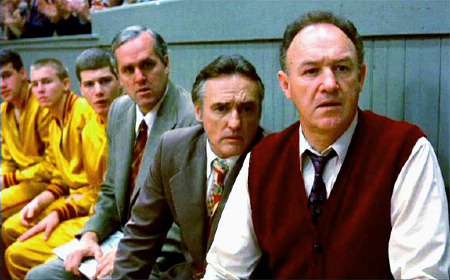
2.  Hoosiers (1986)

“Hoosiers” is loosely based on true story, but its strength is the way it combines classic sports movie clichés—the win-at-all-costs coach down on his luck, the remote superstar, over-achieving team—into a powerful lesson: it isn’t the final victory that matters most, but the journey to achieving it.

Ethical issues highlighted: Forgiveness, generosity, leadership, kindness, courage, loyalty, diligence, redemption.

Favorite quote: “If you put your effort and concentration into playing to your potential, to be the best that you can be, I don’t care what the scoreboard says at the end of the game, in my book we’re gonna be winners.” [ Coach Norman Dale (Gene Hackman)]

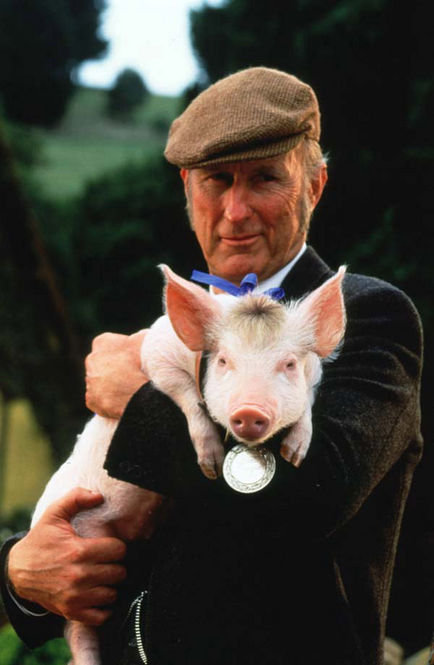
3. Babe (1995)

A wonderful movie about the virtues of being nice, the greatest civility film of all time. Second place: “Harvey.”

Ethical issues highlighted: Civility, kindness, reciprocity, loyalty, courage, love, friendship, bigotry, bias.

Favorite quote: “Fly decided to speak very slowly, for it was a cold fact of nature that sheep were stupid, and there was nothing that could convince her otherwise…The sheep decided to speak very slowly, for it was a cold fact of nature that wolves were ignorant, and there was nothing that could convince them otherwise”  The Narrator (Roscoe Lee Browne) Continue reading

Post-Election Morning Ethics, Early Edition [UPDATED]

hillary-loses

Initial ethics observations following an amazing night in American history:

1. Give Trump a chance, and take note of those who will not.

He is now in the most difficult job in the nation at the age of 70, with less relevant experience and preparation than any previous occupant of the office. For once, it’s a good thing that he’s an egomaniac and a narcissist, because otherwise he might be perseverating in terror right now. One cannot say that he begins with the most daunting set of problems any POTUS has ever faced, but it’s close. Give him a chance. Nobody becomes President wanting to fail, and not wanting to do a good job for his country and his fellow citizens.  Begin with that, and let’s see what happens.

2. Those who are capable of being fair and objective should salute the shades of Mr. Madison, Mr. Jefferson, Mr. Adams, Mr. Hamilton and their colleagues. The Founders wanted a system that was capable of peaceful political upheaval when the public was dissatisfied and demanded change, and their unique creation was strutting its stuff last night. So much has taken place over the last year—the last eight years, really—that has undermined our democracy that it is refreshing to see its resilience and vitality. As before, I still believe that Trump is a cautionary tale about the danger when people who don’t understand leadership, ethics and government become the majority. On the other hand, it’s their country too, and the “elites” (how I detest that word) forgot that, repeatedly, shamelessly, and in many ways.

Jefferson would have reviled Donald Trump, but he would approve of the uprising.

3. Trump’s victory speech last night was widely reviewed as statesmanlike and gracious, which it was. It was also unusually coherent for him. Still, who can’t give a gracious victory speech? The effusive praise being lavished on this shows how low expectations are.

4. Hillary Clinton’s decision to not to appear in person at her headquarters and concede, also graciously, was a failure of character. On CNN, ex-Trump campaign manager Corey Lewandowski and ex-Obama flack Van Jones got in an argument over this, but for once in his life, Lewandowski  was right. Given the backdrop of Clinton and the media questioning whether Trump would “accept defeat,” the decision by Clinton was just plain wrong: unfair to Trump, unfair to her supporters, hypocritical. Continue reading

The Seventh Annual Ethics Alarms Awards: The Best of Ethics 2015, Part II

DavisHand

The Awards continue (Part I is here)….

Most Important Ethical Act of the Year:

The US Supreme Court’s Decision in  Obergefell v. Hodges in which the Supreme Court considered whether states had to recognize a right to same-sex marriages, and narrowly decided that they must. The prejudice against homosexuality is ancient, deep, and complex, mixed up in confounding ways with morality and religion, and deeply divisive. Nonetheless, I felt that the opinion should have been unanimous; it’s a shame that it was not, but in the end, this will not matter. The result was preordained from the moment gays began coming out of the shadows and asserting their humanity and human rights. Since the Stonewall riot, the nation and the culture has learned a great deal about the number of talented and productive gay men and women in our society and our history, the pain, ostracizing, discrimination and mistreatment they have suffered, and the falseness of the myths and fears that lead to this suffering.  In the end, as Clarence Darrow said about blacks, it is human beings, not law, that will make gays equal. No topic immediately causes such emotional and intense debate, on this blog or in society, as this one, but the Supreme Court’s decision is a major step toward changing the ethical culture, by asserting  that gay men and women have the same rights,  in the eyes of the state, to marry those they love and want to build a life with, and by implication, that the beliefs of any religion regarding them or their marriages cannot eliminate that right.

Outstanding Ethical Leadership

Senator Rand Paul.   I am neither a Rand Paul supporter, nor an admirer, nor a fan.  However, his June filibuster-like Senate speech against National Security Agency counter-terrorism surveillance was a brave, principled,  important act, and a great public service. The point Paul made needs to be made again, and again, and again:  there is no reason to trust the NSA, and no reason to trust the current federal government either. The fact that on security matters we have no real choice is frightening and disheartening, but nevertheless, no American should be comfortable with his or her private communications, activities and other personal matters being tracked by the NSA, which has proven itself incompetent, dishonest, an untrustworthy.


Parent of the Year

Tonya Graham

Toya Graham, the Baltimore mother caught on video as she berated and beat on her son in the street for participating in the Freddie Gray rioting and looting. Continue reading

Ethics Tales: How Julia Sand Saved A President And Changed The Nation

open book on concrete background

In my recent overview of the U.S. presidency (the four parts are now combined on a single page under “Rule Book” above), I noted that our 21st President, Chester A. Arthur, was one of my personal favorites and an Ethics Hero. He confounded all predictions and his previous undistinguished background, not to mention a career marked  by political hackery and toadying to corrupt Republican power broker Roscoe Conkling, to rise to the challenge of the office and to effectively fight the corrupt practices that had elevated him to power. Most significantly, he established the Civil Service system, which crippled the spoils and patronage practices that made the Federal government both incompetent and a breeding ground for scandal.

I did not mention, because I did not then know, the unlikely catalyst for his conversion. Recently a good friend, knowing of my interest in Arthur, his tragic predecessor, James Garfield, and presidential assassinations sent me a copy of Destiny of the Republic, the acclaimed history of the Garfield assassination and its aftermath by Candace Millard. It’s a wonderful book, and while I knew much of the history already, I definitely did not know about Julia Sand. Her tale is amazing, and it gives me hope. If you do not know about Julia and Chester, and it is not a well-known episode, you should.

Allow me to tell it to you?

James Garfield, an Ohio Congressman, had been the dark horse nominee of the Republican Party in 1880, foiling the ambitions of many powerful politicians, the most powerful among them being Sen. Roscoe Conkling of New York. In order to cement New York’s electoral votes, the convention gave the Vice Presidential nomination to Conkling’s lackey, the dignified-looking but otherwise unimpressive Chester A. Arthur, who may have been the least qualified individual ever to run for that office. The highest position he had ever held was Collector of Customs of the Port of New York, which had been handed to him by Conkling, and he was later removed from that post for incompetence and corruption.  He’d never been elected to significant office or been any kind of executive. Arthur’s career before becoming Vice President makes Sarah Palin look like Winston Churchill.

After the election, Arthur got to work being a disloyal Vice-President, acting as Conklin’s agent in the White House. (Arthur, a widower, even lived as a guest in Conkling’s Washington mansion.) He actively undermined Garfield’s efforts at government reform, at one point going so far as signing a petition supporting Conkling when Garfield refused to appoint only Cabinet members with the Conkling stamp of approval. Then,  on July 2, 1881, less than six months after taking office, the impressive Garfield was shot in Washington D.C.’s Union Station by Charles Guiteau, easily the craziest of the various crazies who have taken a shot at our leaders. (He was also the only lawyer in that group.)

Everybody was horrified, initially at the crime, but also at the prospect of Arthur becoming President. Some even suspected him of being complicit in the act; Guiteau didn’t help by writing Arthur a letter prior to his attack telling him what he needed to do as President.  Most, however, were just aghast at the prospect of the brilliant, courageous, skilled and honorable Garfield being replaced by this utter non-entity under Conkling’s thumb.

None were more aghast than Chester A. Arthur. He may have been a hack, but he was no fool, and he knew he wasn’t up to the job. It was reported that when he learned of Garfield’s shooting, Arthur began weeping like a child. During the nearly three months it took the hardy Garfield to die—he was killed by sepsis induced by the unsanitary prodding of his doctors as they searched for Guiteau’s bullet: the wound itself was probably survivable—Arthur descended into panic, shock, and depression.  For nearly two months, he stayed at home with the blinds drawn, fearing his own assassination. So invisible was he that there were  rumors that Arthur had poisoned himself.

Then Arthur received a letter, dated August 27, 1881, from a woman he did not know, Julia Sands. It immediately got his attention, for she addressed him in a manner he had never been spoken or written to before. The remarkable letter said in part… Continue reading

Comment of the Day: “’Bang The Drum Slowly,’ My Old Friend, and Me”

Gus Grave

Extradimensional Cephalopod was kind enough to post this wise and evocative reflection prompted by my recent post following the sudden, but really not so sudden, death of an old friend over the weekend. His thoughts helped me a great deal, and I am grateful: here, without further comment, is EC’s Comment of the Day on the post, “’Bang The Drum Slowly,’ My Old Friend, and Me”: Continue reading

“Bang The Drum Slowly,” My Old Friend, and Me

The American Century Theater's "Bang the Drum Slowly"

The American Century Theater’s “Bang the Drum Slowly”

I haven’t mentioned it here, but we are ending the 20 year adventure of my intentionally out-of-fashion theater company, The American Century Theater, after next season. One of the things I will miss most about it is that working so closely with the great works of stage literature we produce causes their wisdom and life observations to stick with us. Since I tend to choose works that involve ethical dilemmas, this has had professional as well as personal benefits.

I was thinking about the Mark Harris play (and novel, and movie) “Bang The Drum Slowly” in May, when I wrote about the kindness shown to Pasco High School student Vanessa Garcia, who was dying of cancer, because we were performing it at the time.  The story involves a baseball team and how it responds to a third-string catcher who is dying of Hodgkin’s Disease. It is about kindness and the Golden Rule, and the ways the impending death of someone in our life often brings into sharper focus the importance of kindness and our shared obligations on this perplexing journey to oblivion we all must travel together. But I really wasn’t thinking about “Bang The Drum Slowly” yesterday. Yesterday, I was just having a wonderful time talking about baseball, politics and family with my old friend from law school, who happened to be in a hospice. Continue reading

Ten Movies For Independence Day Weekend

fireworks

I wasn’t going to do this until I ran across a few lists of “Most Patriotic  Films” that made me fear for the taste and the values of my fellow citizens. “Independence Day” ? “Armageddon”? “Rocky IV”?  When did “patriotic” start meaning “crappy”? “Born on the Fourth of July”? If Oliver Stone is your idea of patriotic fare, you and I are going to have a problem.

Here is my very personal list of ten favorite films that bring a patriotic lump to my throat and a remind me of how lucky I am to be born and raised in the U.S.A. Don’t mind the order: it was hard enough narrowing the list down to ten.

1. Apollo 13  (1995)

The only one of the movies on my list that I saw on the others today. Like many of the films here, it makes me wistful for American boldness and confidence that seem to be in retreat today. When the  Apollo re-emerges from radio silence, and Tom Hanks says, with perfect inflection, “Hello, Houston. This is Odyssey. It’s good to see you again,” I lose it, every time.

2. Mr. Smith Goes to Washington (1939)

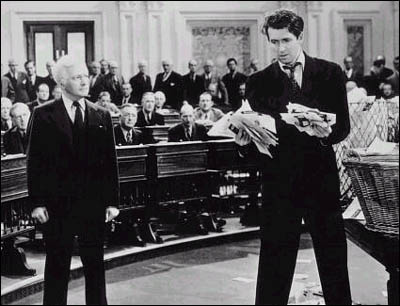
Yes, this is Capra-corn at its corniest, but from Harry Carey Sr.’s sage and heroic Vice -President, to the power of the people triumphing, to the press trying to expose corruption rather than abet it,  this film reminds us of the best ideals of our government. When we get too cynical to enjoy Jefferson Smith’s struggle to make Washington work the way its supposed to, it will be time to pack it in.

3. The Longest Day (1962)

Longest Helm

Yes, it’s not just about Americans, but it is a great film about one of our country’s  finest achievements, all true, and inspiring without a lot of flag waving and sentiment. Best war movie ever—and my Dad’s favorite. Continue reading

Ethics Hero: Pasco High School (Dade City, Fla.)

Graduate

I need this story to get the previous post out of my head.

In Mark Harris’s novel “Bang The Drum Slowly,” best known as the inspiration for the film that introduced Robert DeNiro to the movie-going public, a major league baseball team exhibits uncharacteristic kindness toward a third-string catcher who is dying of Hodgkin’s Disease. The book, like the film and the stage adaptation, is about kindness and the Golden Rule, an ethical value that seldom inspires literature or art. Kindness is not particularly exciting, but it may be the most ethical of all ethical virtues. The serious illness and impending death of someone in our life often brings the importance of kindness into sharp focus. “Everybody’d be nice to you if they knew you were dying,” says the doomed catcher, Bruce Pearson, to his room mate and champion, star pitcher Henry Wiggen.  “Everybody knows everybody is dying,” Wiggen replies. “That’s why people are as good as they are.”

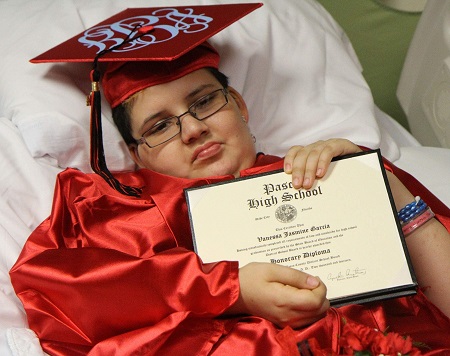
Pasco High School student Vanessa Garcia  learned that she had an inoperable brain tumor when she was in elementary school. Until two years ago, treatment had kept the tumor  in remission, but the mass began growing again when she was 15. Undaunted, Garcia continued to go to school, work diligently, and keep a positive and uncomplaining outlook, earning the admiration of her classmates, teachers and school officials. Continue reading

Michael De Beyer, Like Don Bedwell, An Exemplary Ethics Hero To Inspire Us

Mathis and hero

Writing about my favorite Ethics Hero of all time, Don Bedwell, in 2005, I began, “There are special and rare people whose ethical instincts are so pure and keen that they can make the rest of us feel inadequate.” Like Don Bedwell, Micheal De Beyer is such an individual.

Brittany Mathis, 19, works for De Beyer at his  Kaiserhof Restaurant and Biergarten in Montgomery, Texas, . Her mom and older sister work at the restaurant as well, so she would describe her boss as a family friend. In December, Brittany learned that she has a 1.5 inch brain tumor  She can’t afford to find out whether the tumor is benign or malignant, but her father died from a similar tumor years ago, so her situation is dire. She doesn’t have health insurance.

De Beyer has decided to sell his restaurant, which he opened more than 15 years ago and has an estimated worth of $2 million, to pay for whatever medical treatments are necessary to save Brittany’s life. “I’m not able to just sit by and let it happen,” De Beyer told a local paper. “I couldn’t live with myself; I would never be happy just earning money from my restaurant knowing that she needs help.” Continue reading