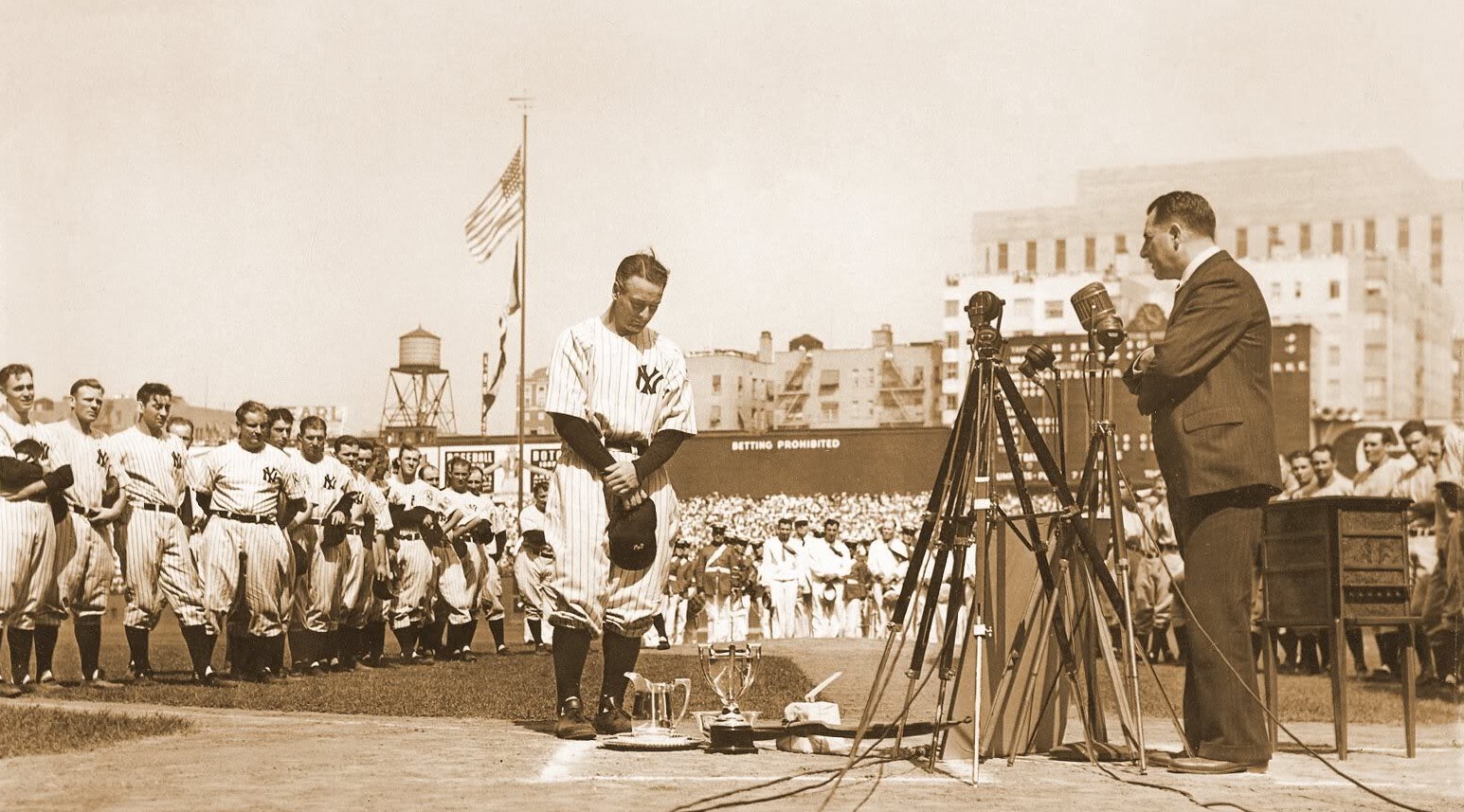
Ethics Quote Of The Day: Lou Gehrig, July 4, 1939

“Fans, for the past two weeks you have been reading about the bad break I got. Yet today I consider myself the luckiest man on the face of this earth.”

—-Baseball great Lou Gehrig, beginning his farewell speech to Yankee fans on July 4, 1939, as they filled Yankee stadium to say farewell to “the Iron Horse,” who was retiring from the game after being diagnosed with the incurable disease, amyotrophic lateral sclerosis (ALS), known forever after as “Lou Gehrig’s Disease.”

Lous Farewell

Lou Gehrig was only 36 years old when he learned that he was dying. ALS is a terrible wasting disease that has no cure, and in 1939 there was little treatment or assistance that could be offered to a victim as his body slowly ceased to function. It is an especially cruel disease for a professional athlete to face, and even more so one, like Gehrig, who was renowned for his endurance and seemingly indestructible body. When the progress of the illness, still then undiagnosed, caused Gehrig to remove himself from the New York Yankees line-up on May 1, 1939, it ended his amazing streak of 2,130 consecutive games, a baseball record that stood until broken by Cal Ripken, 56 years later.

Gehrig’s speech was from his heart. He was an educated and articulate man, but he had not planned on speaking at the moving ceremony to bid him farewell, as current former team mates, some of the greatest players ever to take the field, gathered to pay their respects. But the Yankee Stadium crowd of more than 60,000 began chanting his name, and after initially refusing, Gehrig moved to the microphone. Continue reading

Trust and “The Paradoxical Commandments” of Dr. Keith

In case you were wondering what was on that third tablet that Moses dropped…

I’m preparing a long business ethics program for a large corporation with some ethics issues (which is to say, for a large corporation), and while reviewing my files on business leadership re-discovered some material that I hadn’t looked at for a long while. One of them was “Anyway,” a poem that was also turned into an inspirational book by its author, Dr. Kent M. Keith.  He first wrote it for student leaders in 1968 while an undergraduate at Harvard.

One wonders if what he called “The Paradoxical Commandments” would have occurred to anyone but a student, before he could become jaded, cynical, disillusioned, or stuffed with so many scholarly  details, controversies and nuances regarding ethics that such an idealistic view was tainted forever.  (I should note that Dr. Keith has obviously become none of those things, perhaps because he was able to remain true to his own youthful advice.)

The poem is really about trust, the essence of ethics. There is no question that those who trust—in people, in institutions, in justice, in fairness—will inevitably be betrayed and disappointed, sometimes tragically.  Yet to stop trusting in those things, which so much human experience and simple logic dictates is the safest, most sensible course, is to damn one’s life and the society we live in to perpetual mediocrity, fear, and darkness. Democracy is based on trust of an idea: that human beings can be trusted to live their own lives, and that under the inspiration and catalyst of freedom, will create, persevere, love and build a healthy and happy society. There is plenty of evidence that suggests that trusting this idea is risky and foolish, yet trust is its only hope for fruition. So we must trust anyway.

I’ve never posted Dr. Keith’s poem on Ethics Alarms before. I should have. Here it is: Continue reading

Ethics Quote of the Week: Wellesley High School Teacher David McCullough

“Exercise free will and creative, independent thought not for the satisfactions they will bring you, but for the good they will do others, the rest of the 6.8 billion–and those who will follow them.  And then you too will discover the great and curious truth of the human experience is that selflessness is the best thing you can do for yourself.  The sweetest joys of life, then, come only with the recognition that you’re not special. Because everyone is.”

———-Wellesley High School Teacher David McCullough, in his commencement speech to graduating seniors. McCullough annoyed some parents by basing his speech on the fact that students today are encouraged to believe that they are more “special” than they are, leading to selfishness, narcissism and delusion.

Yes, the parents apparently wanted something more conventionally inspirational, like a speech telling their children how special they are.

The speech, in text and in video, has gone viral on the web; obviously it struck a chord that needed to be struck. I wasn’t going to post about it, I must confess; I think it McCullough’s speech is being over-praised. It is disorganized. It includes false information (50% of all marriages do not end in divorce, but that fake, unsubstantiated statistic  is harder to kill than the Hydra), and I don’t think teachers should be disseminating bad facts. It contradicts itself: “Don’t bother with work you don’t believe in” is dangerous and confounding advice for narcissists who one is trying to convince to think of the needs of others. And throbs with the smug contrariness of someone who set out to be controversial. Continue reading

Credit Ethics: New Ethics Alarms Policy

The sound of my palm belatedly smacking my expansive forehead

What will heretofore be referred to as “The Mary Frances Prevost Affair” has its silver lining. Watching another blogger incorporate the main body of my blog post into her own by-lined essay without credit or attribution has caused me to do a lot of thinking about the inadequacy of credit and attribution in the blogosphere  generally, with a relatively  few exceptions. Most of these are blogs written by academics who hold to the standards of their profession rather than the much looser practices of the internet. It also caused me to wake up to the inadequacy of my own attribution practices on Ethics Alarms. I have never taken an entire post from another source and represented it as my own, but I have frequently taken a factual account of a story from another website that itself was essentially  republishing, for example, an AP story, put the facts in my own words, sometimes with a stray phrase remaining, and not credited either source. I have often derived information in a post from multiple news sources but only linked to the one that I felt related the event the most thoroughly and clearly. Another writer’s work has sometimes sparked an idea for a post that was substantially different, and I have not credited the source of that spark.

All of this is common practice in blogging, but it is still wrong, and sloppiness is always a slippery slope. In the wake of “The Mary Frances Prevost Affair,” a colleague alerted me that I had included one complete sentence and part of another in an Ethics Alarms post that were identical to the post of another writer on the same subject. I didn’t even recall using the source, but upon going over my notes, I found that the earlier post had supplied me with the bulk of the facts I relied upon, though not the analysis of them. . I immediately contacted the author to apologize, and he was gracious and understanding. Nonetheless, this should never happen, especially on an ethics blog.

Therefore, as of today, Ethics Alarms will maintain a strict policy of crediting all sources that go into the inspiration, research and writing of the posts here. Links in the body of the text will be either be for informational purposes only, such as when I make a gratuitous cultural reference that nobody under the age of 50 is likely to recognize, or to back up direct quotes. At the end of each post, there will be credits and/or links listed, when appropriate, in some or all of the following categories: Continue reading

My 15 Hollywood Cures For A Paterno-Penn State-Sandusky Hangover, Part 2

Part 1 listed the first seven of my 15 cinematic remedies for Penn State-inspired ethics ennui. Part 2 includes the final eight. Please don’t take the order too seriously; I could have shuffled the whole batch. I also tried to include as many genres as possible. When it comes to ethics, good lists can be compiled using all Westerns, all sports movies, all war movies, courtroom drama or science fiction. Here we go…

8Spartacus (196o)

The raw history is inspiring enough: an escaped gladiator led an army of slaves to multiple victories over the Roman legions in one of the greatest underdog triumphs ever recorded. Stanley Kubrick’s sword-and-sandal classic has many inspiring sequences, none more so than the moment when Spartacus’s defeated army chooses death rather than to allow him to identify himself to their Roman captors (“I am Spartacus!”)

Ethical issues highlighted: Liberty, slavery, sacrifice, trust, politics, courage, determination, the duty to resist abusive power, revolution, love, loyalty.

Favorite quote: “When a free man dies, he loses the pleasure of life. A slave loses his pain. Death is the only freedom a slave knows. That’s why he’s not afraid of it. That’s why we’ll win.” [Spartacus (Kirk Douglas)] Continue reading

My 15 Hollywood Cures For A Paterno-Penn State-Sandusky Hangover, Part 1

For this hangover, movies work better.

The past week, as much as any week within memory, has caused me to despair about the culture, the state of ethical values in America, and my own futile efforts to try to bring some light to the darkness. My mood was not only ravaged by the Penn State scandal (and Penn State’s students’ scandalous reaction to it), but also the continued drift and incompetence in our government and the lack of any apparent leadership or courage to address the problems of our economic system, other than to complain about them.

In such times—there have been others, though happily not many—my spirit urgently needs an infusion of inspiration and hope, and fast: as Al Pacino reminds us in “Scent of a Woman,” there is no prosthesis for an amputated spirit. This is when I turn to the movies that speak to me of courage, redemption, and ethical virtues validated. They are my lifeline; I can’t write or think about ethics from the bottom of a pit. I’ve got only a few days before Thanksgiving, after all. This is no time to be cynical and dubious about the course of humanity and the United States of America, a nation I love and admire.

Thus I am going to take a brief detour from the usual format of Ethics Alarms, with your leave and forgiveness, and share with you the fifteen movies that I will turn to as I try to recharge my enthusiasm, inspiration, and hope. Here are 1 though 7; the rest will be along shortly:

1. A Man For All Seasons (1966)

Hardly the most upbeat film to start the list, but probably the greatest ethics movie ever made.

Ethical issues highlighted: Integrity, honesty, courage, leadership, corruption, abuse of power.

Favorite quote: “Why Richard, it profits a man nothing to give his soul for the whole world… but for Wales?” [Sir Thomas More (Paul Scofield)] Continue reading

“The Star Thrower” and Ethics

My response to the Ethics Alarms reader who pronounced my efforts here pointless and futile received many kind responses from commenters, several of who have pointed me to the story of the man who threw starfish into the sea. I had never read it or encountered it is any way. The fable is often simplified to represent the lesson that just because one person cannot “save all the starfish dying on all the beaches,” saving one by throwing it back into to the sea is still worth the effort, if only to the starfish that is saved. I am grateful for that analogy to what I do, but even more grateful for being alerted to the original  “The Star Thrower,” by anthropologist/philosopher/ writer Lauren Eiseley (1907-2007)

He had a lot more wisdom to convey  to us. You can read “The Star Thrower ” here.

The Message or the Messenger: The Mysterious Foundation For A Better Life

Does it matter who's behind the curtain?

The Foundation for a Better Life sponsors those slick TV spots promoting ethical values like kindness, sportsmanship, charity, and sacrifice. I have long wondered where they came from, and belatedly visited the organization’s website, Values.com, where I spent quite a while clicking through their extensive links to descriptions of core ethical values and inspiring stories. Not bad. The only deficiency I could see with the site was the lack of any explanation regarding how the Foundation was funded, who ran it and who was responsible for it. The site describes itself thusly:

“The Foundation is a non-profit 501(c)(3) organization, started in 2000. Our sole objective is to promote positive values, using print and broadcast media.

We want the stories we share about the positive actions and values of others to serve as inspiration for someone to do one thing a little better, and then pass on that inspiration. A few individuals living values-based lives will collectively make the world a better place.

The Foundation does not have a political or religious agenda. Our values are selected with the hope that most individuals would find these values universal, encouraging, and inspiring. The Foundation acknowledges that each person has a unique lens through which he or she views the world. Naturally there are religious, nonreligious, political, and cultural views that give meaning to our lives. Our objective is to provide a wide spectrum of values without any intended agenda or slant and provide an uplifting message around each one.”

And this appears to be exactly what the Foundation does. Continue reading

The Dilemma of the Legless High School Pitcher

Seemingly an inspirational movie in the making, Anthony Burruto is a student at Dr. Phillips High School in Orlando, Florida. He has been playing baseball since he was 8 years old, despite the inconvenience of having both of his legs amputated when he was an infant. He plays the game on prosthetic legs that are all he has ever known, and does it well as a pitcher who can throw a mean curve and a fastball that has been clocked at 80 mph. This is Anthony’s sophomore year, and his goal was to play on Dr. Phillips High varsity baseball team this spring.

After two days of try-outs, Coach Mike Bradley cut him. Anthony’s metal legs, adept as he was at using them, made him too slow off the pitching mound when he had to field a bunt, said the coach, and teams would take advantage of his inability to jump off the mound quickly.

Sorry, kid.  Continue reading