Morning Ethics Warm-Up: 8/25/17

Good Morning, everyone!

[I thought I had posted this two hours ago! I’m sorry!]

1. Re President Trump’s latest anti-news media rant: American journalism’s abandonment of partisan neutrality, competence and professionalism has become the single greatest threat to the nation’s functioning democracy, along with the erosion of public trust that this has caused. I have previously endorsed President Trump’s earlier statement that the news media has become an enemy of the people it is supposed to serve. However, saying, as he did this week, that journalists don’t “love America” is incompetent and irresponsible.

But what else is new. Journalists just over-overwhelmingly hate him, and cannot muster the professionalism to do their duties fairly as a result. (Norah O’ Donnell actually interrupted Trump’s anti-journalism rant to call him a liar—nice.  A network news operation with professional standards would suspend her for that. ) To be fair to the President, his use of language and comprehension of it is devoid of nuance. I presume that to him, saying that the news media hates America, hates him, and is the enemy of the people all mean the same thing.

2. Let’s keep track of which journalists and politicians relate Hurricane Harvey to climate change, or cite the dangerous storm as more evidence that the “consensus” is correct. This is the first major hurricane in 12 years, in defiance of virtually all predictions and climate change models, which told us that the warming earth would lead to more frequent violent storms, not fewer. Of course, the sudden and unexpected dearth of hurricanes during the entire Obama administration (no, Super Storm Sandy was not a hurricane) also doesn’t prove that climate change is a crock. But every single individual, activist, meteorologist, reporter, talking head, Democrat and Al Gore Fan Club member that points to Harney and says, “See???” is proving that he or she isn’t interested in the truth, just in furthering an agenda.

3. We shouldn’t allow California to secede, but it will be tempting, if it ever comes to that. Continue reading

Casting Ethics And “The Music Man”

A recently closed summer production of “The Music Man” at the Berkshires’ Sharon Playhouse illustrates many of the ethics landmines overly ambitious directors and non-traditional casting can trigger.

New York director Morgan Green was hired to direct Meredith Willson’s  1957 classic. Until “Hamilton” came along, only two Tony winning musicals had a book, lyrics and music all written by one person: “The Music Man” and “Oliver!” “The Music Man” isn’t my favorite musical, but a strong argument can be made that it is the Great American Musical, celebrating small town Americana with Sousa-style marches, barbershop quartets, and the best ending in musical theater history (stolen, with great success, by “School of Rock.”) There is no need to mess with it, since the show is pretty close to perfect. I was taught that a production should be equally satisfying for an audience member who is seeing a show for the first time and for one who is seeing it for the last time.  A version that takes the show out of 1912 and litters the landscape with anachronisms and forced 2017 social and political references isn’t fair to either of these. This was, I presume from based on Jesse Green’s review, a “Music Man” for people sick of “The Music Man” (like Jason Green.) You know what? If a director is sick of a show, she has an ethical obligation to let someone direct who isn’t sick of it.

Naturally, there was the obligatory stunt casting of women in some men’s roles (but never men in women’s roles, of course), and  the non-traditional casting of a black actress as Marion (the Librarian) Paroo, the romantic lead originally created by the recently departed Barbara Cook in the original production.

I see no problem in principle with casting Marion as black. It’s certainly ahistorical, and the hint of a trans-racial romance in 1912 Iowa is unimaginable, but “The Music Man” is, or should be, about kids, romance, parades, sentiment and fun, none of which is impeded by non-traditional casting.

There is a problem, though. One of Marion’s big solos, in which she sings about her ideal man (whom her mother believes is too ideal to be real), is called “My White Knight.”

Oh-oh. Continue reading

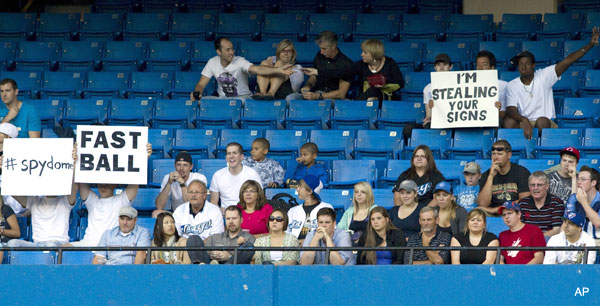
When “Ick!” Strikes Out Ethics: The Intensifying Robo-Umpire Controversy

[I see that I last wrote about this issue in April, and before that, in June of 2016, and in 2012 before that.Well, it’s worth writing about again, and again, until ethics and common sense prevails.]

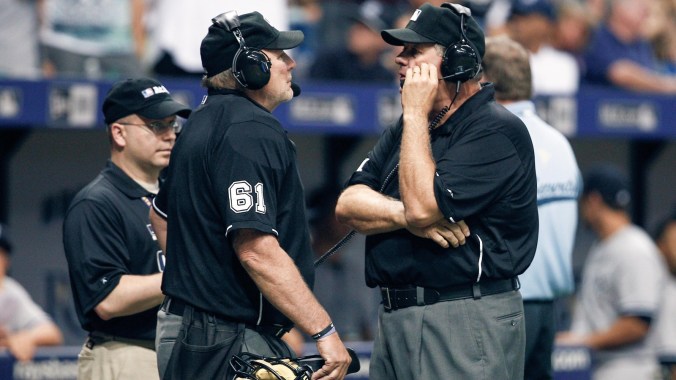
This weekend Major League Umpires held a silent protest, wearing armbands in support of colleague Angel Hernandez, whose competence was publicly questioned by Detroit Tiger player Ian Kinsler. In fact, Angel Hernandez is a terrible umpire, and terrible, indeed, even mildly fallible umpires have a problem now that they never had to worry about in the good old days: their mistakes are obvious and recorded for all to see.

Yesterday Red Sox color man and former player Jerry Remy was reminiscing during the Red Sox -Yankee game broadcast about one of his few home runs. He said he had struck out, missing with his third swing by almost a foot, and was walking back to the dugout when the umpire called him back, saying he had foul-tipped the ball. “I know that was wrong, but I’m not going to argue I’m out when the ump says I’m not.” Remy said. He went back to the plate, and on the next pitch hit a home run. “Of course, they didn’t have replay them,” Jerry added.

Before every game was televised and before technology could show wear each pitch crossed the plate, balls and strikes were called definitively by umpires, many of whom proudly had their own strike zones. “As long as they are consistent with it ” was the rationalization you heard from players and managers. It was, however, a travesty. The strike zone isn’t a judgment call; it is defined, very specifically, in the rules. A pitch is either within the legal zone or it is not. A strike that is called a ball when it is not, or vice-versa, is simply a wrong call, and any time it happens can affect the outcome of the at-bat and the game. If you watch a lot of baseball, you know that we are not just talking about strikeouts and walks.  The on-base average when a batter is facing a 2 balls, one strike count as opposed to a 1-2 count is significantly higher. The wrongly called third pitch can change the result of the at bat dramatically.

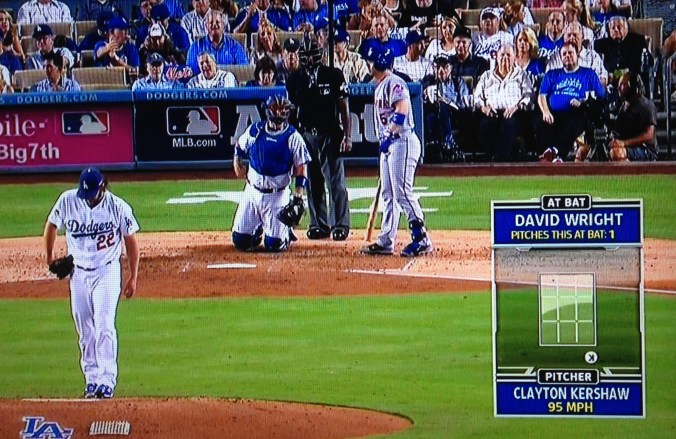
Since the technology is available to call strikes correctly 100% of the time, why isn’t the technology being used? Actually it is being used, in TV broadcasts. The fan can see exactly when the umpire misses a call, and the broadcasters talk about it all the time. “Where was that?” “That was a gift!”  “Wow, the pitcher was squeezed on that one.” Once, a missed call in a game was virtually undetectable, because one could assume that the umpire had a better and closer view than any fan or broadcaster could have. Now, there is no doubt.

Yet the players, sportswriters and broadcasters still overwhelmingly argue against the use of computer technology to call balls and strikes. It’s amazing. They know, and admit, that  mistaken  ball and strike calls warp game results; they complain about it when it happens, point it out, run the graphics repeatedly to show how badly a crucial call was botched, and yet argue that a completely fixable problem with massive implications to the players, the games and the seasons, should be allowed to persist.

These are the rationalizations and desperate  arguments they advance: Continue reading

Accumulated Ethics Notes On The Charlottesville Riots, The Statue-Toppling Orgy and The Confederate Statuary Ethics Train Wreck, Part 2 Of 3: Amy Alkon Loses Her Mind

Part One is here.

Perhaps the scariest capitulation to the Confederate statue hysteria is Amy Alkon, the usually astute and level-headed blogger, advice columnist and political correctness foe (her book is called “Good Manners For People Who Sometimes Say Fuck“). I often quote her and cite her blog, which in some ways is similar to Ethics Alarms.  Tragically, this issue has both lobotomized and hypocritized her:

Not “Foolish” To Remove Confederate Statues From Public Squares — It’s What We Do To Be Decent Human Beings And Fellow Americans To Black Americans

That “so foolish” remark is how the President put it — and, as usual — as John McWhorter pointed out on CNN, it comes from an impulse appropriate to a 12-year-old boy.

There’s the argument some are dragging out that Jefferson owned slaves (so shouldn’t we yank his statues and pictures, too?). I’m disgusted by that; however, it’s a side note to what he was to this country — to all he gave to this country. So, no, I’m not for going around the country and doing searching background checks on all the subjects of monuments and pulling them down.

Having monuments to confederate leaders in public squares, however, is like naming a school “Hitler Junior High.”

It’s a horrible slap in the face to black citizens and it makes me sadder than any of the stuff that we’ve seen in the news lately.

Yes, disgustingly, people are actually fighting to have monuments up that glorify people who believed blacks to be inferior and fought to the death to protect that view and the shameful capture and enslavement of other human beings that went with it….

What? What hysterical, historically ignorant social justice warrior has a cocked gun at Amy’s head, making her type crap like this? Let’s see:

1. It is foolish…short sighted, destructive, presentist, hysterical, knee-jerk—to remove “Confederate statues” by which Suddenly Stupid Amy really means “Individuals who at some point in their career performed bravely or ingeniously in the Confederate army, or on the side the Confederacy.” Are monuments to President John Tyler, who served in the Confederate cabinet, Confederate monuments? Tyler is the one who decided that the Vice President should become President, not just acting-President, when a President dies in office. I’ve visited his home in Virginia; we honor him on President’s Day.

If Tyler hadn’t made his stand for the continuity of government, Lyndon Baines Johnson, the masterful liberal Democrat who moved heaven and earth to pass the Civil Rights Act, would almost surely never have been President at all. Every American should raise their eyes heavenward in thanks to Tyler’s statues and monuments, especially African Americans. Were his honors raised to emphasize Jim Crow? Hardly. Jefferson Davis was a distinguished statesman based on his public service before the civil war, just as Pete Rose was a record-setting baseball player before he got himself thrown out of baseball for gambling. Pete’s statue is justified for his on-field achievements, just as Davis’s honors can be justified by his that had nothing to do with the Confederacy.

2.The President’s words are typical of a twelve-year old. Those criticizing him for properly standing up for his nation’s historical record, complex human beings and major figures in our history who are not just good or bad but an amalgam of influences, upbringing, the times and regions in which they lived and the circumstances under which they made crucial choices, and for seeing immediately the perils of forced cultural amnesia may be more articulate—it isn’t hard—but have failed a test of citizenship that he has passed with flying colors.

3. The fact that Thomas Jefferson was not only a slaveholder but one who repeatedly raped a slave who did not have the power to say “no” while he was extolling her “inalienable rights” is no “side issue.” How breezily Alkon, a fierce feminist, abandons her values so she can oppose Donald Trump!

Yechh.

Alkon is taking the “No True Scotsman” fallacy in her teeth. “We must pull down the statues and memorials of supporters of slavery because they are insults to African Americans, but Jefferson isn’t really a supporter of slavery.” No, he was also a moral coward, a liar, a thief, and perhaps the biggest hypocrite in American history.  Forced to choose, I’ll take Robert E. Lee over Jefferson for character every time. However, Tom wrote our mission statement as a nation, defined our values in his words (though not his conduct), and managed to pull off the Louisiana Purchase.

Those achievements are worth every honor we have given him. The thesis behind the statue assault, however, is that only the bad stuff recognized in hindsight matters. Amy’s rebuttal to those who rightly recognize the unethical nature of that assertion consists of shouting “That’s ridiculous!” She doesn’t have a legitimate rebuttal. There isn’t one. Continue reading

Accumulated Ethics Notes On The Charlottesville Riots, The Statue-Toppling Orgy and The Confederate Statuary Ethics Train Wreck, Part One

As an introduction, I have to say that this episode, which has quickly turned into an ethics train wreck of sweeping and perhaps catastrophic proportions, frightens me as few issues do. It has become a danger to free speech, to cultural diversity, to liberty, education, historical fairness, cultural cohesion and  common sense. It appears to be the metastasis of all the demonizing rhetoric, self-righteous pandering and virtue-signaling, and totalitarian-minded efforts to remold the past in order to control the future. The level of contempt, hate and intimidation being focused on those who—like me—are attempting to keep the issues in perspective by analyzing complex and emotional ethical components in context is causing the fervor involved to approach  that of unthinking mobs. The damage done by the worst mobs of the past, however, were mostly confined to a restricted region, or, like The Terror in France or the Red Scare here, were immediately repudiated one the fever broke. I’m not sure that this fever will break, at least not before it breaks us. It is the perfect storm of self-righteous fanaticism, as the anti-Trump hysteria collides with Obama era race-baiting and victim-mongering, both of which have run head on into the mania for air-brushing history to remove any mention of events, movements, attitudes or human beings that “trigger” the perpetually outraged of today.

Social media has magnified the intensity of this already deadly storm, by allowing once intelligent people to throttle their brains and judgment into mush by confining their consideration of the issues to partisan echo chambers. Daily, I am embarrassed and horrified by what I read on Facebook by people who I know—I KNOW—are capable of competent critical thought but who have completely abandoned it to be on the “right” side, where facile, half-truths and lazy conclusions are greeted by a myriad “thumbs up” and “hearts.”

And I am angry–contrary to popular opinion, I’m not usually emotionally involved in the issues I write about; like Jessica Rabbit, who isn’t really bad (she’s just drawn that way), I’m not usually as intense as I seem. I just write that way—that I am so tangential and impotent that what see so clearly has little persuasive power at all, because I’ve frittered away my opportunities to be influential in a thousand ways.

I have never allowed futility to stop me, though, because I have spent a lifetime banging my head against walls.

Here are the ethics observations I’ve been accumulating since the first torches were lit in Charlotte:

  • Please watch this video, from Ken Burn’s “The Civil War”:

I was moved when I first saw this, which was in the documentary’s final chapter, and I am moved still. The old Union soldiers moaned when they saw the men who had tried to kill them, and who had killed their friends and comrades, re-enacting their desperate open field march into deadly artillery. Then they dropped their arms and met their former foes, and embraced them.

These men didn’t think of the former Confederates as traitors, or racists, or slavery advocates. They, like the Union veterans, were just men of their times, caught up in a great political and human rights conflict that came too fast and too furiously for any of them to manage. They were caught in the same, violent maelstrom, and knew it even 50 years earlier. Soldiers on both side wrote how they admired the courage of the enemy combatants they were killing, because they knew they were, in all the ways that mattered, just like them. It was the Golden Rule.  After the war, these soldiers who had faced death at the hands of these same generals, officers and troops, did not begrudge them the honor of their statues and memorials, nor their families pride in the bravery of their loved ones.

Yet now,  self-righteous social justice censors who never took up arms for any cause and in many cases never would, employ their pitifully inadequate knowledge of history to proclaim all the Civil War’s combatants on the losing side as racists and traitors, and decree that they should be hidden from future generations in shame. We have honored men and women for the good that they represent, not the mistakes, sins and misconduct that are usually the product of the times and values in which they lived. In doing so, we leave clues, memories, controversies, differing vews, and stories for new generations to consider and better understand their own culture and society, and how it came to be what it is.

Those who want to tear down monuments to the imperfect, whether they know it or not, are impeding knowledge, perspective, wisdom, and understanding. They want only one view of history, because they will only tolerate one that advances their ideology and values—just as the Americans of the past believed in their values. Foolishly, I suppose, they trusted future generations to act on their own ethical enlightenment without corrupting the historical record. Continue reading

From The “Grandstanding Ingratitude” Files…Ethics Dunce: Boston Red Sox Owner John Henry

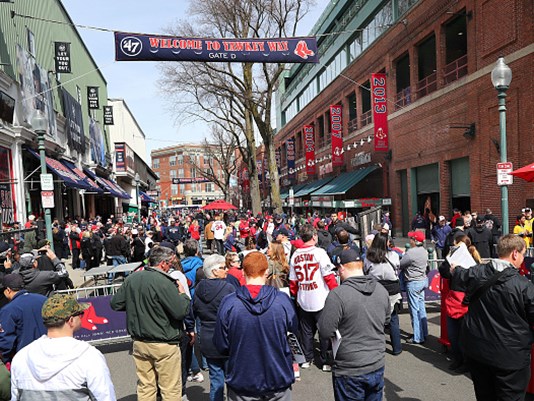
Ah, Ethics Alarms heaven! The statue-toppling mania issue has collided with the Boston Red Sox, just two days after my pilgrimage to Fenway Park!

ESPN reported yesterday that Red Sox owner John Henry wants Boston to change the name of  the street that borders the legendary park, Yawkey Way, and he is trying to exploit the   current political correctness mania that has cities pulling down statues of war heroes in the dead of night to accomplish his goal.

That’s my characterization, of course, not ESPN’s.

Henry told the Boston Herald that he is “haunted” by the racist legacy of previous owner Tom Yawkey, who led the team from 1933 to 1976. Because he is haunted, he thinks that it is fair and right that the man who beyond question saved the team, ran it as a Boston institution and public utility, and is as responsible as anyone for the fact that Henry owns one of the prestige franchises in all of sports, should be dishonored and shunned because he wasn’t enlightened about civil rights long before Martin Luther King began marching.

Such disgraceful moral grandstanding and self-righteous ingratitude is seldom seen. But I guess if anyone should be able to grandstand, its someone who owns a baseball park.

For those who mock the idea that the desecration of Robert E. Lee’s statues leads directly to George Washington, now hear this; for the Boston Red Sox, Tom Yawkey is George Washington.

The only owner any one remembered before Tom Yawkee bought the team was Harry Frazee, consigned to Beantown Hell for selling Babe Ruth (and many other stars) to the New York Yankees in 1919. From that moment on, the team was a perennial loser, often in last place, while New York won pennant after pennant and sneered at its proud rival on the Bay. In 1933,

Tom Yawkey , a lumber tycoon and baseball enthusiast, bought the team and poured money and love into it, buying other team’s stars (Left Grove, Joe Cronin, Jimmy Foxx) and turning the team into worthy challenger to the Yankees.  From the beginning, Yawkey paid no  attention to the bottom line as he tried to build a champion out of the franchise, or as he put it, “to bring a championship back to the fans of Boston.” This was during a period when teams had permanent control over player contracts, and most owners used that leverage to pay players pathetic wages. Not Tom Yawkee. He was criticized for over-paying players–hilarious now, when we’re talking about his paying a utility infielder $15,000 when others of his ilk were making just $8,000, and current utility players make a couple million dollars a season. Sportswriters in Boston called the Red Sox a country club, and blamed Yawkee for “falling in love with his players.” In 1960, Ted Williams had to ask Yawkey to cut his salary, because he felt embarrassed after a bad year, his only one.

Was Yawkey a racist? He was born in 1903, and grew up during the Wilson Administration, when Jim Crow really took of. Sure he was a racist, along with about 95% of the whites in the nation.  Continue reading

An Ethics Hypothetical: If “The Nation” Is Right About The DNC Hacks, How Should Democrats And The Mainstream Media React?

And how will they react?

Yesterday, The Nation, the most Left of the Left’s major national publications, reported this:

  • There was no hack of the Democratic National Committee’s system on July 5 last year—not by the Russians, not by anyone else. Hard science now demonstrates it was a leak—a download executed locally with a memory key or a similarly portable data-storage device. In short, it was an inside job by someone with access to the DNC’s system. This casts serious doubt on the initial “hack,” as alleged, that led to the very consequential publication of a large store of documents on WikiLeaks last summer.
  • Forensic investigations of documents made public two weeks prior to the July 5 leak by the person or entity known as Guccifer 2.0 show that they were fraudulent: Before Guccifer posted them they were adulterated by cutting and pasting them into a blank template that had Russian as its default language. Guccifer took responsibility on June 15 for an intrusion the DNC reported on June 14 and professed to be a WikiLeaks source—claims essential to the official narrative implicating Russia in what was soon cast as an extensive hacking operation. To put the point simply, forensic science now devastates this narrative.

“This narrative” has been a cornerstone of the effort, undemocratic and indefensible, to undermine the legitimacy of Donald Trump’s Presidency from the beginning. It was launched as a primary rationalization for Hillary Clinton’s stunning loss, James Comey and a sexist, racist, stupid electorate being the others. As the Nation writes,

“The evolution of public discourse in the year since is worthy of scholarly study: Possibilities became allegations, and these became probabilities. Then the probabilities turned into certainties, and these evolved into what are now taken to be established truths. By my reckoning, it required a few days to a few weeks to advance from each of these stages to the next. This was accomplished via the indefensibly corrupt manipulations of language repeated incessantly in our leading media.”

The Nation’s report, essentially declaring that a major element in the “Russiagate” narrative, the DNC hacks, is fiction, that the intelligence agencies that declared it otherwise are wrong, and that Wikileaks, Russia, Putin and Donald Trump have been correct all along is noteworthy because the publication is no ally of the Republicans or Trump, but their declared intractable foes. This is an ideological publication, squarely in Bernie Sanders’ camp because it is run by Socialists like Bernie. But bias doesn’t necessarily make you stupid. The Nation has been around for a long time because while its analysis is colored by it view of humanity and the world, it has largely avoided the kind of dishonesty and distortion that are slowly destroying the credibility of CNN, Rolling Stone, the New York Times and others. The Nation has strived to maintain its integrity, not always succeeding, but obviously trying. Its staff believes that the truth supports its dedication to socialism, so it does not usually try to hide the truth—unlike the mainstream media reporters, for example, who apparently tried hard to make the troubling episode of Bill Clinton’s meeting with Loretta Lynch go away. Continue reading

The Audacious And Everlasting Hypocrisy Of Al Gore

In June, CNN’s Jake Tapper asked Al Gore about his apparent energy-use hypocrisy:

TAPPER: This is a criticism we hear from conservatives all the time when talking about people like you or Elon Musk or Leonardo DiCaprio, that you, yourself, have a large carbon footprint.

GORE: Yes. Well, I don’t have a private jet. And what carbon emissions come from my trips on Southwest Airlines are offset. I live a carbon-free lifestyle, to the maximum extent possible.

As Ann Althouse noted at the time, for  a carbon-based organism like Gore to claim to be living carbon-free is a demonstration of shocking ignorance by someone who has been making his millions as an earth-science huckster. To me, the amazing thing was that after repeatedly showing that he couldn’t pass a middle-school science test (as when he declared on national TV that the core of the Earth was “several million degrees”)

After he found himself the official guru of global warming hype, Gore should have had the sense and discipline to educate himself and really learn about the topics he was purporting to be an expert on. He obviously didn’t bother; like the similarly lazy Sarah Palin, he figured that the people who agreed with him weren’t going to be that discerning, so mastery of facts wasn’t worth the trouble.

The other infuriating aspect of Gore’s answer to Tapper  was his “offset” excuse. That just  meant “I’m rich, so I pay to for all my carbon pollution.” Gore really believes that leaving a carbon footprint the size of Godzilla is responsible conduct for a climate change shill telling the peasants that they must change their life-style, because he can “offset” it. He really believes that’s fair and honest.

In the wake of Gore’s sequel to his error and hype-filled climate change alarmist documentary “An Inconvenient Truth,” the National Center For Public Policy Research, which had embarrassed Gore with its 2007 revelations after his first documentary, checked to see if Al, as he promised at the time, had addressed his own polluting ways. It checked Gore’s electricity usage information through public records requests and conversations with the Nashville Electric Service (NES), and found.. Continue reading

Morning Ethics Warm-Up: 8/1/17


Good Morning, World!

1. Follow-Up on the 7/28 morning post: Sometimes a popular public figure’s words and conduct so obviously show a deficit of character that I wonder if those who admire him or her are not paying attention, or are creeps themselves. “Harry Potter” author J.K. Rowling is officially in this category. First, I do not care for foreigners who obsessively bash our leaders, however bashable. They don’t have standing, in most cases, and their opinions are by definition uninformed if they don’t live here. Most obnoxious of all, however, in Rowling’s case, was her indefensible conduct regarding her recent infamous fake news tweet that circulated to her mob of followers a deceptively edited video showing President Trump cruelly ignoring a boy in a wheelchair, when he in fact stopped, crouched, and spoke to the child. She did this (“When someone shows you who they are, believe them.’ – Maya Angelou” was the snotty accompanying comment) on July 28, and the same day it was widely debunked, with the actual video being circulated on the web. No response came from Rowling, even as her tweet and libel continued to be liked and retweeted by “the resistance.”

On July 30, even CNN’s Brian Stelter, with extra time on his hands because his alleged news media ethics show avoids criticizing bias in the news media, flagged the bad tweet, and asked why Rowling hadn’t retracted it. Come on, Brian, you know why! It is for the same reason CNN continues to use unethical journalism to attack the President: they don’t believe he’s worthy of fairness or honesty.

Finally,  after various conservatives dredged up this year-old tweet from Rowling to show her hypocrisy and shame her with her own chosen words…

and after left-wing, fellow Brit Trump-basher Piers Morgan expressed frustration with her, and after PunditFact, a spin-off of PolitiFact, rated Rowling’s claim “Pants on Fire,” and after the boy’s mother herself denied that Rowling’s version occurred, the author finally retracted the tweet and took it down. She also tweeted this unethical apology:

Re: my tweets about the small boy in a wheelchair whose proferred hand the president appeared to ignore in press footage, multiple sources have informed me that that was not a full or accurate representation of their interaction. I very clearly projected my own sensitivities around the issue of disabled people being overlooked or ignored onto the images I saw and if that caused any distress to that boy or his family, I apologise unreservedly. These tweets will remain, but I will delete the previous ones on the subject.

This is a miserable apology, containing the stinking tell of the non-apology apology, “if anyone was offended” in this case the equivalent “if that caused any distress.”  The two people she non-apologizes to had no reason to be “distressed,’ since the tweet wasn’t an attack on them. This is not an apology at all, since it does not apologize ..

…to the person fraudulently attacked, President Trump, as well as his family and supporters

…to those deceived by her retweeted lie, and

…to the people who trusted her and became accessories in the false attack

…for taking four days to take down a lie that had been thoroughly exposes as one.

On the Ethics Alarms Apology Scale, it is a bottom of the barrel #10:

An insincere and dishonest apology designed to allow the wrongdoer to escape accountability cheaply, and to deceive his or her victims into forgiveness and trust, so they are vulnerable to future wrongdoing.

This rot is actually worse than a #10, as Rowling dares to ladle soppy virtue-signalling onto it. She only falsely attacked the President of the United States and spread a lie around the world because she is so, so sensitive and concerned about the treatment of handicapped people! Don’t you understand? It’s because she’s so compassionate and good that this happened!

It is my experience that good people can usually manage a sincere and remorseful apology to those harmed by their words or conduct.

2. This unethical lawsuit could sustain a stand-alone post, but I refuse to devote one to it as a matter of principle. Continue reading

From The Law vs Ethics Files: The July 24, 1983 Pine Tar Incident, When Baseball Chose Ethics Over Law, And Was 100% Wrong

I have written on this topic before, but this is the famous incident’s anniversary, and I have come to believe that the lesson learned from  the pine tar incident is increasingly the wrong one, and the consequences of this extend well beyond baseball.

On July 24, 1983, the Kansas City Royals were battling the New York Yankees at Yankee Stadium. With  two outs and a runner on first in the top of the ninth inning,  Royals third baseman George Brett hit a two-run home run off  Yankee closer  Goose Gossage to give his team a 5-4 lead.  Yankee manager Billy Martin, however, had been waiting like a spider for this moment.

Long ago, he had noticed that perennial batting champ Brett used a bat that had pine tar (used to allow a batter to grip the bat better) on the handle beyond what the rules allowed. MLB Rule 1.10(c) stated: “The bat handle, for not more than 18 inches from the end, may be covered or treated with any material or substance to improve the grip. Any such material or substance, which extends past the 18-inch limitation, shall cause the bat to be removed from the game.” At the time, such a hit was defined in the rules as an illegally batted ball, and the penalty for hitting “an illegally batted ball” was that the batter was to be declared out, under the explicit terms of the then-existing provisions of Rule 6.06.

That made Brett’s bat illegal, and any hit made using the bat an out. But Billy Martin didn’t want the bat to cause just any out. He had waited for a hit that would make the difference between victory or defeat for his team, and finally, at long last, this was it. Martin came out of the dugout carrying a rule book, and arguing that the home run shouldn’t count.  After examining the rules and the bat, home-plate umpire Tim McLelland ruled that Brett used indeed used excessive pine tar and called him out, overturning the home run and ending the game.

Brett’s resulting charge from the dugout (above) is video for the ages. Continue reading