Major League Baseball’s absurd and self-wounding decision to lump all of the old Negro League season and career statistics in with those of its own players is impossible to defend logically or ethically. Ethics Alarms discussed this debacle of racial pandering here, three days ago. What is interesting—Interesting? Perhaps disturbing would be a better word—is how few baseball experts, statisticians, historians, players and fans are defending this indefensible decision or criticizing it. As to the latter, they simply don’t have the guts; they are terrified of being called racists. Regarding the former, there is really no good argument to be made. MLB’s groveling and pandering should call for baseball’s version of a welter of “It’s OK to be white” banners and signs at the games. Instead, both the sport and society itself is treating this “it isn’t what it is” classic like a particularly odoriferous fart in an elevator. Apparently it’s impolite to call attention to it.
Astros first baseman José Abreu, 37, signed a three-year deal with a $58.5 million dollar guarantee last year that goes through the 2025 season. It was a risky free-agent signing: baseball position players peak at ages 27-29, and by 30, virtually all of them are declining unless they take the Barry Bonds route and cheat. Most are no longer MLB-worthy by age 34, though the better a player was, the more he can decline and still be valuable. (Hall of Famer Carl Yastrzemski had almost exactly the same season in his last year as he did as a rookie 22 years before: a perfect bell curve.) In the first year of his Astros deal, Abreu showed unmistakable signs that the jig was up. He had career lows in batting average, on-base pct., slugging pct., OPS (obviously: it’s slugging plus on-base average) and home runs. He was a below-average batter after a career of being All-Star caliber.
This season Abreu has been even worse. As the perennial World Series contender Astros have looked old, hurt and busted, he has been the worst of the bunch. He currently is batting .099 in 71 official at bats, with no homers; in fact, he ranks as the worst hitter in baseball right now.
Today came the stunning news that Abreu has agreed to go to the minors. As a veteran with over five years of major league service time, Abreu could not be optioned to “the bushes” without his consent, and veterans almost never give their consent. For an established star player to go to the minor leagues is like moving from the Ritz Carlton into a Motel 6. Abreu is a particularly unlikely exception, for he never played in the minors, coming directly to the major leagues as a refugee Cuban player.
Several things led me to re-posting this Ethics Alarms entry from 2017.
First of all, the MLB network showed a documentary on the career of George Brett today, and scene above, with Brett erupting in fury at the umpire’s call voiding his clutch, 9th inning home run, is one of the classic recorded moments in baseball history. There was also a recent baseball ethics event that had reminded me of Brett’s meltdown: Yankees manager Aaron Boone was thrown out of a game because a fan behind the Yankees dugout yelled an insult at the home plate umpire, and the umpire ejected Boone thinking the comments came from him.. When Boone vigorously protested that he hadn’t said anything and that it was the fan,Umpire Hunter Wendelstedt said, “I don’t care who said it. You’re gone!”
Wait, what? How can he not care if he’s punishing the wrong guy?
“What do you mean you don’t care?” Boone screamed rushing onto the field a la Brett. “I did not say a word. It was up above our dugout. Bullshit! Bullshit! I didn’t say anything. I did not say anything, Hunter. I did not say a fucking thing!” This erudite exchange was picked up by the field mics.
There was another baseball ethics development this week as well, one involving baseball lore and another controversial home run. On June 9, 1946, Ted Williams hit a ball that traveled a reported 502 feet, the longest he ever hit, and one of the longest anyone has hit. The seat was was painted red in 1984 (I’ve sat in it!), and many players have opined over the years that the story and the seat are hogwash, a lie. This report, assembling new data about the controversy, arrives at an amazing conclusion: the home run probably traveled farther than 502 feet.
But I digress. Here, lightly edited and updated, is the ethics analysis of the famous pine tar game and its aftermath:
***
I have come to believe that the lesson learned from the pine tar incident is increasingly the wrong one, and the consequences of this extend well beyond baseball.
On July 24, 1983, the Kansas City Royals were battling the New York Yankees at Yankee Stadium. With two outs and a runner on first in the top of the ninth inning, Royals third baseman George Brett hit a two-run home run off Yankee closer Goose Gossage to give his team a 5-4 lead. Yankee manager Billy Martin, however, had been waiting like a spider for this moment.
Long ago, he had noticed that perennial batting champ Brett used a bat that had pine tar (used to allow a batter to grip the bat better) on the handle beyond what the rules allowed. MLB Rule 1.10(c) states: “The bat handle, for not more than 18 inches from the end, may be covered or treated with any material or substance to improve the grip. Any such material or substance, which extends past the 18-inch limitation, shall cause the bat to be removed from the game.” At the time, such a hit was defined in the rules as an illegally batted ball, and the penalty for hitting “an illegally batted ball” was that the batter was to be declared out, under the explicit terms of the then-existing provisions of Rule 6.06.
That made Brett’s bat illegal, and any hit made using the bat an out. But Billy Martin, being diabolical as well as a ruthless competitor, didn’t want the bat to cause just any out. He had waited for a hit that would make the difference between victory or defeat for his team, and finally, at long last, this was it. Martin came out of the dugout carrying a rule book, and arguing that the home run shouldn’t count. After examining the rules and the bat, home-plate umpire Tim McLelland ruled that Brett used indeed used excessive pine tar and called him out, overturning the home run and ending the game.
Brett’s resulting charge from the dugout (above) is video for the ages. Continue reading →
Unlike most ethics quizzes, I’ve made up my mind about this incident, but I acknowledge that others may feel differently and have good reasons—maybe—to do so. I hate it, however.
The NBA’s LA. Clippers and Chick-fil-A collaborated on a promotion that if a player on an opposing team misses two consecutive free-throw attempts, fans will win a free Chick-fil-A chicken sandwich. And thus it was that when Houston Rockets’ Boban Marjanovic went to the free-throw with 4:44 to play in the fourth and final quarter of the Rockets’ game against the Clippers with his team leading 105-97 (not an insuperable margin), he had a twinkle in his eye. He missed his first shot, and the Clipper fans stared cheering—for chicken. Marjanovic looked around, pointed at himself, and bounced his shot off the basket rim. The fans went wild, and Marjanovic seemed to revel in his failure.
Yecchh.
…not that I want to influence you, now.
Your Ethics Alarms Ethics Quiz on this Patriots Day (in Boston) is…
“Was it ethical or unethical for Marjanovic to tank his free throw so the fans could get a free sandwich?”
Just listen to those idiots in the broadcast booth…
I absolutely think it was unethical; in fact, the NBA and his team should fine and suspend Marjanovic. But this is emblematic of why I detest pro basketball only slightly less passionately than I do the NFL. The sport has no integrity. Regular season games are virtually meaningless. Players literally play about 60% harder during the play-offs: you can see it.
This episode was disgusting, and unethical in more ways than one:
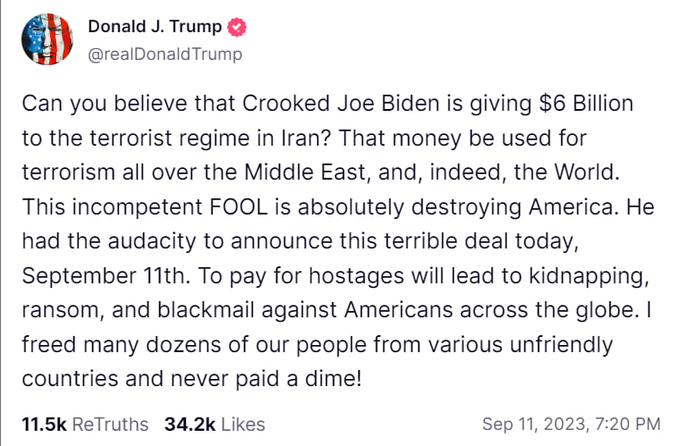
This social media snark is going viral now, and it should, though what Trump predicted should have been assumed by the administration, and apparently was. Of course, Trump’s post is marred by his typical bluster and name-calling, but that shouldn’t outweigh the fact that he was right. As one analyst this morning admitted, without Iran’s support, Hamas wouldn’t exist. Biden’s defenders are arguing that, well, the US didn’t really give all that money to Iran, because it was Iran’s money to begin with. Weak. Iran was given access to funds they didn’t not have access to, in exchange for hostages, and Iran seeds terrorist groups. Hamas launched a deadly sneak attack on Israel, guaranteeing war, and almost certainly would not have done so were it not assured of receiving financial support from Iran.
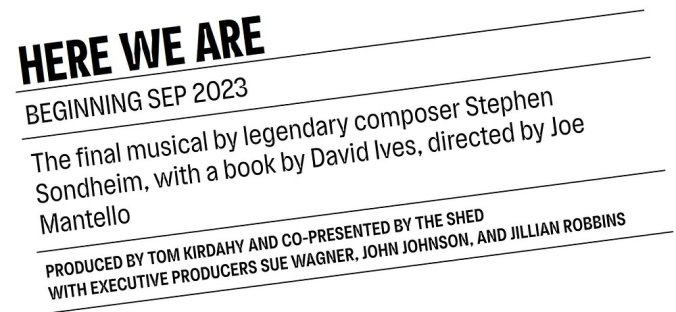
Two years after Stephen Sondheim’s death, “Here We Are” will premiere Off-Broadway in a 526-seat theater. Previously titled “Square One,” the show is based on Buñuel’s “The Discreet Charm of the Bourgeoisie” and “The Exterminating Angel.” The producers are advertising it as “the final musical by composer Stephen Sondheim;” it will open this week and run until January.
Sondheim, however, never finished the musical. In fact, when he announced that he had given up on writing it, Ethics Alarms saluted him, praising the Broadway icon for “doing the responsible thing, quitting….Virtually no composers and very few artists generally do anything but decline after the age of 60, though many try to keep churning out wan imitations of their best work as long as someone will pay them.” Sondheim’s last reasonably successful Broadway musical was “Passion,” in 1994, when the composer was 64. Before “Here We Are,” he labored for a decade over a musical that hit the stage in multiple versions with several titles. None of them were successful. Asked days before his death if he foresaw when his final musical would be finished, Sondheim curtly replied: “No.”
Yet now, mirabile dictu, his collaborators are announcing that the musical is complete. Interesting: Sondheim had said he finished all the songs in the first act, but had been stuck on writing songs for Act II. No problem! The show’s producing team now says that two months before Sondheim’s death, he had agreed to let the show go forward following a well-received reading of the material that existed at that point. That reading, however, contained no music. I’ve directed and organized many readings of new works, and the amount of rewriting, cutting and re-conceiving a show that takes place after that starting point is always massive–and often a show never makes it to production.
Yes, this perplexing ethics issue arises in baseball, but the principles it involves are applicable in other contexts. Attention should be paid.
Although there is no official definition, an immaculate inning in baseball occurs in baseball when a pitcher strikes out all three batters he faces in one inning throwing only nine pitches. This has only happened 114 times in Major League history, and been done by just 104 pitchers. The first immaculate inning was thrown by John Clarkson of the Boston Beaneaters against the Philadelphia Quakers on June 4, 1889. No-hitters, which automatically get a pitcher’s name in the Major League Baseball Hall of Fame in Cooperstown, are three times more common that immaculate innings. Throwing an immaculate inning is a career landmark for any pitcher.
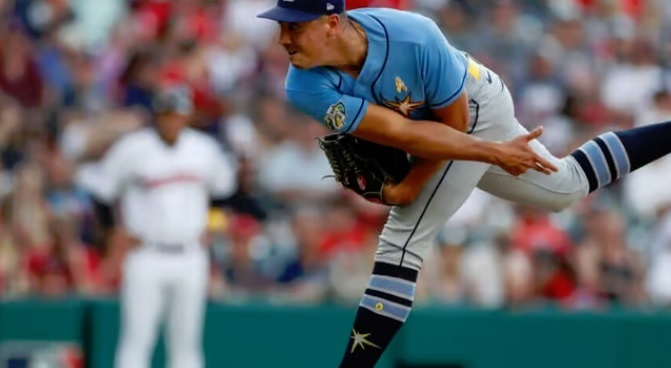
A week ago, Tampa Bay Rays reliever Robert Stephenson threw nine pitches to three Cleveland Indi—I’m sorry, Guardians batters and struck them all out on three pitches each. But whether or not this constituted an immaculate inning is still being debated. Within the controversy is a welter of ethics lessons and problems.
Over the weekend, I got to watch (again) the nauseating spectacle of Detroit Tigers firstbaseman Miguel Cabrera disgracing his own legacy as one of the greatest players of all time. A guaranteed first ballot Hall of Famer with over 3,000 hits and more than 500 career homers, Cabrera is no longer even a passable performer at age 40, and hasn’t been since 2017. That year and every year since, Cabrera has been paid an average of $30 million a season for production that the Tigers could have gotten from a mediocre minor league journeyman playing for the Major League minimum salary. All weekend, the TV broadcasters were blathering on about what a wonderful human being “Miggy” is. If he were really wonderful, he would have retired as soon as he realized he was stealing his salary and hurting his team in the process.
Cabrera has graciously announced that this will be his final season, as if he had any choice in the matter. His long term contract is up: he’s squeezed over $200 million out of it without having a single season worthy of his reputation or his salary. He has one (1) home run this season, with less than a third of the schedule to go. The year he signed his contract, he hit 44.
But Cabrera isn’t the subject of this post; I already complained about him and other greedy, fading players here. There’s a worse offender in baseball now, believe it or not. The current miscreant is St. Louis starting pitcher Adam Wainwright, who had announced before this season that it would be his last. [Wainwright, by the way, has one of the more varied and interesting Ethics Alarms dossiers among pro athletes.] He is 41, and not only are 40+-year-old pitchers who still belong in the Major Leagues rarer than star sapphires, Wainwright’s 2022 season at 40 was not a harbinger of optimism, though he still was getting batters out, albeit not as he once had. But Adam Wainwright has pitched for the St. Louis Cardinals and only them for 17 years , winning just short of 200 games along the way. He is regarded as a hometown hero to Cardinal fans, who also wanted him aboard for one more campaign because they had reason to think their perennial play-off team had a real chance to get to the World Series again in 2023, and nothing is more valued on such teams as a grizzled old veteran who has been through the wars before.
It was a good theory, anyway. Unfortunately, Wainwright was done, through, cooked, out of pitches and excuses. This season his earned run average is almost 9 runs a game, which means he is pitching batting practice to the opposition. A starting pitcher without a long-term contract and with no reputation as a team legend is usually cut if he can’t keep his ERA below 6; under 4 runs a game is good, under 4.5 is considered acceptable. But 8.78, which is what Wainwright has delivered in 15 starts? A decent college pitcher could do that well, maybe a top high school pitcher too. And for this consistent failure, Adam Wainwright is being paid $17,500,000.
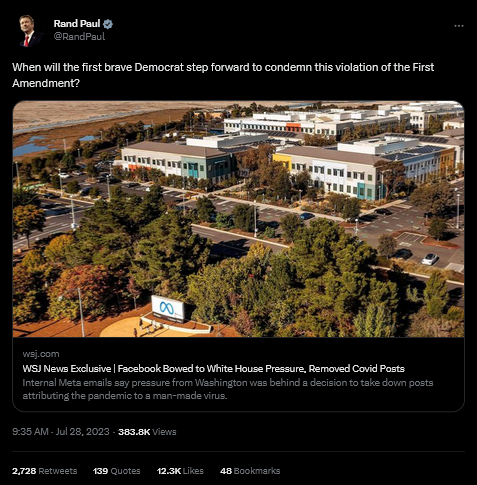
I was literally going to start this post with nearly the exact same statement, except I was going to ask how many progressives and die-hard Biden defenders would have the integrity to condemn the revelation that Facebook and Instagram censored posts and changed their content moderation policies after unconstitutional pressure from the Biden White House.
Not that this should have surprised anyone; it certainly didn’t surprise me, Censorship, deception and suppression of news, facts and reality is how the current mutation of the Democratic Party rolls, and Big Tech and social media have joined the mainstream media as their enablers and accomplices.
“We are supposed to be in the business of calling out the spin, not creating it…If we want the public to trust us in the news business, how can the entities themselves lie or spin their own news?”
—Lawyer, TV pundit and news host (“Nightline”) Dan Abrams,condemning NBC’s story that Chuck Todd was leaving “Meet the Press” to spend more time with his family.
Oh, bingo, Dan! And the answer to Abrams’ rhetorical question is: Given how much, often and routinely they lie, news organizations shouldn’t expect the public to trust them, yet they do, because they have no respect for the public’s intelligence and no regard for the duty of journalists in a democracy to keep citizens informed.



 Ethics Alarms