PETA’s Unethical Treatment Of Human Beings

"You keep using that word, "ethics." I don't think it means what you think it does."

“You keep using that word, “ethics.” I don’t think it means what you think it does.”

From whence comes PETA’s compulsion to periodically make the organization look as unethical and/or deranged as possible? If I were not charitable by nature, I would say that it was because the leadership of the organization is constitutionally unethical, and nuts. I suspect that the real answer is close to that, but it’s not exactly right. I think that PETA’s concept of ethics begins and ends with “the ends justfy the means,” that they are so besotted with the rights of animals that they dehumanize people, and that arrested juveniles run the organization.

The latest jaw dropper from People for the Ethical Treatment of Animals is to use money to induce poor people in Detroit to comply with PETA’s vision of an ethical lifestyle. From the PETA website:

“With jobs in Detroit disappearing, many residents are struggling. As they’re forced to choose which bills to pay, the Detroit Water and Sewerage Department has chosen for them―shutting off water and leaving many people high and dry. The department put the shutoffs on a temporary hiatus, but people’s water bills are mounting. So with the help of a generous PETA member, we have come up with one small way to assist Detroit residents and save animals, too.Thanks to this donor, PETA will be able to pay off the water bills for 10 families who commit to going vegan for one month. We’ll also help them get started by giving each family a basket of healthy vegan foods and recipes.”

In other word, PETA is exploiting the most vulnerable citizens of the urban wasteland known as Detroit to turn them into human billboards for the group’s utopian vision of an animal-friendly world. Continue reading
Senator Walsh’s Plagiarism

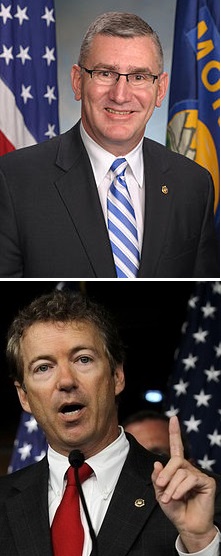
Walsh (top); Paul (bottom) "Whooo are you? Who, who, who, who?"

Walsh (top); Paul (bottom)
“Whooo are you? Who, who, who, who?”

U.S. Senator John Walsh (D-Mt) has an obligation to resign.

He was never elected to office;  Montana Governor Steve Bullock appointed him to fill the vacant  seat of Max Baucus, who resigned to become U.S. ambassador to China. Though he was Montana’s Lieutenant Governor at the time, Walsh’s primary qualification for the job was his military record and honors, including a master’s degree at the U.S. War College. The New York Times revealed this week that Walsh’s  2007 thesis, titled “The Case for Democracy as a Long Term National Strategy,” was substantially plagiarized, copied from other sources without attribution. Now the War College is investigating to determine whether Walsh’s degree should be revoked.

If this happened to a partner at a law firm, he would be fired. If it happened to a professor at a respectable university, he would be terminated. When it has happened to high ranking corporate officers, they have usually been forced to resign. The importance of honesty and trustworthiness to the duties of a U.S. Senator are more important than either of these.  Moreover, the fact that he could not complete an adequate 14 page thesis ( I am still reeling that the War College hands out masters degrees for such paltry work) without stealing the word of others does not inspire faith in his abilities as a lawmaker. Walsh has an obligation to resign.

Instead, he has been making lame excuses and rationalizations, and encouraging others to lie for him. He and his supporters are calling this  “a mistake.” Using someone else’s work to make up 25% of your masters thesis and taking credit for it is not a “mistake.” It is proof of a deficit in character. Had his plagiarism been discovered when he submitted the paper, he would have been kicked out of the masters program, presumably. The military is especially strict regarding dishonesty and dishonorable conduct. Would he have been appointed  if that had occurred? Presumably not. At least I hope not.

Flailing to find an escape, Walsh has played the veteran pity card, suggesting that the plagiarism may have been the result of Post Traumatic Stress Syndrome. It doesn’t matter why he plagiarized, though this seems like a particularly slimy excuse. He plagiarized. His current credentials, which were among the factors that got him nominated, were based on a lie. Continue reading

Musings On The Clarence Thomas Affair and Insideous, Unavoidable, Rationalization Eleven

If you are good enough and valuable enough, do you deserve one of these?

If you are good enough and valuable enough, do you deserve one of these?

A recent—and off-topic—comment caused me to begin thinking about “The King’s Pass,” #11 on the Ethics Alarms Rationalization hit parade,and perhaps the most perplexing of them all. The commenter referenced the 2010 discovery that Supreme Court Justice Clarence Thomas had inexplicably neglected to mention his activist wife’s annual income on his annual financial disclosure filings, meaning that he had filed a false affidavit and violated the law. Thomas claimed that he had made a careless mistake—for five years—and the matter was allowed to drop except for the angry agitating of the Anti-Clarence Thomas Furies, who are constantly searching for any way to get a conservative black justice off the Supreme Court short of assassination.

The episode had left a bad taste in my mouth, and I was happy to be reminded of it, bad mouth tastes being essential to triggering ethics alarms. I went back to read my post on the matter, and sure enough, I had followed the principle of rejecting The King’s Pass, and asserted that Thomas should be punished appropriately and formally…but that really ducked the question. Lawyers have lost their licenses to practice for single episodes of swearing to false information when it was far more obvious that a mistake had been made than in Thomas’s case, as when a hapless Maryland lawyer carelessly signed a legal document that had misrecorded  his address. The logic of this no-tolerance ruling was that a lawyer, above all people, should never swear to a falsehood, and that doing so, even once, was a serious breach of duty calling into question his fitness to practice law. I think the penalty for this particular act was excessive—it is cited locally as a cautionary tale—but I agree with its underlying principle, which should apply with even more vigor when the lawyer in question is a judge, and not merely a judge, but a Supreme Court Justice.
Continue reading

First Nomination For “The Donald Sterling Award Award”: The American Bar Association

Cracked trophy

It’s time to launch  a new dubious honor here at Ethics Alarms: The Donald Sterling Award Award.

The DSAA gets its name from the embarrassing “Man of the Year” award that the San Diego NAACP was preparing to bestow on Donald Sterling shortly before his racially offensive comments to his mistress were recorded and leaked to the news media. Sterling had already engaged in conduct that seemed to make  NAACP recognition both unlikely and ill-advised, so his award, which the organization retracted, is the perfect model to emulate for future organizations determined to undermine their values and objectives by choosing inappropriate honorees.

And the first nomination for the The Donald Sterling Award Award is The American Bar Association, for its decision to give its 2014 Robert J. Kutak Award to New England Law/ Boston dean John F. O’Brien.  The award is given annually “to an individual who has contributed significantly toward increased cooperation among legal education, the practicing bar, and the judiciary.”

Well, maybe O’Brien technically deserves that award, but then Sterling had given a lot of money to local projects benefiting African-American kids in San Diego, too.  The problem is that O’Brien could serve as the poster boy for the ugly underbelly of legal education and its disconnect to the current economics of the legal profession. In 2013, he gave his school unwanted publicity when it was revealed that he earned a salary of $867,000, among the very highest law dean salaries in the country, while  low-ranked New England Law/ Boston charged $40,904 for yearly tuition. Before considering lowering his own compensation, he started cutting faculty positions, until he finally relented and took a pay cut to a paltry $650,000 a year. I know, it’s less than three Hillary Clinton speeches. But the going rate for deans at the top law schools has been estimated to be “only” $450,000, and O’Brien runs a school that is the opposite of “top.” Continue reading

Adam Wainwright’s Foul All-Star Ethics

"Boy, I'm  glad Wainwright threw me a pitch a Little Leaguer could hit, because I'm just about done. I sure hope he tells everyone about it,.."

“Boy, I’m glad Wainwright threw me a pitch a Little Leaguer could hit, because I’m just about done. I sure hope he tells everyone about it,..”

St. Louis Cardinals pitching ace Adam Wainwright lost MLB’s 2014 All-Star Game for the National League (though he was not the official losing pitcher). He gave up three quick runs in the first inning, and his squad never overcame the deficit, losing 5-3. As a result, his league’s champion at the end of the season, which could conceivably be his own team, will labor at a disadvantage: the league that wins the All-Star game get the home advantage, which recently, at least, has been decisive.

None of that reflects poorly on the pitcher. He got hit hard by a group of likely Hall of Famers (Derek Jeter, Mike Trout, Robinson Cano and Miguel Cabrera) in an exhibition game that doesn’t count in the standings. So what?

This, however, does reflect poorly on Wainwright:

The game began with a long ovation for AL lead-off batter Derek Jeter, the Yankee shortstop who is retiring after this season following a storied career. Wainwright, in what appeared to be a class move, placed his glove and the ball on the mound in Minnesota’s Target Field and  stepped off to applaud, becoming, for a moment, just another fan giving a well-earned tribute to an all-time great. Then, three pitches into Jeter’s at bat, the living legend lined a ringing double to right field as if scripted, giving the crowd another chance to cheer, and triggering the American League’s winning rally. Later, in the dugout being interviewed on live TV, Wainwright announced that he had given Jeter “a couple of pipe shots”—that is, grooved his pitches so Jeter could get a hit.

Horrible. This is wrong in every way, no matter how you turn it—poor sportsmanship, disrespectful to Jeter, damaging to the game, and dumb: Continue reading

The Gay Marriage Acceptance Reverse-Foxhole Conversion Problem

Atheists in trenchesThe New York Times sported a front page story extolling the actions and familial love of Rev. Frank Schaefer, a United Methodist minister, whose son Tim, now 30, had been raised  in his father’s conservative church in West Germany, Pennsylvania, where sermons, policy and the congregation embodied the belief that homosexuality was a sin, and gay marriage a monstrosity.  Then, after he had contemplated suicide, Tim told his father he was gay, and later that he wanted to wed his same-sex partner. The loving father accepted his son and presided over the wedding, causing him to become a target of criticism in his church, and the defendant in a church trial. To the Times reporter, Michael Paulson, he is an unequivocal hero.

He did the right thing, no question, just as Dick Cheney and Republican Senator Rob Portman did the right thing by changing their position on gay marriage when their children showed them the human side of the issue. I also agree that it takes courage to admit you are wrong, and that being able to change one’s ethical analysis is an essential ability for all of us. Indeed, in this post, I designated as an Ethics Hero an outspoken gay marriage opponent for changing his position after he became friends with gay men and women, leading him to realize, as he put it, that Continue reading

The Unethical Opposition To Tennessee’s Fetal Drug Abuse Protection Law

200439961-001Tennessee is one of the most activist states that it comes to protecting children; for example, it has the among most stringent laws in the nation regarding the mandatory reporting of suspected child abuse. It also has a new law that just went into effect this month that allows officials to arrest mothers for assault who illegally use narcotics while they are pregnant if the child is born with symptoms indicating that the drug use impaired the child’s condition.

Predictable and tiresomely, the media and “war on women” scolds are attacking this is yet another incursion on the rights of women to have dominion over their own bodies. Think Progress, dishonestly, calls it a “pregnancy criminalization law.”  This is intentional misrepresentation, a TP specialty. The law doesn’t criminalize pregnancy in any way, by even the most distorted interpretation.  The knee-jerk opposition to the law highlights the problems of consistency and integrity that the women’s rights and pro-abortion forces have in all the areas relating to childbirth. Essentially, their position is that if conduct is related to child birth—or preventing it—in any way, anything they say, want or do must be accepted, and asserting otherwise, no matter what the justification, makes the government an oppressor of women. Continue reading

Emmy’s Transgender Nomination: Important, Inspiring, and a Breach of Integrity

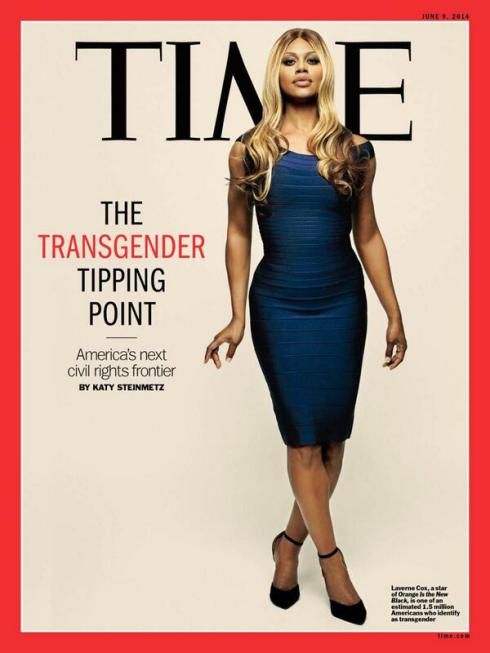
laverne-cox-timeThe Emmys made cultural history yesterday, nominating Netflix’s “Orange Is the New Black” actress Laverne Cox, who plays Sophia Burset in the prison drama, in the category of outstanding guest actress in a comedy series. It is the first time an openly transgendered actress has been nominated for an Emmy.

She joined several of her colleagues  on the show who were also recognized in various acting categories: stars Taylor Schilling, Kate Mulgrew, Uzo Aduba and Natasha Lyonne.

The problem is that Cox received the nomination for political and social reasons unrelated to her performing skills. This will be denied, of course, and since all awards are subjective, no one will be able to prove this is the case. It is, however. In the large, uniformly superb ensemble cast, Cox’s role is relatively minor, and I have a difficult time believing that anyone would objectively identify her as a standout in the show based on her acting. (In the current season, which I have seen in its entirety, her character is almost invisible). This isn’t intended to diminish Cox in any way, for in the role she plays, I cannot imagine it being played better. Nevertheless, there are many un-nominated actresses in that show—as well as other shows— whose characters are more vivid, who have to show more range, and who are more deserving of a nomination once the process is stripped of irrelevant political baggage. Among them: Taryn Manning, whose transformation into the complex religious fanatic Tiffany “Pennsatucky” Doggett is frightening; Yael Stone, as the heartbreaking stalker Lorna Morello; Samara Wiley, as te alcoholic moralist Poussey Washington, and several others.

Everyone is thrilled for Cox, with Cox, reasonably, leading the way. “I’m on cloud nine. I’m through the roof,” said the actress, whose path to an award was  paved when she was featured on the cover of Time magazine.“What a wonderful, wonderful day for “Orange” and for black trans-women,” she said.

Undoubtedly. It’s not such a great day for the acting profession generally, the Emmys, or the principle that awards based on merit should be decided based on merit, and not social and political agendas. I would say, “But that’s Hollywood,” except that it isn’t just Hollywood. Continue reading

Ethics Hero Emeritus (Independence Day Division): John Dickinson (1732-1808)

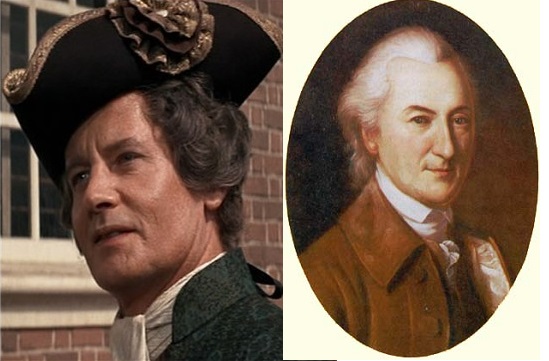
Villainous, singing version on the left; heroic, real life version on the right.

Villainous, singing version on the left; heroic, real life version on the right.

It is the American patriot John Dickinson’s curse that the very strength of character that caused him to stand out among the other Founders and that led them to respect him as much or more than any other also made him the black sheep in the inspiring tale of American independence. This led to relative obscurity. Although Dickinson is honored (along with his wife) by Dickinson College, Dickinson School of Law of the Pennsylvania State University, and University of Delaware’s Dickinson Complex, he is largely unknown to most Americans. He would be even less known, had Peter Stone not chosen to make him the villain of his 1969Tony-winning musical “1776,” where he was portrayed as a conservative loyalist who almost single-handedly foils the efforts of John Adams, Thomas Jefferson and Ben Franklin to declare independence from Great Britain. Whatever that choice’s dramatic virtues, it was unfair to Dickinson in every way.

Raised a Quaker, educated as a lawyer and a farmer by trade, Dickinson began public life in 1760 when he was elected to the Delaware legislature. During the next fifteen years he served both in that body and in the Pennsylvania legislature, a rare dual service made possible because he owned property in both colonies.

When the British Parliament instituted measures in the Colonies to raise revenue and provide for the quartering of British troops, Dickinson was one of the most eloquent and persuasive critics of the Crown, always with the intention of finding a satisfactory negotiated accord that did not involve the threat of armed rebellion. He urged Americans to rely primarily on economic pressure to oppose the hated Stamp Act, and he enlisted the influence of British merchants on the colonists’ behalf. His diplomatic orientation seemed like a prudent antidote to the firebrands calling for revolution in Boston, so the Pennsylvania legislature appointed him to represent that colony at the Stamp Act Congress of 1765. There he advocated the proposition that reconciliation was possible if the King and Parliament would only realize that colonial opposition was in the grand tradition English principles of political liberty. Dickinson set his reasoning to paper in his “Letters from a Farmer in Pennsylvania,” a series of deft essays that brought Dickinson international fame as a man of reason and principle. Continue reading

“Print The Legend” Ethics Again: The Cuban Missile Crisis “Blink”

blink map

It is certainly in part a case of tweeking a rival, but the Washington Post and its “Factchecker,” Glenn Kessler, properly exposed a New York Times columnists’ perpetuation of a popular historical misconception, and worse, that paper’s adamant refusal to correct it.

The columnist was Thomas Friedman, one of the Times’ stable of liberal pundits, and the quote was this, in the opening sentence of of one of the many Obama foreign policy reclamation columns that have appeared lately from the President’s journalistic Maginot Line:

“There was a moment at the height of the Cuban missile crisis in October 1962 when Soviet ships approached to within just a few miles of a U.S. naval blockade and then, at the last minute, turned back — prompting then-Secretary of State Dean Rusk to utter one of the most famous lines from the Cold War: ‘We’re eyeball to eyeball, and I think the other fellow just blinked.’”

Kessler gives Friedman a full “four Pinocchios,” for the simple reason that this is untrue, a myth, a proven historical inaccuracy that has been enshrined in film, print, and Kennedy hagiography. He writes… Continue reading