Comment of the Day: “Clayton Lockett Is Dead, Right? Then 1) Good! and 2) His Execution Wasn’t “Botched””

capital-punishmentThere are well-established group of ethics topics that will always cause spirited debates here, because they are issues that have always divided public opinion and always will: morality vs ethics, drug legalization, abortion, war, social justice, socialism, plus various controversies involving race, sexuality and gender. I try to wade into these only when a current even beckons, as to some extent the arguments are futile and familiar, and too many people refuse to think or listen anymore, retreating to slogans and reflex positions articulated by others.

I decided to wade into one of the most polarized, of these, capital punishment, when the Clayton Lockett execution in Oklahoma sparked a national debate that seemed strange to me, and indeed driven by the unwarranted assumption, uncritically accepted by the news media, that the painlessness of executions were a crucial feature of making them ethical as well as societally palatable. It also opened the question of whether one execution that doesn’t follow the script necessarily calls capital punishment itself into question. I confess: both in my post’s title and in the tone of my responses to anti-death penalty commentators, I intentionally sought to roil the waters of debate, and was determined not to allow the nice people who usually express compassion for the pain and suffering of humanity’s worst and deadliest escape with the usual pieties.

Sure enough, this annoyed the heck out of some readers. Responding to the emphatic objections of one, Isaac delivered a personal and powerful rebuttal. Here is his Comment of the Day on the post Clayton Lockett Is Dead, Right? Then 1) Good! and 2) His Execution Wasn’t “Botched:” Continue reading

Clayton Lockett Is Dead, Right? Then 1) Good! and 2) His Execution Wasn’t “Botched”

Capital punishment foes have no shame, and (I know I am a broken record on this, and it cheers me no more than it pleases you), the knee-jerk journalists who have been squarely in their camp for decades refuse to illuminate their constant hypocrisy. In Connecticut, for example, holding that putting to death the monstrous perpetrators of the Petit home invasion was “immoral,” anti-death penalty advocates argued that the extended time it took to handle appeals made the death penalty more expensive than life imprisonment—an added expense for which the advocates themselves are accountable.

A similar dynamic is at work in the aftermath of the execution of convicted murderer and rapist Clayton Lockett in Oklahoma.Witnesses to his execution by lethal injection said Lockett convulsed and writhed on the gurney, sat up and started to speak before officials blocked the witnesses’ view by pulling a curtain. Apparently his vein “blew,” and instead of killing him efficiently,  the new, three-drug “cocktail” arrived at as the means of execution in Oklahoma after extensive study and litigation failed to work as advertised.  Why was there an excessively complex system involving multiple drugs used in this execution? It was the result of cumulative efforts by anti-death penalty zealots to make sure the process was above all, “humane.” Of course, the more complicated a process is, the more moving parts it has, the more likely it is to fail.

Continue reading

Ethics Dunce: Republican Governors Association…And An Integrity Test For Chris Christie

This ugly beast keeps raising its head out of the muck, and it is the duty of every citizen, Republican or Democrat, who believes in justice and due process under law to beat it back with heavy clubs.

The Republican Governors Association is defending one of its own, South Carolina Gov. Nikki Haley, with a series of ads attacking state Sen. Vincent Sheheen, an attorney who is her Democratic opposition in the gubernatorial race. The message of the ad, as summarized by  a voice-over, is that “Sheheen defended violent criminals who abused women and went to work setting them free.”

False. Continue reading

Pineda-Pine Tar, Part II: Baseball Clarifies Its Bizarro Ethics Culture

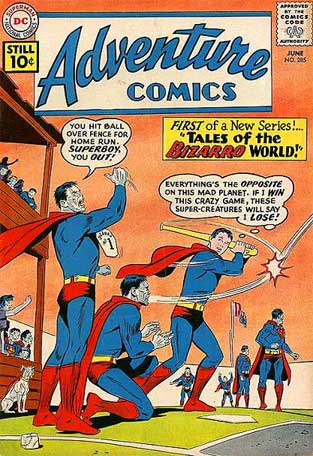
bizarro_world-baseballYou shouldn’t have to appreciate, care about or even understand baseball to find illumination in its latest ethics controversy, which shows how cultures can go horribly wrong, precluding exactly the values that any functioning entity must embrace to remain viable and healthy. For someone like me, to whom Baseball is Life, the whole thing just makes me want to jump out the window.

You will recall that a couple weeks ago, the sport embarrassed itself by making excuses and accepting lies regarding New York Yankees pitcher Michael Pineda being allowed to break the game’s rules against pitchers applying foreign substances (in this case, pine tar) on the baseball while pitching to the Boston Red Sox. I wrote about it here. I interpreted the post-incident consensus of the game and its pundits as “everybody does it, so let’s not make a big deal over a little infraction on a night when it was abnormally cold and hard to grip the ball.”  That’s unethical enough, but the truth, as revealed in Part II, is far worse.

Last night, fate had Pineda on the mound against the Red Sox again. Baseball’s ethics had already begun falling apart in chunks when Sox manager John Farrell, asked about whether he expected Pineda to cheat again (for that is what using pine tar on baseballs is—cheating. Official Rule 8.02 states: “The pitcher shall not apply a foreign substance of any kind to the ball.” ) answered that hopefully, if he did, he would be more discreet about it. Huh?

But Pineda was not discrete; in fact, he could not have been more obvious, or ridiculously so. After a rough first inning in which he gave up two runs, Pineda emerged from the dugout with a large, brown, greasy gob of pine tar on his neck. On TV. In nationally broadcast game. Against the same team that he was caught using pine tar against before. In that team’s home park.

In the Red Sox dugout, Manager Farrell and the team were laughing and rolling their eyes. Farrell finally shrugged, and walked out to complain to the home plate umpire, for it is an automatic ejection for a pitcher to be caught doctoring the ball. The umpire dutifully walked out to the mound—he had to have seen the offending gob before Farrell complained—and to add to the foolishness, checked Pineda’s glove, cap and jock strap before looking at the huge brown smear on his neck. Finally he did so, said, “That’s pine tar!” (in the previous game, Pineda told the press it was “dirt”) and threw him out of the game.

In subsequent interviews with Farrell and others, the explanation that emerged was this gibberish: “everybody” uses something to grip the ball better when it is cold (and often when it isn’t); hitters don’t mind because they don’t want to get hit. Pineda’s offense wasn’t that he used pine tar, but that, as Farrell suggested before the game, that he was “blatant” about it. That gave Farrell no choice, you see….even though his own pitchers also use foreign substances to grip the ball (in unequivocal violation of a baseball rule), and this sets his team up for “retaliation.”

I feel like I’m going crazy. Continue reading

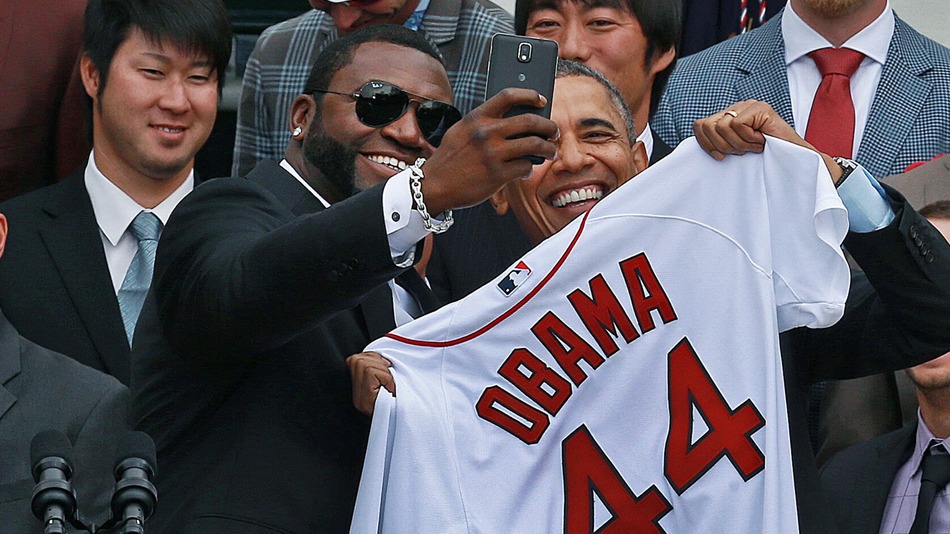
Selfie Ethics: Yes, Big Papi Exploited The President

Ortiz-Obama-Selfie.jpg

I wrote about this ethical breach when Ellen DeGeneris did it at the Oscars. The short version is this:

“It’s unethical to pretend that a selfie is a spontaneous  gesture of fun and friendship when you have a commercial agreement in place to use the photograph in a way that promotes the cell phone manufacturer.”

This is exploitation for commercial gain, and it’s wrong. It’s wrong when the victims are movie stars, and it’s wrong when the exploited party is President of the United States. Continue reading

The Abysmal Quality of Ethical Reasoning in Baseball: A Depressing Case Study

"Dirt."

“Dirt.”

The first bona fide ethics controversy of the 2014 baseball season has erupted, and it involves the team of my youth, the Boston Red Sox. It is not the controversy itself that is so noteworthy, for it is an old, old one: pitchers using foreign substances to doctor the balls so they dip, curve, and sing “Take Me Out To The Ball Game.” What is noteworthy is the reaction to the incident by players and the sports media, which has me feeling that as an ethicist, I need to think about following another sport. The ethics reasoning, or lack of it, is truly depressing.

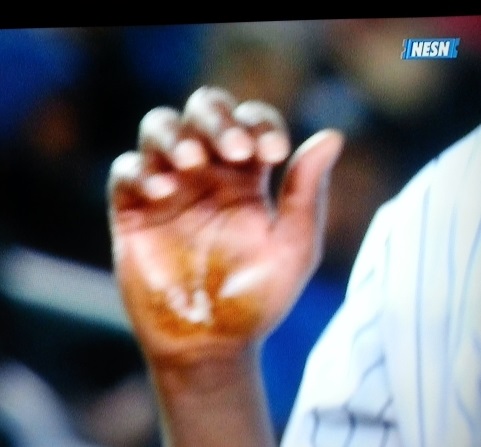
What happened was this: During last night’s Red Sox-Yankee game in Yankee Stadium, the Boston broadcasting team of Don Orsillo and Jerry Remy noticed a glossy brown substance on New York starting pitcher Michael Pineda’s pitching hand. It was very obvious, especially once the NESN cameras started zooming in on it.   “There’s that substance, that absolutely looks like pine tar,” play-by-play man Don Orsillo said. “Yeah, that’s not legal,” color commentator and former player Jerry Remy replied.

Indeed it isn’t.  According to rule 8.02(a)(2), (4) and (5), the pitcher shall not expectorate on the ball, either hand or his glove; apply a foreign substance of any kind to the ball; [or]  deface the ball in any manner.

The Red Sox, who probably knew about the gunk on Pineda’s hand, didn’t complain to the umpires, and just went about their merry way, losing the game. Asked about the stuff on his hand, Pineda demonstrated the full range of body language indicating that he was lying his head off. “It was dirt,’ he said. Later, when the ick appeared to be gone,  Pineda explained, he had just sweated his hand clean. Right. Whatever was on his hand—beef gravy, crankcase oil, chocolate syrup…the majority of pundits think pine tar—it wasn’t “dirt.” Pineda’s manager, Joe Girardi, was brazenly evasive.

The Yankee pitcher was cheating. This isn’t a major scandal, but cheating is cheating: sports shouldn’t allow cheating of any kind, because if a sport allows some cheating, however minor, it will encourage cynical, unscrupulous and unethical individuals on the field, in the stands, and behind keyboard to excuse all other forms of cheating, from corked bats to performance enhancing drugs. Cheating is wrong. Cheating unfairly warps the results of games, and rewards dishonesty rather than skill. Cheating undermines the enjoyment of any game among serious fans who devote energy and passion to it. Any cheating is a form of rigging, a variety of lying.

And yet, this clear instance of cheating, caught on video, primarily sparked the sports commentariat, including most fans, to cite one rationalization and logical fallacy after another to justify doing nothing, and not just doing nothing, but accepting the form of cheating as “part of the game.” I’ve been reading columns and listening to the MLB channel on Sirius-XM and watch the MLB channel on Direct TV since this episode occurred. Here are the reactions, my comments in bold:

  • This isn’t a new phenomenon. Show me the statute of limitations on ongoing misconduct, please. Also not new: torture, rape, adultery, incest, bribery and embezzlement. So what? That makes these things all right? Excuses society from trying to reduce their occurrence?

Continue reading

Further Thoughts On “The Vampire Candidate”

dracula for congress

I don’t want to make this Vampire Day, but after reading the comments so far on today’s Ethics Quiz involving Florida Congressional candidate/ fantasy vampire role-play enthusiast Jake Rush, I realize that the original post omitted some important points and queries. Here, in no particular order, are my further thoughts:

  • The Ick Factor? Both conservative and liberal commentators are ridiculing Rush, essentially concluding that his hobby disqualifies him as a serious candidate. The most quoted source referred to the images embraced by Rush’s role-playing group as “disturbing,” “bizarre,” and “unsettling.” Do these reactions signal a rejection of Rush’s values, or is this a clear-cut example of the “Ick Factor,” which is often mistaken for unethical conduct? Strange does not mean wrong or unethical.
  • Trust. When we elect leaders, we must trust them. “Strange” by definition suggests unpredictability; if we don’t understand why people do what they do, it is hard for us to know how they will behave, and if we don’t know how they will behave, we can’t rationally trust them.
  • Integrity. I should have raised the issue of integrity, for it is critical to the problem. Integrity is essential to trust, and a candidate like Rush raises the question: “Who, or what, is this guy?” Is he a “straight-shooting” conservative who likes to play vampire in his spare time, just like some politicians like to play poker or watch synchronized swimming (now that’s what I call weird), or is he a wannabe creature of the night who is just playing a conservative Republican in the daytime to conform to the expectations of conventional society? If there is doubt about that, then his integrity is in question.

Continue reading

The Loathsome Ed Schultz

Ed-schultz-MSNBC

It is not the first time, but MSNBC’s ugliest Angry Left spokesman just completed a cycle of conduct demonstrating beyond a shadow of a doubt that he is deceptive, dishonest, cowardly, and incompetent—in short, loathsome. This is Ed Schultz, the most unethical of the stable of unethical anchors and commentators intentionally assembled by MSNBC—you could not possible get such an awful group by accident—for reasons best known to its chief, Phil Griffin. Having left-leaning views doesn’t make one loathsome by itself (no matter what Mark Levin says), but I do wonder what to make of fans of the likes of Martin Bashir, Keith Olbermann, Alec Baldwin  (all of whom became so openly loathsome that even MSNBC had to jettison them), Melissa Harris-Perry, Chris Matthews, Lawrence O’Donnell, Al Sharpton and especially Schultz. A viewer admiring an unambiguous jerk on the level of Ed Schultz because he applies his jerk-ness in support of the viewer’s favorite ideology is itself a strong indication of flawed character. In the matter of unethical pundits, it doesn’t take one to know one, but it takes one to tolerate one. If a job applicant tells me she’s never misses the Ed Show, I’m not trusting her with the combination to the safe, I’ll promise you that.

Ed’s moment of self-revelation came as a result of some nakedly partisan Obamacare cheerleading in December. Ed then crowed,

“I’m going to make a prediction tonight. It`s going to hit 5 million by March 1st. That’s right. Five million people signed up by March 1st. Get your tapes rolling at home, folks, because it’s going to be a big “I told you so.”

Well, Ed was wrong, and did not get his “big ‘I told you so.'” But because the man has the maturity of an 11-year-old and the integrity of Newt Gingrich, he couldn’t level with his audience about the fact that his prognostication didn’t pan out. When his March 1st deadline came and went, Ed got into Mr. Peabody’s Wayback Machine and changed the past, saying on March 12 as the sign-ups languished well short of his prediction:

“Well, I predicted five million people are going to sign up by the end of this month. We`re closing on it on that number.”

Continue reading

KABOOM! There’s nothing else to say, really…My head is all over the room…

Voter fraud

Melowese Richardson, a poll worker who was convicted of multiple counts of voter fraud and just released on probation from a five year prison sentence, was brought up on stage  to rousing applause as Rev. Al Sharpton joined State Representative Alicia Reece at a rally to kick off the drive for an Ohio “Voter’s Bill of Rights” amendment.

My head is scattered all over my hotel room, so I am struggling to be articulate, restrained and calm.

The cynicism of Democrats on the voter fraud issue approaches…oh, hell, I can’t do it!

HOW DARE THEY? Continue reading

Ethics Observations On A Journalism Scandal

washington-post-logo

Shame.

Executive Summary: Washington Post reporters Steven Mufson and Juliet Eilperin wrote a story for the website’s Wonkblog headlined, “The biggest lease holder in Canada’s oil sands isn’t Exxon Mobil or Chevron. It’s the Koch brothers.” The story was essentially false. It was based on easily disproved data from a progressive activist organization. Eilperin has close ties to both the environmental advocates opposing the Keystone pipeline, and desperately trying to turn public opinion against it. She also has tied to the White House. John Hinderaker, on Powerline, his respected conservative politics blog, exposed the Post story as a blatant misinformation with a likely political motive. The reporters responded with a jaw-dropping rationalization, and are currently being excoriated by the Post’s readers online.

The Facts: The Post article by Mufson and Eilperin begins: Continue reading