1. “Morning Joe” Scarborough went on “The Late Show With Stephen Colbert”-–where President Trump is officially referred to as Putin’s “cockholster”—and played to the anti-Trump audience by announcing that he was leaving the Republican Party as cheers rang out in Colbert’s echo chamber. More blatant pandering virtue-signaling and grandstanding would be hard to imagine.
Scarborough has followed up his short, undistinguished career as a conservative GOP congressman by playing on-air conservative foil to his supposedly opposite-minded co-host Mika Brzezinski on MSNBC while that network attacked Republicans on every show and all day long. In really, we have learned, he and Mika were sufficiently sympatico to be having a romantic affair while posing as journalists, meaning that the whole format was an act as well as an extended date. Scarborough was also complicit in helping Trump to the nomination of Joe’s alleged party by promoting him until he had nabbed the nomination. Once the Miracle of November 8, 2017 occurred, Joe made the obligatory U-Turn.
Never mind: I don’t care how Scarborough or anyone else registers; what matters is if they have the integrity to vote for the best candidate whatever party he or she represents. I do care that Scarborough used the smear that President Trump is a racist, and expressing to Colbert his disgust that GOP lawmakers, he claims, have refused to admonish Trump’s “racist” statements and election promises. This is another sloppy chunk of the anti-Trump false narrative, and by resorting to it, Joe proves, not that he isn’t a Republican, but that he is a race-baiting character assassin.The evidence that the President is racist is elusive, but the smear is repeated among the resistance as truth so frequently that it has reached Big Lie status.
2. In February, the left-biased, Trump-reviling Huffington Post purported to list “16 Examples” of Trump “being a racist.” The whole campaign, his whole career,, with Democratic groups and activists repeating the slur for months, and this was what they could scrape up. (Spoiler:it’s pathetic…) Continue reading →
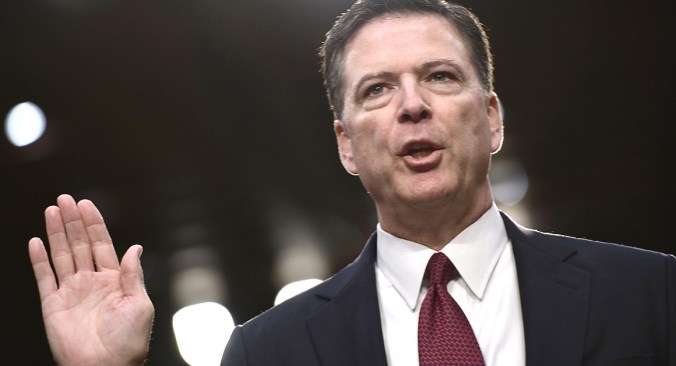
1. “Even though I was appointed to a ten-year term, which congress created in order to underscore the importance of the FBI being outside of politics and independent, I understood that I could be fired by a president for any reason or for no reason at all. And on May 9th, when I learned I had been fired for that reason, I immediately came home as a private citizen. But then the explanations, the shifting explanations, confused me and increasingly concerned me. They confused me because the president that I had had multiple conversations about my job, both before and after he took office, and he had repeatedly told me I was doing a great job and he hoped I would stay. And I had repeatedly assured him that I did intend to stay and serve out the remaining six years of my term. He told me repeatedly that he had talked to lots of people about me. Including our current attorney general. And had learned I was doing a great job. And that I was extremely well-liked by the FBI work force. So it confused me when I saw on television the president saying that he actually fired me because of the Russia investigation. And learned, again, from the media that he was telling privately other parties that my firing had relieved great pressure on the Russian investigation. I was also confused by the initial explanation that was offered publicly, that I was fired because of the decisions I had made during the election year. That didn’t make sense to me for a whole bunch of reasons, including the time and all the water that had gone under the bridge since those hard decisions had to be made. That didn’t make any sense to me. And although the law required no reason at all to fire an FBI director, the administration then chose to defame me and more importantly the FBI by saying that the organization was in disarray. That it was poorly led. That the workforce had lost confidence In its leader. Those were lies, plain and simple. And I am so sorry that the FBI workforce had to hear them and I’m so sorry the American people were told them. I worked every day at the FBI to help make that great organization better. As a help, because I did nothing alone at the FBI. There are no indispensable people at the FBI. The organization’s great strength is that its value and abilities run deep and wide. The FBI will be fine without me. The FBI’s mission will be relentlessly pursued by its people and that mission is to protect the American people and uphold the constitution of the United States. I will deeply miss being part of that mission, but this organization and its mission will go on long beyond me and long beyond any particular administration. I have a message before I close for the — for my former colleagues of the FBI. First I want the American people to know this truth. The FBI is honest. The FBI is strong. And the FBI is and always will be independent. And now to my former colleagues, If I may, I am so sorry I didn’t get the chance to say good bye to you properly. It was the honor of my life to serve beside you, to be part of the FBI family and I will miss it for the rest of my life. Thank you for standing watch, thank you for doing so much good for this country. Do that good as long as ever you can. And senators, I look forward to your questions.”
Observations: This entire statement is unworthy of the emphasis that has been placed on it by the wildly spinning news media, The key piece of information to frame the entire episode is “I understood that I could be fired by a president for any reason or for no reason at all.” Comey also presumably understood that a sub-fact within that understanding is that he could be told some of the reasons he was fired, no reasons, or the reasons the President felt like talking about. He was told he was doing a great job and then fired? Welcome to the work force. Telling an employee that he is doing a great job when he isn’t may be good management, usually isn’t, but is still well within the range of management discretion, and certainly not illegal.
Comey said that he also concerned that the President was saying that firing “had relieved great pressure on the Russian investigation.” As we learn later, the President was not being targeted in that investigation, and we know that he regards it as a politically motivated effort to distract and derail his administration and its agenda. There was nothing sinister about the President’s desire that the investigation go away as quickly as possible. I would argue that he has an obligation to do whatever he can to speed it along. If he didn’t trust Comey’s judgment—and who would?—seeing his exit as a plus is reasonable. Naturally, Comey wouldn’t see it that way.
It is amazing to me that a fired employee saying that his superior’s assessment that his organization was in disarray, that he was a poor leader and that his staff had “lost confidence In its leader” is given any weight at all. What fired employee doesn’t think his firing is unjust and the criticism of him is unfair? Comey calls it a lie: how does he know what Trump had been told or heard? How does Comey know what his agents say behind his back?
Your opinion that someone’s negative opinion about you is wrong and based on erroneous information does not make that opinion a lie. As a lawyer, Comey should know that, and should not have thrown the word “lie” around to be misunderstood by people who don’t know what a lie is—that is, most of the public. Continue reading →
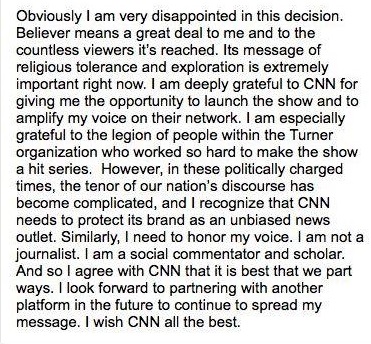
1. In the category of “Good!”, or maybe “Better late than never!” was the news that CNN, after a a full week of pondering, determined that maybe it wasn’t sufficiently professional for a host to call the President of the United States a “piece of shit,” or anyone a “piece of shit,” really, or use “shit” under the CNN banner, so it fired “Believer” host Reza Aslan. I don’t know why CNN can’t figure out that an immediate firing sends the message that the organization has professional standards and enforces them, and the way CNN handled this says, “We were hoping this would blow over, but guess not.”
Aslan’s tweet after his hook raised other questions:
Wait, CNN is trying to be an unbiased new outlet???
Oh, is “piece of shit” how scholars express themselves now?
“I need to honor my voice” by being able to use vulgarity to express his measured views. Got it.
The “tenor” of discourse is entirely within the control of the speaker.
Why does CNN put people on the air who don’t understand or respect their professional obligations to the network or the audience?
2. Fox News’s Sean Hannity got web headlines yesterday by tweeting to Aslan: “I do not think you should be fired. You apologized.” Sean Hannity is really too dumb to be allowed out without a leash. His theory is that an apology magically returns everything to where it was before the conduct in question, as if there were no effects. This was serious breach of professionalism and responsibility showing the Aslan was too untrustworthy to be allowed to have his own TV show. It proved that he was a threat to CNN’s reputation (Crude News Network” is the current successor to “Clinton News Network,” and no organization can function if its announced policy is “Go ahead, do anything; as long as you apologize, your job is safe.” Continue reading →
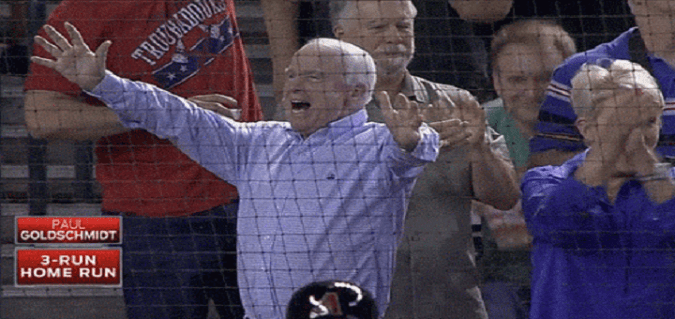
A sub-plot of yesterday’s fizzled firecracker of a “bombshell testimony” by James Comey was Senator John McCain’s bizarre questioning. When I saw how many of my “resistance” member Facebook friends were talking about it, I knew how disappointed they were that Comey produced no smoking guns or even a soggy water pistol. Poor John picked the wrong day to stop taking Ginkgo Biloba. Still, Democrats and Republicans alike were bothered by a senior senator and former Presidential candidate sounding confused and semi-coherent.
I have finally read the transcript, which you should do as well. By now I have also seen a lot of video clips. (James Comey really says, “Lordy!” Wow.)
First, some general observations, with more detailed comments to come in a subsequent post.
1. My earlier expressed opinion of James Comey when I defended him against conservative accusations that he was giving Hillary Clinton an undeserved break by not indicting her were revealed as too generous yesterday. I still believe he is honest and non-partisan. More than ever, I believe that he is untrustworthy. He was obviously in a difficult position—many, in fact—that he was not able to successfully manage, if anyone could have. However, his oft-repeated insistence that he (and his FBI) did not play politics was exposed as false, if not dishonest (a gracious interpretation of the sort that Comey denied the President in his bitter testimony.)
2. The fake Russia collusion narrative pushed by Hillary, Democrats and the news media to simultaneously excuse her loss and undermine the Trump Presidency was killed yesterday, but will wander around like a zombie for months if not years because Trump-haters will not have the integrity to admit they were wrong. Chris Matthews, a once astute and courageous liberal Democrat reporter who morphed into a partisan, knee-jerk progressive shill and anti-Republican scold as soon as he started getting paid by MSNBC, had a sudden flashback to his days of integrity when he pronounced yesterday,
“But the big story has always beenthe assumption of the critics of the president, of his pursuers, you might say, is that somewhere along the line in the last year, the president had something to do with colluding with the Russians. Something to do, a helping hand, encouraging them,feeding their desire, to affect the election in some way, some role they played, some conversation he had with Michael Flynn, or Paul Manafort, or somewhere. And yet what came apart this morning, was that theory, because in two regards the president said according to the written testimony of Mr. Comey, ‘go ahead and get anybody satellite to my operation and nail them, I’m with you on that,’ so that would mean Manafort, Carter Page, someone like that. And then he also came across today what was fascinating, Comey said that basically Flynn wasn’t central to the Russian investigation, that he was touching on it. That there was, of course, Flynn had an honest, we assume, wasn’t honest in his answer on the official forms that he had to fill out to become a national security head.”
But it only touched on that, it wasn’t really related to that. But he could be flipped for that, but in other words, they could flip him because they had him caught on something he dishonestly answered but he wasn’t central to the Russian thing, and I always assumed that Trump was afraid of was that he had said something to Flynn, and Flynn could be flipped on that. And Flynn would testify against the president that he had had some conversation with Flynn in terms of dealing with the Russians affirmatively. And if that’s the case, where’s the there there?”
There is no there there, and never has been. Thus the anti-Trump hysterics are left with what they have always believed was proof enough: Hillary lost, leaked hacks of e-mails that led the public to realize how sleazy the Democrats were should have never been seen by voters, Trump was the beneficiary of the leaks, he had said nice things about Putin, he’s an unethical creep, and a lot of his associates had business contacts with Russia, and besides, they just know Trump is guilty.
That’s not enough; in fact, it’s nothing at all. Matthews as both a lifetime Democrat and a romantic regarding the Presidency and democracy detests Trump to his Irish-American Boston liberal core, but he knows when to get off a bandwagon that will embarrass him if he stays on board, or make it impossible for Chris to look in the mirror.
3. For a lawyer, Comey’s loose use of the term “liar” and his stated belief that he assumed that Trump was a liar early on in their relationship shows a troubling inattentiveness to his own biases, as well as a classic misunderstanding of what it means to lie. Comey said Trump lied about why Comey was fired, for example. Comey has no way of knowing which of the many legitimate reasons for firing him played the biggest role in his firing. He does not know what Trump was thinking, so he cannot assert that Trump lied. He can say that he believes Trump lied, but that is only his opinion: it does not make Trump a liar, and it is not evidence. Last ditch bitter-enders among the Impeach Trump Lynch Mob will be arguing that Comey’s various opinions and reactions prove misconduct by Trump. But lying and obstruction of justice are not like sexual harassment, where a second party, by his or her reactions, determines whether misconduct has taken place. Comey stated that he took Trump’s words that he “hoped” that the FBI would drop the Flynn investigation as a “direction.” He also could have taken it as a marmoset, but that wouldn’t mean that the President meant it as one.
Any time a supervisor says “I hope you do this,” it is a statement of what will make that supervisor happy. (Did Obama ever say to his Treasury Secretary, “I hope the IRS is tough on those tea party groups: they are about as non-partisan as I am!”?) Nevertheless, it leaves the decision in the hands of the subordinate.
4. Comey came off like a classic disgruntled former employee, and I’ve interviewed many of them, angry that he was fired and determined to do as much damage to his former supervisor as possible on the way out the door.
1. News Item: “More than 130 imams and Muslim religious leaders in the United Kingdom have said they will refuse to perform funeral prayersfor the Manchester and London terrorists as a rebuke to the “dastardly cowardice” of the “vile murderers.” Notes Ethics Alarms issue scout Fred, “This time it’s religious institutions refusing [to provide a service based on religious/political beliefs and conduct], and it’s based on the actions of the people they’re refusing to pray for or bury. On the other hand, anyone born in Scotland is entitled to the government’s services even if he’s No True Scotsman. By analogy, is it right for them to deny funerals to Muslims, even the most egregiously sinful?
I’d have to do more research on Islam than I have time for right now to address that question, but it’s an interesting one.
2. As a follow-up to New Orleans’ lamentable decision to remove statues honoring Confederate figures (discussed on Ethics Alarms here), The Atlantic published an exhaustive brief against the “myth” that Robert E. Lee was worthy of his reputation as a noble human being who fought for Virginia out of loyalty to his “country,” but who deplored slavery. I have criticized the hero-worship of Lee as well, but much of what is in Adam Serwer’s article was completely unknown to me. If accurate, it is horrifying. Just one example:
“Lee’s cruelty as a slavemaster was not confined to physical punishment. In Reading the Man, the historian Elizabeth Brown Pryor’s portrait of Lee through his writings, Pryor writes that “Lee ruptured the Washington and Custis tradition of respecting slave families,” by hiring them off to other plantations, and that “by 1860 he had broken up every family but one on the estate, some of whom had been together since Mount Vernon days.” The separation of slave families was one of the most unfathomably devastating aspects of slavery, and Pryor wrote that Lee’s slaves regarded him as “the worst man I ever see.”
3. I’ll discuss the Comey testimony in detail later, but I came close to writing about the unseemly and self-indicting display of gleeful anticipation by much of the news media (and “the resistance,” of course) over what they were just certain would be the smoking gun to get President Trump impeached. CNN had a countdown, second by second, on-screen the whole previous day, like Christmas was coming. Ann Althouse nicely summed up how foolish and ugly this was:Continue reading →
With so much loose talk about impeachment going around (and by “loose” I mean “inexcusably ignorant”), texagg04’s review of the Constitutional standard for the removal of a President is a gift to readers of Ethics Alarms, and one of the most interesting and informative comments ever to appear here.
He was reacting to a New York Times op-ed, cited by another commenter, by political scientist Greg Weiner (no relation) titled, “Impeachment’s Political Heart,” in which the author concluded,
“The question is by what standards they should conduct this work, and that question provides an opportunity to correct the mistaken assumption according to which presidents can forfeit the public trust only by committing what the law recognizes as a crime. That is a poor bar for a mature republic to set. It is not the one a newborn republic established. And that is why the idea that the conversation about impeachment is simply a political persecution of a man who is technically innocent of a literal crime not only jumps the investigatory gun. It misses the constitutional point.”
Having studied the issue myself, I immediately rejected Weiner’s analysis (which still is worth reading in its entirety) on the ground that a constantly evolving standard of what is a “high crime and misdemeanor” simply means that Presidents can be impeached for behaving, or governing, in ways that enough members of Congress, the news media and the public don’t like. That is what is being advocated now, and that approach would undermine our democracy, the power of elections, and the office of the President.
My gut response, however, is wan and insubstantial compared to tex’s masterful historical review and astute analysis, which (whew!) reaches a similar conclusion.
[Weiner] is making an argument from the same source material I mentioned, chiefly the Federalist papers. I still haven’t found Madison’s own specific arguments regarding it, but I think the source is irrelevant as the body of work published by the Founders (“Federalist” and “Antifederalist” alike) should be read as a single work documenting an internal dialogue, to be used as clarification when and where the final adopted documents possibly contain ambiguity. This could very well be one of those cases. That being said, the body of work by the Founders which may aid in revealing their intent or at least how they believed their philosophy of our political system out to be enshrined in the constitution, isn’t the only body of work used to interpret their intent. There is precedence and tradition, which the author of this article disregards when he says “Our tendency to read the impeachment power in an overly legalistic way, which is ratified by 230 years of excessive timidity about its use, obscures the political rather than juridical nature of the device.”
He’s right in nothing but that many of the earliest drafts and proposed language of the impeachment standards were very vague, such as (not an exhaustive list):
It would be unfair to characterize fattymoon’s comment, which was, like the previous COTD, supposed to be posted almost a week ago, as an example of the phenomenon just discussed. Fatty, a smart, disillusioned Occupy veteran, is bipartisan opponent of the status quo, and a revolutionary with integrity: he does not embrace the double standards that render the “resistance” ridiculous, taking such self-disqualifying positions as Maxine Waters’ classic that while President Hillary Clinton could have fired FBI chief Comey without wrongdoing, it was an obstruction of justice for President Trump to do so. I chose his comment for reposting because it is a virtual archive of the faulty reasoning and rationalizations that sustain the anti-Trump barrage. I will elaborate on that after you read fattymoon’s Comment of the Day on the post, “Five Reasons Why This Was President Trump’s Dumbest Tweet Yet”:
Some of your quotes followed by my thoughts…
“None of it justifies the fake news” – Which entity pours on the most fake news, the media or the White House? Open to argument, yes?
“concocted Russian conspiracy theories” – You’re jumping the gun, sir. The jury is out.
“I stand behind the office.” – I refuse to accept the man behind the office. If left unchecked, Trump will bring down the office after inalterably defacing it.
“I made it clear that Trump had neither the Character, nor the skills or knowledge, to hold it, just as I made it clear that Hillary Clinton was also an unfit candidate because of her thorough corruption.” – Are you saying that Trump is not thoroughly corrupt? Just a little corrupt?
“This is Andrew Johnson all over again.” – Rightfully so, imo. (“Johnson is regarded by many historians as one of the worst presidents in American history.” – Wikipedia)
“I have minimal influence, but I will do my best to protect the Office and institution of the Presidency from those who would destroy it, no matter who occupies that office.” – And I will do my best to protect the Office and institution of the Presidency from those who would destroy it, i.e. Donald Trump. Continue reading →
“If it was a polite request saying, ‘Oh, you know, he’s a good guy, Flynn, I wish you’d back off this thing,’ that’s not an obstruction of justice. If it was a command, it would raise stronger problems.”
—Retired Harvard law professor , Constitutional scholar, lawyer, liberal and CNN commentatorAlan Dershowitz, trying to explain to MSNBC what “obstruction of justice” means.
I’ve never been a Dershowitz fan, but when the List of Shame is complied after the Post 2016 Election Ethics Train Wreck has finally ground to a halt, he’ll be on another list: the one containing those who maintained their integrity.
He needn’t have bothered: the news media/Democratic Party/ “resistance'” collective has already labelled James Comey’s so far only rumored “memo” recounting that the President asked the then-FBI Director, in a private meeting in February, to close the FBI investigation of Trump’s former national security adviser, Michael Flynn, proof of criminal motives and acts.
The New York Times learned of the memo from two people who claim they had read it. One of them read part of the memo to a Times journalist. According to these unnamed sources’ description of the memo, Trump told Comey, “I hope you can let this go” in a meeting that took place the day after Flynn was forced to resign.
“I hope you can let this go” would be consistent with what Dershowitz, no Trump supporter but apparently yet to be infected with the integrity- and logic-destoying anti-Trump virus, accurately described as “not an obstruction of justice.”
The Times, however, a card-carrying member of the “overturn the election” cabal—we know this because it stated last August that defeating Trump justified tossing journalism ethics into the trash, and because since the election, its pages have from the book reviews to the op-ed pages have been filled anti-Trump propaganda—called Trump’s reported request “the clearest evidence that the president has tried to directly influence the Justice Department and FBI investigation” into links between Trump associates and Russia. This must mean that there is no evidence, at all, since saying “I hope you can let this go” is barely influence at all.
The news of the alleged memo was breathlessly hailed by the “Can we impeach him now?” fanatics, including some readers of this blog who should know better and once did, as a “bombshell.” As Alan Dershowitz dispassionately points out, and as I have in the comment threads, it’s no bombshell. This is not remarkable observation; a New York Times contributor was even allowed to agree with Dershowitz. (The Times can’t completely commit to the lynch mob, for then its efforts to aid and abet would be less valuable. It’s quite a tightrope these people are walking….). Constitutional law prof Elizabeth Price Foley wrote,Continue reading →
Fred, my topic scout, sent me this and suggested that it was the apotheosis of Rationalization #22, Comparative Virtue or “It’s not the worst thing.”
Boy, was he right.
In last night’s episode of the Tucker Carlson show—right-wingers are actually impressed with Tucker’s skills at taking down lame liberal fanatics, which is sad in so many ways—featured the Fox News conservative dilettante agreeing with guest James Rosen, who was making the fatuous and ethically offensive point that people shouldn’t get so upset about what Trump does because the Civil War and the Cold War were worse.
This argument is the Mother of All Terrible Rationalizations, and especially bad because it spoils a good point, which is that absent historical perspective, it’s not easy to know what a real crisis is. Arguing that people shouldn’t object to something, however, because something else was worse is the mark of desperation as well as intellectual deficiency. Explain why the alleged crisis isn’t one (as in the Comey firing); explain why the assumed harm is exaggerated, or being hyped, or the product of bias and emotion. But to say, as Rosen, a “conservative historian,” which only means he isn’t an aggressive leftist like almost all of his colleagues, did,
“During Watergate, the term ‘crisis’ was thrown around as well and there were people at that time who were old enough to remember when there were legless Civil War veterans still in the streets of Washington.”
And I’m sure conservative historians were reminding those Civil War casualties while their legs were being sawed off without anesthesia that the Civil War wasn’t nearly as horrible as the Black Death. “Ah, I feel much better now,” they smiled. “Just call me ‘Stumpy!’




 Ethics Alarms
With so much loose talk about impeachment going around (and by “loose” I mean “inexcusably ignorant”), texagg04’s review of the Constitutional standard for the removal of a President is a gift to readers of Ethics Alarms, and one of the most interesting and informative comments ever to appear here.
He was reacting to a New York Times op-ed, cited by another commenter, by political scientist Greg Weiner (no relation) titled, “Impeachment’s Political Heart,” in which the author concluded,
Having studied the issue myself, I immediately rejected Weiner’s analysis (which still is worth reading in its entirety) on the ground that a constantly evolving standard of what is a “high crime and misdemeanor” simply means that Presidents can be impeached for behaving, or governing, in ways that enough members of Congress, the news media and the public don’t like. That is what is being advocated now, and that approach would undermine our democracy, the power of elections, and the office of the President.
My gut response, however, is wan and insubstantial compared to tex’s masterful historical review and astute analysis, which (whew!) reaches a similar conclusion.
Here is texagg04’s fascinating Comment of the Day on the post, “Reluctant Additional Ethics Notes On A Manufactured “Crisis”: The Comey Firing Freakout”…I’ll have one brief comment afterwards: