Of Bundys, Trump, Wikileaks, Rebellion—You Know, The Whole 2016 Election Thing

jury-nullThe jigsaw puzzle of an existential national crisis, a real one, are assembling sufficiently so an image can be distinguished. It is uglier than I imagined.

1. Item:  The Bundy Brothers were acquitted. This was pure jury nullification, because they were guilty as hell. It might be an aberration, but I fear it is not. The jury is a fractal of democracy, and when juries start finding lawbreakers innocent, they are sending a message that those in power ignore at their peril. They say “We don’t like or respect you or your laws, and you better change, or else.” The complete class, regional and ideological estrangement from the Federal government this decision represents shows how completely Barack Obama has divided the nation, and portend a long, long, difficult and, one can only hope non-violent recovery, if some competent leaders emerge who can handle it. As trust in our institutions have collapsed with accelerating speed over the last decade, civility has deteriorated and authorities have increasingly threatened the basic Constitutional rights of citizens while extending privileges to non-citizens for political motives, the connective tissue of our society has been frayed to the snapping point. Responsible leadership, objective  and rational citizens must not shrug this verdict off as just a bunch of gun nuts and cowboys throwing a tantrum.

2. Item: Donald Trump keeps saying that the election is “rigged.” This is beyond irresponsible, in isolation not more irresponsible than what Trump has said about other things, but the timing and sheer intensity of this drumbeat from him is truly horrible….and also likely to be effective.  Continue reading

Hillary’s New Tactic: When Caught Lying, Resort To Gibberish

Yesterday in Washington, D.C., Hillary Clinton took questions at a meeting of the National Association of Black Journalists and National Association of Hispanic Journalists. She was asked by NBC’s Kristen Welker to explain her jaw-dropping lie on Fox News Sunday a week ago, when she claimed  that FBI Director James B. Comey had said all of her statements had been “truthful,” when anyone who heard Comey’s public statement or Congressional testimony could see that he actually stated that her public statements—for more than a year—were not true. Incredibly, Clinton had no coherent or credible answer for this, though she had to know—didn’t she?—that the question would be asked.

Her answer began with this:

“I may have short-circuited it, and for that I will try to clarify.”

On “The Honeymooners,” Ralph Kramden (Jackie Gleason) used to stutter out, when confronted with his own whopper or otherwise trapped, “Huminahuminahumina…” “Short-circuited” is as meaningful as that. It’s gibberish, but just as obviously means “you caught me lying through my teeth, and I don’t have a good explanation.” Ralph, however, was a humble, none-too-bright bus driver, and not running for President, so the standards in his case can be relaxed a bit.

(Please also note Clinton’s equivocal “might.” )

Ralph always followed  “huminahuminahumina…” with facial expressions and body language showing silent humiliation, and then an abject apology. Hillary, being Hillary, just started lying again. The AP fact-checked her response, and determined that she had trotted out the same shifting, mendacious assertions we have heard so many time before. Concluded the Washington Post’s Chris Cillizza, 

Er, what? What Clinton appears to be saying is that Comey said that everything she said to the FBI was truthful (he did) and since she said publicly exactly what she said to the FBI, therefore everything she said was truthful.

Oh, so that’s what “short-circuited” means! Continue reading

Jumbo, Ethics Dunce, Kaboom And Unethical Quote Of The Month: Hillary’s Jaw-Dropping Lie To Chris Wallace

hillary and Wallace

“Director Comey said my answers were truthful, and what I’ve said is consistent with what I have told the American people, that there were decisions discussed and made to classify retroactively certain of the emails.”

—-Hillary Clinton to Chris Wallace on Fox News Sunday, asserting that what was demonstrably false was true, regarding a public statement by Comey that can be Googled and watched on YouTube instantly.

My reaction when I saw that: KABOOM! The top of my head blew right off, bounced off the ceiling and knocked over the lamp. Wallace asked Clinton directly about what she had been saying to the public about her e-mails since May of 2015: that she did nothing wrong, that her private, secret e-mail server was approved by the State Department, that she never received or sent a classified e-mail…okay, that didn’t work, that she never knowingly sent a classified e-mail…wait, wait, that she never sent or received an  e-mail that was marked classified. Comey, in his televised, live statement announcing his decision not to recommend prosecution for Clinton, directly contradicted her.

In his careful statement Comey said,

“Although we did not find clear evidence that Secretary Clinton or her colleagues intended to violate laws governing the handling of classified information, there is evidence that they were extremely careless in their handling of very sensitive, highly classified information.,,,seven e-mail chains concern matters that were classified at the Top Secret/Special Access Program level when they were sent and received. These chains involved Secretary Clinton both sending e-mails about those matters and receiving e-mails from others about the same matters. …There is evidence to support a conclusion that any reasonable person in Secretary Clinton’s position, or in the position of those government employees with whom she was corresponding about these matters, should have known that an unclassified system was no place for that conversation…even if information is not marked ‘classified’ in an e-mail, participants who know or should know that the subject matter is classified are still obligated to protect it.”

There is no way that an individual of normal facility with the English language can listen to or read that statement and conclude that Comey was saying that Hillary’s answers to questions about the e-mails to the American public and the news media–for over a year!–were truthful, as in “full of truth.” A technical argument can be made, if one wishes, that  Comey didn’t say that Clinton lied, because maybe she is an idiot and incompetent, and didn’t know or understand what “any reasonable person in Secretary Clinton’s position” should have known and understood, leading to her factually false (and constantly evolving as more facts where uncovered) explanations over months and months. Continue reading

Prelude: Intent, Gross Negligence, And “Extremely Careless”

falling bowling ball

By now I intended to have published a thorough essay deciding the question of whether conservatives, and their claims that James Comey was part of a Justice Department conspiracy to save Hillary from indictment, were more unethical that Clinton supporters in the news media and elsewhere pronouncing her “exonerated” because she’s not facing trial. Alas, pressing matters have intervened, but no matter: I will present it soon. Meanwhile, however, allow me to clean up a relevant controversy.

Much of the mockery of Comey’s explanation of the FBI’s recommendation, since accepted with a big “Whew!” by Loretta Lynch, arises from his assertion that while Hillary’s handling of classified information was “extremely careless,” it did not arise to the standard of “gross negligence” specified in the relevant statute. Too many pundits and commentators to mention have snorted at this, arguing that there is no practical difference. Comey did not help, when he was asked the question in his Congressional testimony, by explaining the difference as one of enforcement: in a century, he said, no conduct similar to Clinton’s has ever been found to meet the “gross negligent” standard sufficiently to warrant prosecution. Attorney General Lynch, when she was asked the same question by Rep. Jim Sensenbrenner (R-Wis), just repeated how she accepted the recommendations of Comey not to indict Clinton.

There is a difference, however. I don’t know why neither Comey nor Lynch could articulate it, but it exists, and I will now make it clear.

For this analogy I owe thanks to a D.C. lawyer, ethics expert and law professor friend of long-standing with whom I was recently discussing the Clinton matter. He has a gift for  analogies, and said this…

“Intent, is when you drop a bowling ball out of an office building window, aiming so that it will kill somebody by falling on the victim’s  head.”

“Gross negligence is when you toss a bowling ball out of an office building window without looking in order to get rid of it, knowing full well that it is mid-day and very likely to fall on someone’s head.”

“AH HA!” I interrupted. “Then ‘extreme  carelessness’ is when you toss the bowling ball out of an office building window without looking, in order to get rid of it, because it’s 3 AM and you mistakenly/ignorantly/ stupidly  assume nobody will be walking on the sidewalk at that time of night!”

“Exactly!” he said.

More to come…

Ethics Observations On FBI Director Comey’s Statement Regarding The Clinton Investigation

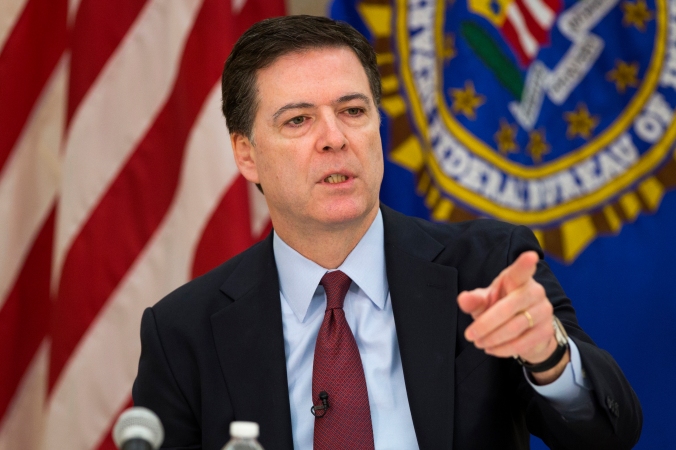
James Comey

The transcript of FBI Director James Comey’s full remarks on the Clinton e-mail probe follow. I will highlight important sections in bold, and in some cases, bold and red. My  observations will follow.

Good morning. I’m here to give you an update on the FBI’s investigation of Secretary Clinton’s use of a personal e-mail system during her time as Secretary of State.

After a tremendous amount of work over the last year, the FBI is completing its investigation and referring the case to the Department of Justice for a prosecutive decision. What I would like to do today is tell you three things: what we did; what we found; and what we are recommending to the Department of Justice.

This will be an unusual statement in at least a couple ways. First, I am going to include more detail about our process than I ordinarily would, because I think the American people deserve those details in a case of intense public interest. Second, I have not coordinated or reviewed this statement in any way with the Department of Justice or any other part of the government. They do not know what I am about to say.

I want to start by thanking the FBI employees who did remarkable work in this case. Once you have a better sense of how much we have done, you will understand why I am so grateful and proud of their efforts.

So, first, what we have done:

The investigation began as a referral from the Intelligence Community Inspector General in connection with Secretary Clinton’s use of a personal e-mail server during her time as Secretary of State. The referral focused on whether classified information was transmitted on that personal system.

Our investigation looked at whether there is evidence classified information was improperly stored or transmitted on that personal system, in violation of a federal statute making it a felony to mishandle classified information either intentionally or in a grossly negligent way, or a second statute making it a misdemeanor to knowingly remove classified information from appropriate systems or storage facilities.

Consistent with our counterintelligence responsibilities, we have also investigated to determine whether there is evidence of computer intrusion in connection with the personal e-mail server by any foreign power, or other hostile actors.

I have so far used the singular term, “e-mail server,” in describing the referral that began our investigation. It turns out to have been more complicated than that. Secretary Clinton used several different servers and administrators of those servers during her four years at the State Department, and used numerous mobile devices to view and send e-mail on that personal domain. As new servers and equipment were employed, older servers were taken out of service, stored, and decommissioned in various ways. Piecing all of that back together — to gain as full an understanding as possible of the ways in which personal e-mail was used for government work — has been a painstaking undertaking, requiring thousands of hours of effort.

For example, when one of Secretary Clinton’s original personal servers was decommissioned in 2013, the e-mail software was removed. Doing that didn’t remove the e-mail content, but it was like removing the frame from a huge finished jigsaw puzzle and dumping the pieces on the floor. The effect was that millions of e-mail fragments end up unsorted in the server’s unused — or “slack”— space. We searched through all of it to see what was there, and what parts of the puzzle could be put back together.

FBI investigators have also read all of the approximately 30,000 e-mails provided by Secretary Clinton to the State Department in December 2014. Where an e-mail was assessed as possibly containing classified information, the FBI referred the e-mail to any U.S. government agency that was a likely “owner” of information in the e-mail, so that agency could make a determination as to whether the e-mail contained classified information at the time it was sent or received, or whether there was reason to classify the e-mail now, even if its content was not classified at the time it was sent (that is the process sometimes referred to as “up-classifying”).

From the group of 30,000 e-mails returned to the State Department, 110 e-mails in 52 e-mail chains have been determined by the owning agency to contain classified information at the time they were sent or received. Eight of those chains contained information that was Top Secret at the time they were sent; 36 chains contained Secret information at the time; and eight contained Confidential information, which is the lowest level of classification. Separate from those, about 2,000 additional e-mails were “up-classified” to make them Confidential; the information in those had not been classified at the time the e-mails were sent.

Continue reading

Essay: On Loretta Lynch And Fighting Cynicism And Distrust Regarding The FBI Investigation Of Hillary Clinton

America_Falling_Apar

Warning:

This is long.

I think it’s important

In the wake of Attorney General Lynch’s acknowledgment of wrongdoing in meeting, however briefly and innocently, with Bill Clinton, some  reader comments here are redolent of the destructive distrust of government and leadership engendered by this administration and others, particularly Bill’s. Yet this attitude feeds on itself, and is to an extent a self-fulfilling prophecy. If leaders think that people expect corruption, they are less likely to shy away from it. Cynicism leads to acceptance. Of course, this is one explanation of why the tarmac meeting took place—pure arrogance and a belief that with the news media’s complicity, now virtually any degree of government dishonesty and corruption will be either effectively hidden from the public, or accepted by it.

This is untrue, still. Indeed, this episode is proof that it is untrue, though the news media did make (disgusting and ignorant) efforts to shrug off the clear appearance of impropriety represented by Lynch having a meeting with Clinton the Impeached under these circumstances. Why do I labor trying to write these essays explaining the legal and ethical context of such events if readers are so poisoned by bitterness and distrust that they can’t or won’t process them, and just default to “it doesn’t make any difference, all is shit, all is lost”?  If I believed that, I wouldn’t be spending time—work  time, uncompensated time—writing this stuff. I can earn peanuts directing professional theatrical productions: it makes people happy, gives actors work, and is a lot more fun, believe me.

Paranoia, suspicion, despair, and conspiratorial views of government, which are all these comments represent, are just forms of bias. Bias makes us stupid, and in this case, bias makes us dysfunctional as a people and fearful and miserable as individuals. Continue reading

Refugee Debate Update: The Good, The Bad, The Ugly, The Stupid, and Then There’s Carol Costello

OccupyDemocrats2

Ugh. It’s hard, not to mention nauseating and repetitious, to simultaneously cover two Ethics Trainwrecks moving at alarming speed and generating unethical conduct and words in all directions. My backlog of other, non-campus, non-terrorism stories grows longer my the minute, but Ethics Alarms has a mission, damn it.

First the Stupid, represented by one of OccupyDemocrats many memes. I am torn, though: is this meme even worse?

OccupyDems

Somebody at OccupyDemocrats.org makes these constantly, and I’d be fascinated to know if whoever it is really thinks these are valid arguments, or are just appealing to, you know, reliably stupid people who aren’t thinking very hard, and who say, “Duhhh, yup! That’ll put those Republicans in their place! I’ll post this to Facebook!” How many Americans really are this deficient in critical thinking?

Maybe I don’t want to think too much about this.

Next, the Good:  Continue reading

Comment of the Day: “An Ethics Mystery: Why Can’t Democrats Be Honest Or Responsible Regarding The Syrian Refugees?”

No risk too small...

No risk too small…

I asked for a single reasonable, rational explanation of Democratic/progressive enthusiasm for allowing Syrian refugees, including an unknown number of potential terrorists, to enter and reside in the United States. I cited the pathetic attempts at such arguments made by various officials, candidates for President, and journalists. What has come in from comments so far does not meet my standard of reasonable or persuasive, and frankly deepens the mystery of why liberal leanings force people to take such positions. One of the most revealing articles of the liberal mindset came from extreme-left journalist Kevin Drum, writing on the web site of the “by any means necessary” leftist publication Mother Jones. He wrote:

“Here’s the thing: to the average person, it seems perfectly reasonable to be suspicious of admitting Syrian refugees to the country. We know that ISIS would like to attack the US. We know that ISIS probably has the wherewithal to infiltrate a few of its people into the flood of refugees. And most voters have no idea how easy it is to get past US screening. They probably figure it’s pretty easy.

So to them it doesn’t seem xenophobic or crazy to call for an end to accepting Syrian refugees. It seems like simple common sense. After all, things changed after Paris.

Mocking Republicans over this—as liberals spent much of yesterday doing on my Twitter stream—seems absurdly out of touch to a lot of people. Not just wingnut tea partiers, either, but plenty of ordinary centrists too. It makes them wonder if Democrats seriously see no problem here. Do they care at all about national security? Are they really that detached from reality?

The liberal response to this should be far more measured. We should support tight screening. Never mind that screening is already pretty tight. We should highlight the fact that we’re accepting a pretty modest number of refugees. In general, we should act like this is a legitimate thing to be concerned about and then work from there….”

How damning and obnoxious. Drum never actually explains why the concern aren’t legitimate; he just condescendingly assumes that his compatriots understand they just are, because…why? Obama, who has been wrong about just about everything, says so, I suppose. Or because progressives are just enlightened. Maybe because Democrats believe open borders are a great thing, because the minority migrants, legal or illegal, mean more votes. I have no idea why he is so smugly superior, but he gives only one substantive argument: “Never mind that screening is already pretty tight.”

Oh is it now? From that far-right conservative, Republican wacko xenophobic newspaper, the Washington Post:

While they say U.S. security measures are much better than in the past, vetting Syrian refugees poses a quandary: How do you screen people from a war-torn country that has few criminal and terrorist databases to check?

The United States has resettled more than 3 million refugees since the mid-1970s, and the screening system in the post-9/11 era includes multiple background checks, screenings against FBI and other databases and an in-person interview. Debate over the program has intensified since the deadly terrorist strikes in Paris blamed on the Islamic State, though each attacker identified so far whose nationality has been confirmed has been found to be a European national, not part of the wave of refugees from Syria.

“I don’t, obviously, put it past the likes of ISIL to infiltrate operatives among these refugees, so that’s a huge concern of ours,” Director of National Intelligence James Clapper said at a security industry conference in September, using another name for the Islamic State. He added that the government has “a pretty aggressive program” for screening refugees but that he is less confident about European nations.

FBI Director James Comey added in congressional testimony last month that “a number of people who were of serious concern” slipped through the screening of Iraq War refugees, including two arrested on terrorism-related charges. “There’s no doubt that was the product of a less than excellent vetting,” he said.

Although Comey said the process has since “improved dramatically,” Syrian refugees will be even harder to check because, unlike in Iraq, U.S. soldiers have not been on the ground collecting information on the local population. “If we don’t know much about somebody, there won’t be anything in our data,” he said. “I can’t sit here and offer anybody an absolute assurance that there’s no risk associated with this.”

Then the story follows with an extensive description of what screening is supposed to be, an was with Iraqi refugees—none of which appears to be relevant to the reality of screening the Syrian. The story concludes:

But one of the senior administration officials at Tuesday’s briefing acknowledged the limitations inherent in screening refugees from Syria, where it’s very difficult to determine something as basic as an applicant’s criminal history.

“We do the best with what we have,” the official said. “We talk to people about what their criminal histories are, and we hear about that. That’s pretty much where we are.”

Talk to people about what their criminal histories are. Yup, nothing to worry about. Only xenophobes and racists would see any deficiencies or risks here. Let’s just pretend to respect what they say; they can’t stop it anyway.

Here is Beth’s Comment of the Day on the post, An Ethics Mystery: Why Can’t Democrats Be Honest Or Responsible Regarding The Syrian Refugees??

Yes, I’ll be back at the end.

And still ticked off. Continue reading