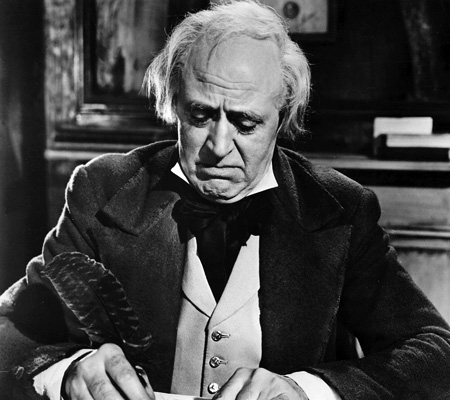
How the Lack of Ethics Cripples Democracy, Reason #2: Corporate Executive Greed


"Let's see...that's one schilling for Cratchet, 280 for me..."

The average compensation for chief executives of the 500 largest U.S. corporations is going up again.

According to Governance Metrics International, the average compensation for the CEOs, including salary, bonus and benefits plus the exercise of stock options, the vesting of stock grants and retirement benefits, was just under $12 million in 2010, up 18 percent from 2009. As Washington Post business writer Steve Pearlstein observes in his column this week, if you believe this is justified by market forces and common sense, “then you must also believe two things: First, that none of these guys would do the same job for a nickel less. Second, that the value of the chief executive went up 18 percent last year while the value of average workers in their companies changed very little.”  “And,” concludes Pearlstein, “if you believe that, you are a fool and an ideal candidate for an open seat on an S&P company board of directors.” Continue reading


Ethics Dunce: Buzz Bissinger

It took about an hour after the  Barry Bonds verdict for the first ethics-challenged national sports writer to write something outrageous about it. Not surprisingly, it was Buzz Bissinger, a the member in good standing of the Daily Beast’s stable of annoyingly hypocritical, biased or appallingly cynical writers, Bissinger belonging to the last category.

His post, which pronounced the Barry Bonds conviction “a travesty” in the title, contained one ethics howler after another, any of one of which would have justified an Ethics Dunce prize.

Here they are:

“It is true that the case of Barry Bonds does hit a new low, a new low in the waste of millions of dollars of taxpayers’ money, a new low in the witch hunt of a player who, because he was considered surly and arrogant and unlikable, is now having intimate details of his life revealed (such as testicle shrinkage), a new low in outrageous abuse of government power.” Continue reading

Ethics Heroes: The Fukushima 50, Reminding Us What Real Heroism Is

We all throw around the words “hero” and “heroism” too readily, and it cheapens the real thing, which is rare, and awe-inspiring. Teachers are heroes, cancer patients are heroes, mothers and dads are heroes, legislators who ignore polls are heroes, quarterbacks are heroes. There is much heroism around us, certainly—those who do vital jobs and make courageous choices at personal sacrifice deserve praise and recognition, as do those who overcome tremendous personal challenges. We should appreciate these acts when we see them.

Still, this leaves us unable to muster the words to distinguish the rarest and most remarkable of heroes, like the fifty Japanese nuclear technicians who have remained behind to try to prevent a nuclear catastrophe at the Fukushima Dai-ichi nuclear plant damaged by Friday’s earthquake. They are not merely risking their lives, but quite probably trading them, for the well-being of their country and its citizens.

We should all aspire to such courage, selflessness, and character.

In the pantheon of ethical conduct, the Fukushima Fifty deserve the most honored place of all.

Ethics Quiz: Who Deserved To Be Fired—Beck or The Duck?

Tough quiz today, ethics fans. Be on your toes!

Our quiz for today: Who most deserved to be fired—Glenn Beck, Gilbert Gottfried (the voice of the Aflac duck),  neither, or both?

The Mad Prophet of Fox, Glenn Beck returned to his radio program with this reflection:

“I’m not saying God is, you know, causing earthquakes. I’m not not saying that either… but there’s a message being sent. And that is, ‘Hey, you know that stuff we’re doing? Not really working out real well. Maybe we should stop doing some of it.’ I’m just saying.”

Yes, Glenn Beck said that the devastation of Japan just may be a message from God. Continue reading

Comment of the Day: “The Cabbie and the Jewelry”

Prodigal Commenter Penn re-entered the ethics fray with two anecdotes about ethics and Japanese culture in reaction to the Ethics Alarms quiz, “The Cabbie and the Jewelry.” This was the second COTD to be inspired by that story of the ethical—or pragmatic—cabbie who rescued $100,000 worth of jewelry left in his cab by a careless fare.

Here is Penn’s “Comment of the Day”:

“70s, Tokyo, 2 anecdotes: Continue reading

The Ethics of Commemorating Hiroshima

I missed it, but apparently the son of the commander of the Enola Gay told Fox News that for America to send a diplomatic delegation to Japan to memorialize the 65th Anniversary of the bombing was a de facto apology that for a necessary wartime action.

Over at Popehat, Patrick (some day I’ll figure out how to get these guys’ last names) offers an articulate and precise explanation of why James Tibbets is wrong, historically and ethically. An excerpt: Continue reading

The Ethics Of The Ground Zero Mosque

The proposed Ground Zero mosque should be a straightforward ethics issue, but it is not. Now it is bound up in a thoroughly confusing  debate that confounds and blurs law, ethical values, history, rights, and human nature.  Everyone is right, and everyone is wrong.

Yes, it’s an Ethics Train Wreck, all right. This one is so bad I hesitated to write about it—ethics train wrecks trap commentators too—in the vain hope that it would somehow resolve itself with minimal harm. That is obviously not in the cards, however; not when the Anti-Defamation League weighs in on the side of religious intolerance, thus forfeiting its integrity and warping its mission. The wreck is still claiming victims, and there is no end in sight. Continue reading

“Raving Private Gump”: Tom Hanks Lets Political Correctness Eat His Brains, and Gets Called On It

I am a big fan of Tom Hanks’ work as an a comic, a dramatic actor, a producer, and in drag, but he has been reliably attached to what may end up being the most infuriating quote of the year. If not the most infuriating, then at least the most ignorant and irresponsible.  In an interview with historian Douglas Brinkley in a Time magazine feature about his upcoming HBO series on World War II in the Pacific, Hanks said this:

“Back in World War II, we viewed the Japanese as ‘yellow, slant-eyed dogs’ that believed in different gods. They were out to kill us because our way of living was different. We, in turn, wanted to annihilate them because they were different. Does that sound familiar, by any chance, to what’s going on today?”

If you are not now running in circles, wide-eyed and screaming, you should be. Continue reading