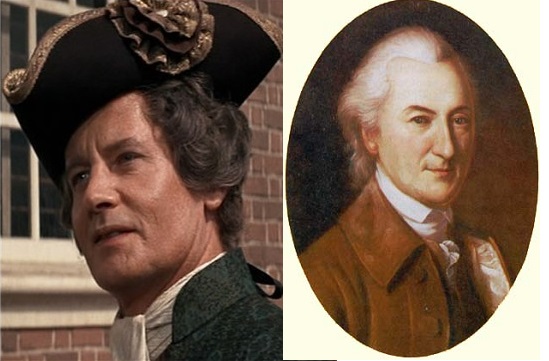
Villainous, singing version on the left; heroic, real life version on the right.
It is the American patriot John Dickinson’s curse that the very strength of character that caused him to stand out among the other Founders and that led them to respect him as much or more than any other also made him the black sheep in the inspiring tale of American independence. This led to relative obscurity. Although Dickinson is honored (along with his wife) by Dickinson College, Dickinson School of Law of the Pennsylvania State University, and University of Delaware’s Dickinson Complex, he is largely unknown to most Americans. He would be even less known, had Peter Stone not chosen to make him the villain of his 1969Tony-winning musical “1776,” where he was portrayed as a conservative loyalist who almost single-handedly foils the efforts of John Adams, Thomas Jefferson and Ben Franklin to declare independence from Great Britain. Whatever that choice’s dramatic virtues, it was unfair to Dickinson in every way.
Raised a Quaker, educated as a lawyer and a farmer by trade, Dickinson began public life in 1760 when he was elected to the Delaware legislature. During the next fifteen years he served both in that body and in the Pennsylvania legislature, a rare dual service made possible because he owned property in both colonies.
When the British Parliament instituted measures in the Colonies to raise revenue and provide for the quartering of British troops, Dickinson was one of the most eloquent and persuasive critics of the Crown, always with the intention of finding a satisfactory negotiated accord that did not involve the threat of armed rebellion. He urged Americans to rely primarily on economic pressure to oppose the hated Stamp Act, and he enlisted the influence of British merchants on the colonists’ behalf. His diplomatic orientation seemed like a prudent antidote to the firebrands calling for revolution in Boston, so the Pennsylvania legislature appointed him to represent that colony at the Stamp Act Congress of 1765. There he advocated the proposition that reconciliation was possible if the King and Parliament would only realize that colonial opposition was in the grand tradition English principles of political liberty. Dickinson set his reasoning to paper in his “Letters from a Farmer in Pennsylvania,” a series of deft essays that brought Dickinson international fame as a man of reason and principle. Continue reading

 Ethics Alarms