
Good morning!
1. Oh! You’re bigots and fools, then! Got it. I was watching a mob of—I don’t know, feminists? The “resistance”? chanting yesterday at the Senate: “I believe Anita Hill! I believe Blasey Ford!” I believe that the only reasonable translation of this particular chant—all chants make protesters sound dumb, some chants more than others; at least this one doesn’t start with “Ho ho, hey hey!”—is “I believe whatever story supports my political agenda, and I believe people according to what they are, rather than based on any objective criteria!”
I guess it’s not sufficiently catchy.
2. In case you aren’t nauseous enough...Former NFL quarterback Colin Kaepernick will be one of the eight honorees of Harvard University for their contributions to black history and culture, the university announced yesterday.
Kaepernick, distinguished for his incoherent on field protest during the national anthem, instantly setting off the NFL’s version of #MeToo, as in “I want make my own pointless, annoying protest that I can’t adequately explain!,” thus costing the NFL fans and billions of dollars, will receive the W.E.B. Du Bois Medal from Harvard’s Hutchins Center for African and African American Research. The deliberately divisive honor to Kaepernick, who favors socks with cartoons of pigs in police uniforms, is apparently the work of Henry Louis Gates Jr., director of the Hutchins Center and Barack Obama pal. You may remember Professor Gates as the race-baiting catalyst for Obama’s “beer summit,” after Gates impugned the character of a Cambridge police officer. No personal agendas here!
The award supposedly honors individuals who “Emerging from a variety of backgrounds and professions…represent the quest for knowledge, freedom of expression, and pursuit of truth that are foundational to black history and culture, and that were foundational to Du Bois as a thinker and activist.”
Yup, that sure sounds like Colin Kaepernick!
3. Ed Whelan, call your ethicist! Ed Whelan, an attorney and president of the conservative Ethics and Public Policy Center, upped the craziness quotient in the Kavanaugh confirmation process and took a First Class seat on the Brett Kavanaugh Nomination Ethics Train Wreck by announcing that Ford’s accusation from three decades ago was based on mistaken identity, and that another student, whom Whelan named and thoroughly doxxed, along with publishing his yearbook photo, was the real alleged assailant.
Well, you can’t just accuse a random private citizen of sexual assault, or even alleged, unsubstantiated sexual assault while a drunken high schooler. I know Ed went to Harvard College and Harvard Law School, but even then, he’s no idiot. I have to believe that this isn’t just an unfounded accusation, because Ed knows that he’s asking for a lawsuit if it is. He wrote:
“By one week from today, I expect that Judge Kavanaugh will have been clearly vindicated on this matter. Specifically, I expect that compelling evidence will show his categorical denial to be truthful. There will be no cloud over him.”
Whelan has to deliver on a statement like that, or have his own reputation permanently scarred. The only explanation I can come up with is that Kavanaugh’s twin has already agreed to admit to being at the infamous party and having some kind of episode involving Ford. Of course, there will be no reason to believe him, either.
Still, I may go to the Senate and chant, “I believe Brett Kavanaugh, I believe his secret twin!”
Just for fun. Continue reading →

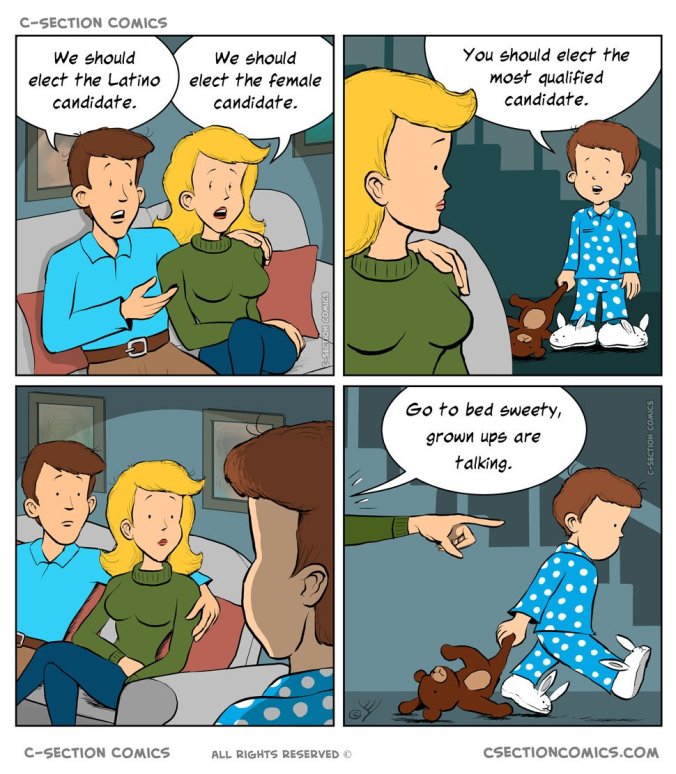 Althouse seems to miss the significance of this: she asks if anyone “gets” humor any more. That’s not what’s going on here. A stunning number of people really believe that voting—or hiring, or admitting college applicants—on the basis of merit is racist. This belief itself is racist, as well as destructive, illogical and batty, but that’s what culture will do to you eventually, if you don’t have a strong foundation of ethical values and critical thinking skills.




 Ethics Alarms