Asshole vs. Asshole, And How To Avoid Starring In It

If you are old enough, you may remember the long-running comic  in Mad Magazine called “Spy vs Spy.” It was kind of a wordless Roadrunner cartoon with a Cold War vibe, and not especially funny, but I just thought of it for the first time in decades. (Incredibly, it is apparently still running in Mad, though the magazine itself is sinking fast.) I was considering this ridiculous story…

…It started small, but disputes over a Kansas man’s alleged violations of his homeowner association’s rules has led to a complex legal battle that is now the most expensive of its kind. Owner Jim Hildenbrand, has been locked in conflict with the HOA of Avignon Villa Homes since he moved there in 2012…

What began with a disagreement over the placement of a satellite dish and a decorative wall has escalated into a legal back-and-forth that has cost both parties at least a combined $1 million. It is the most expensive HOA dispute in the country.

It is also yet another example of the increasingly common societal phenomenon of “Asshole vs. Asshole.” These are ethics breakdowns where two parties in disagreement decide that making the other side pay for daring to have an adverse position overwhelms whatever the original objectives of the two parties were. It is reminiscent of the kinds of disputes parents—the good ones, anyway–arbitrate between siblings. “You’re both right,” Mom or Dad will say, “And you’re both wrong. You have reached the point where the escalation of anger and retaliation is the problem, not what you think you are arguing about.. Work it out. Compromise. See it from the other one’s perspective. And if you don’t, we’re going to punish both of you.”

In the case of Mr. Hildebrand and his fascist Home Owner Association, both sides say it’s the principle of the thing. As any reader hear know, I am a believer in and a practitioner of taking stands for principle, but knowing when this is essential (Do NOT apologize for speaking the truth or bucking the mob) and destructive is a critical life skill. The trick is keeping emotion out of it, and engaging in ethics problem solving. Asshole vs Asshole occurs when hate, and anger, and the desire to teach that jerk a lesson blinds both parties to common sense, the Golden Rule, and the human duty to seek peace, not war. Continue reading
The President’s Ethics Grades So Far

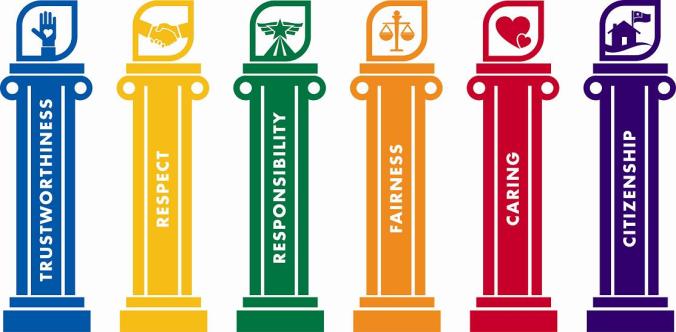
six-pillars

Is it fair to grade President Trump on his ethics after less than a month? Of course. If he wanted to pay attention to this area, the President would certainly seek an objective progress report. There has been enough activity in three weeks to give some preliminary grades. Ethics Alarms began this adventure with low expectations; after all, I have never read or heard a single statement from the President, ever, that suggests that he thinks about or cares about ethics at all. His behavior and opinions appear to be entirely governed by rationalizations, emotions, and impulse. However, we do have hope, and three weeks of a presidency is not sufficient to extinguish it. There is plenty of time for President Trump to address his ethical shortcomings

Let’s use the Josephson Institute for Ethics’ Six Pillars of Character for this exercise. All graded categories should be regarded as incomplete, and the offered grades as provisional only. Remember, these are ethics grades only.

I. TRUSTWORTHINESS, including Honesty in communication, Candor, Truthtelling, Reliability, Sincerity, Honesty in Conduct, Integrity, Loyalty

The President and his agents, like Spicer and Conway, have been especially loose with facts and assertions, some of which can be excused a bit as carelessness, but the sheer volume of misinformation is daunting. I suppose one could argue that Trump is reliably unpredictably, but that’s not what the value of reliability is all about. The President’s astounding verbal sloppiness makes it impossible to gauge sincerity (is he really out to ban Muslims, or just determined to keep out Muslim terrorists?) I score Trump relatively high on integrity, as shown by his Inaugural speech. Whatever he thinks he means, he really means it. (The contrast is Hillary Clinton.) Trump is loyal. Loyalty is a troublesome value that can be abused as often as not: he was loyal to appoint Ben Carson to the cabinet, but it’s still an unethical act, since Carson is unqualified beyond belief. But loyalty also covers conflicts of interest, and the appearance of impropriety. The President’s conflict of interest problems have not been seriously addressed, and won’t be.

He hasn’t been trustworthy, so his grade here is..

F

II. RESPECT, including Civility, Courtesy, Decency, Dignity, Tolerance, Acceptance, Autonomy Continue reading

Ethics Quiz: “Don’t Eat The Daisies” Ethics

I’m trying to take a breather from the Syrian refugees, President Obama, Presidential candidates and rampaging college students, and an ethics issue from a 1960 Doris Day comedy is as far away as I can get.

In “Don’t Eat the Daisies,” a movie loosely (very loosely) based on the humorous mommy anecdote best seller by Jean Kerr, wife of then New York Times  theater critic Walter Kerr, newly appointed prime drama critic Larry McKay (David Niven), his lovely wife Kate (Doris), their four rambunctious kids, their sheep dog and their wise-cracking house-keeper (Patsy Kelly)—yes, this was essentially the “Brady Bunch” without the girls—move to the country. Doris gets roped into the annual musical (for charity, natch) of the very amateur Hooten Holler Players. They ask the Larry for a play they could use, and he isn’t very helpful, so Doris calls up Alfred North, an old friend of the couple and a successful novelist played by Richard Haydn, best known as the sneaky Max in “The Sound of Music,” who has just had his first Broadway play skewered by McKay (Integrity! Integrity!). He is secretly seething and seeking revenge. The betrayed playwright siezes his chance: he sends Doris an obscure, terrible Foriegn Legion melodrama by an unknown author, and the Hooten Holler players turn it into a musical spoof.

Days before its ready to open, after all the tickets have been sold, Doris asks David to watch a rehearsal. He immediately recognizes the plot and some particularly awful lines: he wrote the  play under a pseudonym! “BWAHAHAHAH!” laughs Max, or rather Alfred. Larry’s  onetime friend, now relentless foe, has set the critic up for humiliation and professional doom, for other New York critics have been tipped off that the play getting its world premiere by the Hooten Holler Players is in fact the creation of the hypercritical critic himself. Once this abysmal mess is seen and taken apart by the critic’s rivals, his judgment will never be taken seriously again.

Niven demands that the production be cancelled, and forbids the Players to perform his work. Doris, who stars in the play, begs him to reconsider: the humble theater group will be ruined, and the charity will lose much needed support. The critic explodes: why does she care more about the amateur theater group than her husband’s career? She tells him that his theatrical power and fame has made him petty and mean. Their marriage seems ready to disintegrate.

Your retro-Hollywood Ethics Alarms Ethics Quiz of the Day is..

What’s going on here, and what do you do about it?

Continue reading

The Damage of Health Care Reform “By Any Means Necessary”

I have no idea whether the health care reform bill, assuming it finally gets passed in one form or another, will make things better or worse, and if you are honest about it, neither do you…and neither, I am certain, do most of the elected representatives who will have voted for it or against it (or for it and against it) by the time the dust clears. To only cite the most obvious proof, the bill’s current form was just posted yesterday, giving Congress 72 hours to read and understand over 2,000 pages of technical jargon and badly-written prose. I don’t believe I have ever read 700 pages a day for three days at any point in my life, and if I have, I know it had to be something more diverting than a health care bill.

Relying on second-hand analysis—also by individuals who haven’t read the current bill—simply puts us (and the members of Congress) at the mercy of the biases of those rendering the opinions. For example, one of my favorite commentators, Robert Samuelson, has persuasive arguments against the bill here and here, while one of my least favorite, Paul Krugman, weighs in on the bill’s virtues here and here. Now, I think Krugman has squandered his credibility by blatant untruths in the past (One howler, his infamous statement about the national health care systems of Canada and Great Britain that “We’ve all heard scare stories about how that works in practice; these stories are false” is derisively quoted almost daily by Wall Street Journal blogger James Taranto as he relays tales of national health care horrors from the London press), but the man has won a Nobel prize: maybe he’s right and Samuelson is wrong. I really don’t know.

I do know this, however: whether the bill proves to be disaster or panacea, the manner in which President Obama and the Democrats have gone about passing it has done real and lasting harm.  Continue reading