Windy Morning Ethics Warm-Up, 3/2/18: More Supreme Court Fun, Transparency Games, Ethical and Unethical Quotes Of The Day…

GOOD MORNING!

(Wind storms all over Virginia, knocking out power and my e-mail, and blowing over a tree that narrowly missed my son’s car!)

1 Lack of Transparency? What lack of transparency? During a lecture and moderated discussion at U.C.L.A. this week in which he was a a participant and invited guest, Treasury Secretary Steven Mnuchin was heckled with hisses, jeers, shouted insults and profanity from students and protesters, some of whom were ushered and even carried out by police officers. A programmed sixth grader in the audience even questioned him about the fairness of passing permanent tax cuts for companies and expiring cuts for individuals, because as we all know, 10-year-olds are well-versed in tax policy theory.

Afterwards, Mnuchin  revoked his consent for the official video of the event to be released, perhaps because he was flustered by the harassment and it showed. In response to criticism of this virtual censorship,

The Treasury Department, through a spokesperson, said that what the Secretary did wasn’t what he obviously did—a Jumbo, aka “Elephant? What elephant?”—saying,

“The event was open to the media and a transcript was published. He believes healthy debate is critical to ensuring the right policies that do the most good are advanced.”

He just doesn’t want anyone to see or hear the debate.

A related point: The protests were organized by Lara Stemple, a U.C.L.A. law professor, and students and faculty members participated. Protests are fine; disrupting the event is not. Faculty members who assisted in the heckling should be disciplined, and students who participated should be disciplines as well.  It’s an educational institution, and all views sgould be openly explored and heard without interference. No guest of the university should be treated this way. Ever. No matter who it is or what their position. The treatment on Mnuchin was unethical.

2. More Supreme Court fun with ethics! Minnesota’s law banning “political” clothing and buttons from polling places is being challenged as an affront to free speech. The law prohibits people from wearing a “political badge, political button or other political insignia” at a polling place on an election day, and a member of the tea party movement sued after his “Tea Party” message got him in trouble when he came to vote.

Here is Justice Samuel A. Alito’s exchange with Daniel Rogan of the Hennepin County Attorney’s Office, who was defending Minnesota’s law:

“How about a shirt with a rainbow flag?” asked Alito. “Would that be permitted?”

“A shirt with a rainbow flag?” Rogan repeated. “No, it would — yes, it would be — it would be permitted unless there was — unless there was an issue on the ballot that — that related somehow to — to gay rights.”

Justice Alito: Okay. How about an NRA shirt?

Mr. Rogan: An NRA shirt? Today, in Minnesota, no, it would not, Your Honor. I think that that’s a clear indication—and I think what you’re getting at, Your Honor—

A T-shirt bearing the words of the Second Amendment? Alito asked.

Probably banned because of the gun-control issue, Rogan said.

The First Amendment? Alito asked. Probably not, Rogan answered.

Got it. The First  Amendment isn’t a political statement, but the Second Amendment is. That led Justice Neil M. Gorsuch to observe: “Under your interpretation of ‘political,’ it would forbid people from wearing certain portions of the Bill of Rights into a polling place but not other portions of the Bill of Rights. And I guess I’m just wondering what compelling interest Minnesota has identified that requires a statute that goes so much further than the vast majority of states?”

In contrast, Justice Anthony M. Kennedy asked J. David Breemer, a lawyer for the Pacific Legal Foundation, representing the challengers, “Why should there be speech inside the election booth at all, or inside the what you call the election room? You’re there to vote.”

This is a problem requiring an “all or nothing” solution. Either all forms of political speech must be allowed, or no speech at all. In a sick time where citizens honestly argue that a MAGA cap or a picture of a gun makes them feel threatened and “unsafe,” the ethical option would seem to be Justice Kennedy’s. No speech, messages, no logos, no photos, no American flags. Last fall I voted wearing my Red Sox jacket.

Uh-uh. Continue reading

Morning Ethics Warm-Up, 2/13/18: You Can’t Get Much More Ethics Issues Variety Than This!

http://www.youtube.com/watch?v=L2hLvqKe0V8

Good Morning!

[Mickey is really playing that piano. Boy he was amazing…]

1 A Russian Jumbo!  And it worked! In Russia, Irina Kudinova was charged with mocking the Church after she  posted a photograph that prosecutors alleged was obscene and thus constituted the “deliberate desecration of a religious object” and “insulting the feelings of believers.”   Gee, I can’t imagine why anyone would think THAT..Here’s the photo:

The judge ruled that it was merely a photo of an Easter cake and nothing more. Elephant? What elephant? Or maybe “What elephant phallus?” would be more accurate. Kudinova was awarded 20,000 rubles in a court action for false accusations.

Few cases better illustrate the principle that in Bizarro World attempts at ethical acts become unethical. The problem is that Russia has laws that discourage free speech. In order to undermine an unethical law, the judge in this case made a ruling that is obviously contrary to reality, and what anyone can see with their own eyes. If judges can ignore evidence and deny reality to protect citizens from an unjust law, then they can do the same to unjustly punish citizens who break no laws at all.

I’m happy for Kudinova, but the Russian judge is a well-intentioned ethics dunce. His solution does as much damage as good.

2. “Thanks, Mom and Dad…and bite me.” The parents of GOP Senate candidate Kevin Nicholson each gave $2,700, the maximum allowed, to the primary campaign of the Democrat their son is challenging, Senator Tammy Baldwin. Continue reading

Rewarding Violence And Vigilante Justice: The Unethical Glorification of Randall Margraves

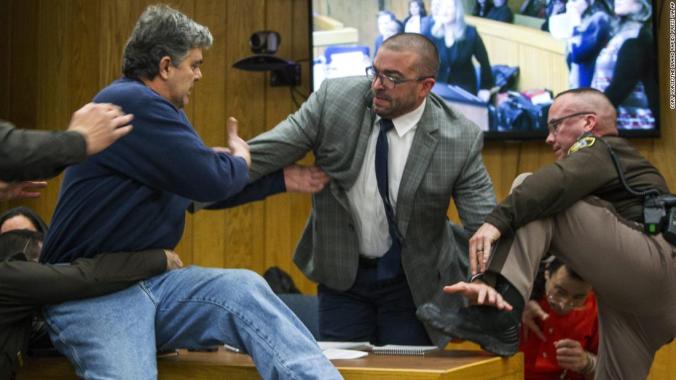
That’s Margraves on the left, with Nassar, his target, cowering in red…

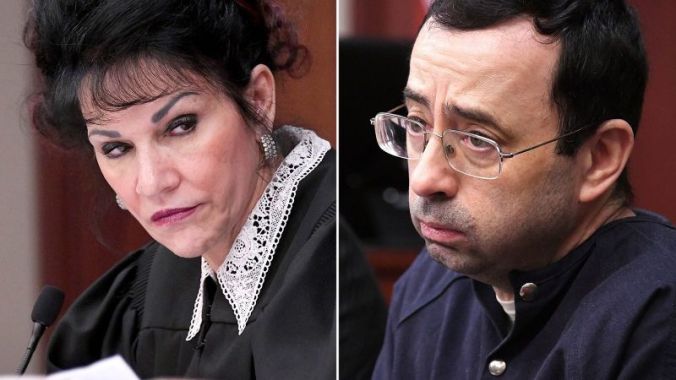
During the sentencing hearing for sexual predator Larry Nasser in an Eaton County, Michigan courtroom, Randall Margraves, the father of three daughters who were all molested by the former USA Women’s Gymnastics doctor, shouted “You son of a bitch!” and rushed Nassar.  He was tackled and placed in handcuffs. Before the attack, Margraves asked Judge Janice Cunningham to grant him “five minutes in a locked room with this demon. Yes or no.”  Perhaps he thought she was Ingham County Court Judge Rosemarie Aquilina, who might have granted his request based on her words at his previous sentencing hearing. Cunningham, however, refused the request.

After the father’s attempt to take the law into his own hands, Michigan Assistant Attorney General Angela Povilaitis told the stunned courtroom, “We cannot behave like this. This is letting him have his power over us….You cannot do this. I understand Mr. Margraves’ frustration, but you cannot do this. Use your words, use your experiences. Do not use physical violence.” Judge Cunningham added,

“We cannot react by using physical violence and assault against someone who has performed criminal acts. What Mr. Nassar did is horrible. It’s unthinkable, but please let the criminal justice system do what it is supposed to do and issue the punishment he should get.”

Nonetheless, no charges were filed against Margraves. Wrong.  This is irresponsible and hypocritical, as well as cowardly. (We know any punishment will be unpopular with the “Think of the children!” and the “What if it was your daughters?” crowds as well as the “Punch Nazis in the face”  constituency) If the message really is that a society can’t give in to vigilante justice and let citizens employ physical violence as extra-legal means to exact vengeance against criminals, then those who behave this way must be punished.  If they are not, then the opposite message is sent: “Well, when someone is really bad, and hurts someone you really care about, we sympathize. We understand how you feel.” What if Margraves had reached Nassar and delivered a punch to his face, fracturing his jaw? Or ripped his lips off? That he didn’t was just moral luck. Would the father have been charged then, as millions around the nation shut down their ethics alarms and cheered?

For the justice system to remains coherent and maintain integrity, the father had to be charged. Continue reading

The Unethical Sentencing Of Dr. Lawrence Nassar

Non-lawyers and journalists mostly cheered Ingham County Court Judge Rosemarie Aquilina’s grandstanding, self-indulgent, unprofessional and unethical handling of Dr. Larry Nassars’s sentencing yesterday. Nobody bothered to seek the opinion of criminal lawyers and judges, much less ethicists. If they had, they would have heard a loud, collective, “Ugh.”

It was a disgrace. I object to victim impact statements in sentencing, a terrible idea pushed by victim’s rights advocates, because it misrepresents the purpose of the justice system. The objective is to punish citizens for violating laws, not to get revenge for victims or their families, not to get “closure,” and not to satisfy emotional needs. The process isn’t personal, or shouldn’t be. If it is personal, then it isn’t objective. Judge Aquila threw all of that out the window as she played to the cameras and the mob.

Criminal defense lawyer and blogger Scott Greenfield aptly explained what was unethical about the parade of victims:

Nassar’s sentencing hearing is a clear example of a judge straying from promoting the public’s trust in a fair and impartial judiciary. Let’s begin with Judge Aquilina’s decision allowing over one hundred and sixty victim impact statements across seven days. 

Victim impact statements are theoretically allowed as a means of giving a crime victim the chance to describe their experience to the court. Defense lawyers aren’t typically fans of them, and too many can arguably have a prejudicial effect against a defendant.

Contrast Nasssar’s hearing with that of Dylann Roof, the Charleston shooter responsible for the deaths of nine churchgoers. Judge Richard Gergel admonished the State’s list of thirty-eight statements, cautioning against a “spectacle”. David Bruck, the attorney assigned to advise Roof, claimed the proceeding violated “every principle restraining victim impact statements under the 8th Amendment.”

Strangely, no advocate stood to question admitting impact statements from over 160 victims, including gold medal Olympians, might prejudice a jurist’s decision. It’s hard to imagine Judge Aquilina even entertaining such an argument.

It is also hard to imagine Nassar’s sleepwalking defense attorney making such an objection. She was praised by the judge for taking on an unpopular client, but taking him on isn’t enough. She was supposed to protect his rights.

Then the judge delivered her sentence, turning her moment in the national spotlight into a self-aggrandizing, virtue-signalling, vainglorious soliloquy to the gallery. This was one more example of why televised court proceedings are a bad idea.

I’m going to give you the whole transcript of her remarks, bolding the sections before my comments. Cut to the bolded sections if you don’t care to experience the full measure of Judge Aquilina’s narcissism. One section,, however, was left out of all the published versions that I could find:

“Our Constitution does not allow for cruel and unusual punishment. If it did, I have to say, I might allow what he did to all of these beautiful souls—these young women in their childhood—I would allow someone or many people to do to him what he did to others.”

The judge apparently had this excised from the official transcript. No wonder. She is advocating prison rape and by doing so, endorsing it. Michigan’s judicial ethics standards require in part,

“A judge should respect and observe the law. At all times, the conduct and manner of a judge should promote public confidence in the integrity and impartiality of the judiciary. Without regard to a person’s race, gender, or other protected personal characteristic, a judge should treat every person fairly, with courtesy and respect.”

Needless to say—I hope—‘I wish I could have you gang raped’ does not meet this standard. It is also troubling that a judge would distort the record. She said what she said, and the public should know she is the kind of jurist would say something like that—an unethical one. The state’s judicial panel should also know.

Here is the rest: Continue reading

The Unprepared Judicial Nominee [Updated]


http://www.youtube.com/watch?v=79Hq9yHtMCk

Matthew S.] Petersen, a lawyer serving on the Federal Election Commission, was one of five President Trump judicial nominees to be questioned by the Senate Judiciary Committee last week. Senator John N. Kennedy, a Republican from Louisiana, subjected Petersen to questions regarding basic litigation law, such as the Daubert standard, which has to do with qualifying expert witness testimony, the definition of a motion in limine, and several other bits of information a junior litigator would have to have in his memory banks. The potential judge told the Senator that he had never tried a case or argued a motion in court. He said he last read the Federal Rules of evidence in law school. “I understand that the path that many successful district court judges have taken has been a different one than I’ve taken,” Petersen said.

Naturally, being a Trump nominee, Petersen is being widely mocked in the news media and by Democrats. Some legal experts have been more sympathetic, like Judge Wayne R. Andersen, who was a federal judge in the Northern District of Illinois for nearly 20 years. He told reporters  that there was a continuing debate within the legal profession about the qualifications required of a trial judge, saying, “Anyone who steps to the federal bench lacks a huge amount of federal experience necessary to do the job,” and that Senator Kennedy’s questions, while fair, “would eliminate 80 percent of the nation’s lawyers and many of the most talented lawyers.”

Lawyer/Blogger John Hinderaker wrote in part,

The lawyers who have the most thorough understanding of substantive areas of the law–real estate, taxes, corporate governance and so on–are generally not litigators. Do we really want to say that all of these non-litigators–the majority of lawyers–are unfit to be trial judges?…does it mean that one of my non-litigator partners would be disqualified from such an appointment, no matter how good a lawyer he or she might be? I don’t think so.

… Newly-appointed judges attend “judge school,” where they are taught the finer points of the rules of evidence….Most lawyers who are appointed to the bench in both federal and state courts have backgrounds in litigation. No doubt that is appropriate. However, it is by no means rare for non-litigator lawyers to be appointed, or win election, to the bench. In my opinion, that is a good thing. I don’t see why a minority of lawyers–litigators–should have a monopoly on the bench. I don’t know whether Matthew Petersen will make a good judge or not. But in my view, he doesn’t deserve to be ridiculed because his highly-successful law career has been conducted outside of the courtroom.

I agree; he shouldn’t be ridiculed for that. Continue reading

The Bad Judges And The Law Dog

The legal commentariat is much amused by a case out of Louisiana involving  the right to counsel. I don’t think it’s funny at all.

( Oh all right, it’s a little funny.)

Warren Demesme was being interviewed by detectives, not for the first time, about some alleged sexual misconduct with minors. He was read his rights, “Mirandized,” as they say, and said that he understood, and waived those rights. (He could, however, choose to invoke them at any time, per several Supreme Court rulings.)

At some point the interview got tense, and the suspect said,

“If y’all, this is how I feel, if y’all think I did it, I know that I didn’t do it so why don’t you just give me a lawyer dog cause this is not what’s up.”

He was not, however, given access to a lawyer, and when he appealed his subsequent conviction on the grounds that he requested legal assistance and was not accommodated, the lower court rejected his argument, saying that he had not made his desire for a lawyer clear and unambiguous. Incredibly, the Louisiana Supreme Court agreed, writing in part,

The defendant argues he invoked his right to counsel. And the basis for this comes from the second interview, where I believe the defendant ambiguously referenced a lawyer..As this Court has written, “[i]f a suspect makes a reference to an attorney that is ambiguous or equivocal in that a reasonable police officer in light of the circumstances would have understood only that the suspect might be invoking his right to counsel, the cessation of questioning is not required.” State v. Payne (La. 2002); see also Davis v. United States (1994) (agreeing with the lower courts’ conclusion that the statement “[m]aybe I should talk to a lawyer” is not an unambiguous request for a lawyer). In my view, the defendant’s ambiguous and equivocal reference to a “lawyer dog” does not constitute an invocation of counsel that warrants termination of the interview and does not violate Edwards v. Arizona (1981).

Right.

And the vote on the Supreme Court in favor of this indefensible ruling was 8 to 1. 8 to 1!

Forget it, Jack. It’s Louisianatown. Continue reading

Morning Ethics Warm-Up, 10/31/2017: A Hate Outbreak, A Bigoted Judge, A Lost Post, And More Halloween Ethics

Good Morning!

1 On Facebook, many of my progressive friends literally expressed glee at yesterday’s indictments, especially at the charge that Paul Manafort had engaged in “conspiracy against the United States.” Lots of social media users were expressing similar sentiments, the thrust being that they were excited that two individuals who worked for the Trump campaign were facing criminal charges…simply because they worked for the Trump campaign. This cackling mob hadn’t read the indictment, or if they did, they didn’t understand it. They just were engaging in free-standing hate by association.

The reaction is not sort of like, but exactly like, what I called  the “Ugliest moment of election night”: Trump’s crowd chanting “Lock her up!” as the upset electoral victory approached. Criminalizing the political process is not the way of democracy, and rooting for people’s lives to be ruined because of their partisan alliances is disgusting. Who among the people so thrilled to see Manafort and former Trump campaign foreign policy advisor George Papadopoulos being prosecuted know anything about them other than the fact that they worked for the President’s campaign? What do they think justifies cheering their indictment? Papadopoulos pleaded guilty for lying to the FBI about when he tried to meet with Russians claiming to have damning Hillary Clinton e-mails—which, I hope you know (and I bet the Facebook mob doesn’t) isn’t a crime.

Last night, Stephen Colbert, the full-time attack jester of “the resistance,” said of the indictments, “I know it’s almost Halloween, but it really feels more like Christmas!” What an idiotic and hateful thing to say, as well as a statement that is misleading to his audience, who naturally would think that the action implicates the President and the White House in something. (It doesn’t.)

2. Colbert also engaged in gratuitous race-baiting, because dividing the country along racial lines and promoting racial distrust is apparently what progressives think is funny and cool. Noting that the charges against Paul Manafort were filed on Friday but that he didn’t have to turn himself in until Monday Colbert smirked,  “Wow, we white people really do get arrested differently.” The “joke” is untrue, and racist in its own implications, suggesting that only whites commit white collar crimes and are regarded as low flight risks, while blacks commit the violent crimes and robberies that lead to immediate arrests.

These are ugly, mean-spirited people, poisoned by ugly, mean-spirited thoughts.

You can quote me.

3. Judge W. Mitchell Nance, a Kentucky judge, resigned after judicial ethics charges were filed against him as a result of his refusing to preside over any same-sex couple adoption cases. Nance announced that he would not  participate in  gay adoption matters in April, when he issued an order saying he was recusing himself from such case, arguing that adoption by a gay couple would never be in the best interest of a child.

The judicial misconduct complaint filed last month argued that Nance’s order violated the judicial ethics canons requiring judges to promote confidence in the integrity and impartiality of the judiciary, to be faithful to the law, and to refrain from showing bias or prejudice.

It does. Good riddance. Continue reading

The Alabama U.S. Senate Republican Run-Off: The Worst Choice Ever [UPDATED]

And you thought having to choose between Hillary and Donald Trump was bad!

The upcoming Republican run-off for the special election to choose a successor to Alabama previous GOP Senator Jeff Sessions, now U.S. Attorney General, is as bad as it gets. Whoever wins is certain to be elected in super-red Alabama over Democrat Doug Jones, but one GOP candidate is corrupt and absurd, and the other is absurd, a fanatic and a habitual scofflaw. Both can be counted upon to immediately lower the ethical and intellectual level of the U.S. Senate, and normally I would assume that only electing a horseshoe crab or some other lower species could do the latter, while nothing short of sending Hillary Clinton back there could accomplish the former. That Alabama voters would allow their state’s seat in the U.S. Senate to depend on a run-off between these two examples of the worst of the U.S. politics bestiary doesn’t merely show that the state is backwards, it shows that its voters deserve one of these jerks. The rest of us, however, do not.

Let’s look at the two contestants, shall we? First current Senator Luther Strange, whose best feature is his name. Allow me to save you a click by re-posting a substantial section from February’s post about him:

When the Senate confirmed Jeff Sessions as U.S. Attorney General in hearings that may be best remembered as the time Elizabeth Warren earned the fawning admiration of feminists by behaving like a mean-spirited jerk, it meant that Alabama’s Republican governor got to appoint his successor. There wasn’t much discussion in the news media about who this might be, because it’s hard for journalists to inform the public properly when it is concentrating on bringing down the President, per the orders of their Eldritch Progressive Masters—sorry, I’ve got Dr. Strange stuff rattling around in my brain now—but there was some interesting speculation in Alabama.

You see,  Republican Governor Robert Bentley is fighting to avoid  impeachment as the result of a sex scandal, and one that called his honesty into question as well.

An official fired by Bentley alleged that the Governor had engaged in an extramarital affair with his senior political adviser, Rebekah Caldwell Mason. An audio recording surfaced in which Bentley told a woman named “Rebekah” that he “worr[ied] about loving you so much” and that “[w]hen I stand behind you, and I put my arms around you, and I put my hands on your breasts […] and just pull you real close. I love that, too.” At a press conference, Bentley apologized for the comments but denied having an affair and stated that his relationship with Mason was purely platonic.

Sure.

Bentley invaded the Ethics Alarms Rationalizations List, saying that  he “had made a mistake” by saying “inappropriate things” to his aide, and apologized to Mason , her family and to the people of Alabama. On April 5, 2016, an impeachment resolution against Bentley was filed in the State Legislature, which appointed a special counsel to lead an investigation into the impeachment charges. Then, in November, Alabama Attorney General Luther Strange asked that the investigation be halted pending “related work” by his office. This was widely interpreted to mean that Strange, also a Republican but not an ally of Bentley’s, was overseeing his own investigation of whether charges should be brought against Bentley.

Trump was elected President on November 8, and ten days later he announced his intention to nominate Alabama Senator Jeff Sessions as U.S. Attorney General. On December 6, 2016, Strange announced that he was a candidate for the soon to be vacant seat, meaning that he would run in the 2018 election, if he wasn’t appointed to fill the vacancy by Bentley.

With the wolves gathering at  his door, however, that’s exactly what Gov. Bentley did. He appointed the man who was overseeing his current impeachment investigation to the U.S. Senate, thus creating a vacancy in the Attorney General’s post. Then he appointed a new AG named Steve Marshall (no relation), who many doubt will vigorously pursue an indictment against the governor.

Can you say, “Appearance of impropriety”?

I can’t imagine a better example of how the law can’t anticipate everything, making ethics indispensable.   There is an Alabama law prohibiting a governor from appointing himself to fill a U.S. Senate vacancy, but nobody foresaw a situation where a governor facing impeachment would interfere with the investigation by appointing a political adversary and the Attorney General overseeing the investigation to fill the slot. This is entirely legal, and spectacularly unethical.

Some in the state wonder if Strange’s request to the legislature wasn’t part of a deal with the Governor, in anticipation of a Sessions departure.  “He definitely slowed down the impeachment process, which put the governor in a place to actually appoint him. That’s the problem we have,” said Ed Henry, the legislator who brought the original  impeachment motion to a vote.  “He stopped an impeachment process and then in turn accepted the nomination to the Senate. I believe the damage is already done.”

For this to have been a pre-arranged  quid pro quo would have required that Strange and Bentley both believe that Trump would win, however. Hmmmm. Maybe they were in league with the Russians too…?

Yet it requires no conspiracy theory to conclude that for Strange to accept Bentley’s appointment makes him complicit in a sequence of events  that appears corrupt. It is too redolent of the Roland Burris affair, when now jailed former Illinois governor Rod Blagojavich was caught selling a Senate appointment. Burris swore in an affidavit  that he had no contact with the governor prior to his appointment to a Senate seat he had no qualifications for, and then as soon as he was safely on office, suddenly remembered that he had met with “Blago.”

The newly minted Senator Strange, had he been an ethics hero—and shouldn’t we be able to expect our elected officials to be ethics heroes?—could have foiled Bentley, inspired Alabamans, and proved that he would be a worthy Senator when he ran in 2018, if he had simply turned down the appointment, saying,

‘I am grateful and honored that Governor Bentley felt that I was qualified to represent the citizen of Alabama in the U.S. Senate. However, I feel I would betray the trust of those same citizens if I were to accept the post under these circumstances. As the lawyer for the people, I am obligated to undertake and oversee a fair and objective investigation of serious allegations against the Governor, and this raised a conflict of interest for me, pitting my personal political ambition against my duties in my current position. Moreover, should I accept the Governor’s offer, it would raise doubts regarding the functioning of the legal system as well as my personal integrity. Therefore I must decline the appointment.’

Nah.

Now, however, the Senator has proven himself unworthy of his new job by accepting it.

Strange!

Now normally I would say that anyone—Kathy Griffin, Jimmy Kimmel, Dormammu—is a preferable U.S. Senate choice than this shameless, ambitious hack. Roy Moore, however, is a piece of work. The one-time kickboxer and full time fundamentalist Christian fanatic first warranted Ethics Alarms notice as an Incompetent Elected Official in 2014, and his recognition came that late only because I viewed his stand-off over displaying the Ten Commandments in his court room and trying to turn Alabama justice into a theocracy too ridiculous to write about (and Ethics Alarms didn’t exist then.) Continue reading

Morning Ethics Warm-Up, 9/11/17: Irma and Climate Change Hype; Democrats And Anti-Catholic Hypocrisy

Good Morning!

1 I’m in Boston to address a group of new admittees to the Massachusetts bar today.

2. Broadcast journalists were surprisingly restrained with Harvey, but the second major hurricane in less than two weeks is apparently too much for them, as it is for other climate change shills on social media and elsewhere (I’m looking at YOU, Jennifer Lawrence…which, I admit, isn’t all that unpleasant…)

Thus I am hearing (and reading) more and more claims that Hurricane Irma on top of Hurricane Harvey is the result of the nation’s failure to aggressively limit carbon emissions…as if two (or more) big storms in hurricane season is unprecedented, and didn’t, in fact, occur far more frequently when Al Gore was knee-high to a grasshopper. What does the cynical use of the 2017 storms as propaganda for the gullible and weak-minded tell us?

It tells us that the journalists don’t know beans about climate, weather and the science of global warming. It shows us that they are willing to mislead the public out of dishonesty, bias or incompetence, by spreading what amounts to junk science regarding an important policy issue. It tells us that they can’t resist using their position as reporters to boost what is for them a political agenda, for not one of them has first hand knowledge or genuine expertise regarding whether the earth is warming, how much, for how long, to what effect, and what will actually slow it down, and very, very few of them could explain a climate change model if their lives depended on it.

Finally, it tells us they are stupid. Every time it becomes obvious that the news media, elected officials and others are hyping this issue by using weather as an argument that climate change is occurring, they make skeptics more skeptical, and justly so. When advocates and activists resort to phony arguments and fake facts, it is  fair to assume that they don’t have sufficiently persuasive actual facts, and that they cannot be trusted not to cheat to get their way. Continue reading

Morning Ethics Warm-Up: 7/29/2017

Good Morning!

1. There are several accurate and fair points in the New York Times overview of the Obamacare repeal and replace fiasco, as well as some details that all add up top one thing: the GOP, top to bottom, wasn’t prepared to follow up on the promises it was making during the campaign. To be responsible and honest, it should have had the substitute plan for the Affordable Care Act crafted, analyzed and ready before the 2016 campaign was even underway—you know, one that still dealt with pre-existing condition problem, capped mediacl negligence lawsuit awards. and took steps to lower health care cots while giving the public more choices rather than fewer and not adding to the national debt. Instead, they just used a false promise to stir up the base, like Harold Hill railing about the new pool table corrupting the youth in River City. It was a con job, in other words, all along. Incredibly, the Times reports—assuming that what it reports is true, and of that we can never be sure, remember—

“Vote yes, Republican leaders told the holdouts in their conference. We promise it will never become law. After seven years of railing against the evils of the Affordable Care Act, the party had winnowed its hopes of dismantling it down to a menu of options to appease recalcitrant lawmakers — with no more pretenses of lofty policy making, only a realpolitik plea to keep the legislation churning through the Capitol by voting to advance something, anything.”

That’s nauseating, and unethical governance and politics at its worst.

Other notes from the article

  • “A ruling party that never expected to win. A conservative base long primed to accept nothing less than a full repeal. An overpromising and often disengaged president with no command of the policy itself and little apparent interest in selling its merits to the public.”

It’s fine to face reality when you appear to be defeated. It is unethical to run for office without being as prepared to win as you would be if your were the frontrunner.

  • “Yet in private sessions…Republicans worried about being saddled with a politically toxic “Trumpcare,” with some acknowledging that their dual promises — repealing the law swiftly without pulling the rug out from Americans — could not be reconciled.”

This just occurred to them? Wasn’t this obviously a problem that could have been predicted since. oh, 2010?

  • “Senator Mitch McConnell of Kentucky, the majority leader, assembled a working group of 13 senators to draft the legislation — all of them male — excluding Ms. Murkowski and Ms. Collins.”

What a moron.

2. J.K Rowling, Harry Potter’s mommy who hates our President with a passion, sent out a re-tweet of an edited video appearing to show President Trump snubbing a child in a wheelchair. She wrote, “When someone shows you who they are, believe them.’ – Maya Angelou https://twitter.com/ansel/status/889596818383814656 …”

The tweet had gone viral, with more than 58 thousand retweets. It’s also carrying a lie. The actual, unedited video shows the President kneeling and talking to the boy. Now the tweet itself and the page of the tweeter has vanished.

Rowling has shown us that she is a foreign citizen using her influence to spread fake news in an effort to undermine our government. Someone should turn her into a newt. Continue reading