The Great Norwalk Kindergarten Heist

The Tanya McDonald controversy

A homeless woman is facing 20 years in prison if she is convicted of stealing over $15,000 of Norwalk, Conn. taxpayer funds. The details of her crime are controversial: she lied about her residence to get her child into what she believed was a better school system, but one that, as non-resident, she was not entitled to use. The details also create a tangled mess of law, justice, ethics, fairness, compassion, public policy, finances, class and education.

Let’s try to unravel it, shall we? Continue reading

Comment of the Day: “Osama’s Assassination: The Ethics Elephant in the Room”

First time commenter Margo Schulter delivers a powerful, passionate and eloquent absolutist rebuttal to my post asserting an ethical defense of Osama bin Laden’s targeted killing/assassination/execution by U.S. military personnel. My immediate response to her can be found in the comments to the original post here; I don’t want to re-post it with this post because Margo’s thoughtful comment should be read and thought about prior to considering my rebuttal. Ethics Alarms is blessed with many sharp and persuasive comments, and this is one of the finest. In the grand tradition of absolutism, her answer to my question about firing the bullet that would kill an unarmed and submissive Osama  is “I wouldn’t fire that bullet to save the whole universe.” And she explains why:

“Please let me try to put my best foot forward, and keep a spirit of civility and friendly inquiry, as I say that my whole being — my guts, heart, intuition, and intellect –cry out, “No exceptions! Executions, extrajudicial or legal, are _wrong_!” I wonder what an MRI might show, and what neuroethics might say, about how people in the U.S.A. and elsewhere have such different reactions to what I would call a consummately evil and dehumanizing act.

“Please let me also apologize for the length of this comment, nevertheless just the starting point for a dialogue with lots of ramifications. How do pacifists like me see the scale of moral evils in different kinds of violence, and when might we consider using certain forms of nonlethal force? Also, there’s a way that President Obama might have modified his strategy a bit to fit Frances Kamm’s Doctrine of Triple Effect (DTE), illustrating what I see as the dangers of this intellectually intriguing concept. I’d love to join a dialogue going in any or all of these directions.

“It’s curious. You write, “I assume you shoot him dead.” And my whole being cries out, “You assume wrong!” While I’m not a physicalist, I do recognize that while we’re in this world experience and behavior are mediated through the brain, so I wonder what an MRI or the like would show for
people who have these radically different intuitions. Continue reading

Osama’s Assassination: The Ethics Elephant in the Room

You are one of the Navy Seals raiding Osama bin Laden’s Pakistan compound. Bin Laden rushes out, with a white flag, shouting “Mercy!”, “I surrender!” and “I’m so, so sorry!” He throws his flag down, puts his hands up, and falls to his knees, pleading for his life. What do you do?

I assume that you shoot him dead. I would. Is this ethically defensible? Continue reading

Comment of the Day: “Death Photo Ethics”

Tim LeVier elaborates on the ethical awkwardness of President Obama’s stated rationale for not releasing Osama’s death photos, the topic of the post, Death Photo Ethics: Continue reading

Death Photo Ethics

Even before Achilles dragged the corpse of Hector behind his chariot through the dust around the walled city of Troy, the tradition of demoralizing the enemy by degrading and displaying the bodies of its dead heroes was well-established. The United States was horrified when this was done to our fallen servicemen in Somalia, and it is one of the most barbaric and unnecessary practices of war.  While the Geneva Convention doesn’t mention the displaying of enemy corpses, a 2005 publication by the Red Cross called Customary International Humanitarian Law does. It was written to address issues that international treaties omitted, and its Rule 113 reads:

“Each party to the conflict must take all possible measures to prevent the dead from being despoiled. Mutilation of dead bodies is prohibited. Continue reading

In Search of Accountability, Fairness, Justice and a Champion: the Unending Persecution of Anthony Graves

Job would pity Anthony Graves

Governments and other bureaucracies are capable of unimaginable callousness, stupidity, and wrongful conduct, allowing individual fools to multiply their power to harm exponentially, and then to see an inhuman computer-driven monstrosity run amuck as everyone denies responsibility. You could not devise a better example of this process than what Texas is doing to Anthony Graves.

He is an innocent man convicted of murder in 1994 who was released last October after spending 18 years in prison, condemned to death. He had been convicted with fabricated evidence and coached testimony employed against him by former Burleson County District Attorney Charles Siberia, and a state investigation got a Texas judge to set Graves free. But the maw of Texas bureaucracy wasn’t through ruining his life. Continue reading

The Conclusion to “Texas Cheerleading Ethics: Cheer Your Rapist” (And You’re Not Going To Like It)

"Give me an R! A! P! I! S! T!---RAPIST!!!"

Back in November, Ethics Alarms reported the awful story of the Silsbee, Texas High school cheerleader, identified only as “H.S.”,who was kicked off her cheerleading squad for violating “the Cheerleader Code of Ethics” after she refused to cheer at a game for the player who, it was later determined, had sexually assaulted her. She stood silent in mute protest, and when her parents sued the school, the Fifth U.S. Circuit Court of Appeals ruled that H.S.’s silent protest was not protected speech under the First Amendment, meaning that she could be disciplined for violating the cheerleading conduct code.

Now the Supreme Court has turned down the case, refusing to review it, meaning not only that H.S. loses, but also that her parents have to pay court costs and legal defenses to the tune of $45,000.

This is a perfect example of the distinction between the law, justice, and ethics. Continue reading

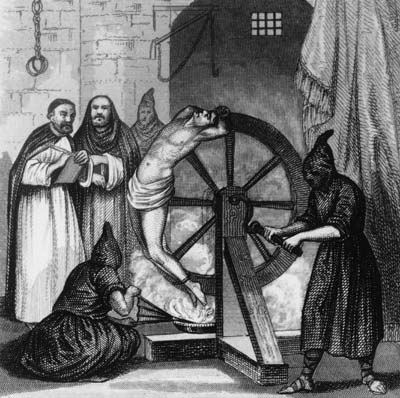
Is Flogging More Ethical Than Incarceration?

Ah, those were the good old days!

Peter Moskos is about to publish a book entitled “In Defense of Flogging.” He’s not really advocating a return to the Cat O’ Nine Tails, however, but engaging in a so-called “thought experiment”, which Moskos, an assistant professor of law, police science, and criminal-justice administration at the John Jay College of Criminal Justice, summarizes at the end of his article on the topic (in the Chronical of Higher Education) like this:

“So is flogging still too cruel to contemplate? Perhaps it’s not as crazy as you thought. And even if you’re adamant that flogging is a barbaric, inhumane form of punishment, how can offering criminals the choice of the lash in lieu of incarceration be so bad? If flogging were really worse than prison, nobody would choose it. Of course most people would choose the rattan cane over the prison cell. And that’s my point. Faced with the choice between hard time and the lash, the lash is better. What does that say about prison?”

I’ll answer that:  it says that imprisonment is a better and more efficient punishment for serious crimes than flogging, and who didn’t know that? Continue reading

Are Conviction Bonuses For Prosecutors Ethical?

Next, how about a bonus for confessions?

Sometimes a story starts the ethics alarms ringing so loudly that it is hard to think about anything else. It is rare, however, to have this occur when it is not entirely clear what is so unethical. An unusual bonus arrangement in Colorado is in this category.

Carol Chambers, the District Attorney for Colorado’s Eighteenth Judicial District, offers financial incentives for felony prosecutors who meet her office’s goals for convictions.  Plea bargains and mistrials don’t count in the incentive program; they have to be trial convictions.  The bonuses average $1,100, and Chambers says she gives them out to encourage prosecutors to bring her district’s rates in line with other jurisdictions in the state. No other Colorado DA gives out bonuses, or bases evaluations on conviction rates. Continue reading

Facebook, Truth Trap: The Saga of the Belly Dancing Invalid

Just imagine how she could dance if she weren't disabled!

Facebook is beginning to reveal itself as a kind of truth trap for the unethical. It is infinitely more difficult to live a lie when you give the world a window into your life via social media. The choice may be between undiscovered fraud protected by social isolation, and blogging candor resulting in unpleasant justice. Indeed, not being on Facebook may create suspicions that some individuals are hiding misconduct. And they just might be, for if they become active on Facebook, the Truth Trap is waiting.

Take the Saga of the Belly Dancing Invalid.

Dorothy McGurk was stripped of a divorce settlement she had forced out of her ex-husband three years ago, when a court ruled that her Facebook entries proved she wasn’t unable to work as she had claimed. Continue reading