Sunday Ethics Warm-Up, 11/18/18: “The Show Must Go On” Edition

Here we are.

After a brief recovery Friday the 16th, an early morning seminar for D.C. Bar admittees yesterday crashed me entirely, which is why there were no posts. I almost didn’t make it to the end of the program, which surprised and alarmed me; the last few minutes were excruciating. But I have never cancelled a seminar, and when I do, it will be because my metaphorical chips are about to be cashed. Those who know my theatrical history will recall that I damaged my lungs in college staging and performing a professional dinner theater show six days a week (during final exams)  while I was suffering from a serious bronchitis attack; that I refused to cancel in-door performances of The American Century Theater (RIP) during snow storms, and one out-door performance during an electrical storm. Not being able to do my job and fulfill my responsibilities due to illness or injury absolutely crushes me (like many of my obsessions, this one is partially Dad’s fault: he refused to take sick days), and keeping Ethics Alarms current is the least burdensome of my responsibilities.

Once again, I apologize.

1. More apologies, Arlington High School Dept.: My ill-timed illness is also keeping me away from my 50th high school class reunion. I intended to make it, and wanted to make it: I had a wonderful time in high school, and met many of the best people I have ever known while I was there. Past reunions have been somewhat depressing for me: seeing people I remember vividly as young, vital and full of excitement for the future looking as old as they are and often feeling defeated by life makes me feel old, and the inevitable sad cases who feel he or she has to boast about successes and wonderful kids caused me stress as I barely controlled the urge to tell them off. Nonetheless, I regard attendance at such milestones as an obligation to the past, a demonstration of respect for where we have come from and the people and institutions that got us to where we are. And, of course, the more old friends who attend, the better the experience is for everyone. I wish there was a way to let my classmates know that I still think about them and care about them. This blog isn’t it.

2. Who made bad losers in politics respectable? When public trust in democratic institutions reached some yet-to-be-determined tipping point, a democracy is finished. Once, not too long ago, the tradition in American politics was that the defeated candidate—the office didn’t matter, nor did the margin of victory—conceded the race in a timely fashion, congratulated his or her opponent, and vowed to help and assist the victor as much as possible.  This not only modeled graciousness and good sportsmanship, but also protected the system. Now every election shows this healthy model being further pushed into cultural obscurity, with a new low being established in Georgia last week, when the loser of the governor’s race, Stacey Abrams, blamed her loss on a failure of democracy, refused to officially concede while admitting that she had lost, and announced a lawsuit alleging that Governor-Elect Brian Kemp and Republicans had tampered with the election without offering any proof or evidence. Well, maybe this wasn’t the new low; it would be hard to top Roy Moore.

3. The new Title IX rules. The Education Department finally released new guidance on how  Title IX, the federal statute that forbids sex and gender-based discrimination in public schools and colleges, should be enforced. This was desperately needed after the Obama Administration had muddled and corrupted the process with blatant gender bias and its infamous “Dear Colleague” letter, creating a culture that undermined free expression and due process on college campuses and due process rights for students accused of sexual misconduct. Continue reading

Saturday Morning Ethics Warm-Up, 10/6/18: As “The Bad Guys” Throw A Tantrum Because Their Plot Blew Up In Their Smug Faces

Good Morning!

Wish I was there!

In this post, and later this one, I directly stated that the Left, “the resistance,” progressives, Democrats, had increasingly embraced objectively wrongful conduct and unethical means and objectives as routine, and that the Kavanaugh confirmation fiasco proved it. The commenter here who goes by the handle of “Chrissy Boy” accused me of being openly partisan, which is demonstrably false: I would write exactly the same thing about the Republican Party if it were trying to eliminate due process, the presumption of innocence, fairness, decency, respect for elections, respect for dissent, a competent and objective press, and the integrity of national institutions. But you see, the current strategy of the Left is to make it crushingly clear that you are either with them, or “the other.” They certainly don’t like being “othered” themselves, but when you set out to topple an elected government and a Constitution, that’s what you deserve. In one of its Sunday Reviews—they all run together, since it it is really “The Resistance This Week” under a deceptively neutral name—the New York Times led with an essay in which the writer wrote that the term “resistance” was unfair and untrue, since they were trying to “create a new nation” and the Trump administration was resisting the inevitable. That new nation, the last few weeks proved, would reject the values I just listed.

This is why, though I have a backlog of ethics issues on a variety of topics, as well as some excellent Comments of the Day that require posting, I have to use the limited time I have right now to chronicle the carnage of the Brett Kavanaugh Nomination Ethics Train Wreck, which, it appears though I am afraid to hope, includes dramatically reduced public support for the “resistance,” the news media, and the Democratic Party. President Trump’s approval ratings (whatever they mean) are way up. Approval of the Democratic Party is crashing, and with it the likelihood of a “blue wave” that might allow the Democrats to execute that coup they’ve been attempting. I have been counting on the historical, cultural reality that in the United States of America, we don’t like Bad Guys, and don’t want to support them. I am still hoping that this prompts the Left to have its Michael Douglas epiphany, and start being the Good Guys again. So far, however, the signs are not good.

Ann Althouse flagged this tantrum from Matt Yglesies at Vox  yesterday (several self-exiled Ethics Alarms progressives insisted Vox was an objective commentary site–suuuuure), neatly summing up:

When the Supreme Court gives lefties outcomes lefties like, they want conservatives to stand down and accept that the Court is doing proper, even brilliant, legal work.

Yes, this is a quality of Bad Guys: they have no integrity. Remember that same sex marriage decision that the evil old reloigious right claimed was “illegitimate” because it opposed “God’s law”?

1. It’s Hate Senator Collins Day! I’m not a Susan Collins fan, as I have always found her annoyingly wishy-washy, equivocal, pandering and a poor role model for women in power whose manner and speaking style illustrates why it is that more women aren’t in positions of power. However, she gave a ringing speech yesterday explaining why she would be voting for Kavanaugh’s confirmation, verbally nailing the coffin shut that contained the Democratic schemes to defeat him. My Facebook ffed is filled with people writing that she is a coward, a traitor (to her gender! to #MeToo!), an idiot. Althouse also flagged this comment (with over 1000 “likes”) to the Times piece, “Collins and Manchin Will Vote for Kavanaugh, Ensuring His Confirmation”:
Continue reading

And The ACLU Takes A First Class Seat On The Brett Kavanaugh Ethics Train Wreck. Of Course It Has. (The ABA Stayed In Coach)

The American Civil Liberty Union has decided to make an “exception” to its supposedly unshakable policy of being non-partisan and non-political—Oh,  the pop-up fundraising appeal the group is currently showing on its website says to contribute to “stop Trump’s attack on civil liberties.” Then it vanishes, with the permanent text on the site staying abstract and without any overtly partisan slant.  Nice. And dishonest!—and announced its opposition to Kavanaugh’s confirmation.

This should not have surprised anyone, because the ACLU has become a sham organization, claiming to be non-partisan and apolitical while every day making it increasingly obvious that it, like so many organizations that take that pose (including virtually all of the mainstream news media), it is a fully committed ally of the Democratic Party. Nonetheless, there is always hope that at crucial moments in the nation’s history, organizations will find their soul, their guys and their principles before they seep away.

For this we need look no farther than The American Bar Association, another “non-partisan” group that habitually endorses Democratic Party agenda items that should not concern it at all. Its membership is overwhelmingly Democratic, and being that this entire section of the political spectrum is in the process of being ethically corrupted, many members, including members of its governing body, were prepared to turn on Brett Kanavaugh, a judge the organization had rated as very qualified for the Supreme Court, and recommend his rejection as a consequence of unsubstantiated, last minute allegations of sexual misconduct by an accuser dredging up dim memories from more than three decades ago. As a lesser tactic, many were in favor of bolstering the Democratic Party’s disingenuous call for an open ended FBI investigation, not because it is likely to clarify anything, but because it will accomplishe the Party’s stated objective since before Dr. Ford was persuaded, or pushed, to play the part of Anita Hill in this adaptation of “The Clarence Thomas Hearings.” They want to delay until after the November elections.

Thus it was that Robert Carlson, the latest Democratic Party contributor to lead the organization, wrote this letter on ABA letterhead, falsely stating that he was speaking for the ABA itself:

“The American Bar Association urges the United States Senate Judiciary Committee (and, as appropriate, the full Senate) to conduct a confirmation vote on Judge Kavanaugh’s nomination to the Supreme Court of the United States only after an appropriate background check into the allegations made by Professor Ford and others is completed by the Federal Bureau of Investigation.”

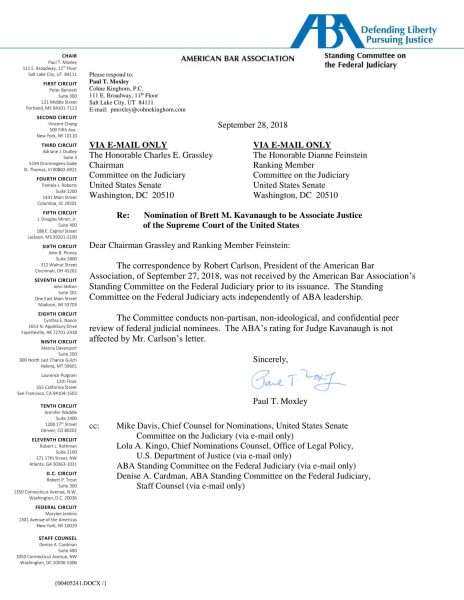
Rather than allow him to hijack its process and integrity, the ABA sent this letter to the Judiciary Committee, clarifying that Carlson was speaking for himself only:

Of course, if it were really a non-partisan, non-ideological organization, the ABA would be in the process of removing Carlson from office. In every organization, falsely using one’s post to imply organizational support of a personal view is a firing offense. Instead, the ABA took the face-saving measure of posting Carlson’s misleading letter (lawyers are prohibited from engaging in misleading conduct) under a link saying, “ABA President Calls For…” THAT’S deceit (lawyers are prohibited from engaging in deceit). Most readers will not notice the material distinction between the President of the ABA’s position and the official ABA position, and that’s just the way the association wants it.

Well, it’s not exactly integrity, but it’s a lot closer than what the ACLU has become. Continue reading

Saturday Morning Ethics Warm-Up: The Bad Guys, Continued.

“Good morning,”

…he said through grimly clenched teeth…

1 My pledge. That’s it. I’ve had it. Every single time I read or hear a reference to how women accusing men of sexual assault or harassment have a “right to be believed,” and anytime I read or hear someone quoting such a reference with approval, I’m going to point out in the strongest possible terms how sinister, unethical, and certifiably stupid this is. If you want to believe Dr. Ford’s dredged up memories of a party—somewhere—where she was jumped and groped by two drunk teens, go ahead. You do have a right to believe anything, including in the Hindu elephant god,  the brilliance of Sean Hannity, and the virtue of Bill Clinton: I don’t care. Be gullible. Asserting that women have some special chromosome-based right to be judged 100% reliable when they make damning and destructive accusations against men violates all standards of logic, ethics, equal protection, fairness , justice and common sense, and threatens tangible harm to innocent citizens and society. It needs to be condemned, and those making it must be condemned until this insidious, ideologically-spawned Big Lie is killed, squashed, burned and vaporized for all time.

For some reason, the tipping point for me was not the nauseating conduct of the Democratic Senators yesterday, which included a dramatic multi-NO! from perhaps the worst of them—well, after Diane Feinstein—Hawaii Senator Mazie Hirono, the one who told Jake Tapper that the very fact of being a conservative is sufficient to disqualify Brett Kananaugh from any presumption of innocence. Stalin reasoned like that. That Hawaii would elect such an un-American, totalitarian-minded fool—she is more ignorant than evil, I think, but I could be wrong—to represent the state is enough to make me resolve to vacation elsewhere when the tropical breezes beckon. What a disgrace she is, and any voters who would allow someone like that to have access to power.  But no, what made me snapo was a small note in today’s paper about how Rep. Leonard Nance’s race to be re-elected to his New Jersey Congressional seat was seen as threatened because he “seemed to cast doubt on Ms Blasey’s allegations” in remarks to a group of college Republicans.

What the hell? Her allegations are over three decades old, she never spoke of them until a SCOTUS nominee she opposed was about to be confirmed, she has no corroboration or evidence whatsoever, and the man she accused uncategorically denies her story under oath. There is nothing but doubt in this controversy. If you don’t see doubt, then you are a bigot, a hopelessly close-minded ideologue, or incapable of rational thought. Continue reading

Oh-Oh… I May Be Mellowing: I’m Not As Keen On The Felony Murder Rule As I Once Was

The New York Times recently had a story about the latest state, California, considering abolishing the felony murder rule, the tough American principle that if you participate in a felony and someone is killed, you can be tried for first degree murder even if you didn’t directly cause the death. Writing about the rule in 2014 as it  applied in a particularly odd case, I wrote,

I sort of like it, and always have. Like all laws, however, it doesn’t work perfectly all the time.

The reason I like the rule is that it acknowledges the real danger of initiating felonies, crimes that are serious and destructive. If you burn a business down to collect the insurance, for example, you should be held responsible by the law if the fire gets out of control and someone is killed. The law combines criminal and civil offenses; the felony murder rule is like a negligent crime principle. It is a law that implicitly understands Chaos Theory at a basic level: actions often have unpredictable consequences, and even if the consequences are worse than you expected or could have expected, you still are accountable for putting dangerous and perhaps deadly forces in motion. If you commit a felony, you better make damn sure you know what you are doing, because if people get killed,  you will be held to a doubly harsh standard. Better yet, don’t commit the crime.

Don’t commit the crime. I have this reaction to all complaints about harsh sentences when the individual complaining (or having an advocate complain on his behalf) is guilty of the crime involved…You knew the risk, and you get no sympathy from me. The same applies to felony murder. The felon rolled the dice, and lost. (Somebody else lost too: the victim who was killed.) Nobody made him (or her) roll.

The potential California reform would change state law so that only someone who actually killed, intended to kill or acted as a major player with “reckless indifference to human life” could face murder charges. That would avoid seemingly harsh sentences in cases like the one the Time story focuses on, in which Shawn Khalifa, 15 at the times, served as a look-out while some teenage friends broke into an elderly neighbor’s house in the  California town of Perris, looking for cash. The elderly homeowner was injured in the burglary and eventually died.  A jury convicted the teenager of first-degree murder under the felony murder rule, and he is serving a sentence of 25 years to life. I am tempted to support the California  measure, which would avoid Khalifa’s kind of sentence while keeping the possibility of a felony murder charge when the culpability is more than just moral luck. Continue reading

Comment Of The Day, Rebuttal #1: “Morning Ethics Warm-Up, 4/4/2018:…A Presidential High Crime…”

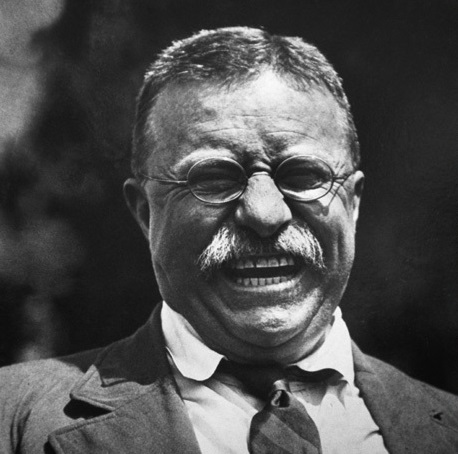
Is Teddy looking down from Rough Rider Heaven and smiling at Trump’s Big Tweet?

Of course, I knew suggesting that President Trump’s deliberate attacks on Amazon via Twitter was an impeachable offense would set heads a-blowing. The resulting debate has been fascinating, with interesting historical parallels being proposed. This comment, by Chris Marschner, is the first of two erudite and well argued rebuttals.

Not to hold you in unnecessary suspense, I am not convinced or dissuaded. I do not see Teddy Roosevelt’s  policy-oriented attacks on the era’s monopolies, correctly leading a movement to reform an area of widespread capitalist abuses that eventually were agreed to be criminal, with Trump’s tweeting crudely phrased animus to the public. Nor do I find Obama’s general criticism of big money lobbying efforts by energy interests in general and the Kochs in particular at the same level of abuse of power as Trump taking aim at the owner of the Washington Post,

I am a lifetime fan of Teddy, but he crossed many lines, and could have been legitimately impeached himself. As I have stated before in multiple posts, the power of the Presidency is too great to be abused with casual wielding against individuals and named businesses. As always, there are exceptions.  I’ll concede that taking on the robber barons and the monopolists in the early 20th Century can be fairly designated as one.  Chris seems to feel that there is a close parallel in Amazon’s growing power, but that’s not the case the President chose to make, instead focusing on a deal Amazon forged with the Postal Service, as much to keep the latter in business as to benefit Amazon.

Basic lessons in POTUS leadership: if you are going to cross lines of appropriate uses of  power, 1) You better be right and 2) Be Presidential about it.

Other examples, like Obama designating Massey Energy as responsible for the Upper Big Branch mining disaster before the investigation was complete, can not be so easily excused, but can be fairly labelled a mistake. (Obama made many, too many, such mistakes.) Trump’s attack on Amazon is neither as limited as Obama’s mistake, not as carefully considered and justifiable as Roosevelt’s trust-busting. I would like to see future Presidents restrained from abusing power in this way, even if it takes a trail before the Senate to do it. If we don’t restrain it, we will be sorry.

But the other side has some good arguments: by all means, read them.

Here is Chris Marschner’s Comment of the Day on the #2 in “Morning Ethics Warm-Up, 4/4/2018: Baseball Lies, A Presidential High Crime, And A Judge Makes A Panty Raid”:

I would like to point you to this in 2015:

https://www.usatoday.com/story/news/politics/2015/08/26/war-words-obama-v-koch-brothers/32423959/

“When you start seeing massive lobbying efforts backed by fossil fuel interests, or conservative think tanks, or the Koch brothers pushing for new laws to roll back renewable energy standards or prevent new clean energy businesses from succeeding, that’s a problem,” Obama said at the summit. “That’s not the American way.”

“Josh Earnest said the exchange illustrates the kind of president Obama set out to be.”

“This is exactly why the president ran for office, it’s why he ran for this office, is that for too long, we saw the oil and gas industry exert significant pressure on politicians in Washington, D.C.,” he said. And when Obama fights that influence, “the special interests, including the millionaires and billionaires that have benefited from that paralysis, start to squeal. And I guess in this case, at least one billionaire special interest benefactor chose to squeal to a Politico reporter.”

This type of rhetoric does not include Obama officials publicly stating (incorrectly and improperly) that one of the Koch brothers paid no income taxes. (http://freebeacon.com/politics/hazy-memories/)

Is it only an abuse of power when referencing specific individuals? Does it matter if you say the 1% don’t pay their fair share or is it an abuse of power only if you identify them by name?

I will concur with the Koch brothers that it is beneath the dignity of the president to go after a specific individual, but to suggest that it amounts to even a misdemeanor abuse of power is a stretch. If calling out a specific firm is an impeachable offense then why was there no call to impeach Obama when he routinely criticized and mocked Koch Industries, Fox News and others that did not line up with full throated support of his agenda.

But , Obama was not the first to chastise “punch down” on a business person. Who can forget the trust buster himself Teddy Roosevelt. JP Morgan was singled out for bad behavior. Continue reading

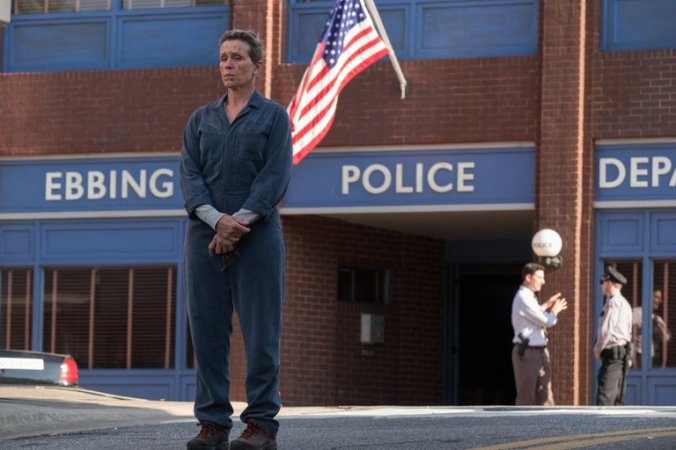
Ethics Review: “Three Billboards Outside Ebbing, Missouri”

I watched last year’s “Three Billboards Outside Ebbing, Missouri,” twice, just to make sure it was the profound ethics movie I thought it was. It is. None of the reviews described it that way, of course. Here is the New York Times:

“The movie opens on low boil with Mildred behind the wheel of her station wagon near three derelict billboards…she uses the billboards to announce her crusade … a way to get things jumping (the investigators, the tale) and splash some foreboding on an outwardly pacific scene. Much of the story involves the ripples of outrage, confusion and buffoonery that the billboards inspire and that soon envelop almost everyone Mildred knows. Months after her daughter’s death, grief has walled her in; isolating and seemingly impenetrable, it is inscribed in the hardness of her gaze and in her grim new identity as a mother of a dead girl. The billboards turn that grief into a weapon, a means of taking on the law and assorted men — a threatening stranger, a vigilante dentist and an abusive ex (John Hawkes) — who collectively suggest another wall that has closed Mildred in….”

None of which addresses what is remarkable about the film, which is that it shows what causes our ethics alarms not to ring—Frances McDormand as Mildred and Sam Rockwell as Dixon, a racist and vicious deputy, in particular demonstrate  what it is like to be driven by non-ethical considerations of the darkest and most passionate sort—and more important, what causes them to start ringing again. Most reviewers described this as a dark and depressing film. The ethics alarms are mostly off again as the film ends, and that is ominous, but its main ethics message is uplifting in many ways. “Three Billboards” teaches us that even broken, ignorant, alienated human beings have the capacity to access their innate instincts for compassion, justice, forgiveness, selflessness and kindness, and even when our ethical selves seem permanently overcome and decisively defeated, they can burst out again, in control, salvaging what’s best about the species.

There is a moment early in “Three Billboards” that signals that it is not only going to show us what monsters anger and grief can transform us into, but also that what George Washington’s list of 110 Rules called “that little spark of celestial fire called conscience” is remarkably resilient.  A sheriff—the ethics compass of the story, played by Woody Harrelson— visits Mildred after her billboard messages embarrass him and roil the town. She is hard and cold as marble as he tries to explain his failure to find her daughter’s rapist/killer, even after he reminds her that he is dying of cancer. Suddenly the sheriff has a violent  spasm: he coughs up blood on himself and Mildred. And we see her fury evaporate in an instant. The compassionate and caring mother she once was emerges, if only for a few moments. ( McDormand is such a superb actress that she pulls off the sudden transition convincingly and movingly: you believe it, though it is like watching Mr. Hyde turn into Dr. Jekyll in the snap of a finger.) Later, when again her fury has been aroused, we see the same woman firebomb the police station and watch implacably as her nemesis deputy burns. A warning: just because the ethics alarms can ring doesn’t mean they are working well enough.

Sam Rockwell’s character also reveals surprisingly that his ethics spark has not been entirely extinguished, again thanks to a catalyst supplied by the sheriff. This transformation caused considerable  criticism of the film among critics and artists in Hollywood, and some attribute the film’s failure to win the Best Picture Oscar to the fact that a racist is redeemed and revealed to have an ethical core. But except for the sociopaths and psychopaths among us, admittedly a disturbingly large group, we all have that ethical core. We have the ethics alarms too, ready to be re-activated, even if they aren’t in perfect working order. Yes, this is  even true of racists. So much of our current political discourse is driven by the false construct that a single belief or a single lapse of reason marks an individual as irredeemable. Its easier to marginalize and demonize them that way. But it isn’t true.

Indeed Ethics Alarms often declares certain conduct and words as signature significance, proving that an individual is unethical because such actions and thoughts are alien to ethical human beings. “Three Billboards Outside Ebbing, Missouri” reminded me that people may be unethical–Mildred and Dixon, the deputy, could never be called ethical, for ethical people don’t set police stations on fire or throw young men out of second story windows, as Dixon does—but that even unethical individuals can find their ethics if you give them a chance.

And if they can find their ethics, so can all of us, and so can society. There is hope.

________________________

Addendum: I cannot leave “Three Billboards” without a salute to one of its most powerful scenes, when Mildred tells a priest why she doesn’t care what he has to say when he comes to her home to admonish her for the messages on the billboards:

Bingo.

Comment Of The Day: “NOW What? The Most Discouraging News Of All”

As usual with her contributions, Mrs. Q  is thought-provoking and frank in her searing Comment Of The Day on the post,,NOW What? The Most Discouraging News Of All:
Far from this information being new, black conservatives for years have discussed this very topic only to be labeled traitors and Uncle Tom’s for doing so, often by white liberals. Shelby Steele, George Schuyler, Marc Lamont Hill, and many others have been outright dismissed or smeared in their attempts to get the message out that (white) liberal social policies and the welfare state are hurting blacks for more than helping. To allude to the anti-discernment, infantilizing policies of the Great Society, subsidized housing (which are often ghettos), affirmative action, welfare, etc, as potentially making things worse for minorities is to be a heretic and worse… ungrateful for all “they” have done for us.

At our local bookstore, Burgess Owens, books were shelved in the Fascism section. Yup, a black questioning communism and public assistance is apparently a straight up fascist. Is it any wonder that blacks trying to make something of themselves and encouraging others to do the same is barely heard? Look at a recent example when sports commentator Sage Steele pointed out that a protest over immigration at an airport was actually blocking immigrants from getting home. She lost her job, had her life threatened, and was called often (again mostly by white liberals) traitor. How can blacks be a part of a good conversation about self-sufficiency and public policy if any and every thing said that doesn’t tow the leftist line is traitorous? Continue reading

Comment Of The Day “Morning Ethics Warm-Up: 1/27/2018: “If You Want It, Here’s How To Get It” Edition”

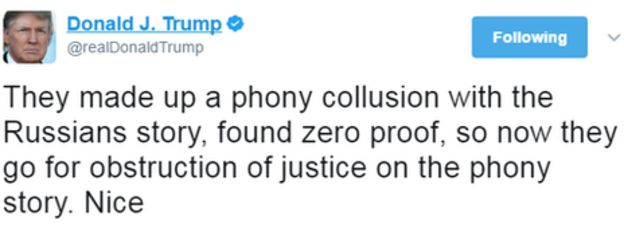
Chris Marschner, who has had several, scored another Comment of the Day today with his reflections on the strange nature of “obstruction of justice ” charges, when justice would in fact be for no charges to be brought at all.

He was focusing on #3 in today’s warm-up,  which discussed yesterday’s “resistance” theory that  allegations  that the President wanted to fire the Special Prosecutor (but didn’t) prove that he was trying to obstruct justice when he fired James Comey, who so, so deserved it.

I see unmistakable signs that the “resistance” is losing its already tenuous grip on reality, and is increasingly yielding the raw hate and fury that long ago supplanted any rational criticism of Donald Trump. Consider has-been Leftist documentarian Michael Moore, who with fellow progressive performers Mark Ruffalo, Whoopi Goldberg, Rosie Perez and Cynthia Nixon, who have to do something between jobs, is pushing  Monday’s Counter-State of the Union , which is only slightly more sensible than the “scream pointlessly at the sky” event. Remarkably, among Moore, Whoopie, Rosie, Cynthia and Mark there isn’t a single political science, history, economics, or government major. In fact, there isn’t a single college degree of any kind between them, or business, government or executive experience of any kind.

 Michael Moore, speaking on behalf  of MoveOn.org (Do the Time’s Up and #MeToo crowd recall that Move-On was spawned to protest Bill Clinton facing accountability for his cover-up of sexual misconduct? Nah.), sent out an email that read in part, before the fundraising pitch,

Donald J. Trump has proven himself to be completely unfit for office, a threat to our country, and an imminent danger to the world. He is not well; he is a malignant narcissist and an active sociopath. And because he holds the codes to fire nuclear weapons, he is a singular threat to humanity.

This situation is a nightmare. And the only reason that things aren’t FAR WORSE than they already are is that millions of us have come together to engage in our democracy, resist, and organize.

But our problems go far beyond one sociopath president. The mission that we are on and the work that we must do is to tear down the rigged system that produced Trump in the first place. We must imagine the America that we want to live in. We must create the post-Trump America.

And this is actually possible: The fierce, determined Resistance movement that began after Trump’s election could create an avalanche at the polls this November. Together, we can stop Trump and the GOP and begin the work of creating the country that we imagined.

The country the Moore imagined was called the USSR. But I digress.

Here is Chris Marschner’s Comment of the Day on the post, Morning Ethics Warm-Up: 1/27/2018: “If You Want It, Here’s How To Get It” Edition: Continue reading

Comment of the Day: “I’m Curious: Do Women—Any Women, A Lot Of Women, Adult Women, Rational Women—Think This Times Column Makes Sense? (Because It Doesn’t)”

(This is sort of what Juliet has in mind, I think...)

Juliet Macur’s column in the New York Times calling for what was essentially Old Testament Biblical vengeance against one of the more recently accused sexual harassers disturbed me greatly, and the resulting Ethics Alarms post reflected my reaction.  Steve-O-in NJ picked up the baton, and the result was this, his Comment of the Day on the post, I’m Curious: Do Women—Any Women, A Lot Of Women, Adult Women, Rational Women—Think This Times Column Makes Sense? (Because It Doesn’t):

The principle that those who do wrong should not be allowed to profit from their wrongs is not without basis in either ethics or the law. It is that principle which gave rise to the “Son of Sam” laws that allow suits against convicted criminals by their victims or the victims’ families if they receive assets from the sale of their stories. It is also that principle that sometimes leads to “Son of Sam” clauses being worked into plea agreements, whereby any profits made from the sale of a pleading wise guy or terrorist’s story goes to the government. Much more than that, and you run into First Amendment problems. It’s also a given that courts can order restitution to victims as part of a sentence or as part of a plea deal.

However, as pointed out above, all of these legal principles involve, presumably, a wrongdoer who has either had his day in court or decided to forego his day in court in the hopes of better terms. Even in an employment or other civil setting, an accused wrongdoer is not without rights. A company who not only terminated an accused harasser but stripped him of his pension and whatever other assets came with the position, all without so much as an investigation, would almost unquestionably find itself on the wrong end of a lawsuit, and could conceivably lose, which is why a lot of those situations resolve with a more favorable deal. In this case, the accused is choosing to walk away before it even comes to that, and cash out.

Juliet Macur is looking for blood, or the equivalent. I know the feeling, we all know the feeling, and writers and sports entertainers the world over know how to exploit that feeling very well. That’s why thrillers almost always end with the initial wrongdoer dead and WWE kayfabe angles always end with the heel badly injured and humiliated. We all have that urge to jump to revenge, that snap reaction of “why that blankety-blank, I’ll teach him!” Continue reading