Morning Ethics Warm-Up, 2/13/18: You Can’t Get Much More Ethics Issues Variety Than This!

Good Morning!

[Mickey is really playing that piano. Boy he was amazing…]

1 A Russian Jumbo!  And it worked! In Russia, Irina Kudinova was charged with mocking the Church after she  posted a photograph that prosecutors alleged was obscene and thus constituted the “deliberate desecration of a religious object” and “insulting the feelings of believers.”   Gee, I can’t imagine why anyone would think THAT..Here’s the photo:

The judge ruled that it was merely a photo of an Easter cake and nothing more. Elephant? What elephant? Or maybe “What elephant phallus?” would be more accurate. Kudinova was awarded 20,000 rubles in a court action for false accusations.

Few cases better illustrate the principle that in Bizarro World attempts at ethical acts become unethical. The problem is that Russia has laws that discourage free speech. In order to undermine an unethical law, the judge in this case made a ruling that is obviously contrary to reality, and what anyone can see with their own eyes. If judges can ignore evidence and deny reality to protect citizens from an unjust law, then they can do the same to unjustly punish citizens who break no laws at all.

I’m happy for Kudinova, but the Russian judge is a well-intentioned ethics dunce. His solution does as much damage as good.

2. “Thanks, Mom and Dad…and bite me.” The parents of GOP Senate candidate Kevin Nicholson each gave $2,700, the maximum allowed, to the primary campaign of the Democrat their son is challenging, Senator Tammy Baldwin. Continue reading

Comment Of The Day Weekend Continues! Comment Of The Day : “Morning Ethics Warm-Up, 12/30/2017: Is Robert Mueller Biased? …Is President Trump A Robot?

A single line in this morning’s  Warm-Up sparked this fascinating exposition by Ash. Here was the context:

Jay Malsky, an actor who has appeared in drag as Hillary Clinton. Melsky, while watching  the Hall of Presidents attraction at Disney World, began shouting at the audio-animatronic Donald Trump. (The Huffington Post said he “mercilessly” heckled the robot, showing  derangement of its own. Robots don’t need mercy, and you can’t “heckle” one either.)

Here is Ash’s Comment of the Day, primarily a quote but a perfectly chosen one, on the post, Morning Ethics Warm-Up, 12/30/2017: Is Robert Mueller Biased? Are The Patriots Cheating Again? Is Larry Tribe Deranged? Is President Trump A Robot?: 

“Robots don’t need mercy, and you can’t “heckle” one either.”

You should date this and file it, because I guarantee you, the way you treat Siri and Alexa and Cortana and Ok Google is *already* being described as problematic.

“Sexual harassment: there are no limits…According to Dr Sweeney, research indicates virtual assistants like Siri and Amazon’s virtual assistant Alexa find themselves fending off endless sexual solicitations and abuse from users. But because humans don’t (yet) attach agency or intelligence to their devices, they’re remarkably uninhibited about abusing them. Both academic research and anecdotal observation on man/machine interfaces suggest raised voices and vulgar comments are more common than not. It’s estimated that about 10% to 50% of interactions are abusive, according to Dr. Sheryl Brahnam in a TechEmergence interview late last year. Continue reading

I LOVE IT When This Happens!

Two recent Ethics Alarms posts collided on Ann Althouse’s blog today. She wrote that she was listening to the audiobook “The Righteous Mind: Why Good People Are Divided by Politics and Religion,”by none other than Jonathan Haidt, who uttered the Ethics Quote Of The Month recently discussed here.

In his audiobook, Haidt said that this statement “captured the spirit and self-image of the modern American left”:

“I am a liberal, and liberalism is the politics of kindness. Liberals stand for tolerance, magnanimity, community spirit, the defense of the weak against the powerful, love of learning, freedom of belief, art and poetry, city life, the very things that make America worth dying for.”

Who authored this ringing declaration of liberal principles?

Garrison Keillor, that’s who. Continue reading

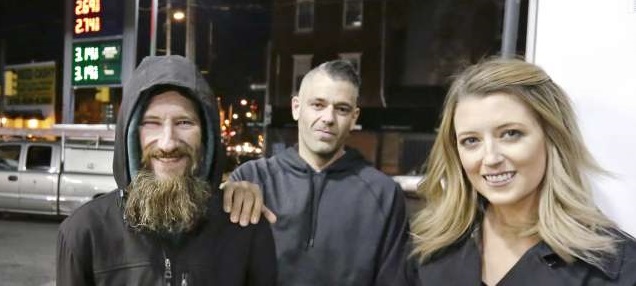
An Ethics Hero Epic: Johnny Bobbitt, Jr, Kate McClure, And Americans

Kate, Johnny, and Kate’s boyfriend. I bet you can tell which is which…

I learned about this story days ago, and got so distracted by all the nauseating ethics news that I neglected to write it up. I apologize. This kind of story should always be the top priority.

Kate McClure of Bordentown, New Jersey, was driving through Philadelphia to visit a friend when her car ran out of gas in a tough section of the city. McClure pulled over, got out of her vehicle and began to walk to the nearest gas station. But Johnny Bobbitt, Jr, an ex-Marine who lives on the streets, saw her plight and immediately took charge. The neighborhood was a dangerous place for a woman to walk alone, he told her, and suggested that she get back in her car, lock the doors, and leave matters to him.

A few minutes later, Bobbitt was back with a full gas can, and gave Kate  20 dollars, the only money he had to his name,  to make sure she could get home safely.

McClure said she did not have money to pay Bobbitt back that night, but she returned several times to the spot where he sits, offering him a few dollars and useful items.. Then McClure started a GoFundMe for her rescuer. She wrote,

I would like to get him first and last month’s rent at an apartment, a reliable vehicle, and 4-6 months worth of expenses. He is very interested in finding a job, and I believe that with a place to be able to clean up every night and get a good night’s rest, his life can get back to being normal.

So far, her campaign has attracted donations totalling almost $380,000 for Bobbitt.

The veteran has been homeless for over a year because of real problems. He has battled drugs, bad choices and probably emotional issues as well. I hope this story has a happy ending. So far so good, though. Johnny demonstrated exemplary ethics, sacrificing his own well-being for a stranger. Kate demonstrated genuine gratitude, empathy and concern, and took affirmative action to try to pay him back. And the American public, as it usually does, showed that when sufficiently alert, it knows how to reward good and selfless deeds.

“Next Time”… Our Thanksgiving Ethics Botch

Yesterday, faced with the prospect of a tiny Thanksgiving, which I find only reminds me of the former table-mates lost forever, and having the extra excuse of our wedding anniversary, Grace and I decided to take our increasingly otherwise occupied son and have Thanksgiving dinner at the Prime Rib, a ridiculously expensive restaurant. The meal was lovely and low stress for a holiday dinner, a feature especially welcome right now.

The restaurant was filled with family groups without kids, many in gowns and formal wear. Also filling the air was happy banter of the sort that holidays typically inspire. Over to my right, however, sat a well-dressed man in his late 60s or seventies, dining alone. I found myself thinking about him throughout the meal. What a lonely, solitary, depressing way to celebrate Thanksgiving, I thought. If I get to the state where I am so bereft of family and friends that I find myself in a five-star restaurant dining alone on Thanksgiving, just hit me over the head with cinder block. He looked a little like Alan Greenspan, and I still felt terrible for him.

After dinner, and he had left the restaurant, I mentioned all of this to my wife.

“I was thinking the same thing,” she said. “We should have invited him to join us.”

Ugh. I had considered that. But our family gets the opportunity to eat together so seldom, and this was an anniversary celebration too. My son also has a tendency to clam up around strangers, and he seemed relaxed and happy for a change. I had quickly talked myself out of even raising the possibility of inviting a fourth to our Thanksgiving/ 37th Anniversary table.

Yet of course that’s what we should have done, isn’t it? Isn’t it? Maybe the man was having a great time by himself. Maybe we would have embarrassed him. Heck, I don’t know. It’s also possible that he would have jumped at the chance. Who knows? All I do know is that I would have appreciated the offer, and will, unless someone gets behind me with the cinder block before I have the chance. It was still the kind, considerate, compassionate, ethical thing to do.

“Next time, let’s make sure we invite someone like that,” Grace said. I agreed.

Sure.

Next time.

Comment Of The Day: “Thanksgiving Ethics Quiz: The Girl Scouts Anti-Hug Campaign”

Now and then I see an issue and immediately think, “Now THIS should get the comments flowing.” So it was when I caught a mention of the Girl Scouts’ anti-hugging screed on CNN’s Headline News. Sure enough, the resulting ethics quiz not only sparked a lot of comments, but a lot of excellent ones. This, by Emily, was a standout.

Here is her Comment of the Day on the post, Thanksgiving Ethics Quiz: The Girl Scouts Anti-Hug Campaign.

Oh goodness, do I have thoughts on this. It isn’t new to me at all; my Facebook page is full of young moms who share this stuff (it’s been going around for years) and it drives me nuts.

First of all, we all show affection at different times when maybe we don’t totally want to. You give a friend or spouse or family member a hug because they’re feeling down, or they’re leaving for a six month trip to Japan, or you want to show you’re glad to see them, even if they need a shower or a breath mint or you don’t feel like getting out if your comfy chair. This is part of the give and take of personal relationships; you’d feel insulted if they didn’t offer your preferred form of affection or support when you need it.

Children need to be taught this, or we’re going to raise a generation who think their comfort is the only thing that matters, even in personal relationships and within their family. Continue reading

Thanksgiving Ethics Quiz: The Girl Scouts Anti-Hug Campaign

From the Girls Scouts website:

Holidays and family get-togethers are a time for yummy food, sweet traditions, funny stories, and lots and lots of love. But they could, without you even realizing it, also be a time when your daughter gets the wrong idea about consent and physical affection.

Have you ever insisted, “Uncle just got here—go give him a big hug!” or “Auntie gave you that nice toy, go give her a kiss,” when you were worried your child might not offer affection on her own? If yes, you might want to reconsider the urge to do that in the future.

Think of it this way, telling your child that she owes someone a hug either just because she hasn’t seen this person in a while or because they gave her a gift can set the stage for her questioning whether she “owes” another person any type of physical affection when they’ve bought her dinner or done something else seemingly nice for her later in life….

…Give your girl the space to decide when and how she wants to show affection. Of course, many children may naturally want to hug and kiss family members, friends, and neighbors, and that’s lovely—but if your daughter is reticent, don’t force her. Of course, this doesn’t give her license to be rude! There are many other ways to show appreciation, thankfulness, and love that don’t require physical contact. Saying how much she’s missed someone or thank you with a smile, a high-five, or even an air kiss are all ways she can express herself, and it’s important that she knows she gets to choose which feels most comfortable to her.

Your Ethics Alarms Thanksgiving Ethics Quiz:

Is this responsible advice, or does it go too far?

Continue reading

Morning Ethics Warm-Up, 11/17/2017: Groping And Griping [Updated]

GOOOOOOD  Morning!

1 Well THAT took an excruciatingly long time! Ethics Alarms finally reached its high water mark in followers this week, and has held the line for a change. Traffic has been disappointing in 2017; this will be the first year in which visits have fallen from the previous one. I blame the anomalous lack of any viral posts, which usually number two or three a year, (and are completely unpredictable), and the Trump-and-Hillary-driven polarization of the web. I have seen a significant net drop in followers every time Ethics Alarms unequivocally criticizes one “side” over the other, no matter how richly the ethics criticism is deserved.

People really do prefer echo chambers. It’s dispiriting.

Update: Right after I posted this, EA lost a follower.

2. Speaking of echo chambers..It is incredible how quickly the Democrats and progressives on Facebook  started defending Sen. Al Franken in the exact same terms, excuses, rationalizations and fallacies used all week by Roy Moore’s unprincipled defenders. The timing is suspicious…it’s only one time…this is politically motivated…we need his vote regardless…I believe him, not her…it was a long time ago…why did she wait so long?…he wasn’t in politics then…What about Trump?...everybody does it. In many cases they  mocked virtually the exact same statements by Republicans spinning for Moore that they are now making themselves.

Those who aren’t quite so hypocritical nonetheless praise Franken’s deceitful and manipulative apology. I guess Al’s supporters and journalists are exactly as dumb as he’s betting they are. The news media has also swallowed that apology whole. If they would just read Ethics Alarms, they wouldn’t embarrass themselves. Well, not so much and so often anyway.

(I’m sorry. The traffic stuff is getting to me…)

3. Read this, and get a surprise! Here’s an interesting website: Your Morals. Org. It has a list of studies you can participate in online—there’s a registration process that isn’t too time consuming— that gather data while purporting to measure your values, political leanings, tolerance for opposing views, and “morality.” I took the political orientation and attitudes survey.

I scored almost exactly in the center, leaning juuust a smidge…Democrat!

4.  NOW they tell us! I’m sorry, but I don’t care to hear Democratic politicians say  that Bill Clinton should have resigned during the Lewinsky scandal. Senator Gillibrand, who brought “Mattress Girl” to the State of the Union, has the immense gall to say that, 20 years after the  issue became moot. Of course he should have resigned. He lied under oath, lied to the American people, directly, calculatedly and intentionally, and obstructed the investigation, legally and illegally. But Democrats and feminists threw their principles into a big bonfire for political expediency, and it is a cheap, transparent and nauseating tactic to reverse themselves after all the damage Clinton’s pass for his “personal conduct” —I remember all the doges and rationalizations–did to the culture.

Paul Mirengoff,  a prominent Maryland-based lawyer who handles labor and employment-law cases, does an excellent job debunking a current Democratic talking point being used to explain why the party’s disgraceful posturing and enabling for Clinton was the result of sexual harassment “not being taken as seriously as it is today.”  He concludes,

Given the history I’ve just described, the argument that feminists and Democrats shrugged off claims of sexual misconduct against Clinton because of “the times” is unsustainable. The argument that, if Bill Clinton were president today, feminists and Democrats would believe Clinton’s accuser, or even just treat them with a modicum of respect, is unpersuasive.

The claims against Clinton were brought at a time of intense consciousness of the problem of sexual harassment. If anything, that consciousness subsided after Clinton’s presidency, thanks to the unwillingness of feminists and liberals to take his sexual misconduct seriously.

That unwillingness cannot be defended on the theory that times were different.

An aside: I saw that Move-On.Org has called for Franken to resign. Hilarious. The organization was created to argue that the nations should “move on” from the Clinton-Lewinsky scandal and let Bill off the hook. I invoke the Ethics Alarms principle of Ethical Estoppel. This group, of all groups, may not argue that any politician should resign after allegation of sexual misconduct. Ever.
Continue reading

Comment Of The Day: “From The ‘Stop Making Me Defend Lawrence O’Donnell!’ Files: The Golden Rule”

A commenter on the post on the studio tantrum thrown by MSNBC host Lawrence O’Donnell going viral on YouTube after it was leaked said that such a leak was “predictable.” I asked,

“Why should it be “predictable”? Why shouldn’t we be able to trust co-workers not to try to hurt us, e-mail correspondents not to send out our messages to strangers and on social media? Was it predictable that Donald Sterling’s mistress/beard would tape his comments in his bedroom to destroy his reputation?”

This prompted Crella’s  Comment of the Day on the post, From The “Stop Making Me Defend Lawrence O’Donnell!” Files: The Golden Rule:

Exactly. It shouldn’t be predictable. However, it seems that for a lot of people, their first instinct with anything they come across is to put it on the net, no matter the consequences. It’s so easy ( and I assume, extremely satisfying to bully types) to shame and humiliate on a scale previously unknown in human history. It’s irresistible to too many.

The ability to find thousands of like-minded people in a relatively short period of time on social media, and the sheer volume of encouraging positive feedback you can receive ( ‘if so many people agree with me, I must be right!’) has brought grade-school level cliques and meanness to the fore in a great deal of adult communication. It’s the same mechanism on a large scale. People rarely step back and see themselves, but I read and just wonder at it daily…the people most stridently against fat shaming, objectification, being leered at, and other ‘lookist’ offenses on social media are routinely ridiculing Trump on his hair, weight, skin color, and posture while playing golf, comments on appearance are very common. Continue reading

Morning Ethics Warm-up: 8/16/17

GOOD MORNING!

1. I’m heading to Boston and Fenway Park in a few hours to meet with two of my high school classmates and together pay our respects to the 1967 Boston Red Sox, the spiritual beginning of Red Sox Nation, and a group of men, then barely more than boys, who had as profound an effect on my life and view of it as anything I have ever experienced.

It’s the 50th Anniversary of that amazing team and the heart-stopping pennant race it won against all odds, in a four team race that came down to the final game of the regular season. I mean heart-stopping literally: the team wasn’t called “The Cardiac Kids” for nothing. TWO of my father’s colleagues at the Boston Five Savings Bank died of heart attacks while attending Red Sox games, during one of the 9th inning desperation rallies for which the team was famous. The only reason I didn’t perish in like fashion is because I was just 16 years old.

Why was this team, and that summer 50 years ago, so important to me? I don’t have time or space to answer that question well, and you’d probably wonder what I was babbling on about anyway. A 2017 film by Major League Baseball called “The Impossible Dream” does a fair job of explaining it, but it’s too short to do the job right.

I had listened to, watched or attended every Boston Red Sox game for five years, as the team lost and lost. From those bad teams, followed weakly by the city in those days, in a crumbling old park that seemed destined to be abandoned and torn down, I learned that winning wasn’t everything, that loyalty wasn’t easy, that Hemingway was right, and that baseball was about courage, humility, perseverance, doing your job every day, sacrifice, and hope, as well as usually losing at the end. That summer of 1967 taught me that hope is worth the effort even though hope is usually dashed by the ice water of reality, that you should never give up, that miracles do happen, and that nothing is as wonderful as when a community is united in a single, inspirational goal, no matter what that goal might be…and that you should never be afraid to give everything you have in pursuit of a mission, even when it is likely that you will fail.

I learned difficult, discouraging lessons, too. When an errant pitch hit Red Sox right-fielder Tony Conigliaro in the face on August 18, 1967, it was the beginning of a lesson that revealed its tragic last chapter 23 years later. That one taught me that life is horribly, frightening unpredictable, and that we envy others at our peril. It taught me that we need to do what we can to accomplish as much good as we can as quickly as we can, because we may lose our chance forever at any moment.

Tony C, as he was and is known as, was a beautiful, charismatic, local kid, the idol of Boston’s huge Italian-American community,  in his fourth season with his home town team at the age of 22. He dated movie stars; he recorded pop songs; he had a natural flair of the dramatic, and was destined for the Hall of Fame. One pitch took it all away. Although he had two comebacks and played two full seasons facing major league fastballs with a hole in his retina and his field of vision, Tony was never the same. After his final attempt to keep playing failed at the age of 30, he became a broadcaster, and at 37 was seemingly on the way to stardom again in 1982 when he suffered a massive, inexplicable heart attack—Tony  did not smoke, and had no family history of heart problems– that left him brain damaged until his death in 1990.

As Henry Wiggin, the star pitcher protagonist of the novel, play and movie “Bang the Drum Slowly” observes as he  reflects on the death of his catcher and roommate, everyone is dying, and we have to remember to be good to each other. But it’s so hard. Ethics is hard. The ethics alarms ring faintly when we are about the task of living, or not at all…

At the end of the story, the narrator, the best friend of the catcher (but not really that close a friend) recalls how quickly everyone on the baseball team went back to their selfish ways after their teammate went home to die Even the narrator, who was the leader of the effort to make the catcher feel loved and appreciated in his last days, ruefully recalls his own failing. The catcher had asked him a favor, just to send him a World Series program (the team won the pennant after he had become too ill to play), and he had forgotten to mail it until it was too late. How hard would it have been, the narrator rebukes himself, to just put it in an envelope and mail it? Why are we like that, he wonders?

1967 was the beginning of my exploration of that mystery too.

So I am going to Boston for the 30 minute ceremony. I can’t even stay for the game; I have a seminar to teach tomorrow morning, and the last flight out of Logan is at 9 PM. There will probably be just a small contingent from the Cardiac Kids: most of them are dead now, or too infirm even to walk onto the field. But Yaz will be there, and Gentleman Jim Lonborg; Rico Petrocelli, Mike Andrews, and maybe even Hawk Harrelson  and Reggie Smith. I will be there to say thank-you, that’s all.

And to show that I remember. Continue reading