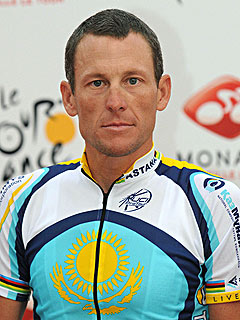
No Excuses and No Mercy For Lance Armstrong

Sorry, Lance…good guys don’t cheat.

Back when Barry Bonds was still playing baseball, a sportswriter mused about why it was that everyone assumed  Bonds was a performance-enhancing drug cheater despite his protestations to the contrary, while most Americans and sports journalists brushed away similar allegations regarding Lance Armstrong. Both competed in sports with acknowledged steroid abuse problems; indeed, the problem in bicycle racing was presumed to be more pervasive than in baseball. (A few years later, with the banning of multiple Tour winners, the presumption became a certainty.) Both athletes had improbable late career improvements in their performance to reach previously unimaginable dominance in their respective sports. Both had to explain or deflect multiple credible accusations of cheating and circumstantial evidence that suggested that they were doping. Both claimed they had never failed drug tests, and there were good reasons to doubt the denials.

So why was Bonds a villain by consensus and Lance an untouchable hero? The sportswriter explored many theories (Apologies: I cannot locate the article. If someone can, please send it), among them the greater popularity of baseball over cycling, Bond’s startling physical transformation into a behemoth while Armstrong remained cyclist-sinewy,  Armstrong’s inspiring story as a cancer survivor, Armstrong’s philanthropic work,and the fact that Bonds, unlike Armstrong, was black. The biggest difference, however, and to the writer the key one, was that Armstrong acted the role of a hero, while Bonds refused to. Armstrong was friendly and accommodating, while Bonds was angry, intimidating and antagonistic. Armstrong seemed like someone who played by the rules, and who lived his ethical values. Bonds seemed like a rebel, one who wouldn’t hesitate to break the rules for his own benefit. In short, the public wanted Armstrong to be the hero he seemed to be, so they ignored the evidence linking him to performance-enhancing drugs.

After last Sunday, the disparate public perception of Bonds and Armstrong, always illogical, became unsustainable. Continue reading

The Ethics of Giving Up on Ethics

Paul Daugherty, a sportswriter for the Cincinnati Enquirer,recently wrote a column expressing a theme I hear all too often regarding politics, government, education, and society generally. Motivated by the steroid allegations against yet another hero, Lance Armstrong, Daugherty penned his surrender to a culture that doesn’t seem to care about ethics. Daugherty wrote:

“Everyone wants sports to be equitable. We all desire the level field. No one wants sports to be as drugged up as Woodstock in 1969. But it is. We’ve fought the ethical fight. We’ve lost. It could be time to let it go.
Even the athletes who lose still win. Mark McGwire got his, Barry Bonds got his, Brian Cushing got his. If you wait enough, deny enough, then rationalize believably, you get yours. Disgrace fades. Only Olympic athletes wear the stink of doping longer than the average 5-year-old’s attention span. In one respect, it’s not unlike the fight against legalizing marijuana. It has lasted so long, and now seems so pointless, I can’t even remember what we’ve been arguing about. We’ve become numb to it….It’s only a little outrageous now to suggest that a professional athlete be allowed to use performance-enhancing substances to his (enlarged) heart’s content, as long as he’s doing it legally….So what’s the point?”

“What’s the point?” Continue reading

Armstrong, Bonds, Steroids, and Bias

Barry Bonds was forcibly retired from baseball despite general agreement that he could still hit a ball better than most active players. No team would hire him, because he had become the symbol of baseball’s steroid and performance-enhancing drugs scandal that casts a permanent shadow over the game’s image, statistics, integrity, and current stars. Bonds never has admitted to using P.E.D.’s, but the evidence that his remarkable late-career success was illicitly aided by banned substances is overwhelming, and indeed was overwhelming while he was playing. [I have written about the fairness of judging Bonds a cheater and the tortured rationalizations employed by his defenders here, here, and here.] At the same time, another individual who dominates his sport, cyclist Lance Armstrong, has managed to convince most of the media and his adoring public that accusations that he used steroids are false, even though the circumstantial evidence against him rivals what has condemned Bonds. This has always had the stench of a double standard; now, in the wake of new allegations by a former team mate, the only excuses for not giving Armstrong the Bonds treatment are unethical ones. Continue reading