Morning Ethics Warm-Up: 6/11/17

1.  Mainstream media bias has been such a frequent topic on Ethics Alarms that I hesitate to focus on it even when, against all odds, what passes for American journalism has another rotting chunk fall off.  The reaction of most of the media to the Comey testimony was a huge chunk, once again shocking me when I didn’t think my regard for this unprofessional profession could sink lower. Some commentators yesterday (they were conservative, but there is no reason a fair and objective liberal wouldn’t and shouldn’t come to the same conclusion) said that we are witnessing the birth of a mainstream media-progressive fusion political party. This is not a hysterical analysis. The New York Times coverage of the Comey hearing, for example, was so misleading and dishonest as to eliminate that paper from ever being regarded as a reliable political analyst again, at least until it cleans house and issues an abject apology to the nation. Ethics Alarms reader Greg did an excellent job detailing the Times’ disgraceful anti-Trump/pro-resistance spin in the thread on the Comey testimony post, as did journalist commenter Tippy Scales.

The Times knows its first take was untenable; you can tell by its editorial today, in which it already is changing the subject. If Comey had laid a glove on Trump (and he didn’t) regarding  impeachable conduct and a route to removing him—which was the Left’s fervent hope and the resistance’s confirmation bias-driven fantasy—the Times would have been  shaking its fist and demanding action in it Sunday pronouncement. Instead, it offered an extended whine about how Paul Ryan excused Trump’s clumsy handling of his communications with Comey by citing Trump’s inexperience, but that he had condemned President Obama for his inexperience, as if the two positions are inconsistent. First, they are not: Ryan did not support Trump’s nomination, though political inexperience was the least of his disqualifications. Second, the President’s cluelessness is directly relevant to the weaker than weak argument that he was obstructing justice by having the kinds of conversations with a subordinate that is commonplace in a business setting. The Times, as it has been doing a lot lately, simply assumes away an insuperable obstruction to its “resistance” position, , saying that “The president obviously knows that it’s wrong to interfere in an investigation.”

Like Hillary Clinton, apparent cyber-dolt,  “obviously” knew that using a private server for State Department business violated classified communications law?

The same logic that Comey himself used to give Clinton a Stay Out Of Jail pass applies to Trump’s statements to Comey, but far more reasonably. Not only was he not, as Ryan said, “steeped in the long-running protocols that establish the relationships between D.O.J., F.B.I. and White Houses,” the President  wasn’t interfering in the Flynn  investigation by telling Comey he hoped it would end, and he couldn’t interfere in the Russian investigation by firing the FBI director. The Times editorial reveals the real impetus behind the paper’s determination to bring down the President who dared to be elected by “deplorables” who don’t march to the Times’ ideological lock-step: Trump “[struts] about at the head of the party, insulting everyone and everything in sight: staff members, allies, laws, diplomatic decorum and common sense.”

Yes, for once the Times is reporting accurately, but that’s not grounds for removing an elected President, and it does not justify misrepresenting facts to create a public groundswell based on bias, hate, fear and ignorance.

2. And when it is clear that the news media and the Democrats are coordinating in an “Anti-Trump” party, what is a responsible stance for the Trump Administration regarding news organizations who wave the anti-Trump banner at the expense of fair reporting? Continue reading
This Is The Heartbreak Of Anti-Trump Brain Loss…

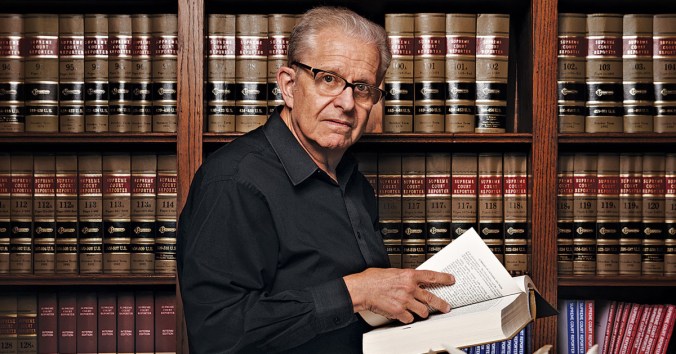
We already beheld the sad spectacle of one of the nation’s most distinguished and respected legal minds beginning to crumble under the dual attacks of anti-Trump hysteria from his peer group, and the inexplicable power of social media to make wise men and women behave like idiots..here (my linking function isn’t working this morning: http://lawnewz.com/high-profile/in-dumbest-move-famous-law-prof-broke-ethics-rules-in-apparent-shot-at-trump/), when famed Harvard Law scholarLawrence Tribe breached a basic and legal ethics principle by issuing a tweet implying that Donald Trump had once asked him about a legal matter, and wouldn’t you all love to know what it was?  When I mention this to lawyers in my legal ethics seminars, they literally laugh and roll their eyes. They know lawyers can’t do this: why didn’t the famous Constitutional Law prof from Harvard Law School have his well-oiled  ethics alarms go off? It was because, I explain, Twitter often turns lawyers and other professionals into fools, and what brains social media hasn’t chewed up can be swallowed by anti-Trump madness.

That was before the election, and poor Tribe’s deterioration has  continued. Three days after the President was sworn in, Tribe joined a group of deranged lawyers and the early stirrings of the “resistance” to sue Trump for violating the obscure Emoluments Clause, which, sane and objective authorities agree, was not intended to apply to a President who has his name on hotels, making the claim that this unprecedented situation constitutes a government official receiving prohibited payments from foreign governments. The theory is not just a stretch, but an embarrassingly  partisan one that a respected Constitutional law scholar should have been mocking, not joining.

Now Tribe has really gone around the bend, and may soon be seen wandering aimlessly through Harvard Square, wearing a Red Sox cap, muttering to himself and carrying a crudely lettered sign. Continue reading

Ethics Train Wreck Update: Now The Dictionary People Have Boarded The Post-2016 Election Freakout

It’s really depressing. I did not expect to see so many professions and professionals debase themselves and their ethical principles because they couldn’t deal with the results of a presidential election. . Historians. Judges. Scientists. Professors. College presidents and administrators. Performing artists. Intelligence community professionals. Judges. Journ–well, no, that one wasn’t a surprise.

My own profession, legal ethicists, booked a seat on the ethics train wreck, a development that was profoundly disappointing. Wrote one member of the profession who has remained clear -eyed while keeping his integrity, Steve Lubet in Slate,  “As a liberal Democrat, I have no sympathy for Conway’s habitual disregard for truth. As a professor of legal ethics, however, I think this complaint is dangerously misguided and has the potential to set a terrible precedent…The professors no doubt have faith in the professionalism of the District of Columbia Office of Disciplinary Counsel, but the bar authorities in other states may not always be reliably even-handed or apolitical. It is hardly inconceivable that lawyer discipline might somewhere be used as a weapon against disfavored or minority candidates, or as a means to squelch protest movements and insurgent campaigns. In the 1940s and 1950s, suspected Communists and alleged “fellow travelers” found their law licenses in jeopardy in many states. In the 1960s and 1970s, civil rights lawyers were hauled before the bar authorities in the South. The complaint against Conway is an unfortunate step back in the direction of using lawyer discipline against political enemies….”

Bingo.

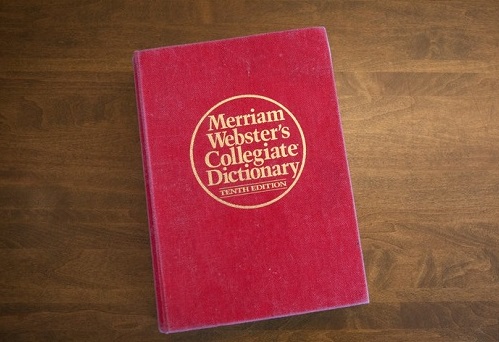
Now “America’s dictionary,” Merriam-Webster, has decided that it is within its mission and purview to attack and mock the President of the United States..

Almost immediately after his election, the dictionary’s editors began trolling Trump and his administration, defined, by Merriam-Webster, as “to antagonize (others) online by deliberately posting inflammatory, irrelevant or offensive comments or other disruptive content.”

The website Acculturated has observed that on social media and its website Merriam-Webster has ridiculed the President  “for his every spelling mistake, grammatical error, and verbal gaffe. In honor of the election, they changed their header photo to a picture of a German word defined as the “collapse of a society or regime marked by catastrophic violence and disorder.” Then they highlighted what they claimed was the word most frequently looked-up, “fascism.” On Inauguration Day, they tweeted “Welp,” a word that conveys dismay or disappointment. The company also derided Betsy DeVos, Sean Spicer, Steve Bannon, and, of course, Kellyanne Conway.

This, needless to say, is not their job, their mission, or responsible professional conduct. It is, as it is for the other derailed professionals, smug virtue signalling and tribalism. Acculturated again:

[T]he dictionary’s editors are clearly partisan. They didn’t harass Hillary Clinton, and they don’t needle sports stars, celebrities, or, well . . . anyone else like they needle the President and his people.Theoretically, even that could be okay—a good, playful, occasional joke from the dictionary could have the whole country laughing. But if you mock one person too often, you start to reveal a pattern. If that pattern persists, the fun and games lose their light-hearted feel, and begin to betray bias instead.

Ya think???

Continue reading

The Unethical, Depressing, Bar Complaint Against Kellyanne Conway

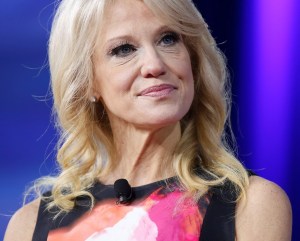
kellyanneThis post is one I do not want to write, and the fact that I have to write it is profoundly depressing. It requires me to criticize, indeed blow the whistle on,  professional colleagues in the fields of law and ethics, some of whom I know and admired very much, as well as fellow members of the District of Columbia Bar. Some of these colleagues are also members, like I am, in a distinguished association dedicated to the field of legal ethics. A superb book on the topic by one of the professors involved  sits in a prominent place in my office bookshelf.  I can see it right now.

Yesterday evening, I learned that a group of fifteen law professors and lawyers have filed a professional misconduct complaint against White House Counselor Kellyanne Conway, claiming that she violated the Rules of Professional Conduct for attorneys by giving false statements to the media. The fifteen signed the complaint, which was filed with the D.C. Bar’s Office of Disciplinary Counsel. When I read the names, signed on a statement printed upon the official stationery of Abbe Smith, a distinguished full time professor at my alma mater, (and where I worked in the administration for four years), Georgetown University Law Center, my heart sank. While I did not need to read the whole complaint to know it was contrived and intellectually dishonest nonsense, I did, and it fulfilled my worst fears. The anti-President Trump hysteria that has caused so many previously fair and rational citizens on the Left to behave atrociously and to betray their previously held values has officially infected lawyers in the legal ethics field. They are now riding the rails on the 2016 Post Election Ethics Train Wreck.

To be absolutely clear and unambiguous: the complaint is a political attack, and a cheap shot at the President of the United States through his staff. There is no merit to any of its contentions.

The professors claim that they were “compelled” to file the complaint because D.C. Rule of Professional Conduct 8.3 (a) requires that

“A lawyer who knows that another lawyer has committed a violation of the Rules of Professional Conduct that raises a substantial question as to that lawyer’s honesty, trustworthiness, or fitness as a lawyer in other respects, shall inform the appropriate professional authority.”

They are either addled by partisan political animus or lying, because there is no way, no way, these fifteen professors could know that, or even validly conclude it, based on what they have written in the complaint. To call their accusations against Conway a stretch is to be too kind. They are forced, exaggerated, trivial and manufactured. From what I have read in past commentary and opinions of several of them regarding other matters of lawyer misconduct, I have serious doubts about whether they believe them. I know that’s a serious charge, but I see no other explanation, other than temporary insanity.

To begin with, Kellyanne Conway is not working in a legal position in Trump’s White House. She is Counselor to the President, not White House Counsel. The President and Conway may choose, for his protection, to treat her non-legal policy advisor position as a legal representation, but the fact remains that she is not providing legal advice and services, only policy-related ones. Now, lawyers can violate D.C. Rule of Professional Conduct 8.4, Misconduct, while not engaged in the practice of law, but unless the conduct involved is criminal or displays “moral turpitude” sufficient to call into question the lawyer’s fitness to practice the likelihood of the conduct being regarded as sanctionable by the Bar is vanishingly slim.

From everything I can determines, Conway, though she is a member of the New Jersey Bar and an inactive (she needs to pay back dues and take my mandatory D.C. Bar ethics course before she can practice) member of the District Bar, has not practiced law in more than 20 years. She has been a pollster, an activist, a flack and TV personality as well as candidate  Trump’s campaign manager, but none of her professional profiles refer to her as a lawyer. The complaint alleges that Conway “engage(d) in conduct involving dishonesty, fraud, deceit, or misrepresentation” in breach of D.C. Rule of Professional Conduct 8.4 (c), and did so while not engaged in the practice of law.  In order to bring down the wrath of the Bar, such conduct must be extremely serious, criminal or bordering on it. Rule 8.3 “limits the reporting obligation to those offenses that a self–regulating profession must vigorously endeavor to prevent.” What kind of non-law-related “offenses” must “a self–regulating profession…vigorously endeavor to prevent”?  It is well established that questionable statements that an individual with a law license utters in the course of political activity and advocacy is not such conduct. Continue reading

Now THIS Is An Unethical Lawyer…In Fact An Unethical ETHICS Lawyer AND A Law Professor! [UPDATED]

breaking-bad

[ My apologies: when this was first posted, I had inadvertently pasted in an excerpt from the Justice press release when I thought I had inserted a link to the complaint. The result was gibberish, and I apologize profusely. Thanks to reader Neil Dorr for alerting me. No more posts composed on my netbook while watching the O.J. miniseries, I promise.]

Today the Justice Department announced a criminal complaint  charging attorney Jack Vitayanon with conspiring to distribute 500 grams or more of methamphetamine. Incredibly, Vitayanon, who is under arrest, is an attorney with the Internal Revenue Service Office of Professional Responsibility in Washington, D.C. That’s the office that monitors IRS lawyers’ ethics. He’s also an adjunct professor at Georgetown University Law Center, where I got my law degree. I’m so proud.

Well, AMC needed a “Breaking Bad’ sequel.

The complaint says that Vitayanon conspired with others in Arizona and on Long Island to distribute methamphetamine for several years.He recently negotiated and competed the sales of distribution quantities of methamphetamine to undercover HSI special agents, and were recorded on internet-based video chats and text messages. Then the professor shipped the methamphetamine from his apartment in Washington D.C. to Long Island via Federal Express.

Vitayanon was also observed in his residence smoking methamphetamine from a glass pipe. A search of the defendant’s Washington D.C. apartment executed pursuant to a warrant led to the seizure of additional quantities of  methamphetamine, drug paraphernalia, packaging materials and drug ledgers.

In other words, they’ve got him dead to rights.

The defendant graduated from Dartmouth, got his law degree at Columbia, and received his Masters in Taxation from NYU. A lawyer cannot be admitted to any bar without a showing of reliable and honest character. The system and the profession could not have failed more miserably.

Vitayanon is the criminal, but the legal profession and the IRS allowed the rot to get into works.

____________________

Facts:Washington Post


The Professor’s Blackface Salute: An Ethics Mess

oregon-blackface-mashup

Halloween costumes, political correctness, law, privacy, and the Niggardly Principles—this one has it all.

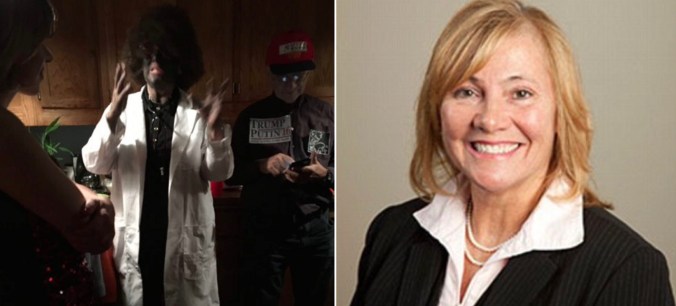
Last Halloween, University of Oregon law professor Nancy Shurtz dressed as Dr. Damon Tweedy, the author of Black Men In A White Coat , as an homage to the African American physician and author. She did this at a Halloween party in her own home. Nobody at the party appeared to misunderstand the gesture or the intent of the costume, in part because she could explain it on the spot, and because they knew that Shurtz was no racist. Shurtz had also told the students who were invited that she would be “going as a popular book title,” hence the blackface, Afro wig, white coat, and  stethoscope.The university report on the episode states that Shurtz “was inspired by this book and by the author, that she greatly admires [the author] and wanted to honor him, and that she dressed as the book because she finds it reprehensible that there is a shortage of racial diversity, and particularly of black men, in higher education.”

But as always happens now because there is no such thing as a reasonable expectation of privacy even in one’s own home, reports of Shurtz in costume and make-up got out into the campus at large, and inflamed the predictable outrage. The university launched an investigation that culminated in a critical report prepared by an attorney and the university’s Office of Affirmative Action and Equal Opportunity.  Shurtz issued an apology—for her private conduct within her own home that was pounced upon by Political Correctness Furies, since she appears to be one herself-–on November 1. Some of her colleagues on the faculty and many students demanded that she resign, and she may have to yet. Shurtz has been censored and suspended, and is now on paid leave. It being claimed that her wearing the costume–within her own home as a gesture that all agreed was intended as benign and that nobody at the party either objected to or failed to understand— created “a hostile environment” at the school. This is apparently because

“as part of the uproar, students said things of which the administration disapproved: The report specifically notes that students used “other offensive racially-based terminology during class times in the context of discussing this event and broader racial issues.” It related that “some of the witnesses reported that the students’ reactions to the event were racially insensitive or divisive.” And it apparently viewed such statements as relevant to whether Shurtz’s own speech was properly punished.”

The report, meanwhile, concludes that the costume constituted “harassment,” and that her intentions are irrelevant.

Writes First Amendment expert Prof. Eugene Volokh: Continue reading

The Kinky Law Professor Principle: “It’s No Shame To Be Kinky, But It Still Might Be Newsworthy”

We haven’t had a “Naked Teacher Principle” story to mull over for a while, and this isn’t one. It raises some parallel issues, though.

I saw the story about the Drexel Law professor who who accidentally sent her students a link to a pornographic video about anal beads. I didn’t find it worthy of a post, though I thought it was funny. It is funny. But we had covered a similar issue here, in the ethics quiz about the hapless teaching assistant at the University of Iowa who somehow managed to send her class not merely sexually provocative photos of herself, not merely nude photos of herself, but something much more kinky. Attached to a message that read “Hi Class, I attach the solutions for number 76 and 78 in this email” were a series of images showing the young woman sans clothes and sans inhibitions having a lively cyber-sexting chat with a partner in which the two were pleasuring themselves in front of video equipment while streaming to each other.

That was funnier. She was “reassigned”—a not unreasonable result of presumed reduced respect from the class.  The Naked Teacher Principle doesn’t strictly apply when the students are adults, and Lisa McElroy, the professor at Drexel University’s Thomas R. Kline School of Law who is apparently an anal bead fan–the video she sent by accident was called called “She Loves Her Anal Beads”—wasn’t naked. There is no “Kinky Law Professor Principle.”

However, Prof. McElroy was mightily offended that her cyber-goof was picked up by the professional publications and websites, and that she was embarrassed as a result. She even posted a Streisand Principle-defying op-ed in the Washington Post, blaming everybody—students, bloggers, and Drexel, which briefly suspended the professor pending an investigation on the basis of possible sexual harassment—but herself. She argued that she should not have been publicly shamed, because, she wrote,

“…there was nothing newsworthy about it. What happened was, in the grand scheme, pretty trivial. My students are adults. The link was quickly removed. There was nothing illegal in the video. The post occurred in the same two-month period when the movie “Fifty Shades of Grey” grossed almost $570 million worldwide. Yet, because it was porn and I’m a law professor, news organizations spread the story around the world.”

Yup. Because it was funny. I understand that the Professor doesn’t see the humor of a law professor—especially her—inadvertently sending her private porn film about anal beads, which themselves are kind of amusing, to a staid law school class. It’s still funny. Trivial? Of course. But trivial can still be funny. Would it be kind for all of us to scrupulously refuse to communicate the hilarious tales of when we do dumb things or embarrass ourselves? Yes. But society as a whole benefits from being reminded that we are all equally fallible human beings—especially the elite and privileged. A lot of people think laughing at slapstick is cruel too.

I pity them. Continue reading

“It’s Unethical To Be A Weenie,” Part III: Hypersensitive Law Students

[Part I is here; Part II is here]

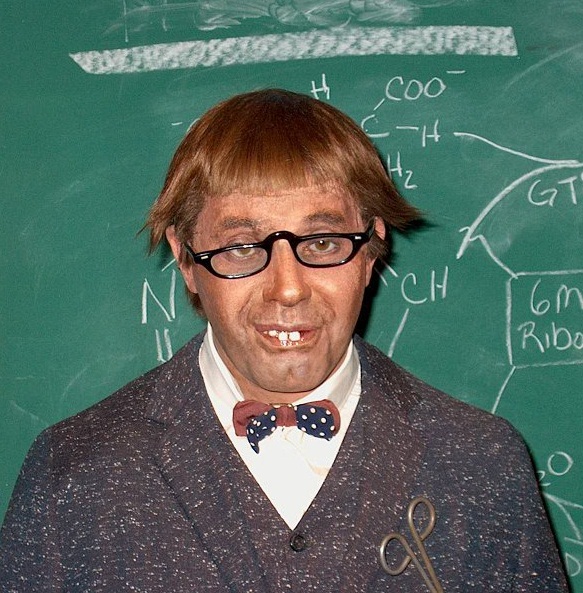
“Today’s lecture is on WHAT???????”

This belongs in an emerging sub-category: future legal weenies. We have already seen black law students insisting that they be able to defer exams because the Eric Garner death has them too preoccupied to concentrate, and other law students protest an “insensitive” exam question involving the Ferguson riots. This trend does not bode well for the ability of citizens to receive competent representation in years to come. The latest entry was revealed by Harvard law professor Jeannie Suk, who registers her observations  in the New Yorker.  Suk says rape law is becoming impossible to teach and may be dropped from criminal law courses because many students can’t handle the stress of the subject matter. Criminal law professors at several schools confirmed that they are no longer teach rape law because they fear student complaints.  Suk writes, “Many students and teachers appear to be absorbing a cultural signal that real and challenging discussion of sexual misconduct is too risky to undertake—and that the risk is of a traumatic injury analogous to sexual assault itself.” Continue reading

Ethics Quote of the Week: Prof. Paul Horwitz

“I can think of a number of posts about the ACA from legal scholars last week that were clearly and openly offered as advocacy and did a fine job of it. And I can think of others that were clearly not offered as advocacy at all, and said useful and interesting things about the oral arguments…But I do believe that some posts last week traded on the authority of their authors, made overconfident or disingenuous claims about the state of current law and the strength or weakness of opposing arguments, and did so for strategic reasons. I see those reasons as more inculpatory than exculpatory. I don’t see the minimal requirements for scholarly integrity that I offered as changing because of the medium, or because of the importance and currency of the case.”

Hey, Professor! We assume you're smarter than we are: don't play games with our trust!

—-University of Alabama Law Professor Paul Horwitz, writing about the confounding number of liberal law professors and scholars who wrote internet posts professing that the constitutionality of Obamacare’s individual mandate was obvious and undeniable, and that the provision’s Supreme Court approval was assured. As Ethics Alarms did regarding other commentators, Prof. Horwitz suggests that some of the commentary was designed as spin, or to use his term, to “shape the narrative.” He argues that in cases where the scholar was deliberately over-stating the case for constitutionality, this constituted a breach of integrity and honesty. Hie professor-speak for this is “inculpatory.” He means that it was unethical.

Which, of course, it was. Continue reading