When Ethics Alarms Don’t Ring: The Bad Date Lawsuit

No story is too stupid for Ethics Alarms!

I’m so proud.

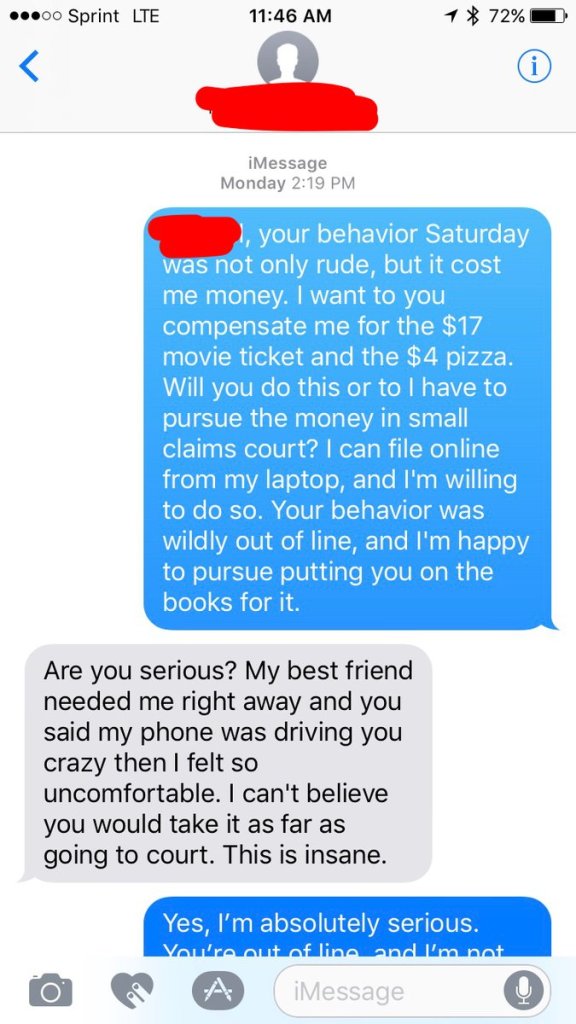
In Round Rock, Texas, Brandon Vezmar took a woman out for a pizza and to see “Guardians of the Galaxy, Vol. 2” , but she texted throughout the film and then left him sitting alone. He texted her, demanding that she  refund the cost of the pizza and the ticket, but she says she refused because “he took me out on a date.”. Now Brandon has filed a claim for $17.31 in small claims court.

Ethics Observations:

1. Brandon’s law suit can be translated as: “Look at me! I’m a big jerk!” I cannot imagine that he will be more successful finding dates in the future. And no wonder she abandoned him.

2. The lawsuit is an abuse of process. He will be lucky if he doesn’t get a dressing down from the judge.

3. Of course he should have let the incident go. This is custom, not contract. The date stunk. That’s a risk you take.

4. The woman, who remains un-named, is a rude jerk as well. She could and should have apologized quickly enough that Big Jerk didn’t have time to complain.

5. There is so much wrong with any two people who can’t locate the social skills and common sense to resolve a matter like this without resorting to the legal system, that it is a near certainty that they will engage in far worse conduct, doing real harm, in the future.

______________________

Pointer: Tim Levier


Unethical Quote Of The Month: President Trump

“I think he shouldn’t have settled; personally I think he shouldn’t have settled. Because you should have taken it all the way. I don’t think Bill did anything wrong. I think he’s a person I know well — he is a good person.”

President Trump to the New York Times , speaking of the sexual harassment allegations intensifying around star Fox News Bloviator Bill O’Reilly.

Now President Trump is acting like President Obama. The President of the United States abuses his power and position by ever commenting upon or registering an opinion about matters that do not involve the national welfare or his direct responsibilities. These include local law enforcement episodes (Trayvon Martin, the arrest of an African-American professor in Cambridge by a white cop), employment matters, private lawsuits, pending criminal trials, TV shows (Saturday Night Live), media coverage (don’t get me started), legal business decisions and sports controversies (Colin Kaepernick). Obama never learned this (among other leadership basics, a problem fagged as “flat learning curve” on Ethics Alarms), and, not surprisingly, Trump is going to be even worse. Continue reading

O’Reilly, Fox News, And Sexual Harassment…AGAIN

Bill O’Reilly’s five accusers…so far.

I saw an online article that called Bill O’Reilly the “Bill Cosby of Fox News.” That’s not entirely fair: O’Reilly is likely just a serial sexual harasser, whereas Cosby is a rapist. Then again, they are both named “Bill,” and there are other similarities. Both have paid hush money to accusers, both have had a series of accusations made against them by women, the watermark of the sexual harasser (though Bill Cosby, so far, is way ahead in that category), both angrily deny the charges against them, and both have indignant defenders.

Both also are probably sociopaths.

Is it possible that Cosby has been wrongly maligned? Let me think…NO. Of course not. Over 50 women (what is the current count now?) do not accuse the same innocent man of sexual assault. Is it possible that the other Bill is a victim, not a predator? My “no” here isn’t quite as emphatic, perhaps, but…no. The New York Times piece yesterday thoroughly covers the evidence, and the odds against  all this being meaningless boggles the mind: Continue reading

Candy Packaging Ethics: How Much Air Can A Candy Box Contain Without Being Deceptive?

Peeps Manufacturing

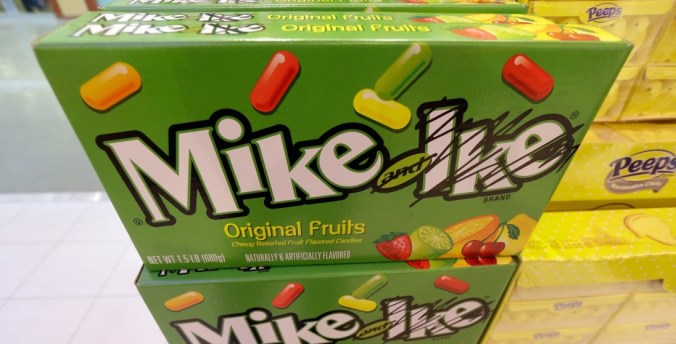
Stephanie Escobar is suing the makers of “Mike and Ike,”  claiming that it is misleading customers by filling nearly half the box with air rather than candy. She bought a box of “Mike and Ike” for  $4 at a Los Angeles movie theater, and was stunned  to find that  46 percent of the it  was filled air, what is known in the business as “slack-fill.”  She checked a box of Hot Tamale candy sold by the same company, and there was only 54% candy in that box too, disappointing her greatly.

Her suit argues candy maker “Just Born Quality” Confections is violating California’s false advertising law, unfair competition law and the consumer legal remedies act.

(This is a separate movie candy ethics issue from the apparently obscene $4 price, much on my mind since on my recent visit to the the theater to see “Fences,” a drink, hot dog and popcorn cost me $19. 85. Movies charge those prices to keep the prices of tickets down, and in the aggregate, that is better for consumers and the theater than charging 20 bucks for the movie and half as much for the junk food.)

Just Born vice president Matt Pye promised a vigorous defense to the “baseless allegations.”“Our products and labels comply with all FDA regulations and provide consumers with the information they need to make informed purchase decisions,” Pye said in a statement.

That rather ducks the issue, doesn’t it? How often have you been shocked that a container is mostly air? Many products, candy notable among them, have been reducing the size of the product sold rather than raising the price. That is fair enough, if one can see what one is purchasing. A box, however, doesn’t permit a consumer to see what’s inside. The argument that the labels are compliant isn’t the same as proving that it’s ethical to have a container that’s twice as large as the the contents require.

Fortunately, I’ve always hated Mike and Ike. AND Hot Tamale. But now I’m wondering about my Raisinettes…

____________________________

Pointer: ABA Journal

The 8th Annual Ethics Alarms Awards: The Worst of Ethics 2016, Part 1

bad-2016

Welcome, if that’s the word, to the 8th Annual Ethics Alarms Awards.

Last year, in a burst of self-pity as I began this annual task, I wrote,

“It is depressing and discouraging: 2015 was much worse than 2014, which was considerably worse than 2013. What am I doing here? What is the point of spending all of this uncompensated time—it is more profitable bagging groceries!—trying to nurture a more ethical culture and a more ethically competent public when all evidence points to utter futility as the result? Well, that way madness lies, I guess. I’m just going to grit my teeth and do my duty. Last year I began by saying that 2014 was the year of the Ethics Train Wreck. There were far more of them in 2015, and they were more serious and damaging. That should give you sufficient warning of the horrors to come…”

Then came 20i6.

To paraphrase  Margo Channing, “Fasten your seatbelts: It’s going to a bumpy post…”

Ethics Train Wreck of the Year

train-wreck-air

The Hillary Clinton E-Mail Scandal Ethics Train Wreck

I thought last year was the Year of the Train Wreck. Wrong. In 2016, we had the 2016 Post Election Ethics Train Wreck, the Campus Sexual Assault Witch Hunt Ethics Train Wreck, the Freddie Gray Ethics Train Wreck, the old stand-by Obama Administration Ethics Train Wreck, the still active Ferguson Ethics Train Wreck, and the Ethics Train Wrecks of both Presidential candidates campaigns. Hillary’s e-mails and their related lies in the long trail of cars called the Hillary Clinton E-Mail Scandal Ethics Train Wreck, was a clear winner though.

Passengers included President Obama, Bernie Sanders, Anthony Weiner, the F.B.I., Loretta Lynch, Bill Clinton, James Comey and more. And, of course, it played a significant and perhaps decisive role in bringing us President Trump.

Runner-Up: 2016 Post Election Ethics Train Wreck. It had less than a month to get up steam, but it caused lots of ethics carnage, and is still going strong.

Fraud of the Year

The Trump Foundation, which revealed itself to be a near total sham. RUNNER-UP: Fake lawyer Kimberly Kitchen, who worked as an estate planning lawyer at BMZ Law in Huntingdon County, Pennsylvania, and served as president of the county bar, though she never went to law school, and never took the bar exam, but forged documents to fool everyone that she had.

Most Unethical Act By A Major Church

The Catholic Church, which, incredibly, restored a convicted rapist to the priesthood. Father Joseph Jeyapaul,  a Catholic priest from India, while serving in the Crookston, Minnesota diocese from 2004 to 2005 raped at least two adolescent girls.  After being charged with the crimes, including rape and forcing at least one of his victims to perform fellatio on him, Father Joseph  escaped to India, where an Interpol warrant got him extradited back to Minnesota.  There he confessed, and as part of a plea bargain, received an outrageously light sentence of a year and a day for pleading guilty to one count of molestation. Jeyapaul was suspended from the priesthood and served his time in Minnesota. The U.S. deported him back to India, while the Minnesota diocese had to pay millions in a civil lawsuit, during which we learned that the rapist priest had told one of his victims  in the confessional that she was at fault, and had made Jeyapaul “impure” by letting him abuse her. In February, the Vatican lifted Jeyapaul‘s suspension and restored him to the priesthood. It then assigned him to a new parish in India, where he is now the diocesan head of its commission for education. 

Tell me again why that fake news story that the Pope endorsed Trump was supposed to help The Donald.

Incompetent Elected Official of the Year

kkane

Kathleen G. Kane (D), Pennsylvania’s ex-Attorney General.  In October, a judge sentenced her to 10 to 23 months in prison for her conviction on charges of perjury and abuse of her office. You can’t be more incompetent, I’d say, than an elected attorney general who can’t stay out of jail herself. I regret not writing about the Kane saga last year, but her ethical void was fairly apparent back in 2013, the only time I did write about her, after she leaked grand jury testimony, which is illegal. I wrote at the time (I must have been in a bad mood)…

“Leaking grand jury testimony is both illegal and spectacularly unethical for a lawyer, yet Pennsylvania’s Attorney General, Kathleen Kane, appears to have done it for the slimiest of reasons, and is offering the most cynical of defenses in the most offensive of ways. (Incidentally, I don’t understand how this could happen. After all, Kane is a woman, the first Democrat and the first woman to be elected to the post, and since having a vagina alone is supposed to imbue a candidate with trustworthiness, surpassing competence and virtue, this makes no sense at all.)”

Unethical Elected Official of the Year

Continue reading

From The “Law vs. Ethics” Files: A Westin Hotel Comes To The Nuisance

nookwestin

The photo says it all.

In Austin Texas, Westin  opened a large hotel next to the Nook Amphitheater, which is famous venue for live music in a city with a strong music culture  Westin is now suing the Nook because its music is disturbing the guests. The complaint states that the Nook plays “chest thumping bass” seven nights a week until 2 a.m. making some rooms uninhabitable.and thus harming the hotel’s business.

Law professor and invaluable ethics story source Jonathan Turley notes that the case recalls the now defunct “coming to the nuisance” doctrine.  The defendant in such a case once could move to dismiss a nuisance claim on grounds that the plaintiff moved next door only to challenge the activities, business and even the existence of it neighbor in court.  Turley writes,

The doctrine originated in early common law with cases like Rex v. Cross, 172 Eng. Rep. 219 (1826).  The Court held:

“if a certain noxious trade is already established in a place remote from habitations and public roads, and persons afterwards come and build houses within the reach of its noxious effects; or if a public road be made so near to it that the carrying on of the trade becomes a nuisance to the persons using the road; in those cases the party would be entitled to continue his trade, because his trade was legal before the erection of the houses in the one case, and the making of the road in the other.”

American courts found the doctrine to hinder growth and work against the common good, particularly as populations in cities expanded into rural areas.  

But, Turley explains, even in the absence of the “coming to the nuisance” defense, defendants have had some support from the courts: Continue reading

Yes, Poker Champ Phil Ivey Cheated, Even If He Didn’t Think He Did

baccarat2

Phil Ivey is known as one of the best all-around professional card players in the world, in part because he notices things that other players, even great ones, may not. While playing baccarat at the Borgata Casino in Atlantic City in 2012, Ivey and a friend noticed  inconsistencies on the back of the cards that allowed him to read some of them as if they were marked. He even asked the dealer to position the cards so he could see them better, as in “see what nobody else noticed, giving him an unfair advantage.” Some advantage: he and his associate, Cheng Yin Sun, won $9.6 million at baccarat over four visits to the casino, then won an additional $504,000 betting their winning at the  craps table.

A federal judge has now ruled that the two must repay the $10 million. What they did is called “edge-sorting,” and it is considered cheating, though technically the ruling was that Ivey and Sun breached their contract with the casino.

In baccarat, players bet on the relative value of two hands of two cards each before the hands are dealt or the cards are revealed. The game is  played with six or eight decks of cards placed into a dealing “shoe,” and the object is to bet on the hand that will have a total value closest to nine. If a player knows the value of the first card in the shoe before it’s dealt, the player has a significant advantage over the house. Borgata accused Ivey and Sun of exploiting defects in playing cards manufactured by Gemaco Inc. that were not cut symmetrically during the manufacturing process, so Ivey and Sun were able to spot the manufacturing defects and  read the “marked”  cards without actually touching or defacing them themselves. The New Jersey Casino Controls Act requires that all casino games offer “fair odds to both sides.”  Without intending to or knowing, the casino was creating unfair odds against itself, and these two players made out like bandits as a result.

Ivey’s lawyer argued in a court filing that since his client never touched the cards, his advantage was like the casino trying to distract players with “free alcohol served by only the most curvaceous and voluptuous females in the industry.” Continue reading

Warning From Great Britain: The “Lawscam” Excuse Is Coming To Colleges

It was all the fault of imperial Indian history....

It was all the fault of imperial Indian history….

The controversy died down a bit in 2016, but it is still out there: unemployed young lawyers are still blaming their law schools for the fact that their degrees didn’t deliver riches and success in a competitive field. When a ballyhooed lawsuit by one such lawyer failed last April, it briefly muted the howling, but the central misconception is still virulent. From the Ethics Alarms post about that law suit:

The rejection of Alaburda’s law suit sends a message that young lawyers need to hear, and heed. If they thought a law degree was going to guarantee their success, they have been tragically confused by the culture’s hucksters and politicians, not the law schools.  For too long, education has been sold as the key to income and jobs, when it is nothing but a process designed to make more competent, able, creative and responsible human beings. By itself, a degree proves nothing. It only signifies that its owner has had access to useful knowledge and the chance to develop useful skills. It is up to graduates to use that knowledge and those skills to make a life for themselves. If they fail to achieve their goals, they cannot blame the law school because they perceived a promise that was never made.

One failed suit, however, couldn’t undo the destructive false message society and its leaders have been issuing for decades: “the purpose of earning a diploma is to get a good job.” As more and more young men and women are steered into college and a college degree becomes symbolic of nothing, there will be more law suits by college graduates like the one currently being fought in Great Britain, where Faiz Siddiqui, an Oxford graduate, is suing his alma mater for not giving him a first-class degree 16 years ago. (In British universities, graduating with a “first class degree” is roughly similar to graduating “with honors” in an American college. Based on a student’s grades, Oxford gives out three classes of degrees, first-class being the highest.)

Siddiqui is now 38 years old, angry and disillusioned. In his suit, he alleges that his life and career were stunted because he didn’t earn “a first,” as the degree is called, when he  studied modern history at Brasenose College and graduated from Oxford University in June 2000. “Negligent teaching” in a course on Indian imperial history, he says, pulled down his overall grade and ruined his life. Now he’s asking for a million British pounds in damages for his lack of lifetime earnings in a legal action against the Oxford chancellor, masters and scholars. His barrister, Roger Mallalieu, also claims that Oxford is responsible for Siddiqui’s insomnia and depression.

Apparently the history module was less than optimum while Siddiqui was a student, because half of the teaching staff responsible for Asian history were on sabbatical.  Mallalieu told the British high court that the inferior teaching resulted in his client’s lesser grade and thus “denied him the chance of becoming a high-flying commercial barrister.” Continue reading

More Ethics Movies For The Holidays: “Woman In Gold”

portrait-of-adele-bloch-bauer-i-by-gustav-klimt

The movie critics site “Rotten Tomatoes”calls “Woman in Gold” dull, which tells you pretty much all you need to know about “Rotten Tomatoes.” No, there are no explosions, no sex scenes, no CGI, just a well-acted, powerful story of how justice can take a long time to prevail, but given enough dedication, integrity and luck, it still does prevail with sufficient frequency to stave off despair.

“Woman in Gold” is a 2015 film starring Ryan Reynolds and Helen Mirren. It is a virtual docudrama telling the true story (mostly accurately) of Maria Altmann (Mirren), a plucky Jewish refugee in Los Angeles, who, assisted by her young lawyer, Randy Schoenberg, battled the government of Austria  to obtain the return of Gustav Klimt’s renowned portrait of her aunt, Adele Bloch-Bauer. That painting, along with more by Klimt and  other painters as well, were among the art treasures stolen by the Nazis  prior to World War II. The legal battle ended up before the Supreme Court of the United States, and the conflict was finally settled by a shocking decision by an Austrian panel of mediators. You can read about the real case here.

It may be dull to dull minds, as Red Smith famously said about baseball, but I have seen the film twice now, and it moved me to tears both times. “Woman in Gold” shows once more, as I fervently believe, that right can and often does triumph over bureaucracies, greed, power and stupidity, and that lawyers, maligned as they are, are often essential to that process. Schoenberg shows us the epitome of a zealous and courageous lawyer, making personal and professional sacrifices for a cause he comes to believe is important both to his client and to humanity. Continue reading

From The Ethics Alarms Mail Bag: “Does It Matter If A Lawyer Is A Neo-Nazi?”

"Anyone who would hire this lawyer is evil! EVIL!!!"

“Anyone who would hire this lawyer is evil! EVIL!!!”

“…What if he’s hired for a government job?”

This is a great question, and I’m going to bedevil the lawyers in my upcoming ethics seminars with it. It’s not a hard question, though.

The answer is, “No, it doesn’t matter, just as it doesn’t matter if the lawyer is a Republican, a vegan, a libertarian, a creationist, a global warming denier, an Adam Sandler fan, a Donald Trump loyalist, a Muslim, an ISIS sympathizer, a Druid, a Celine Dion worshiper, a New York Yankee fan or anything else. Lawyers have First Amendment rights. Lawyers can think what they want to, believe what they want to, donate where they want to and spout whatever unpopular or offensive opinions they want to, as long as it doesn’t interfere with their representation of their clients.

What prompted the question was this post on the Southern Poverty Law Center (SPLC) website, which attempts to use guilt by association and classic McCarthyism tactics to smear the City of Baltimore because of what the lawyer defending it in a law suit believes. The SPLC—which itself often resembles a hate group–writes, Continue reading