Another Visit To “The Ethicist”: Appiah Overthinks The Dilemma Of The Treacherous Ex-Wife

is the first and only competent ethicist to handle the long-time New York Times Magazine column, so I feel badly that most of the time when I reference his opinions, it is to criticize one of them. He over-all record is excellent, despite the impression one might get from Ethics Alarms. For example, read his superb, if a bit overblown, response to a white woman who was “deeply offended” that a contractor hired by her husband flew a small confederate flag on his truck. She wanted to report him as a racist to his boss, and asked Appiah if this was the right thing to do.

That nuanced advice is more typical of “The Ethicist’s” work than this recent chapter, in which a man wrote that he had split from his wife after she had refused any physical intimacy, saying that it was no longer “part of her life.” She suggested a trial separation, which led to a formal divorce, and the couple signed a non-disparagement agreement as part of the process. Recently she admitted to him that she had repeatedly cheated on him during their marriage, and that she suggested the trial separation so she could resolve her affair at the time with a married man.

The inquirer says that he has never blamed his wife in discussions with his sons for the end of the marriage, but that he has learned from them that she “places the sole blame on me for every problem ever experienced by our family, including the drug addiction of our older son. When I recently contacted her about visiting him in jail, she said he didn’t want to see me. I contacted him and found that this was not true.”

He asks “The Ethicist” if he can ethically violate the non-disparagement agreement in his own defense, and tell the sons what a lying, cheating, betraying mother they have. To my amazement, Appiah said he could, and even suggested that he should, arguing in the process of a looooong discourse, Continue reading


Dead Wrong: The Withdrawn Bequest Share

That is, the advice columnist’s answer to an easy ethics question last week was dead wrong.  Once again, the advice-giver in question is Philip Galanes, the Times proprietor of Social Q’s, essentially that paper’s version of “Miss Manners.” Galanes, I now see upon googling him, is a novelist and a lawyer. That explains, perhaps, his unfamiliarity with some of the more nuanced aspects of ethics. Here’s the question he received in its entirety:

My brother died last year and bequeathed his entire (small) estate to me. He had one child, a daughter, to whom he left nothing. Feeling sorry for her, I told my niece I would give her half of the estate. (None of this becomes official until April.) But my circumstances have changed dramatically. My husband was recently diagnosed with pancreatic cancer. He is undergoing treatment, but we face a very uncertain financial future. I would now like to keep the entire estate. My niece is doing well financially, with many earning years ahead of her, unlike me. Is there a way to tell her I’ve changed my mind so she won’t hate me forever?

The Social Q’s verdict: “…Say, ‘I’m sorry if your father’s will hurt you. I promised you half of my inheritance out of love for you and hoping to heal any pain the will caused. But my husband is seriously ill, and I can’t afford to give you the money now. If I can make it up to you later, or in my estate, I will do it.’….For readers worrying about a verbal contract here, let’s assume B’s promise falls into one of several exceptions that requires agreements to be in writing….”

Yeccchh.

Here’s the ethical answer: Continue reading

Now Don’t Sue Me, SmileDirectClub, Because This Only This Ethicist’s Opinion, But…

“Hey! That’s a GREAT Idea! I LOVE it! Sure I’ll accept a refund in exchange for never telling anyone how lousy your product is!”

…no one should trust or do business with a company that engages in this unethical practice. Just an opinion, now.

What SmileDirectClub does, as documented in a New York Times Business Section story, is force customers to sign a non-disclosure (or confidentiality) agreement before they can receive refunds for unsatisfactory products. That way, other customer can’t find out about what the SmileDirectClub  can turn out to be, and in ignorance are more unwitting customers.

Here’s an excerpt from the Times piece: Continue reading

Afternoon Ethics Refresher, 1/15/2020: Firing, Tweeting, Protesting, Talking Friends Into Suicide…

Hello?

Traffic here inexplicably dead yesterday and today. Is there a secret ethics convention nobody told me about? There is, isn’t there? I’m hurt…

1. It’s too bad so many readers don’t pay attention to the baseball posts, because a lot of fascinating ethics issues with general applications arise…like right now. Yesterday, as already mentioned in an update to yesterday’s post and a couple of comments, the Boston Red Sox “parted ways with Manager Alex Cora by mutual agreement.” (He was fired.) In a press conference I just watched, the Red Sox brass said that Cora, who was both successful and popular in Boston, was let go solely because of the MLB investigation report regarding his involvement in cheating while serving as a coach for the Houston Astros in 2017, and the allegations of cheating  while managing the Sox in 2018, still under investigation, played no part in the decision. What they meant is that the Astros cheating was going to result in a long suspension for Cora anyway, so the team didn’t need to wait for the bad news regarding his cheating in Boston.

The weirdest thing about the press conference is that none of the four Sox officials would do anything but praise Cora, his character, his judgment, his dedication to the team, his devotion to baseball. Gee, why did they fire this saint, then? Alex Cora’s character is obviously flawed, or he wouldn’t have masterminded major cheating schemes that cost the Astros 5 million dollars and four key draft choices while losing the jobs of two men who advanced his career. Cora’s judgement also stinks, because his actions have now cast a shadow over two teams, their championships, and the records of the players his schemes benefited.

If he was so dedicated to the team, why is  it now facing a public relations and competitive disaster because of his actions? If he was devoted to baseball, how did he end up at the center of a scandal that undermines the perceived integrity of the game? Continue reading

The Topless Stepmother Conundrum: When Ethics Work Better Than Laws

MOM?!

A lawyer for Utah’s chapter of the ACLU asked Utah Judge Kara Pettit to rule that the state’s lewdness law violates the Constitution by treating women differently than men and thus violating the Equal Protection Clause. The  statute makes it a crime to expose “the female breast below the top of the areola” in the presence of a child in a private place “under circumstances the person should know will likely cause affront or alarm.”

Tilli Buchanan, 27, faces imprisonment, fines and the requirement to register as a sex offender for 10 years if convicted of violating the law, which she certainly did. Buchanan and her husband had been installing drywall in the garage, and they had taken off their shirts that had become scratchy from the fibers, she told reporters.  When her stepchildren, aged 9, 10 and 13, walked in, she “explained she considers herself a feminist and wanted to make a point that everybody should be fine with walking around their house or elsewhere with skin showing,” her lawyers wrote in court documents. Here’s Tilli…

Just kidding.

Lawyer Leah Farrell of the ACLU says the law requires women to do a “mental calculation” about whether going topless would cause alarm. But men can go shirtless without violating the law and without making that calculation. “That really sets up an unequal and unfair dichotomy,” Farrell says.

Prosecutors say that Buchanan stripped in front of the children and  was under the influence of alcohol at the time. They also claim she said she would put her shirt back on if her husband showed her his penis.

Ick. Continue reading

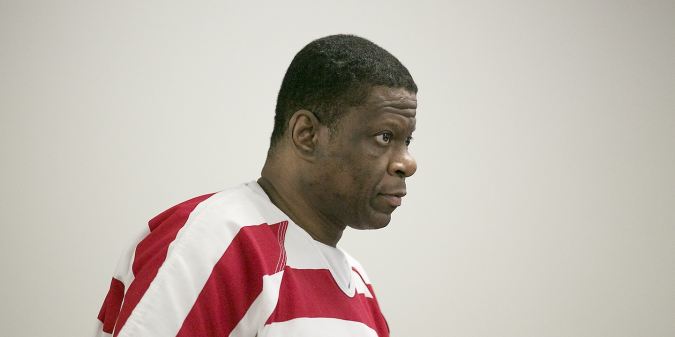
No Way Out? The Rodney Reed Affair [UPDATED!]

Rodney Reed was convicted by a Texas jury in 1998 and sentenced to die for the rape and murder of 19-year-old Stacey Stites two years earlier. On April 23, 1996, Stites’s body had been found on the side of a country road outside of Bastrop, Texas. Marks on the woman’s  neck led investigators to conclude that she had been strangled, and she had had sexual relations with someone before she was killed.

Police tested the recovered DNA against that of Reed, then 29 years old.  There was no other evidence tying Reed to the murder, other than the fact that he initially lied to police, claiming that he didn’t know the victim. Finally, Reed said that he was having a sexual affair with her, and that the two had sex a couple of days before Stites was found dead. The witnesses Reed’s defense called to confirm the relationship between the two were not convincing, for varying reasons. It didn’t help Reed’s cause that he was regarded as a serial sex offender, with many arrests on his record.

As The Intercept explains in detail, the case against Reed has deteriorated over time, and was never strong to begin with. Many forensic pathologists have concluded that the verdict lacked scientific support. The medical examiner who conducted Stites’s autopsy has recanted his testimony. In 2018, both a state crime lab and a private DNA lab undercut the testimony of their own employees who had testified at Reed’s trial.  Nonethless, Reed is scheduled to be executed in five days, on the 20th of November.

The new evidence indicating that he was wrongly convicted has not been reviewed by a court and apparently will not be because of the judicial principle of finality, the very old concept that hold that legal disputes at some point achieve a resolution that cannot be appealed and must be regarded as final. The principle is deemed necessary because without it, the public could not trust in the meaning of any law, or the result of any legal process. It is a utilitarian principle: individual cases may have unjust results occasionally, but the system as a whole benefits from the certainty of finality.

When the finality principle will result in the execution of a someone who appears to have been wrongly convicted, however, the gap between law, justice and ethics is difficult to accept.  The Supreme Court will consider Reed’s case today. There is also a plea to Abbott and to the Board of Pardons and Paroles to intervene.

The ABA has also made an appeal to the Board, via a letter from American Bar Association President Judy Perry Martinez.  Continue reading

Thoughts Upon Reading The Comments To The Recent “Conscience Clause” Post

The comments on the recent post regarding the so-called conscience rule being voided in court generated the comments the topic always does. What follows is a relatively short, general post to frame the issues as clearly as possible.  Admittedly, when a post is titled “When Law and Ethics Converge,” perhaps I shouldn’t have to explicate with a post focusing on the difference between law and ethics. I strongly believe that conscience clauses undermine the law, and are unethical, as you will see.

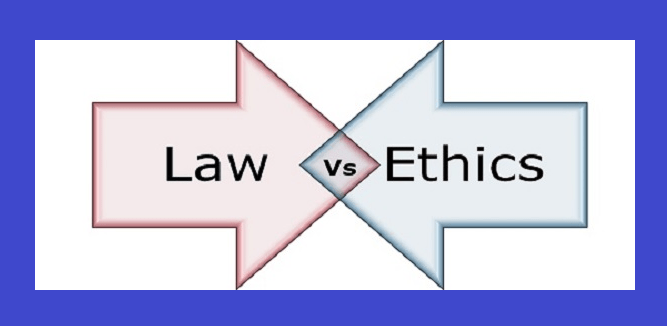
Law and Ethics are not the buddies people think they are, or wish they were. If you look around Ethics Alarms, you see why. Ethics, as the  process by which we decide and learn what is good and right conduct, evolves with time and experience. A predictable cut of a society’s ethics are always going to be a matter of intense debate. Ethics are self-enforcing, for the most part and by nature, because being ethical should make us feel good.  Once an authority or power starts demanding conduct and enforcing  conformity, we are mostly out of the realm of ethics and into morality, where conduct is dictated by a central overseer that, if it is to have genuine authority, must be voluntarily accepted by those subject to its power.

Society cannot function on ethics alone. Without laws, chaos and anarchy result. Because chaos and anarchy are bad for everyone, no individual who has accepted the social compact may decide which laws he or she will follow and which he or she will defy—at least, not without paying a price, which is society’s punishment. In ethical terms, this is a utilitarian calculation: we accept laws that individually we may find repugnant, because allowing citizens to pick and choose which laws they will obey as a matter of “conscience” doesn’t work and has never worked. Ethics pays attention to history.

Thus it is ethical to obey the law, and unethical not to,  even if good arguments can be made that particular laws are themselves unethical. This is where civil disobedience comes in: if a citizen chooses to violate a law on a the basis of that citizen’s conscience or principle, the citizen also has to accept the legal consequences of doing so as an obligation of citizenship. Continue reading

When Law And Ethics Converge: Goodbye To The Trump Administration’s Unconstitutional and Unethical “Conscience Clause”

Today’s decision by U.S. District Judge Paul Engelmayer, voiding the Trump administration’s “conscience rule” that resuscitated the Bush Administration’s similar rule, is right on the law, and, more important for this blog, right on ethics. The Trump version, which was yet to go into effect,  allowed health-care providers to refuse to participate in abortions, sterilizations or other types of care they if they disagreed with them on religious or moral grounds.

It was an invitation to open-ended discrimination, and as objectionable in principle as allowing public accommodations to refuse to serve Jews, blacks or gays. This topic has been thoroughly explored on Ethics Alarms over the years, and I don’t have anything much new to say. In fact, perusing my various essays on the topic, my favorite is one that is so old, it was on the Ethics Alarms predecessor the Ethics Scoreboard (on which I am slowly making progress in my efforts to get it back online) and mentions Paris Hilton, working at Blockbuster, and an earlier incarnation of Colin Kaepernick in the NBA.

I wrote, in 2005, Continue reading

Another Leap Down A Slippery Slope: Massachusetts Repeats The Michelle Carter Debacle

The Suffolk County (Mass.) District Attorney has charged Inyoung You, a 21-year-old South Korean native and former Boston College student,  with involuntary manslaughter in the suicide of 22-year-old Alexander Urtula, who jumped to his death on May 20, 2019, the day he was going to graduate.  You was in cellphone contact with her boyfriend that day, and was at the scene when he plunged to his death.

While Urtula struggled with mental health issues throughout the pair’s 18-month relationship,  You was “physically, verbally, and psychologically abusive, and was so “wanton and reckless” that it  “resulted in overwhelming Mr. Urtula’s will to live,” the DA told reporters. “She was aware of his spiraling depression and suicidal thoughts brought on by her abuse, yet she persisted, continuing to encourage him to take his own life.”  Among the over 47,000 text messages sent by You in the two months leading up to Urtula’s suicide, here were hundreds “where (You) instructed him” to take his own life, as well as “claims that she, his family and the world would be better off without him.”

Nice.

But is it criminal?

There are differences in the two cases, but this is redolent of the 2017 prosecution and conviction Michelle Carter, who was convicted in the Bay State of involuntary manslaughter for urging her 18-year-old boyfriend, Conrad Roy III, to kill himself, which he did. The conviction was upheld by an appeals court this past February, so Carter will apparently serve out her entire 15 month sentence—for the content of her text messages. Continue reading

The Right To Be Unethical: The 10th Circuit Allows “Faithless Electors”

This is professor Larry Lessig. Is it unfair of me to believe that this particular pose is signature significance for a pompous ass? Nobody in the history of photography who wasn’t pompous  posed this way, Lessig has several pictures like this.

The 10th U.S. Circuit Court of Appeals at Denver ruled 2-1 this week that the Electoral College system established by Article II and the 12th Amendment of the U.S. Constitution allows Presidential electors to vote against the candidate the popular vote in their state commits them to vote for. In 1952, the U.S. Supreme Court ruled  that primary candidates for party electors can be required to pledge to support the party’s candidate, but according to this decision, that pledge is not enforceable.

The 10th Circuit’s decision was a victory for Michael Baca, a Colorado elector who in 2016 cast his vote for John Kasich, then governor of Ohio, even though state law at the time required him to vote for the winner of the state’s popular vote, who was Hillary Clinton. Baca said his intention was to persuade enough members of the electoral college to cast votes for Republicans other than Donald Trump in an effort to deny Trump a victory.

Ooh, good plan! One way to avoid this problem is for states to make sure their electors aren’t arrogant, undemocratic whack-jobs.

The state removed Baca as an elector and canceled his vote, causing two other electors to abandon their plans to vote for Kasich. All three joined the lawsuit against the Colorado secretary of state’s office, but the 10th Circuit found only Baca had standing to sue.

It seems that the decision has strong Constitutional law behind it. Baca v. Colorado Dep’t of State said in part, Continue reading