Statue Ethics Stand-Off: “Charging Bull” vs. “Fearless Girl”

The Wall Street art ethics controversy pitting a nearly 30-year-old sculpture of an angry bull against the upstart statue of a defiant little girl has fascinating cultural implications. The ethical solution to the confrontation are simple and undeniable, however, though the legal issues a bit less so. “Fearless Girl” has got to go.

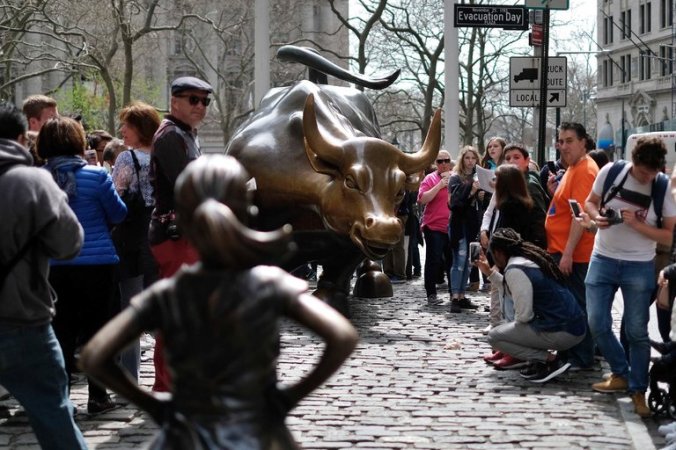
Arturo Di Modica created “Charging Bull” in response to stock market travails during the late 1980s. The three-and-a-half-ton sculpture was placed near Wall Street in the dead of night,  and was embraced by the financial ditrict and New Yorkers as iconic public art. The artist copyrighted and trademarked his work, which he has said was meant to symbolize “freedom in the world, peace, strength, power and love.”

I don’t get the love part, but okay: the point is that the bull is a positive metaphor, not a sinister one.

The “Fearless Girl” statue was positioned this year, the night before International Women’s Day, in a direct stand-off with the bull. It had been commissioned by State Street Global Advisors, a financial firm based in Boston, as a public relations and advertising move and classic virtue signalling. State Street Global’s home page trumpets the new statue’s message of “the power of women in leadership” and uses it to urge “greater gender diversity on corporate boards.” The metal girl’s  cynical and self-serving origins don’t seem to bother the work’s fans though.

The problem is that the message of “Fearless Girl” requires the participation of the bull to make any sense and to have any power at all. Otherwise, it might as well be Pippi Longstocking.  In essence, the new statue appropriates Di Modica’s work, and violently alters it. The artist is a furious as a charging bull that what he intended as a symbol of capitalist power and national vigor has been transformed into a sexist representation of male domination. Di Modica and his lawyers demand that the statue be moved away from its bull-baiting position, arguing that State Street Global commissioned “Fearless Girl” as a site-specific work conceived with “Charging Bull” in mind. It thus illegally commercialized  Di Modica’s statue in violation of the artist’s intent and copyright. They also claim that the city  violated the artist’s  legal rights by issuing permits allowing the four-foot-tall tyke to face off with the bronze bull without the artist’s permission. Letters to the Mayor DiBlasio, Ronald P. O’Hanley, the president and chief executive of State Street Global; and Harris Diamond, the chairman and chief executive of McCann Worldgroup, State Street Global’s marketing agency demand the removal of “Fearless Girl” forthwith.

Ethically, “Fearless Girl” doesn’t have a leg to stand on. Continue reading
Comment of the Day: “Ethics Quiz: Is This Question Easy?”

I intensely disagree with some of this comment regarding illegal immigration and the laws surrounding it, but it is still thoughtful and provocative. I’ll be back at the end.

Here is slickwilly’s Comment of the Day on the post, “Ethics Quiz: Is This Question Easy?”

“But sometimes the law itself is evil.

Agreed, and a good observation. Laws are made by men, many times men with hidden agendas who stand to profit from those laws. What I think Glenn is getting at is that ‘illegal’ is seen as equal to ‘immoral,’ which many equate with ‘bad.’ Is it immoral to disobey a law? In the strict sense, by the definitions involved, I think so. In practice, I am not so certain. What if the ‘law’ is written by an un-elected bureaucrat who has no effective over site from lawful entities? When petty rules have the enforcement power of law, democracy falls into tyranny.

Of course, immigration laws are a necessary evil. We have to have them. But we need to get more serious about whether the ones we have now are ethical, sensible, and productive.

Many of the laws we have now benefit those in power, or those who paid them to make the law a certain way. This is generally bad for everybody else, taken as a whole. Immigration laws do not punish those who create the situation for corporate (and private) greed, and even when they do provide punishment for such as these they are not enforced. The first thing that must change is that this class starts suffering for their crimes by lawful enforcement and new laws to address that situation.

I will agree that MOST immigration laws (including ‘how one becomes a legal resident’) are unethical, nonsensible, and unproductive. To those, I will add unfair to all involved but those that crafted them. Continue reading

Comment of the Day: “From The Ethics Alarms “Res Ipsa Loquitur” Files: Now THAT’S An Unethical TSA Patdown”

The post about the TSA agent’s excessive “patdown” of a young boy, caught on video, prompted spirited debate with many high quality comments.

Before presenting John Billingsly’s COTD, let me note up-front two of John’s points that I disagree with. First,while refusing to follow an illegal order is mandatory, the fact that one is given an order to do something unethical—and this patdown was unethical—does not reduce the responsibility to refuse if the harm to another is clear, obvious, and objectively unjust, as in this case. Second, everyone involved in a wrongful act is accountable, from the top of the chain of command to the bottom. I also have a third and fourth, but I’ll let others cover those.

Here is John Billingsley’s Comment of the Day on the post, From The Ethics Alarms “Res Ipsa Loquitur” Files: Now THAT’S An Unethical TSA Patdown:

According to a report at Dallasnews.com, “Afterward, the TSA officer was instructed by his supervisor, who was observing, to complete the final step of the screening process.” My emphasis added. This suggests to me that the agent himself was going to break procedure and omit “the final step” of the screening process, which I believe to be the genital grope, until he was directly ordered by his supervisor who was there in person to do it.

I understand the “just following orders” issue per the Nuremberg Trials. It looks like he was going to disobey the order (procedure) until he received the direct order from his supervisor. I don’t think there are many low level employees who would immediately disobey a direct order of a supervisor in that situation. When you are a grunt at the bottom and your boss tells you to do things the way you have been taught to do them, it is going to be very difficult to make the decision to disobey.

Continue reading

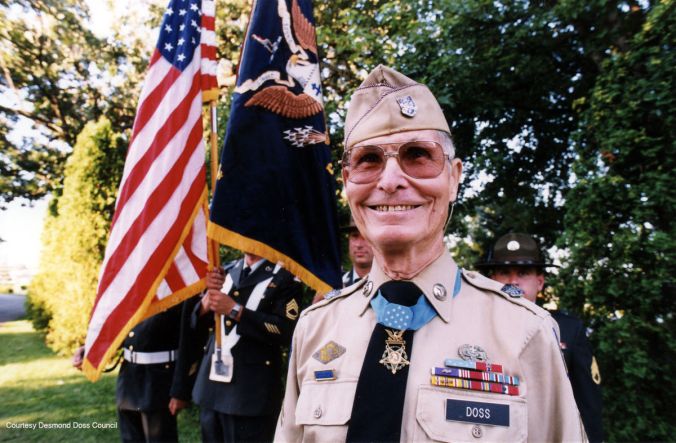
Ethics Hero Emeritus Desmond Doss, And “Hacksaw Ridge,”

desmond-doss

Desmond Doss, who died on March 23, 2006 at the age of 87,  was the very first hero to be enshrined in the Ethics Alarms Hall of Heroes. I wrote about him before there was an Ethics Alarms, shortly after he died.  I had never heard of Doss before, and I remember being angry that I had never heard of him. Everyone should know about him. There literally are no Americans who were any more heroic, and whose ethical conduct was any more astounding, than Desmond Doss.

If the values of this nation, and especially Hollywood, were healthy and correctly aligned, he would be a household name, and the film about his World War II heroism would have been made long ago. Finally “Hacksaw Ridge” was produced in 2016, and has been nominated for an Academy Award, although it will never win.

When I first read about Doss, I couldn’t get my mind around what he had done to be awarded the Congressional Medal of Honor, the only conscientious objector ever to achieve that honor during combat. During the battle of Okinawa, we were told that he survived heavy enemy fire as he struggled to carry seventy-five wounded soldiers to the sheer cliff at Hacksaw Ridge, personally picking up each one and lowering them over the edge the cliff 400 feet to safety.   How is that possible? Now that I’ve seen the film, it still seems impossible.

Desmond Doss proved that principled opposition to violence against his fellow human beings need  not be based on fear, self-interest or self-preservation. It is often impossible to tell whether those who oppose armed combat really object to the spilling of all human blood in battle, or only their own. With Desmond Doss, there was never any doubt. He didn’t like the term “conscientious objector,” preferring the term “conscientious cooperator.” He enlisted in the army following Pearl Harbor, believing that the war against the Axis had to be fought and wanted to be part of the war effort despite believing, as a devout a Seventh Day Adventist, that it was a sin to kill, with no exceptions. Thus he refused to carry a rifle (or shoot one, even in training) but yet insisted that he be involved in combat as a battlefield medic. He achieved conscientious objector status  but would hot accept a deferment. Assigned to the 307th Infantry Division as a company medic, Doss was hazed, abused and  ridiculed  for his dedication to non-violence, and as the Mel Gibson-directed film shows, many of his tormentors eventually owed their lives to his astonishing heroism. All of his compatriots were amazed by his evident fearlessness under fire and remarkable dedication to duty, never hesitating to go after a wounded soldier no matter what the personal risk. As a combat medic on Guam and at Leyte in the Philippines, Doss had already been awarded the Bronze Star  before the three-day battle at Hacksaw Ridge.

Many of the soldiers in Doss’s 307th Infantry, 77th Infantry Division were driven off the ridge by a furious Japanese counter-attack, and  wounded G.I.s were stranded atop it. Doss remained with the wounded, and, according to his Medal of Honor citation refused to seek cover, carrying them, one by one, to the edge of the ridge in the face of enemy fire, some of them from behind enemy lines. He lowered each man on a rope-supported litter he improvised on the spot, using double bowline knots he had learned as a youngster and tying the makeshift litter to a tree stump to serve as an anchor. Every wounded man was lowered to a safe spot 35 feet below the ridge top by the 145 pound medic. Finally, Doss came down the ridge himself, incredibly, unharmed. Continue reading

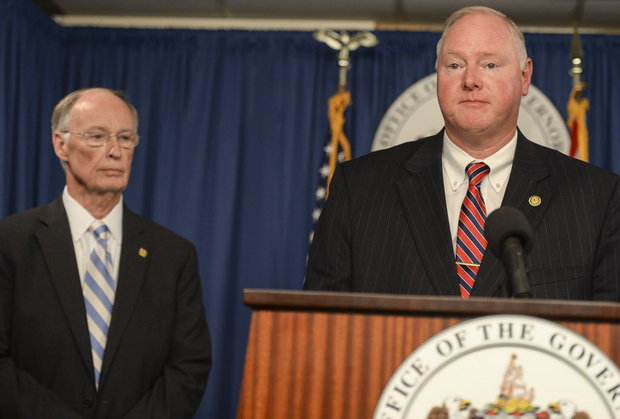
The Strange Story Of How Alabama Corruption Threatens To Infect The U.S. Senate

That's Senator Starnge on the right, and Governor Dormammu on the left...

That’s Senator Strange on the right, and Governor Dormammu on the left…

Personally, I love the idea of Congress having a “Senator Strange.” The movie almost writes itself, with a Senator who has magic powers and who says things like “By the Hoary Hordes of Hogarth! Point of order!”

But not like this.

Now bear with me. This is a complicated story and will take a while, but as Keven Costner says to James Earl Jones (as Terrance Mann) in “Field of Dreams,” “It’s a good story.”

And a really, really strange one, in more ways than one..

When the Senate confirmed Jeff Sessions as U.S. Attorney General in hearings that may be best remembered as the time Elizabeth Warren earned the fawning admiration of feminists by behaving like a mean-spirited jerk, it meant that Alabama’s Republican governor got to appoint his successor. There wasn’t much discussion in the news media about who this might be, because it’s hard for journalists to inform the public properly when it is concentrating on bringing down the President, per the orders of their Eldritch Progressive Masters—sorry, I’ve got Dr. Strange stuff rattling around in my brain now—but there was some interesting speculation in Alabama.

You see,  Republican Governor Robert Bentley is fighting to avoid  impeachment as the result of a sex scandal, and one that called his honesty into question as well.

An official fired by Bentley alleged that the Governor had engaged in an extramarital affair with his senior political adviser, Rebekah Caldwell Mason. An audio recording surfaced in which Bentley told a woman named “Rebekah” that he “worr[ied] about loving you so much” and that “[w]hen I stand behind you, and I put my arms around you, and I put my hands on your breasts […] and just pull you real close. I love that, too.” At a press conference, Bentley apologized for the comments but denied having an affair and stated that his relationship with Mason was purely platonic.

Sure. Continue reading

More Ethics Movies For The Holidays: “Woman In Gold”

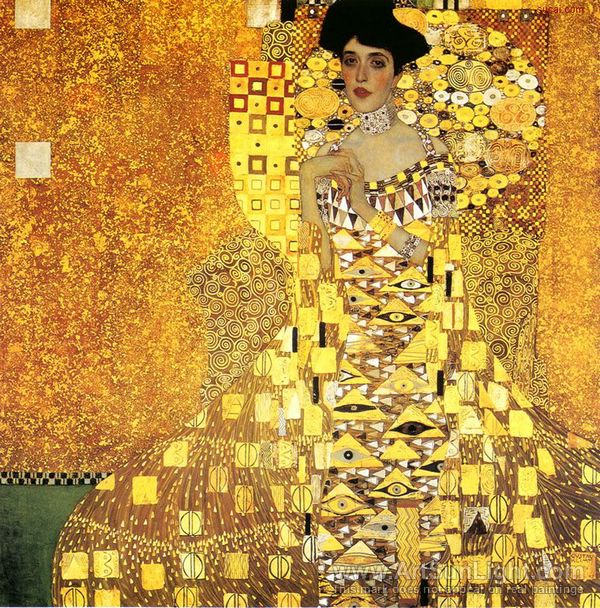
portrait-of-adele-bloch-bauer-i-by-gustav-klimt

The movie critics site “Rotten Tomatoes”calls “Woman in Gold” dull, which tells you pretty much all you need to know about “Rotten Tomatoes.” No, there are no explosions, no sex scenes, no CGI, just a well-acted, powerful story of how justice can take a long time to prevail, but given enough dedication, integrity and luck, it still does prevail with sufficient frequency to stave off despair.

“Woman in Gold” is a 2015 film starring Ryan Reynolds and Helen Mirren. It is a virtual docudrama telling the true story (mostly accurately) of Maria Altmann (Mirren), a plucky Jewish refugee in Los Angeles, who, assisted by her young lawyer, Randy Schoenberg, battled the government of Austria  to obtain the return of Gustav Klimt’s renowned portrait of her aunt, Adele Bloch-Bauer. That painting, along with more by Klimt and  other painters as well, were among the art treasures stolen by the Nazis  prior to World War II. The legal battle ended up before the Supreme Court of the United States, and the conflict was finally settled by a shocking decision by an Austrian panel of mediators. You can read about the real case here.

It may be dull to dull minds, as Red Smith famously said about baseball, but I have seen the film twice now, and it moved me to tears both times. “Woman in Gold” shows once more, as I fervently believe, that right can and often does triumph over bureaucracies, greed, power and stupidity, and that lawyers, maligned as they are, are often essential to that process. Schoenberg shows us the epitome of a zealous and courageous lawyer, making personal and professional sacrifices for a cause he comes to believe is important both to his client and to humanity. Continue reading

Nobody Cares, But NBC Has Been Wildly Unethical In The Trump-Bush Video Affair

nbc-peacock-ap

NBC deserves to be condemned for its conduct in many ways in reference to the Trump Pussy Tape episode, going back eleven years.

1. NBC technicians allowed Trump to continue talking without his realizing that his microphone was on. Unethical, and unprofessional, as well as a pure Golden Rule violation. Basic decency, fairness and professionalism requires that when a guest is doing this, his mistake must be  made known to him at the earliest possible time. This is the rule when someone continues to speak on a conference call believing the call has ended. It is the ethical thing to do  when you are in a bathroom stall and your opponents in a law suit start discussing strategy while they are washing their hands. I have several times, at taped seminars, begun to answer questions during a break and realized that I was still being recorded. Sometimes a technician has reminded me. Worse (but funnier) I have done a full “Naked Gun”, using the Men’s Room while wearing a live mic…and the technician dashed in to get me to turn it off, just in time. (Well, almost.) Allowing a guest to embarrass himself on tape as Trump did is despicable and unprofessional in every way.

2. NBC betrayed its own employee, Billy Bush, by not alerting him, either.  Disloyal, unfair, and uncaring.

3. Once the recording was made, it should have been destroyed as soon as anyone in authority realized the participants were speaking without knowing the mics were on.

4. Attorney Robert Barnes makes a compelling argument that NBC’s conduct violated California Penal Code 632, which criminalizes the act of any person who “without the consent of all parties” records their conversations. Of course, violating the law is also unethical. Trump might  have a just lawsuit, though the damage can’t be undone: the pussy’s out of the bag, so to speak.

5. Bush, as an NBC employee, should have been told about the recording and its contents long, long before it was made public. NBC was obligated to inform him as a basic courtesy. Continue reading

A Horror Story From The Law vs. Ethics Files: The Mario Hernandez Saga [UPDATED and BACKDATED!]

Mr. Hernandez? Mr. Unger would like a word with you...

Mr. Hernandez? Mr. Unger would like a word with you…

This is complicated.

Occasionally a trusted source sends me to a link or a news item that turns out to be old, sometimes many years old. I assume it is current (I need to learn to check the dates), write the post, and then find out that what I wrote about took place in 1978. I usually trash the post. There have been a few like this. Now this story came to me from a trusted source, and linked to a current story, or so I thought. The post, on a site called “America Now,” is dated August 25, 2016. But WordPress pointed out, right at the bottom, that I had in fact written about Mario Hernandez’s citizenship problems two years ago. What? For a second I thought there were TWO Marios (Mario brothers?), who had the same problem, but no, they are the same guy.

The story  I was given today, based on this New York Times story from May of 2014, led to the post below. There is an ending to the story, which was explicated by me in the post of two years ago. However my two posts were on two different ethics issues, and today’s though inspired by a stale story, is still ethically useful. Pretend Mario plight isn’t two years old: that doesn’t alter the principles involved, or my analysis. I’ll tell you what happened at the end of the post..

***

Continue reading

Four Supreme Court Decisions: Abortion, Guns, Affirmative Action, Corruption…And Ethics. Part 2: McDonnell v. United States

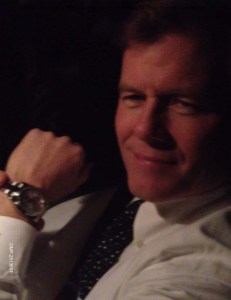
Virginia Governor McDonnell shows off the luxury watch he got as a gift from a businessman he barely knew who expected expected nothing in return...

Virginia Governor McDonnell shows off the luxury watch he got as a gift from a businessman he barely knew who expected expected nothing in return…

Governor Bob McDonnell, Virginia’s Republican governor from 2010 to 2014, was charged with using his office to assist businessman Jonnie R. Williams Sr., who, often with Mrs. McDonnell as a conduit, gave his family wedding receptions, loans, vacations and jewelry worth more than $175,000. I wrote about this scandal here, here, and here. The gifts were legal, thanks to absurdly lenient Virginia ethics laws, just as they were obviously unethical, except perhaps to the clueless McDonnells.

Governor McDonnell arranged meetings for Williams and attended events with him. My favorite part of the criminal trial was when McDonnell claimed that he never dreamed that Williams expected anything in exchange for all of his gifts, and then Williams said that of course he expected some favors in return. The jury found that McDonnell’s actions amounted to corruption and a quid pro quo exchange amounting to bribery. A federal appeals court upheld the conviction.

The Supreme Court’s 8-0 decision this week to vacate the conviction upholds the principle that even if someone has done something obviously bad, there has to be a law against what was done before the act occurred in order to convict him. It’s a rather narrow decision. The Court points out that the law McDonnell was convicted of breaking requires “official acts” to be bought and sold for the law to be breached, but that all McDonnell did was hand out political favors to his “friend”: setting up meetings, communicating his favor, greasing the wheels, essentially. (Much is made of the fact that Williams didn’t benefit very much from any of this, which is just moral luck. It doesn’t make what the governor did any less sleazy.)

Wrote Chief Justice Roberts in his opinion for the unanimous Court: Continue reading

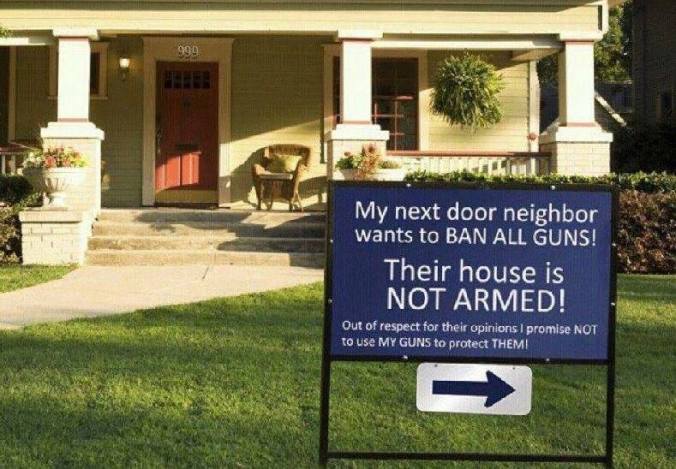
From The Law vs. Ethics Files: The ‘Be My Guest, Rob My Anti-2nd Amendment Neighbor’ Sign

Gun Lawn Sign

I can’t seem to find out for certain if anyone has been so vile and foolish as to actually put up the sign shown above. (That photo is obviously fake.) Even if there are genuine photos posted somewhere, I doubt that such a sign would ever be left up for long. I could be wrong.

It’s probably not protected speech, as the sentiment invites violence toward another citizen. It is undoubtedly unethical speech, just like signs that say “My neighbor’s door sticker saying the house has burglar alarms is a bluff” or “The lady next door is beautiful and incapacitated” or “The little girl next door is excessively trusting.”

Yet the sign shown above is sold on line. Selling a sign with a dangerous, hateful and irresponsible message is legal. This one is also completely unethical. I know: it’s a joke.  I don’t care. To sell a sign that you know might cause harm if anyone used it as a sign is still indefensible, especially since we know how many Americans voted for Donald Trump.

In other words, there are a frightening number of hateful, reckless fools out there.

The company selling these abominations is called Zazzle.

Treat the company appropriately.