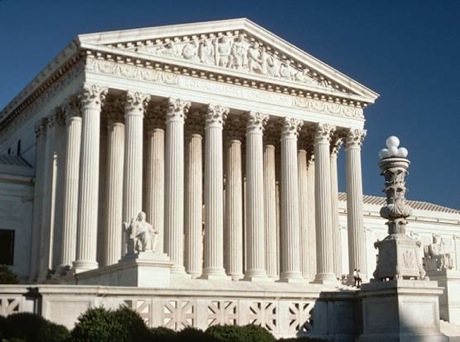
SCOTUS Punts An Important Legal Ethics Controversy

In the Supreme Court case In Re Grand Jury, the government had been trying to obtain  documents from an unnamed law firm specializing in international tax law. The documents were needed to investigate the law firm’s client. A judge held the law firm in contempt for failing to turn over disputed documents, and the 9th U.S. Circuit Court of Appeals at San Francisco affirmed in 2021. The issue was what test courts should apply when considering whether to protect “dual-purpose” documents that contain both legal and nonlegal advice.  The 9th Circuit ruled that courts should look to the “primary purpose” of a communication when it involves both legal and nonlegal analysis. Documents may be privileged when the primary purpose is to provide a client with legal advice. The firm argued that the entire document, along with any non-legal advice and material in it, should be considered privileged if legal advice was one of the “significant purposes” of the communication.

The legal ethics traditions argue for the more expansive standard. ABA Model Rule of Professional Conduct 2.1, “Advisor,states in part,

“In rendering advice, a lawyer may refer not only to law but to other considerations such as moral, economic, social and political factors, that may be relevant to the client’s situation….Advice couched in narrow legal terms may be of little value to a client, especially where practical considerations, such as cost or effects on other people, are predominant. Purely technical legal advice, therefore, can sometimes be inadequate. It is proper for a lawyer to refer to relevant moral and ethical considerations in giving advice. Although a lawyer is not a moral advisor as such, moral and ethical considerations impinge upon most legal questions and may decisively influence how the law will be applied.”

I agree with this approach. Requiring a client or an attorney to parse a letter or oral discussion to separate the legal, privileged content from the rest would chill effective lawyer client communication. Continue reading

Clearing Up A Matter Of Widespread Confusion: How Lawyers Acquire Accidental Clients

When I pointed out this morning that by Sean Hannity’s own description of his relationship to Trump fixer Michael Cohen, he was Cohen’s client, several commenters protested, including a lawyer or two. This suggests that many more were similarly confused, and it is no surprise. A disturbing number of lawyers fall into the trap of acquiring “accidental clients.” There are many ways this can happen, but the most insidious of them is this, which people like me constantly and repeatedly warn lawyers about, often to no avail.

A relative or a friend approaches you, a lawyer, at a party. He or she asks you a question about some legal issue, and you give an off-the-cuff answer. Because you are a lawyer, and because you gave advice, however vague, that individual accepts it as a free legal opinion, and also assumes that the conversation was confidential. Usually nothing happens. Sometimes, however, the friend or relation acts based on your advice. If the results turn out badly, he or she may sue for malpractice, and sometimes will win damages. In an infamous case that is still good law, an individual went to a medical malpractice specialist to engage him to sue a hospital. After describing the facts, the potential client was told, “You have no case,” and informed that the lawyer would not accept the representation. But the individual relied on that statement, and didn’t bring a suit until the statute of limitations had run. Then he learned, from another lawyer, that he did have a valid case, though one he could no longer pursue. The first lawyer was sued for malpractice, and the court found that indeed “You have no case” constituted legal advice, and the advice was relied upon, meaning that an attorney-client relationship had been formed. Continue reading

Lawyer Snaps, Criticizes Own Client On Twitter, Daily Kos

Mark S. Zaid is a distinguished lawyer currently active in bolstering anti-President Trump efforts. He actively trolls on Twitter for clients looking to bring laws suits against the administration, and his clients include prominent “resistance” conspiracy theorist and blogger Louise Mensch, whose name I was blissfully unaware of until last week, and now she is turning up in my e-mail, in my story feeds, everywhere.

A couple of days ago, Mensch launched a new Trump rumor, using “anonymous sources” (which makes her just like the New York Times and Washington Post!) that the Daily Kos picked up. You can read it here: good luck. It is so muddled in its “facts” and suppositions that it makes other fake news look good. Naturally, the Daily Kos took the “breaking” scoop at face value, although it was so legally absurd it made my teeth hurt. The Palmer Report, the same wacko site that drove Larry Tribe around the bend, also was in the mix.

My favorite item in the “story” was that a court had handed down an indictment against President Trump, not for criminal purposes but to support his impeachment. When I read stuff like this, I stop reading further. Grand juries don’t work like that. Courts don’t work like that. Indictments don’t work like that. Impeachment doesn’t work  like that. Nothing works like that, except to a mind where complete hatred and fear of Donald Trump and the joy of having so many mutually infected embarrassing themselves in high places has caused the brain to morph, hopefully only temporarily, into a gerbil wheel.

Zaid, who obviously has a high tolerance for this blather being a 24-7 Trump basher himself, apparently couldn’t take it any more, and wrote to his client Louise on Twitter and in the comments to The Daily Kos story,

Respectfully to my client, there is no info available to support this. We need more than just these anonymous source(s).

This is like putting client advice on a billboard. This is like leaving client advice on an answering machine (yes, I’ve encountered that!). This is like putting client advice on your Facebook wall, and it is exactly like posting  client advice on a public website, because that’s essentially what Zaid did. Continue reading

Ethics Dunce (Advice Columnist Division): “Dear Prudence”

Hmmm...refreshing! And strangely tangy!

Hmmm…refreshing! And strangely tangy!

Here is my guess: nearly 100% of all people with two ethics alarms to rub together would be able to answer this question correctly, responsibly, and within about 1o seconds of thought. The question, in essence:

‘I worked as a nanny for a couple I didn’t like, so to make myself feel better, I secretly poisoned them. Now I work elsewhere, and I hear that they are both ill and doctors are stumped. I feel kinda bad about it. What should I do?’

The obvious answer: “For God’s sake, you idiot, tell them what you did, so the doctors can treat them! Why are you wasting time talking to me? They could die, and you would be responsible!”

But this answer isn’t the one given by Emily Yoffe, Slate’s serially incompetent and unethical advice columnist. She responded, in a live online chat that uncovered this vile supplicant, who confessed to routinely dipping her employers’ toothbrushes in the toilet and periodically spiking their bedside water with the same fecal solution, by writing this:

“Part of me would love to tell you to rush to confess. However, I will extend you a courtesy that you didn’t give your “inconsiderate” and “rude” employers. That is, while I think this couple should know the source of their illness, confessing could leave you open to potential prosecution. You may deserve it, but you need to consider the stakes here.”

That part of Emily, apparently, is the sensible, compassionate, ethical part, and it was over-ruled by the unethical, irresponsible, dumb part. The lawyer, if he or she is more ethical than Emily, a good bet, will tell the Potty Poisoner that she should confess immediately in case an E Coli infestation is what is making the couple ill, particularly because they might die, greatly increasing her risk of serious criminal penalties as well as, you know, ending their lives and leaving their children parentless.  The lawyer will also explain all the possible scenarios resulting from what Emily seems to dread, honesty and accountability. Even lawyers, who are required to place their clients’ best interests first, are not supposed to advise them to cover up their crimes and allow their victims to perish. Advice columnists are definitely not supposed to do this, and are duty bound to give wise and responsible advice that is in the best interests of all concerned, not just their correspondents, who are likely to be, in general, less than bright, ethically-clueless, and in need of nannies themselves.

“Dear Ethics Alarms: I’m an advice columnist and I told someone who said that she had been poisoning her employers with fecal matter that she didn’t need to ‘fess up, even though they became deathly ill. Now she has written me a follow-up, thanking me for my advice since the couple died, leaving several young children orphaned, and she would have been in big trouble if she had come clean. Now I feel guilty. Should I?”

Yes.

______________________
Pointer: Fark

Source: Slate

White House Mendacity on Libya

The White House says this isn't "hostilities." Right.

I detest it when Presidents and their administration play self-evident language games to assert intellectually dishonest positions, whether it is Bill Clinton’s minions claiming blow-jobs aren’t “sex with that woman,” or Dick Cheney arguing that torturing prisoners by water-boarding technically isn’t torture.  Such deceit and mendacity by the representative of the Chief Executive or the President himself vastly increases public cynicism about our government and diminishes our democracy’s most precious and endangered asset, trust.

The Obama administration, despite its leader’s stirring words in the 2008 campaign, has already shown itself capable of outrageous misrepresentations, as when it reported “jobs saved” by the stimulus package using fictional Congressional districts and counting single jobs as multiple jobs “saved.” So we shouldn’t be surprise, only nauseated, when it tells Congress, as it did this week, that U.S. participation in the Libyan uprising doesn’t fall under War Powers Resolution. Continue reading