Sometimes It All Comes Together…But First, A Song!

As those who have read here for a while know, among my fondest passions, virtually life-long, are baseball,  theater and ethics. Today, I have the pleasure of seeing them all come together in a single event. How often does that happen?

At noon, I will be giving my most recent musical Continuing Legal Education ethics seminar, “Ethics Cabaret,” at Nationals Park in D.C. prior to the Mets-Nats game. “Ethics Cabaret,” like its six predecessors, presents legal ethics hypotheticals  as parodies of pop, rock, Broadway or country-western standards, presented by a professional performer. In this case, the performer is American Century Theater veteran Esther Covington, who accompanies herself on the keyboard. I write the songs that make the young lawyers cry, but she sings them, beautifully and often hilariously.

Speaking of Barry Manilow, my favorite segment of the seminar is the parody of one of his signature songs, which you can hear above—it’s an ear-worm, so be careful. The legal ethics version is about “Bridge of Spies” and the many quandaries raised in the film, which I examined in this post earlier this year. The parody is called “Who is the Client?,” lyrics-only copyrighted by ProEthics. Here they are….you can sing them along with Barry’s version! Continue reading →

Ethics Quiz: Ammon Bundy’s Cowboy Boots

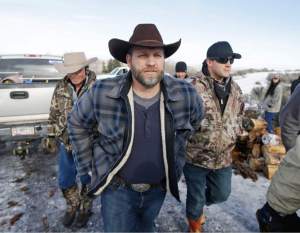
Ammon Bundy. Nice look...that last name is a problem, though.

Ammon Bundy. Nice look…the jury should like it. That last name might be a problem, though.

Jury selection is was about to begin last week  in the trial of Ammon Bundy (Son of Cliven, no relation to Ted) and his fellow defendants who led an armed stand-off on federal lands in Oregon.  First, however, the judge in the case had to rule on Bundy’s lawyer’s motion demanding that the defendants, who are in custody, can wear neckties, belts and boots at trial as requested.

The U.S. Marshal’s Service  emailed  Bundy and the rest to alert them that certain  items of apparel wouldn’t be permitted at their trial: “Ties, Bows, Belts, Handkerchiefs, Cuff Links, Steel toe boots/shoes, Shoe laces, Shirt tie down straps, Safety pins, Shirt pocket pen protectors.” When U.S. District Judge Anna J. Brown Tuesday afternoon asked Barbara Alfono, the deputy U.S marshal in charge of the Bundy trial, about the requirement, she explained that security concerns were the source of the order. Those accessories could be used as weapons against deputy marshals or the defendants themselves, she said. As for the boots, they would interfere with the shackles that are placed around the defendants ankles as they are transported to and from the courthouse. (The shackles will be removed, because prior courts have ruled that they are prejudicial, making defendants look dangerous to the jury.)

J. Morgan Philpot,  Ammon Bundy’s marvelously named lawyer, argued that since his client is innocent until proven guilty, he should be allowed to wear the civilian clothes that he chooses.  “These men are cowboys,” Philpot wrote  in his motion, “and given that the jury will be assessing their authenticity and credibility, they should be able to present themselves to the jury in that manner.” He continued:

“We must consider, when he does so, how will he look? And what are the spot assumptions and impressions will the jury have about him when they see him in the kind of white socks and loafers he was wearing today, with his beltless trousers, and dressed in a formal suit without a tie,Just as significantly, how will the lack of belt, tie, or other apparel compare to others in the courtroom, as he and the other detained defendants are the only ones who will appear that way.”

The judge ruled against him.

Your Ethics Alarms Ethics Quiz of the Day:

Is it ethical for the system to prevent accused cowboys from looking like cowboys during their trial?

Continue reading →

Jacoby Ellsbury, Catcher’s Interference, And The Perplexing Ethics Problem Of “Using A Shield As A Sword”

interference

I led two legal ethics seminars for the Oregon State Bar yesterday. For some reason the issue of “using a shield as a sword ” kept coming up.

“Using a shield as a sword” is when lawyers game the ethics rules. Many local bar associations include a pledge within their creeds promising not to intentionally use the ethics rules as a tactical weapon; still, it’s not an enforceable promise. Examples are limited only by a lawyer’s devious ingenuity, but they usual involve one side creating a conflict of interest for the opposing firm or lawyer that will force the lawyer to withdraw from the case. One ploy: a lawyer recruits a key expert witness specifically because she was once a client of the the lawyer on the other side, making it impossible for her to be impeached on the witness stand by that lawyer because he would have confidential information about her that he would be bound to keep secret, even while being required to represent his current client by ripping her credibility to shreds.

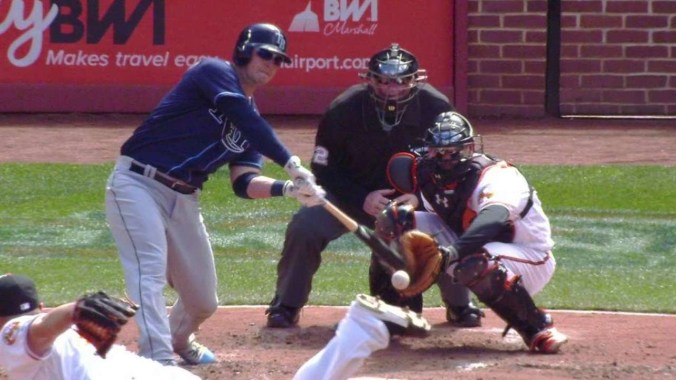
What does this have to do with Yankee centerfielder Jacoby Ellsbury? Well, Ellsbury is in the process of shattering an obscure baseball record: number of times reached base on catcher’s interference during a season. Catcher’s interference refers to instances in which a catcher makes any contact with a batter or his bat during a pitch. Usually, this involves the batter’s bat hitting the catcher’s glove, as in the photo above. When that happens, a player is awarded first base. The rule is based on fairness and  designed to protect the batter, but apparently Ellsbury has perfected the weird practice of using it as an offensive weapon.

Jacoby Ellsbury became the single-season record holder in catcher’s interference calls  in July with his ninth instance  getting rewarded for it. The record was formerly held by Roberto Kelly, who did this eight times in 1992.  Since breaking the record, Ellsbury has gotten catcher’s interference called three more times, for a current total of 11 with almost a month  left to the season. He is also second all-time in catcher’s interference with 23. The career record belongs to Pete Rose with 29; since Rose is baseball’s all-time leader in games played and career at bats, we would expect him to hold this record. No one else in baseball history has more than 18. Ellsbury is only five catcher’s interferences shy of Rose’s mark, and has done it in less than a third of the at bats. Continue reading →

The Word For The Notes On Hillary Clinton’s FBI Interview—And Everything Related To It—Is “Pathetic”

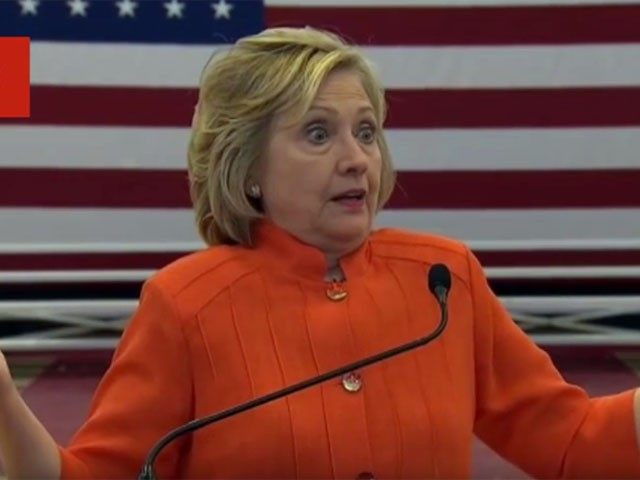
Hillaryshrug

Pathetic, adj.: arousing pity, especially through vulnerability or sadness.
Synonyms: pitiful, pitiable, piteous, moving, touching, poignant, plaintive, distressing, upsetting, heartbreaking, heart-rending, harrowing, wretched, forlorn

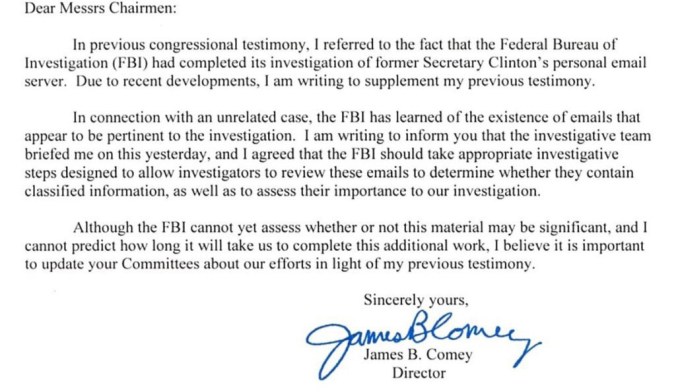
This is the word that constantly came to mind and heart as I explored the FBI’s notes (you can too, here) regarding Hillary Clinton’s decisive—at least in terms of saving her from prosecution—interview with the FBI. Everything about them arouses pity–for her, for us, for the nation. Let us count the ways.

1. Over at MSNBC, “Meet the Press” host Chuck Todd, a fully committed operative of the Democratic Party, like most of his colleagues, and like them committed through his partisan bias to saving America from Donald Trump, was overcome with an attack of objectivity.  “It bothers me as an American citizen,” he said,  that the FBI didn’t record Hillary’s interview, and left Americans to ponder merely notes taken by one agent as the public tries to assess who it may be electing President in November. “Are you kidding me?!” Todd cried. “We’re releasing notes?!”

We’re releasing notes. It’s pitiable to see one of many prominent journalists who have tried so, so hard for eight years to paper over, minimize and otherwise shrug off the constant, near complete incompetence of the Obama Administration and every agency under it to be suddenly stung by the realization that this has consequences—for trust, for truth, for belief that the government isn’t actively engaged in suppressing it. Pathetic.

2. Some of you will recall that I was collecting the various partisan reactions to  FBI director James Comey’s statement announcing that the FBI would not be recommending Clinton’s indictment to ultimately gauge which party’s reaction was more ridiculous, irresponsible, dishonest and foolish. Democrats were claiming that Comey’s report, despite showing that Clinton had lied outright about her use of the private e-mails server, and that her recklessness had endangered U.S. intelligence, exonerated Hillary. Republicans were claiming that Comey’s statement and the decision not to prosecute was indefensible. I was waiting to learn what Hillary had said in her interview, as I assumed that it would have to be released before the election. To reveal a closely guarded Ethics Alarms secret, I was prepared to declare Republicans the “winner” of the competition, as obviously idiotic as it is to say that a report declaring Clinton incompetent and dishonest could possibly “exonerate” her. Reading the notes, however, and considering the fact that the F.B.I. only has these notes to show us, I am back to, as Bobby Fisher would say, square one. Which is pathetic.

3.  Why? Well, we have just learned that  Clinton had her server “wiped”  after the New York Times, on March 3, 2015, broke the story of the server system’s existence. At the same time, she and her surrogates were telling the news media and us, “I want the public to see my email,” even as she directed her henchmen to destroy it. The FBI knew this, yet still found Clinton’s actions just negligent, and not criminal. Five months later–back in those halcyon days when she actually held press conferences— she feigned ignorance when Fox News’s Ed Henry asked, “Did you wipe the server?” saying, “Like with a cloth or something?” Now we know, vie the FBI notes , that she had the server emptied using a sophisticated software program, BleachBit, that is designed to make purged e-mails virtually unrecoverable, and indeed several thousand of hers were successfully destroyed. Clinton got away with this, her supporters don’t think it matters, and the FBI apparently minimized these efforts to obstruct justice. Pathetic.
Continue reading →

No, Washington Post, This Isn’t The Unethical Lawyer’s Statement You Falsely Suggested It Was

rapture

Lyle Jeffs, the polygamist religious leader indicted in a huge food stamp fraud, violated his house arrest this summer by coating his ankle monitor in olive oil, sliding it off, and vanishing. As his lawyer, Jeffs’s  public defender attorney cannot help authorities find her missing client (nor can she assist Jeffs in eluding the police). Thus Kathryn Nester filed court documents last week asking for a continuance, writing,

“As this Court is well aware, Mr. Jeffs is currently not available to inform his counsel whether or not he agrees to the Continuance. Whether his absence is based on absconding, as oft alleged by the Government in their filings, or whether he was taken and secreted against his will, or whether he experienced the miracle of rapture is unknown to counsel.”

Washington Post reporter Cleve R. Wootson Jr. describes this development as follows:

“Jeffs’s attorney has put forth a divine reason for his disappearance — the miracle of rapture..”

If  Nester really did claim that the Rapture was the reason Jeffs vanished, she would be engaging in sanctionable dishonesty and a misrepresentation to the court. The one who is lying, however, is Wootson and, as his editors let him do it, the Post. All Nester said was that she did not know why Jeffs was missing, and mentioned three of many alternative fates that she had no knowledge of whatsoever. Her job is to try to defend him from additional criminal charges, and at this point, that means arguing that nobody can say with certainly that he is a fugitive from justice. That is the opposite of saying “one of these things happened.” It is saying “I don’t know what is behind his disappearance, and neither does the FBI. Here are three of many explanation that I cannot, based on my knowledge, rule out.” Continue reading →

Monday Ethics Revelations…

Taking stock of ethics from a long and eventful Monday…

1. As of yesterday, Ethics Alarms is about to complete its most successful month ever in terms of traffic and new followers, beating last August by almost 2000 visitors a day. Thanks to everyone who participated. Thanks especially to the untrustworthy folks at Snopes, whose partisan manipulations and the Ethics Alarms exposure of them fueled the single most read Ethics Alarms post in any month, unseating the previous champion, this, which was a trivial post that the Instapundit, Glenn Reynolds, deemed the only Ethics Alarms story worth linking to.

2. Yesterday, I was a guest at a large and combative gathering of personal injury lawyers to work out a dispute involving lots of money, and when the time came for me to speak, I was hooted down and had it made quite clear to me that the majority of participants had no interest in legal ethics whatsoever.

3. They  made it clear that they didn’t know much about ethics either. For example, at one point a lawyer threatened to sue another lawyer for representations made on behalf of a client that the first lawyer felt impugned his character. Lawyers are immune from such suits. To the extent that the lawyer was trying to use a bogus threat to intimidate the other lawyer into representing his client with less zeal, that tactic is unethical, but still not forbidden by the legal ethics rules….because lawyers use the threat to sue all the time.

Just like Donald Trump. Continue reading →

About That Obviously Dishonest Disclaimer On Movies And TV Shows

“The story, all names, characters, and incidents portrayed in this production are fictitious. No identification with actual persons, places, buildings, and products is intended or should be inferred.”

The character of Jake LaMotta is fictional, and any similarity to Jake LaMotta is purely coincidental...

The character of Jake LaMotta is fictional, and any similarity to Jake LaMotta is purely coincidental…

This and disclaimers like it on movies and TV shows have driven me crazy for a long time. So often the text is an obvious lie. I first began obsessing about it during the early days of “Law and Order,” when Dick Wolf’s show would herald the fact that its episodes were “ripped from the headlines,” then end with a disclaimer that said it was completely fiction. Sometimes, an episode was obviously based on a specific crime and specific individuals, and the actors were made up to look like the actual criminals. The disclaimer was and is a lie, and since it was obvious, why did they bother? Legally, it does no good to publish a boilerplate disclaimer that says, “We’re not really doing what any fool can see we are doing, ” except to discourage potential lawsuits by stupid people. I am of the (minority, unfortunately) position that it’s unethical for lawyers to author legally meaningless language like this for the sole purpose of misleading the ignorant.

The background of the disclaimer is interesting; Slate just published the story, which I realized I once knew but had forgotten.

The 1932 MGM film “Rasputin and the Empress”, was based on the events leading up to the fall of the Romanovs, and starred John, Ethel and Lionel Barrymore. Its most famous sequence was a version of the antic assassination of Rasputin, an event largely known because of the book written by one of the assassins, Prince Felix Yusupov, portrayed as “Prince Paul Chegodieff” in the film. The film also suggested that the Prince’s wife, “Princess Natasha,” was raped by Rasputin—suggested but not shown, since Rasputin was played by John Barrymore (Drew’s grandfather) and the princess was played by his sister, Ethel.  Princess Natasha was the avatar for Princess Irina Alexandrovna of Russia, who, like her husband Prince Felix, had escaped Russia before all the royals were killed.

Yusupov, living in Paris, heard about the film and decided that since audiences would recognize him as  the fictional killer of Rasputin, they would also assume that his wife was raped by Rasputin. She wasn’t, or if she was, only she and the Mad Monk knew about it. Officially, Irina and Rasputin had never met. An MGM researcher had pointed out this factual discrepancy to the studio during production and warned that the Yusupovs could sue, but was pooh-poohed off the lot. She was correct, however, for Irina Yusupov sued the studio, and after watching the movie twice, the British jury awarded her £25,000, or about $125,000. MGM took the film out of circulation for decades, and when it turned up on Turner Classic Movies, the pseudo-rape scene was gone. Continue reading →

From The Ethics Alarms Mail Bag: “Does It Matter If A Lawyer Is A Neo-Nazi?”

"Anyone who would hire this lawyer is evil! EVIL!!!"

“Anyone who would hire this lawyer is evil! EVIL!!!”

“…What if he’s hired for a government job?”

This is a great question, and I’m going to bedevil the lawyers in my upcoming ethics seminars with it. It’s not a hard question, though.

The answer is, “No, it doesn’t matter, just as it doesn’t matter if the lawyer is a Republican, a vegan, a libertarian, a creationist, a global warming denier, an Adam Sandler fan, a Donald Trump loyalist, a Muslim, an ISIS sympathizer, a Druid, a Celine Dion worshiper, a New York Yankee fan or anything else. Lawyers have First Amendment rights. Lawyers can think what they want to, believe what they want to, donate where they want to and spout whatever unpopular or offensive opinions they want to, as long as it doesn’t interfere with their representation of their clients.

What prompted the question was this post on the Southern Poverty Law Center (SPLC) website, which attempts to use guilt by association and classic McCarthyism tactics to smear the City of Baltimore because of what the lawyer defending it in a law suit believes. The SPLC—which itself often resembles a hate group–writes, Continue reading →

Was It Ethical For Donald Trump’s Former Lawyer To Trash Him In The Huffington Post?

Backstabbed

That’s an easy question.

The answer is maybe, and no.

A couple of weeks ago, a real estate lawyer named Thomas M. Wells provoked a lively debate in the legal ethics community when he authored a Huffington Post piece titled “Donald Trump Hired Me As An Attorney. Please Don’t Support Him For President.” I’m proud to say that I flagged the issue for my colleagues first, in part because they unanimously detest Trump, even the tiny minority who aren’t full-blooded Democrats or progressives, and may have been blinded by that bias.

For me, the issue was crystallized by the headline. Wells’ headline (it doesn’t matter if it was really his or the site’s: as a lawyer, he is obligated to make sure that his article doesn’t breach legal ethics rules and principles, and the headline is part of his article) suggested that he had some special knowledge and authority regarding Trump because of what he had learned while representing him decades ago. The ethics rules prohibit lawyers from revealing client confidences, which are usually defined as what a lawyer learns about a client during the course of a representation that the client would not obviously want revealed to the world. Confidences can be revealed by actions, as well as words, and the headline comes very, very close to saying “I know things you don’t about Donald Trump because of what learned when I was his trusted lawyer.” What follows from that may be  a reader’s conclusion that the post reflects secret information. Thus the headline made my legal ethics alarms sound.

Wells has the same right as you or I to register a public opinion about his former (or current, for that matter ) client, as long as the opinion doesn’t interfere with his representation. Lawyers do not give up free speech right by being lawyers. That’s where the “maybe” comes from. There is strong disagreement in the profession about whether the answer to “Is this unethical?” should be an outright yes. The status of loyalty among the legal ethics values hierarchy is as hotly contested now as it ever has been. If a lawyer wants to attack a former client in a matter unrelated to the representation and no confidences are revealed in the process, is that a legal ethics breach? If it is, it would be a very tough one to prosecute. I think it’s a general ethics breach, as in wrong and unprofessional. It is disloyal, and clients should be able to trust their lawyers not to come back years later, after a client let the lawyer see all of his or her warts, and say, “This guy’s an asshole.” It undermines the strength of the public’s trust in the profession. Continue reading →

Now THIS Was Zealous Representation! The Incredible, Unethical, Zealous, Crooked And Courageous Bill Fallon

Fallon

I’m giving an ethics seminar for a group of government lawyers this morning. I think I’ll tell them about Bill Fallon.

Bill Fallon (1886-1927) was a very successful New York criminal defense attorney, and a contemporary of Clarence Darrow. He was called “The Great Mouthpiece,” because he represented some of New York’s leading pimps, narcotics dealers, embezzlers, swindlers and gamblers.  One famous client was Arnold Roth, who was the architect of the 1919 Black Sox scandal, bribing eight Chicago White Sox stars to throw the World Series. Another was Nicky Arnstein, the gambler husband of Fanny Brice. That was Omar Shariff playing Nicky in “Funny Girl.”

Fallon often bribed his juries, and got away with it: the one time he was caught and indicted, a jury found him non guilty. He probably bribed that jury, too. Clarence Darrow was proud of the fact that he represented over a hundred men and women facing the death penalty and none were ever executed. Fallon could top that: he represented over 120 homicide defendants, all of them guilty as hell, and not one was convicted.

Dashiell Hammett referred to Fallon in his novel, “Red Harvest,”, when he wrote,

He’s the guy that the joke was wrote about: ‘Is he a criminal lawyer?’ “Yes, very.'”

Continue reading →