President Trump’s Massive, Unfixable, Unwaivable Conflict Of Interest…And Why Weren’t We Worrying About This BEFORE The Election?

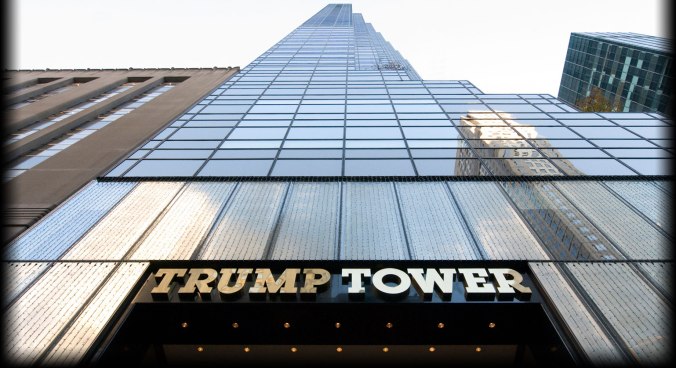
trump-tower

Donald Trump, as President of the United States, will have an unprecedented conflict of interest—many, actually—that realistically cannot be fixed and never could. He will be President, and he will own a global set of businesses worth billions of dollars that his policies and decisions will unavoidably affect for better or worse, usually to his long term benefit or disadvantage.

Almost nobody, including me, and it’s my business to do so, focused substantially on the problem during the campaign. Trump, as  usually, airily dismissed the issue when it came up as if it was nothing, saying, “If I become president, I couldn’t care less about my company. It’s peanuts,” during one debate. “Run the company, kids. Have a good time.” Typical, stupid, and neither Clinton nor the moderator had the wit or information to follow up with the required, “Wait a minute, that doesn’t deal with the problem. Will you also not care about your kids, Mr. Trump? Your companies’ stockholders? Business partners? Employees?”

At least we know why Hillary was reluctant to pursue this issue, don’t we?

The Trump Organization’s executive vice president, Alan Garten, similarly brushed the problem away, saying in September, “His focus is going to be solely on improving the country. The business is not going to be a factor or an interest at that point.” That’s an incredible statement, naive at best, dishonest at worse. Of course it will be an interest. How could it not be? The question is whether it will be a factor. Human nature, and Trump’s nature, strongly suggest that it will be.

Who can tell with Trump? Maybe he really believes there’s no problem. After all, as I have written repeatedly and all evidence proves, the man doesn’t know ethics from ambergris. Whether he knows it or not, however, this is a massive  and potentially crippling problem for him and his administration, not to mention his children and his businesses. It is especially a problem because the same journalists who dismissed Hillary’s family foundation’s influence peddling while she was Secretary of State and after as another overblown conservative attack (after all, why should venality and hidden conflicts of interest interfere with electing the First Woman President?) have the long knives out to eviscerate Trump on any hint of impropriety, real or not, they can find.  This is real. Continue reading →

From The “Why People Hate Lawyers” File: The Lawyer Who Bit Off More Than He Could Chew

"Bit--off--too-much--chicken--no---plastic---knife---ARRRGH!"

“Bit–off–too–much–chicken–no—plastic—knife—ARRRGH!“

Paul Newton Jr., a lawyer in Gulfport, Mississippi, sued Popeye’s after he required emergency surgery to remove a chunk of fried chicken from his throat last November. He claims the fast-food restaurant was negligent and caused his near fatal accident because it didn’t include a plastic knife along with the “spork” in his drive-through order.

Newton says he consumed  the meal (two chicken breasts, an order of red beans and rice, a biscuit and a soft drink…YUM!) in his office, and had to “hold a chicken breast in his hands and to tear off pieces thereof with his teeth.”In the  lawsuit , the lawyer maintains Popeyes had a duty to provide the appropriate utensils so customers will be able “to cut their purchased food orders into appropriate portions.”

Newton abandoned his chicken suit–well, not his chicken suit, but his chicken lawsuit— the Huffington Post reported, after receiving “extreme comments directed to me and my family.”

Like “Learn to eat!”, maybe? Continue reading →

‘It Profits A Law Firm Nothing To Give Its Soul For The Whole World … But For Hillary, Thornton?’

Once again, a memorable line from the best ethics film of them all, “A Man For All Seasons,” came rushing back to me as I observed another example of professionals abandoning their ethical principles to assist the most demonstrably corrupt Presidential candidate in U.S. history, Hillary Clinton.

Not just her, however, to be fair. The Thornton Law Firm in Boston has used an illegal and unethical maneuver to circumvent election laws and give millions of dollars to the Democratic Party and Sen. Elizabeth Warren, Sen. Harry Reid, President Obama and, of course, Hillary, among others.  The scheme was revealed by the Center for Responsive Politics and the Spotlight investigative team at the Boston Globe.

The firm has just ten partners, but is one of the nation’s biggest political donors. A whistle-blower sent firm documents showing that firm members have been making large donations to Democrats, only to be reimbursed by the firm days or even hours later with bonuses matching the amounts donated exactly.

Federal law limits partnerships–law firms are almost all partnerships—to maximum donations of $2,700 per candidate. This was what is called a “straw donor” plot. “Straw donor reimbursement systems are something both the FEC and the Department of Justice take very seriously, and people have gone to jail for this,” Center for Responsive Politics editorial director Viveca Novak told CBS. Continue reading →

James Comey’s Ethical Conflict

twopaths2

We now know that James Comey’s decision to inform Congress that the Clinton e-mail investigation had been re-opened (If I hear one more Clinton spinner  tells me that no case is ever “closed,” even one that is “completed,” I am going to run naked through the Safeway, screaming dirty limericks in pig latin. Be warned.) was “against Justice Department policy,” specifically the policy of “not acting in such a way as could influence an upcoming election.” Comey understood he was violating these guidelines, sources tell us,but felt he was obligated to do so because he had promised members of Congress he would inform them of any further developments related to Clinton’s email server misuse. Thus he sent a letter to F.B.I. employees after alerting Congress of the (possible) new evidence that necessitated re-opening the investigation. In the letter,  Comey acknowledged that his actions were unprecedented, but explained that…

I feel an obligation to do so given that I testified repeatedly in recent months that our investigation was completed. I also think it would be misleading to the American people were we not to supplement the record. At the same time, however, given that we don’t know the significance of this newly discovered collection of emails, I don’t want to create a misleading impression. In trying to strike that balance, in a brief letter and in the middle of an election season, there is significant risk of being misunderstood, but I wanted you to hear directly from me about it.

According to the Washington Post,  Comey was also concerned that the discovery of the emails would be leaked to the media after he briefed a team of investigators about them, causing the  F.B.I. to be accused of a coverup to benefit Clinton.

Some ethics conclusions:

1. Comey’s actions are consistent with an understanding of the Ethics Incompleteness Principle, which is often discussed on Ethics Alarms:

“The human language is not sufficiently precise to define a rule that will work in every instance. There are always anomalies on the periphery of every normative system, no matter how sound or well articulated. If one responds to an anomaly by trying to amend the rule or system to accommodate it, the integrity of the rule or system is disturbed, and perhaps ruined. Yet if one stubbornly applies the rule or system without amendment to the anomaly anyway, one may reach an absurd conclusion or an unjust result. The Ethics Incompleteness Principle suggests that when a system or rule doesn’t seem to work well when applied to an unexpected or unusual situation, the wise response is to abandon the system or rule—in that one anomalous case only— and use  basic ethics principles and analysis to find the best solution. Then return to the system and rules as they were, without altering them to make the treatment of the anomalous situation “consistent.”

Assuming that the “policy” is a sensible and ethical one to begin with (though it isn’t), this was an anomalous case. The FBI, and Comey personally, were rightly under intense criticism for their handling of the investigation. Among other puzzling decisions, Clinton’s aides were given immunity for no apparent reason; Clinton’s interview was neither videoed nor under oath; and Cheryl Mills, who was directly involved in the private server fiasco, was allowed to serve as Clinton’s lawyer when she was questioned. The policy was designed to protect the Justice Department and its component from suspicions of bias and partisan complicity, and the inept handling of the investigation  had already created those suspicions. When such a policy appears likely to have the opposite effect that it was established for, the rational and ethical approach is to make an exception, which is what Comey did.

2. This was courageous. Continue reading →

Hillary, Her Minions, And Scooby-Doo

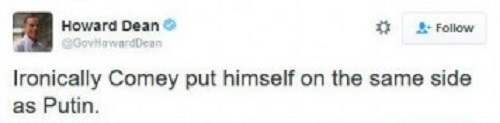
Former DNC chair Howard Dean just reinforced his prominent position among the ten most loathsome figures in modern politics with this tweet regarding James Comey’s revelation that the investigation into Hillary Clinton’s mishandling of her official communications via e-mail was being re-opened:

dean-tweet

Dean’s meaning: since Russian hacks of  various e-mail accounts have provided ugly and often sinister evidence of the corrupt attitudes and practices of Hillary Clinton and her campaign, Comey’s required notification of Congress—required, mind you, by basic ethical principles and the rules of the legal profession—makes him a wrongdoer on par with those fueling Wikileaks. After all, without them, Hillary and her minions—including the outrageously complicit news media—would have succeeded in fooling all of the people all of the time. Yes, Comey, damn him, is now “on the same side” as Putin, because he is stripping away Clinton’s facade of trustworthiness.

Even before yesterday’s surprise announcement, the Democratic defense was in place that because Russia was attempting to influence the US election by revealing the filthy underside of Clinton, Inc., including, among other things…

….the inappropriate melding of Sate Department business, pay-to-play incentives, Clinton foundation fundraising and family enrichment

….discussions among aides on how to cover-up Hillary’s e-mail misadventures

….private speeches to Wall Street contradicting her public, anti-Wall street rhetoric, and most disturbing of all,

….collusion by journalists to assist the campaign

….such enlightening evidence should be ignored. This, those well-versed in the Ethics Alarms Rationalizations list will recognize, is   Rationalization #55, The Scooby Doo Deflection, or “I should have gotten away with it!,” in practice. Continue reading →

Comey’s Letter Ignites A Public Seminar On Spin And Disinformation

comey_letter_0_1477662300

From the New York Times (Note: the officially declared Trump  reviling/Clinton-favoring  Times is still a solid source on the matter of Hillary’s e-mails, because it broke the story about her private server in the first place.):

WASHINGTON — The presidential campaign was rocked on Friday after federal law enforcement officials said that emails pertinent to the closed investigation into Hillary Clinton’s private email server were discovered on a computer belonging to Anthony D. Weiner, the estranged husband of a top Clinton aide.

In a letter to Congress, the F.B.I. director, James B. Comey, said the emails had surfaced in an unrelated case, which law enforcement officials said was an F.B.I. investigation into illicit text messages from Mr. Weiner to a 15-year-old girl in North Carolina. Mr. Weiner, a former Democratic congressman from New York, is married to Huma Abedin, the top aide.

Mr. Comey’s letter said that the F.B.I. would review the emails to determine if they improperly contained classified information, which is tightly controlled by the government. Senior law enforcement officials said that it was unclear if any of the emails were from Mrs. Clinton’s private server. And while Mr. Comey said in his letter that the emails “appear to be pertinent,” the F.B.I. had not yet examined them.

That’s it, as of this morning. Anything else, at this point, is speculation or disinformation. However, this is undeniable: whatever was found on the computer was considered relevant enough to the question of whether Hillary Clinton knowingly violated federal law and endangered US security in her machinations to avoid FOIA scrutiny of her private dealings to mandate re-opening the investigation, which had been, as the Times notes, closed.

It seems fair to assume that this is all we will know until the election, which means that Hillary Clinton will face the verdict of voters while under FBI investigation. That isn’t good for her, but boy, does she (and the Democrats) deserve it. The Clinton way, as we learned from Whitewater and the other controversies during Bill’s administration, is that when one of their seamy deals provokes suspicion, the game plan is to deny, deny, stonewall, confuse, muddle the story, muddy the water, barely cooperate with authorities, count on the “friendly journalists” to assist, run out the clock, and wait for the public to become so frustrated and bored that the cry of “Let’s move on!” is effective. We have seen this time and time again, because it has worked. This time, her lies and delaying tactics backfired, and left the sword dangling over her head for all to see far too long. Now everyone will have to wonder if Clinton will be declared a felon while in the White House. I’d say that’s extremely unlikely, but you never know, especially with this bizarre election script.

What’s going on here?

What’s going on here is that James Comey played it by the book, and by book I mean the District of Columbia Rules of Professional Conduct governing the ethical conduct of all lawyers within its borders, including Comey.

Rule 3.3 in all jurisdictions (except California, but it has an equivalent rule) requires  lawyers to correct any material representations of fact or law that they have presented in a “Tribunal,” which is defined as an “ajudicative body,” usually a court. Congress and congressional committees are not adjudicative bodies for the purposes of 3,3. However, the most obscure and infrequently cited rule in all of legal ethics, Rule 3.9, says this:

Rule 3.9 – Advocate in Non-adjudicative Proceedings

A lawyer representing a client before a legislative or administrative body in a nonadjudicative proceeding shall disclose that the appearance is in a representative capacity and shall conform to the provisions of Rules 3.3, 3.4(a) through (c), and 3.5.

I have met few lawyers in the government or out of it that have ever read this rule. I know for a fact that lawyers who testify before Congress almost never “disclose” that. However, lawyers—ethical ones, anyway—will correct misleading testimony as Rule 3.3, though 3.9, requires. That’s what Comey did.

It is disgraceful that the FBI’s investigation into a matter bearing on the fitness of a Presidential candidate was closed prematurely and that its recommendation to the Justice Department in the matter was based on incomplete evidence, resulting in the current uncertainty. Nonetheless, once new evidence was uncovered that agents felt could change the results of that investigation, the Bureau had no choice. It had to investigate, and Comey had to correct his testimony that the investigation of Clinton’s conduct was over. It’s not.

Now Democrats, partisan agents of the Clinton campaign and corrupted journalists are giving a spectacular public seminar on how they spin, and, if we pay attention, a demonstration of who is interested in truth and whose function in life is to mislead the public. Continue reading →

A Fake Judge Disqualifies Herself From Becoming A Real Judge

This is ridiculous.

Well, sure it's OK to impersonate a judge ON STAGE...

Well, sure it’s OK to impersonate a judge ON STAGE…

The Illinois Attorney Registration and Disciplinary Commission is asking for the immediate suspension of a judicial candidate Rhonda Crawford, who is running  for a judgeship covering parts of Chicago and its suburbs. The request asks the Illinois Supreme Court to block Crawford from becoming a judge if she wins the election, which is likely, since she is running unopposed. The reason she has been deemed unfit to be a judge is that she already pretended to be one, in essence impersonating a judge and ruling on cases in traffic court.

Crawford admitted last month that she wore a judicial robe and sat at the bench as part of a “shadowing process”  under the direction Judge Valarie Turner, who was reprimanded and  reassigned to administrative duties after pulling the stunt. Near the end of the afternoon court call, Judge Turner announced that “we’re going to switch judges” and gave her judicial robe to Crawford. Crawford didn’t correct the misstatement, and began acting as the judge. Judge Turner, who appears to have taken leave of her senses, told the prosecutor earlier in the day that Crawford was a judge, and Crawford did not correct the misstatement. When an officer in the courtroom congratulated Crawford on her judgeship, Crawford did not correct him, either. Judge Turner later told the presiding judge investigating the incident that she thought Crawford really was a judge, which is odd since she was employed as a law clerk and staff attorney, and real judges tend to have their own robes while not requiring second judges to stand behind them. Continue reading →

Now THIS Is “Conduct Prejudicial To The Administration of Justice”!

The late Joe Jamail, role model...

The late Joe Jamail, role model…

Almost all jurisdictions include in their lawyer ethics rule a catch-all provision, Rule 8.4 (d), that says that is is professional misconduct for a member of the bar to

(d) Engage in conduct that is prejudicial to the administration of justice;

Virginia is one state that omits this prohibition as too vague; D.C.’s version says that a lawyer must not engage in conduct that is seriously prejudicial, whatever that means. My position is that such a rule is necessary, since no set of rules can cover every situation, and lawyers, I have found, are especially creative in finding new ways to be unethical.

Texas Super Lawyer Joe Jamail (who died last December) established the proposition that a lawyer could prejudice the administration of justice by his spectacular incivility in this deposition:

The Delaware Supreme Court condemned Jamail’s conduct as “rude, uncivil and vulgar,” saying that it abused the privilege of appearing in a Delaware proceeding,” and showed “an astonishing lack of professionalism and civility.” (The immortal quote from the video is Jamail telling his adversary counsel that he “could gag a maggot off a meatwagon.” The deposition deteriorated into a Trumpian insult-fest, with Jamail calling the other lawyer “Fat boy” and being called “Mr, Hairpiece” in return.) The court went on to call Jamail’s unprofessional behavior “a lesson for the future—a lesson of conduct not to be tolerated or repeated.”

Following the judicial reprimand,  Jamail said,  “I’d rather have a nose on my ass than go to Delaware for any reason.”

But even Joe never did this. Continue reading →

Without Courage, Integrity And Professionalism In The Legal Profession, The Rule Of Law Hasn’t A Prayer: The House of Representatives v. Burwell Saga

" Nice law firm you got here. Too bad if something were to happen to it..."

” Nice law firm you got here. Too bad if something were to happen to it…”

As I explained  here and here in 2015, the process of judicially determining whether the Defense of Marriage Act was constitutional or not was unethically sabotaged by  threats to and improper lobbying of the law firm that had agreed to defend it. The Justice Department and the President had refused to do their sworn duty to uphold the laws of the United States, and same-sex marriage activists pressured the biggest client of the firm that had accepted the case to pass the pressure along. It worked. The firm dropped the case, precipitating a resignation by the partner handling it and this ringing assertion of traditional legal ethics:

“…[D]efending unpopular positions is what lawyers do. The adversary system of justice depends on it, especially in cases where the passions run high. Efforts to delegitimize any representation for one side of a legal controversy are a profound threat to the rule of law.”

This was, we are learning, not an anomaly. On the Volokh Conspiracy, law professor Josh Blackmon relates how the same strategy of applying of unethical political pressure, and the unprofessional capitulation of major law firms to it, nearly made a legitimate challenge to illegal payments to insurers under Obamacare impossible. He explains in part: Continue reading →

Sometimes It All Comes Together…But First, A Song!

As those who have read here for a while know, among my fondest passions, virtually life-long, are baseball,  theater and ethics. Today, I have the pleasure of seeing them all come together in a single event. How often does that happen?

At noon, I will be giving my most recent musical Continuing Legal Education ethics seminar, “Ethics Cabaret,” at Nationals Park in D.C. prior to the Mets-Nats game. “Ethics Cabaret,” like its six predecessors, presents legal ethics hypotheticals  as parodies of pop, rock, Broadway or country-western standards, presented by a professional performer. In this case, the performer is American Century Theater veteran Esther Covington, who accompanies herself on the keyboard. I write the songs that make the young lawyers cry, but she sings them, beautifully and often hilariously.

Speaking of Barry Manilow, my favorite segment of the seminar is the parody of one of his signature songs, which you can hear above—it’s an ear-worm, so be careful. The legal ethics version is about “Bridge of Spies” and the many quandaries raised in the film, which I examined in this post earlier this year. The parody is called “Who is the Client?,” lyrics-only copyrighted by ProEthics. Here they are….you can sing them along with Barry’s version! Continue reading →