Meatball’s Lawyer’s Infuriating Excuse For Her Client’s Role In Philly’s Looting Spree: Yes, It’s Unethical, But Not For The Reason You Might Think

[Unlike the previous post, I remembered to attach the statement I’m writing about in this one. The Bowman update now has the missing information, thanks to Old Bill who reminded me this morning that I’m a moron ]

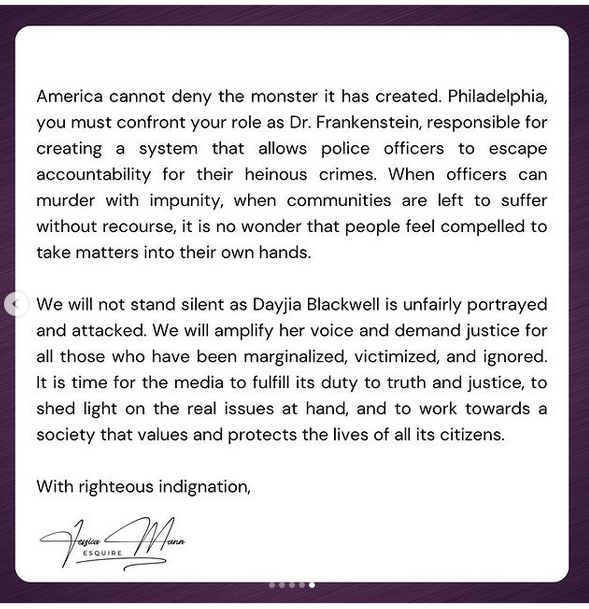
Following close on the metaphorical heels of Rep. Bowman’s ridiculous excuse for setting off a fire alarms to delay a vote in Congress yesterday (‘Oh THAT’S what a fire alarm looks like! Who knew?’) comes the equally ludicrous statement of Jessica Mann, the criminal defense attorney for Dayjia Blackwell who represents the 21-year-old Philadelphia “influencer” known as “Meatball.”

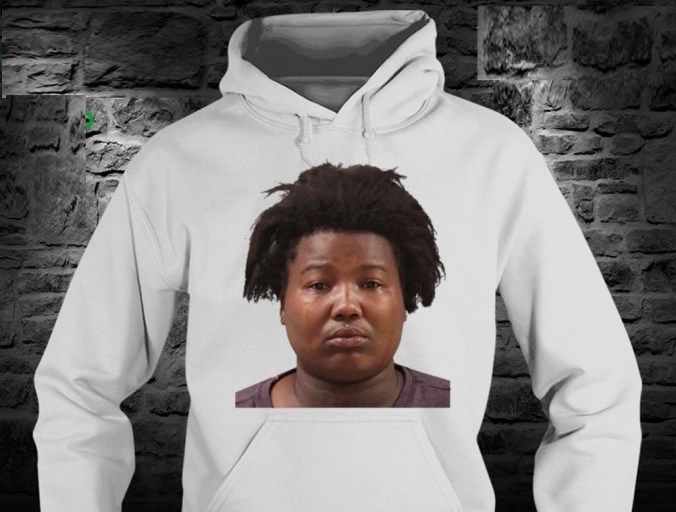
Blackwell was arrested and charged with burglary, conspiracy, criminal trespassing, rioting, criminal mischief, criminal use of communication facility, receipt of stolen property and disorderly conduct. This seems fair, as she not only livestreamed the destructive rioting and looting that took place for two days in Philadelphia last week, but encouraged her fans to participate, and took part in the crime spree herself, announcing what she had stolen in the video feed. Then, after her arrest, she begged her fans to donate money for her bond (she told her 196,000 followers, “All I want to do is go treat myself” and plugged her Cash App handle) then quickly had T-shirts, hoodies and other items made using her mugshot above— and thanks, Donald Trump, for creating this obnoxious new trend. Those are selling briskly. “Remorse” does not seem to be part of her defense—-nor innocence, since she’s on video doing everything she’s charged with.

Despite all this, lawyer Mann posted on Instagram…

Continue reading

An Invitation To Be An Unethical Lawyer…

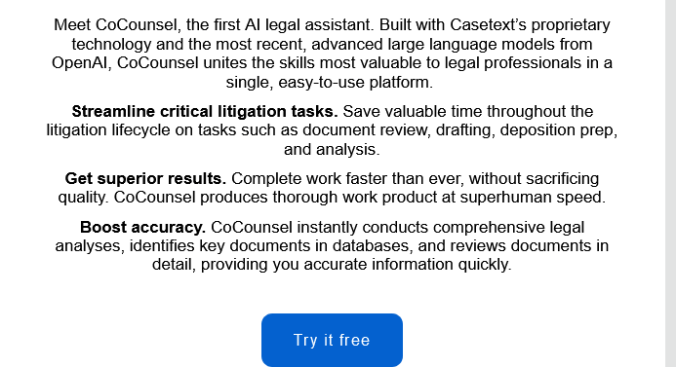
Just as I was preparing yesterday for today’s 3-hour legal ethics CLE seminar (which, coincidentally, contained a section about the unsettled status of lawyers using artificial intelligence for legal research, writing and other tasks in the practice of law), I received this unsolicited promotion in my email:

Let’s see: how many ways does this offer a lawyer the opportunity to violate the ethics rules? Unless a lawyer thoroughly understands how such AI creatures work—and a lawyer relying on them must—it is incompetent to “try” them on any actual cases. Without considerable testing and research, no lawyer could possibly know whether this thing is trustworthy. The lawyer needs to get informed consent from any client whose matters are being touched by “CoCounsel,” and no client is equipped to give such consent. If it were used on an actual case, there are questions of whether the lawyer would be aiding the unauthorized practice of law. How would the bot’s work be billed? How would a lawyer know that client confidences wouldn’t be promptly added to CoCounsel’s data base?

Entrusting an artificial intelligence-imbued assistant introduced this way with the matters of actual clients is like handing over case files to someone who just walked off the street claiming, “I’m a legal whiz!” without evidence of a legal education, a degree, or work experience.

On the plus side, the invitation was a great way to introduce my section today about the legal ethics perils of artificial intelligence technology.

More On The Fake Defendant Ploy

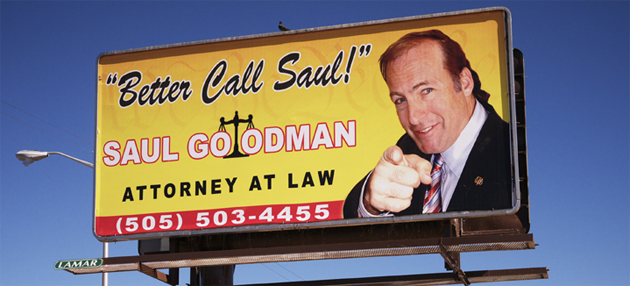
Yesterday’s post about the lawyer facing disciplinary charges for secretly having someone else pretend to be her client in a hearing that would involve an alleged victim of a hit-and run identifying the defendant in court sparked references to Perry Mason and “Better Call Saul’s” central unethical lawyer using the same trick. I’ve also included a discussion of this tactic in my ethics orientation presentation for new bar members for many years. As some commenters pointed out, in court IDs where the alleged perpetrator of a crime is sitting next to the defense attorney at defense counsel’s table are inherently unfair. Courts have pointed this out too. The “fake defendant” ploy has been justified as avoiding that problem.

However, it isn’t nice to fool the judge. If a lawyer suspects that an alleged victim can’t identify his or her client and will point at anyone in the chair next to defense counsel, having someone who might resemble the defendant (or not) sit where the defendant would be expected to sit while the real defendant sits elsewhere in court might be permitted, but the judge has to be told about the plan and asked to approve it in advance. Not doing so almost guarantees a criminal contempt citation for the lawyer, maybe a mistrial, and eventual bar discipline. In addition, the lawyer cannot and must not refer to the fake defendant as his or her client by word or body language other than having the individual sitting at the lawyer’s table. Most jurisdictions have rules limiting who sits at counsel tables; that’s why Perry Mason’s ploy of using Della, his loyal legal secretary, to confuse the witness might have been at least legal in Los Angeles when he tried it.

Continue reading

Ethics Quote Of The Week: Lawyer John Eastman On The Georgia Trump Indictments

“I am here today to surrender to an indictment that should never have been brought.  It represents a crossing of the Rubicon for our country, implicating the fundamental First Amendment right to petition the government for redress of grievances.  As troubling, it targets attorneys for their zealous advocacy on behalf of their clients, something attorneys are ethically bound to provide and which was attempted here by “formally challeng[ing] the results of the election through lawful and appropriate means.”  – An opportunity never afforded them in the Fulton County Superior Court. Each Defendant in this indictment, no less than any other American citizen, is entitled to rely upon the advice of counsel and the benefit of past legal precedent in challenging what former Vice President Pence described as, “serious allegations of voting irregularities and numerous instances of officials setting aside state election law” in the 2020 election.  The attempt to criminalize our rights to such redress with this indictment will have – and is already having – profound consequences for our system of justice. My legal team and I will vigorously contest every count of the indictment in which I am named, and also every count in which others are named, for which my knowledge of the relevant facts, law, and constitutional provisions may prove helpful.  I am confident that, when the law is faithfully applied in this proceeding, all of my co-defendants and I will be fully vindicated.”

John Eastman, respected conservative legal scholar, lawyer, law professor and former Dean of Chapman University Law School, as he surrendered last week to authorities on charges in the Georgia case alleging an illegal plot to overturn the Trump’s 2020 election loss.

Continue reading

Now THESE Are Unethical (California) Lawyers…

Famed California trial attorney Tom Girardi was accused of stealing more than $18 million from clients; I was late to the metaphorical party, not covering the long-running ethics scandal until a month ago. (Sorry.)The State Bar of California had opened 205 disciplinary investigations in 40 years against Girardi, but he ducked accountability until the very end, in part because of pay-offs to bar staff.

One of several new regulations designed to prevent future Girardis is the Client Trust Account Protection Program. That requires the state’s lawyers to report whether they are responsible for client trust accounts, to provide basic account information, to complete an annual self-assessment, and to certify that they comply with ethics rules related to safeguarding client funds. The point, of course, is to stop lawyers from stealing from their clients. There are a lot of unethical practices lawyers get away with, but not taking proper care of client funds is supposed to be the third rail of lawyer misconduct.

The deadline for compliance with Client Trust Account Protection Program was April 3, 2023. Lawyers who failed to comply were fined $75 and had until June 30 to meet the regulations. Suspensions began in July. The results: 1,641 California lawyers have had their licenses suspended.

This is not a good sign.

Now THAT’S An Unethical Lawyer…And Maybe Two

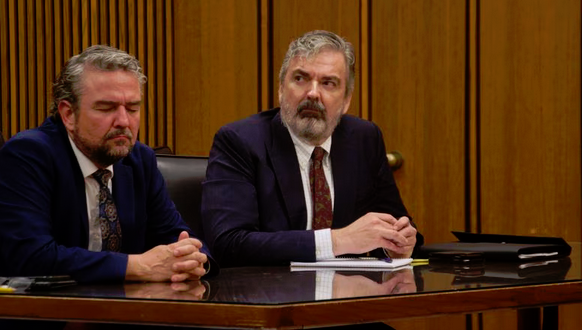
The Cleveland Plain Dealer reports that lawyer James Saunders, who previously worked for the Internal Revenue Service, violated the law by voting twice in both the 2020 and 2022 national elections. His public defender Scott Roger Hurley—he’s on the right above— is arguing that his client should be acquitted because it was “an accident.” “Mistakes do happen, accidents do happen,” he told the court.

Suuuuure.

Saunders voted in two separate locations in two separate states: Cuyahoga County in Ohio, and Broward County in Florida, and in both elections. “The fact that you do that in consecutive general elections I think takes ‘accident’ to the land of imaginary doubt, and not reasonable doubt,” the prosecutor said.

Ya think?

Continue reading

Unethical Quote Of The Month (And Incompetent Elected Official): Vice-President Kamala Harris, Part 2: Harris Has Directly Violated California’s Legal Ethics Rules

There is another aspect of Kamala Harris’s attack on the Supreme Court majority on Dobbs that bears noting.

In most jurisdictions, a lawyer may not publicly impugn the integrity of a sitting judge, and certainly not a Supreme Court Justice.

Here is the relevant rule in California, one of the jurisdictions with the duty to oversee her conduct. California’s position is that a member of its bar is subject to California rules no matter when the lawyer violates them.

Rule 8.2 Judicial Officials – State Bar of California:

(a) A lawyer shall not make a statement of fact that the lawyer knows* to be false or with reckless disregard as to its truth or falsity concerning the qualifications or integrity of a judge or judicial officer, or of a candidate for election or appointment to judicial office.

Comment “To maintain the fair and independent administration of justice, lawyers should defend judges and courts unjustly criticized. Lawyers also are obligated to maintain the respect due to the courts of justice and judicial officers.”

If there is a California lawyer reading who wants to take a stand for the integrity of the ethics rules, a formal complaint to the would be apt and appropriate.

[The graphic above represents my assessment of the likelihood that the California Bar would ever enforce its rules against a good, abortion-loving Democrat for attacking the U.S. Supreme Court.]

Now THAT’S An Unethical Lawyer! [Expanded]

Every December, when I do an end-of-year legal ethics seminar for the D.C. Bar, I discuss the Unethical Lawyer of the Year. It’s only June, but it’s hard to see how anyone, not even Alvin Bragg, can match Jason Kurland this year

Kurland, an attorney who represented lottery winners and was once a partner at the prestigious firm Rivkin Radler, one of the 200 largest firms in the nation, was sentenced last week to 13 years in prison. He had been found guilty of wire fraud, wire fraud conspiracy, honest services wire fraud, unlawful monetary transactions and a related conspiracy charge.

Fraudulent representations by Kurland and his co-defendants caused his clients to lose more than $80 million. He also lifted $19.5 million from the account of one lottery winner to make an investment for the benefit of himself and his accessories.

Continue reading

Trump Indictment Update: The Deceitful Indictment Photos [Corrected]

This one should have been obvious, but was so devious that I missed it. I bet you did too.

The indictment says that Trump’s alleged illegal conduct related to 102 classified documents. What you see above are four of six photos the Justice Department included in the indictment, apparently showing Trumps trove of stolen government materials. I don’t know how large the documents were, but assuming that those photos weren’t staged, they must have been taken before the boxes were examined. I’ll believe they contained paper (unlike the very similar piles of boxes in three of the rooms in my home, which also contain, for example, dinosaur models), but it is wildly unlikely that the boxes contain just 102 classified documents.

Never mind: that’s how all of the news sources presented them, and that is why the Justice Department probably included the photos: to poison public opinion against the former President. Poisoning public opinion is also poisoning the jury pool, and as we know, much of the public doesn’t have to be metaphorically poisoned. I realized this open deceit as I read my Facebook friends’ comments mocking the photos as proving how flagrant Trump’s “crime” was. The photos, in fact, prove nothing, except this: 1) the Justice Department lawyers who prepared the indictment violated the ethics rules and 2) it worked, because so many Americans want to believe that Trump is guilty.

Continue reading

On Senator Hawley’s Unethical Questioning Of Judge Loren AliKhan

I hate this stuff; I condemn it frequently in my legal ethics seminars as a sign of the public’s ignorance regarding the function of lawyers, and when practiced by political parties and the news media, it is particularly disgusting. And here comes supposed GOP star, Senator Josh Hawley (R-Mo), to pull this despicable stunt in a hearing on the qualifications of Judge Loren AliKhan, nominated for a federal district court judgeship by President Biden.

Hawley’s “gotcha!” employed to discredit AliKhan was that in 2020, when she served as Washington, D.C. Solicitor General, she defended the city in court after the Capitol Hill Baptist Church sued D.C. Mayor Bowser for religious discrimination. Bowser (who, as I’ve already mentioned once today, is one of the worst major city mayors) shut down church events to protect public health during the pandemic freak-out, but encouraged and allowed mass Black Lives Matter protests. A federal judge ruled in Capitol Hill Baptist’s favor, and the city did not appeal because as almost everyone with any legal literacy knew at the outset that Bowser’s double standard was pretty much indefensible.

Continue reading