Now THAT’S An Unethical Lawyer…And Maybe Two

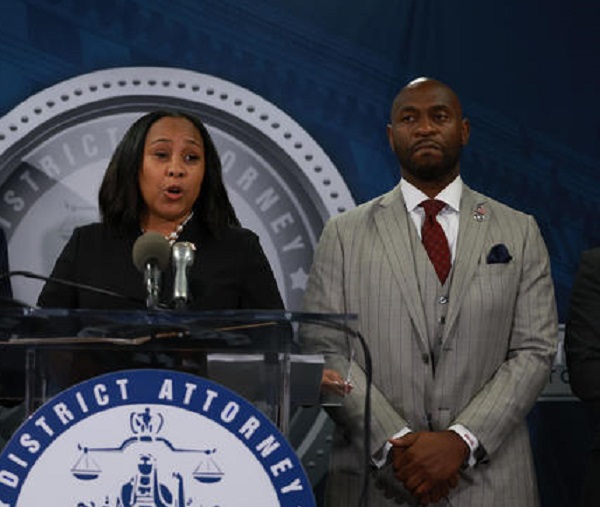
The Cleveland Plain Dealer reports that lawyer James Saunders, who previously worked for the Internal Revenue Service, violated the law by voting twice in both the 2020 and 2022 national elections. His public defender Scott Roger Hurley—he’s on the right above— is arguing that his client should be acquitted because it was “an accident.” “Mistakes do happen, accidents do happen,” he told the court.

Suuuuure.

Saunders voted in two separate locations in two separate states: Cuyahoga County in Ohio, and Broward County in Florida, and in both elections. “The fact that you do that in consecutive general elections I think takes ‘accident’ to the land of imaginary doubt, and not reasonable doubt,” the prosecutor said.

Ya think?

Continue reading

Unethical Quote Of The Month (And Incompetent Elected Official): Vice-President Kamala Harris, Part 2: Harris Has Directly Violated California’s Legal Ethics Rules

There is another aspect of Kamala Harris’s attack on the Supreme Court majority on Dobbs that bears noting.

In most jurisdictions, a lawyer may not publicly impugn the integrity of a sitting judge, and certainly not a Supreme Court Justice.

Here is the relevant rule in California, one of the jurisdictions with the duty to oversee her conduct. California’s position is that a member of its bar is subject to California rules no matter when the lawyer violates them.

Rule 8.2 Judicial Officials – State Bar of California:

(a) A lawyer shall not make a statement of fact that the lawyer knows* to be false or with reckless disregard as to its truth or falsity concerning the qualifications or integrity of a judge or judicial officer, or of a candidate for election or appointment to judicial office.

Comment “To maintain the fair and independent administration of justice, lawyers should defend judges and courts unjustly criticized. Lawyers also are obligated to maintain the respect due to the courts of justice and judicial officers.”

If there is a California lawyer reading who wants to take a stand for the integrity of the ethics rules, a formal complaint to the would be apt and appropriate.

[The graphic above represents my assessment of the likelihood that the California Bar would ever enforce its rules against a good, abortion-loving Democrat for attacking the U.S. Supreme Court.]

Now THAT’S An Unethical Lawyer! [Expanded]

Every December, when I do an end-of-year legal ethics seminar for the D.C. Bar, I discuss the Unethical Lawyer of the Year. It’s only June, but it’s hard to see how anyone, not even Alvin Bragg, can match Jason Kurland this year

Kurland, an attorney who represented lottery winners and was once a partner at the prestigious firm Rivkin Radler, one of the 200 largest firms in the nation, was sentenced last week to 13 years in prison. He had been found guilty of wire fraud, wire fraud conspiracy, honest services wire fraud, unlawful monetary transactions and a related conspiracy charge.

Fraudulent representations by Kurland and his co-defendants caused his clients to lose more than $80 million. He also lifted $19.5 million from the account of one lottery winner to make an investment for the benefit of himself and his accessories.

Continue reading

Trump Indictment Update: The Deceitful Indictment Photos [Corrected]

This one should have been obvious, but was so devious that I missed it. I bet you did too.

The indictment says that Trump’s alleged illegal conduct related to 102 classified documents. What you see above are four of six photos the Justice Department included in the indictment, apparently showing Trumps trove of stolen government materials. I don’t know how large the documents were, but assuming that those photos weren’t staged, they must have been taken before the boxes were examined. I’ll believe they contained paper (unlike the very similar piles of boxes in three of the rooms in my home, which also contain, for example, dinosaur models), but it is wildly unlikely that the boxes contain just 102 classified documents.

Never mind: that’s how all of the news sources presented them, and that is why the Justice Department probably included the photos: to poison public opinion against the former President. Poisoning public opinion is also poisoning the jury pool, and as we know, much of the public doesn’t have to be metaphorically poisoned. I realized this open deceit as I read my Facebook friends’ comments mocking the photos as proving how flagrant Trump’s “crime” was. The photos, in fact, prove nothing, except this: 1) the Justice Department lawyers who prepared the indictment violated the ethics rules and 2) it worked, because so many Americans want to believe that Trump is guilty.

Continue reading

On Senator Hawley’s Unethical Questioning Of Judge Loren AliKhan

I hate this stuff; I condemn it frequently in my legal ethics seminars as a sign of the public’s ignorance regarding the function of lawyers, and when practiced by political parties and the news media, it is particularly disgusting. And here comes supposed GOP star, Senator Josh Hawley (R-Mo), to pull this despicable stunt in a hearing on the qualifications of Judge Loren AliKhan, nominated for a federal district court judgeship by President Biden.

Hawley’s “gotcha!” employed to discredit AliKhan was that in 2020, when she served as Washington, D.C. Solicitor General, she defended the city in court after the Capitol Hill Baptist Church sued D.C. Mayor Bowser for religious discrimination. Bowser (who, as I’ve already mentioned once today, is one of the worst major city mayors) shut down church events to protect public health during the pandemic freak-out, but encouraged and allowed mass Black Lives Matter protests. A federal judge ruled in Capitol Hill Baptist’s favor, and the city did not appeal because as almost everyone with any legal literacy knew at the outset that Bowser’s double standard was pretty much indefensible.

Continue reading

Ethics Dunce: Ty Cobb (No, This Is NOT A Baseball Post)

That stylish-looking gentleman above is Ty Cobb III, a descendant of the iconic baseball player, himself a rather infamous ethics dunce. I never quite figured out Ty III’s relationship to Ty the First, but that is neither here nor there. I wish I didn’t have to write this post: I know Ty a bit, for we were in the same class at Harvard (where he already was sporting that handlebar mustache), and I knew many of his friends a lot better than I knew him. He is a nice guy, a funny guy, and by all accounts a terrific lawyer. He may have been the best lawyer ever associated with Donald Trump: Ty joined the White House staff to manage legal matters surrounding the Mueller investigation—yes, the Russian collusion scam run by the Democrats, the FBI, and the news media. He reported directly to Trump, and he was extensively quoted during the media frenzy over that disgusting set-up.

On May 2, 2018, Cobb announced that he was retiring as White House special counsel, and later that year, said that he did not think the Mueller investigation was a “witch hunt,” later saying in an ABC News interview on March 5, 2019, that he thought Mueller was “an American hero.” I almost blew my ethics whistle then; I didn’t: I should have. As a lawyer the public identified with President Trump (though his client was the office, not the man), Ty’s apparent vouching for the investigation was bound to be taken by the public (and certainly the news media) as a hint that someone on the inside with legal expertise knew Trump was guilty. I know I looked at it that way.

Now he’s done it again. Cobb told the news media that the “feds are coming fast” for Trump, and predicted that the investigation into the his alleged mishandling of classified documents will land him in prison. Spewing his opinions like an oil gusher, Cobb said,

Continue reading

A Cautionary Legal Ethics Tale: The Paralegal’s Goof

There are a lot of ethics lessons in a recent lawsuit out of Connecticut.

William Cote, the lawyer for the seller in a real estate transaction, had $159,000 that he was supposed to wire to the Freedom Mortgage Corp. He had received a correct payoff statement with accurate wire instructions, but before he completed the payment, his paralegal received an email from the seller—it claimed— changing the wiring information. The new statement specified wire instructions for a different bank and account, and the paralegal passed in on to Cote, who then wired the money to the designated account—which had been set up by a scamster to snatch the money away.

Cote didn’t realize the gravamen of his error until more than a month later when the seller said he received a statement from the Freedom Mortgage Corp. reflecting a balance still owed on his loan. The buyer of the property is now suing both the seller and Cote because the title to the home she purchased is still encumbered by the seller’s mortgage.

Well…

  • Lawyers are responsible for the ethical conduct of their non-lawyer employees, including basic competence. Neglecting their training is an ethics violation.
  • The invasion of technology into every aspect of the legal profession requires vigilance and ongoing education. A firm or lawyer that does not have procedures and software in place to check the validity of emails is asking for a disaster. More than that, regular trainings of staff, including legal and non-legal, on technology advances and emerging perils are crucial. As with the non-lawyer trainings, they are too often skipped or made perfunctory.
  • Cope was probably busy with other matters when his paralegal passed along the phony change to the wiring instructions. Obviously, he should have asked some crucial questions, but instead just acted on trust. Trusting one’s staff is a good thing, but when so much money is involved, it is the lawyer’s duty to make sure a non-lawyer assistant hasn’t missed anything. Meanwhile, distracted law practice is as dangerous as distracted driving.

_____________________

Source: ABA Journal

Addendum To “An Ethics Conflict Conundrum: The Fraudulent Friend”

Apparently my choice of words confused some readers when I wrote that once “The Ethicist’s” inquirer in this post was made aware of a serious fraud (and an ongoing one) perpetrated by a close friend, she had become an accessory after the fact. That’s a legal term of art and I was careless to use it in nontechnical context. Almost no one is ever charged as an accessory for not blowing the metaphorical whistle, but the woman nonetheless shared responsibility for the harm done by the ongoing fraud by knowing about it, having the ability to stop it, and not doing so, thus letting it continue.

The duty she breached was an ethical one, not a legal one. As I said, I should have been clearer.

I am reminded of a personal experience that might clarify the issue further. I may have even related this story in another post; if so, I can’t find it, and it is worth repeating.

A lawyer friend contacted me for advice. He had been meeting with a client at the client’s home, and overheard, in the kitchen, a loud argument between his client and his wife culminating in what sounded like a hard punch in the face, the woman crying out in pain, and someone falling on the floor. My friend said he had said nothing, but was increasingly bothered by what he heard.

Continue reading

SCOTUS Punts An Important Legal Ethics Controversy

In the Supreme Court case In Re Grand Jury, the government had been trying to obtain  documents from an unnamed law firm specializing in international tax law. The documents were needed to investigate the law firm’s client. A judge held the law firm in contempt for failing to turn over disputed documents, and the 9th U.S. Circuit Court of Appeals at San Francisco affirmed in 2021. The issue was what test courts should apply when considering whether to protect “dual-purpose” documents that contain both legal and nonlegal advice.  The 9th Circuit ruled that courts should look to the “primary purpose” of a communication when it involves both legal and nonlegal analysis. Documents may be privileged when the primary purpose is to provide a client with legal advice. The firm argued that the entire document, along with any non-legal advice and material in it, should be considered privileged if legal advice was one of the “significant purposes” of the communication.

The legal ethics traditions argue for the more expansive standard. ABA Model Rule of Professional Conduct 2.1, “Advisor,states in part,

“In rendering advice, a lawyer may refer not only to law but to other considerations such as moral, economic, social and political factors, that may be relevant to the client’s situation….Advice couched in narrow legal terms may be of little value to a client, especially where practical considerations, such as cost or effects on other people, are predominant. Purely technical legal advice, therefore, can sometimes be inadequate. It is proper for a lawyer to refer to relevant moral and ethical considerations in giving advice. Although a lawyer is not a moral advisor as such, moral and ethical considerations impinge upon most legal questions and may decisively influence how the law will be applied.”

I agree with this approach. Requiring a client or an attorney to parse a letter or oral discussion to separate the legal, privileged content from the rest would chill effective lawyer client communication. Continue reading

Cultural Illiteracy Meets Judicial Ethics!

This was resolved in September 2022, but I missed it, and attention should be paid.

An Illinois lawyer was representing a client in an age discrimination lawsuit that arose out of an attempt to purchase property and, chagrined at the judge’s ruling at one point, uttered the Elizabethan era word, “gadzooks!” under his breath. The judge admonished the lawyer not to make comments “under your breath,” and the attorney replied, “I said, ‘gadzooks!'”  The judge shot back, “If you make one more comment that’s offensive to this court, I will hold you in contempt of court.”  The lawyer, apparently astonished, said: “Gadzooks is offensive to the court?”

The judge stated: “You are now in contempt of court. I’m fining you $1,000.” When the the lawyer replied, “May I ask the court.”  The judge stated: “You are now (at) $2,000!”

During the eventual disciplinary hearing—the episode tied up the lawyer for years—the judge testified that she did not know what “gadzooks” meant but found it offensive, and that she regarded the exclamation an attempt to impugn her ruling.  The lawyer testified that he did not consider “gadzooks” to be offensive, and also  testified that he did not yell or shout “gadzooks” as the judge claimed. When he did raise his voice during the trial, it was so his 83-year-old client could hear him, he said. Continue reading