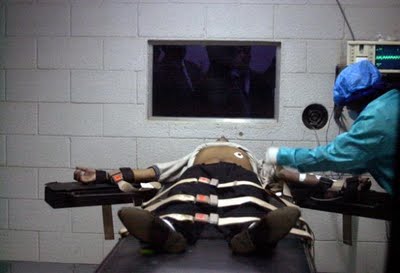
“For 90 Minutes, I Watched an Execution Go Horribly Awry” [Gift link!]is an unethical opinion piece. It is manipulative and an appeal to emotion, while pretending to make a persuasive argument against capital punishment using deflection and misdirection, tying three separate ethics issues together as one. The author’s methodology is to argue that killing someone can be icky. So?
The author is a criminal defense lawyer, so you might think I should cut her some slack. I won’t. It is acceptable for a lawyer to use trickery, logical fallacies and rhetorical cheats to convince a jury, because that is what defense lawyers have to do to zealously represent their clients. A newspaper’s readers, however, are not jurors. A publisher and paper’s editors should maintain journalistic standards, which demand truthful communication that is not calculated to deceive or confuse. The New York Times, however, is not an ethical newspaper, and is interested in advancing agendas, not fair and responsible punditry. Even the headline is deceitful. Her client’s execution by lethal injection was botched, but he survived. His execution was delayed for a year by the governor. She doesn’t reveal that little detail until the next to last paragraph. Surprise! The execution attempt went ‘horrible awry,” but there was no execution.
Author Maria DeLiberato is a mission lawyer, meaning that she takes cases to accomplish a personal objective, in her case, opposing the death penalty. She begins by telling us that she believes Tony Carruthers, her condemned client, was wrongly convicted. That issue is 100% irrelevant to the focus of her article, which is that executions in Tennessee (and presumably elsewhere) are often botched and excruciatingly painful as a result, making them “cruel and unusual punishment,” an 8th Amendment violation. She argues that Carruthers was innocent, which is a different ethical issue entirely. A botched execution is exactly as painful and torturous whether the condemned is guilty or not. Like a good lawyer (but an unethical writer) DeLiberato pre-sets the dial to sympathy and indignation by framing Carruthers’ ordeal as an unjust one. But even a perfect, quick and painless execution of an innocent individual is wrong beyond redemption: it doesn’t become more wrong because the killing takes longer.


What is the agony of the doctors not being able to find a vein? My doctor’s office tried for 20 minutes trying to find a vein to draw blood. After the third stick she decided she needed help from the RN who could not pierce the vein because it kept “rolling under” – whatever that means. Even the RN could not get the blood and I was sent elsewhere to get the sample. The point is that there was no agony. just a couple of extra pinches and a small bruise.
I hold the same position as you regarding the death penalty. Perhaps this should be extended to politicians indirectly cause death by giving CDL licenses to people who cannot speak English – which is a violation of the Federal Motor Carrier Safety Act – so they can plow into cars in a work zone and kill 5 and injure scores more. Take that Kathy Hochul. If that does not work I hope the families sue New York state for hundreds of millions of dollars for each of those killed and injured by their woke political calculus.
This point of objection has been mentioned times here at EA, but I don’t understand it. How does reading, even speaking, English factor into illiterates/mutes plowing into cars in a work zone killing and injuring? It seems to me that if I see something in front of me I slow down or go around without reading. Too, most of the world uses 0-9 glyphs and base 10 counting. It stretches my imagination thin to believe that some random dude from India can’t read 45(other countries have similar speed limit signs to ours) or see that there are cars ahead for which he must slow down.
“How does reading, even speaking, English factor”
Because not all road signs are fixed signs, like flashing construction signs warning of rolling construction work over a hill or around a blind turn in the road that can’t be seen before it is too late to slow down.
The problem I have with it is not that the non-English speaking commercial drivers can’t read road signs; it is that they are driving bigass, heavy as hell motor vehicles and most probably do not know how to operate them legally or safely. I am not a physicist or an engineer but I know it takes a lot longer to stop an 18-wheeler fully loaded with cargo than it does to stop a sedan or an SUV.
jvb
many, many years of medical practice. When the peripheral approach to establsihing intravenous ACCESS is difficult or impossible ( usually due to prior drug abuse) THEN ONE CAN ALWAYS GAIN ACCESS WITH A CENTRAL LINE THROUGH THE LARGE NECK VEINS OR THE FEMORAL VEIN. ONE CAN ALSO INJECT DIRECCTLY INTO THE HEART.
DEXTER HAS A UNIQUE APPRAOCH WHICH NEVER FAILS.
however, the bullet headshot is the msot efficient, seee THE AMERICAN SNIPER
Well, the guillotine was efficient, fast, and relatively inexpensive aside from periodic maintenance costs.
jvb
Unfortunately, legislated interference is a becoming an effective way to get your way politically, even when you lose on the main issue.
Death penalty legal? Make it impossible to acquire the drugs to perform injections, rule any form of discomfort as cruel and unusual, allow seemingly infinite appeals…
The same is done with many other issues. Don’t like legal gun ownership? Have waiting periods, magazine limits, bump stock bans. Abortion? Mandate ultrasounds or counseling, waiting periods, etc.
There’s no such thing as settled law when opponents are always nipping around the edges.
From Page 1:
“Carruthers pre-sets the dial to sympathy”
I think you meant DeLiberato.
-Jut
Sure did. Rats. Fixed. Thanks.
The supposed compassionate alternative to the death penalty, life without parole cannot be trusted. Witness California defining old age as 50 for purposes of compassionate early release after serving at least 20 years of the sentence. While it is currently true that life without parole is exempt from the 50/20 rule, that could change. The original old age was 60 and lowered to 50 in 2021, so why not loosen the exemptions? Unfortunately, early release is only compassionate for the felon, whose crimes may have included sexual assaults or pedophilia, neither of which is impossible at age 50. Come to think of it, most crimes are still possible at age 50. It is the new 40, after all.
Firing squad executions are quick, probably painless, lethal – but only 5 states allow them.
Another elegant feature of a firing squad, you typically have five to seven individuals administering the punishment; one at random is issued a blank. There’s also a new technology interlock that could prevent all rifles from firing unless all have sufficient trigger pressure and are on target.
The “cruel” component may also include guilt imposed on the executioner, and the above traditions that help rationalize the guilty aren’t possible with the more intimate “modern” methods.
Guilt for members of the firing squad is probably no worse than that of the doctor who aministers the lethal drugs. Or anyone in military or law enforcement who must fire a weapon. Hanging is unreliable … what about a heroin overdose?